Browsing the archives for the Literature category.

PRESS RELEASE: Udenwe, Liam and Okokoh Arrive for Ebedi Residency

Three young and dynamic Nigerian Writers last week arrived at the Ebedi International Writer’s Residency, Iseyin, Oyo State for the July/August 2014 session of the Residency. The writers who have already commenced their six-week-residency are: Obina Udenwe, Paul Liam and Koko Okokoh.
Obinna Udenwe is a 26-year-old writer of conspiracy theories who was honoured by his native Ebonyi State for his outstanding literary activities on May 29, 2014. As the Ebonyi State Governor Martin Elechi put it during the award ceremony, ‘Obinna Udenwe’s impressively meticulous literary documentation places him ahead of his contemporaries.’  Udenwe’s first novel ‘The Dancing Bird’ was published in 2009 while  ‘Satans and Shaitans’ – a conspiracy theory on terrorism, love and occult, is scheduled to be released in the UK in October, 2014 by Jacaranda Books. Udenwe will use his time at the Ebedi Residency, to complete work on his new novel ‘Viaticum’ – a novel set against the backdrop of the civil war in Sudan, and the period of pre-democracy and democracy in Nigeria. In his reaction to Udenwa’s admission into Ebedi Residency, Mr Jazzmine Breary, the Acquisition manager of Jacaranda Books, UK, was full of praise for the management of Ebedi Residency for accepting the company’s author for the residency.
The second writer, Paul Liam, an indigene of Benue State, is the Assistant Secretary of the Association of Nigerian Authors (ANA), Niger State Chapter. He is also a columnist with Newsline Newspapers, Minna and has published several literary essays in national dailies. His debut poetry collection: ‘Indefinite Cravings’ was published in 2012. His second poetry collection: ‘Saint Sha’ Ade And Other Poems’ was recently released by Kraft Books. Paul will use his time at Ebedi, to complete a manuscript of poetry titled ‘Armageddon Blues’. According to Paul, ‘Armageddon is a collection of about sixty-something poems inspired by the chaos that have engulfed the nation, and I have been working on it since 2012. But, I have not been able to concentrate and finish it due to several distractions.’ Paul will also use his stay in Iseyin to conduct a creative writing workshop for school children and probably generate an anthology of poems from the workshop. As he puts it, ‘I have great passion in the development of the intellectual capacities of the younger ones for a productive society. It is because of this passion that I am a Mentor and the Public Relations Manager of the Hilltoparts Centre, Minna, Niger State.’
Karo Okokoh, the third author, is a published author with several titles in poetry and drama. He is an alumnus of the University of Ibadan where he bagged a Bachelor of Science degree in Political Science.  He is based in Agbarho, Warri, Delta State. Okokoh hopes to use his time at Ebedi to complete work on his new novel titled “The Forgotten Tomorrow’’ a novel based on the well known problem of oil spillage in the Niger Delta Region. It is a problem which the author describes as ‘a brutally big and mournfully monotonous cycle of violence in the Niger Delta… a cycle of violence that is continually being re-cycled again and again… a familiar pattern of recurring violence and recurring sadness.’
 
 Apart from working on their manuscripts and mentoring Secondary Students in Iseyin, the residents will also use the period of their stay in Ebedi to edit and publish the maiden edition of THE EBEDI REVIEW. As the writers expressed, ‘The need for the Ebedi Reviewwas conceived out of the dire need to provide a comprehensive information resource on the Ebedi International Writers Residency, Iseyin. The primary objective is to provide a channel of communication between the residency and the outside world in order to accentuate its relevance. The Review, therefore, seeks to articulate the activities of the residency since its inception and provide an overview of its existence to those who may have not had the privilege of knowing about it or visiting it.’ The Ebedi International Residency Programme is a private initiative for the benefit of writers who want to complete their ongoing works in a secluded and comfortable environment. In its fourth year of existence, the residency which is managed by a Board of Directors has played host to about 40 international writers and is run at no cost to the writers.
 
                                                           
Signed:
 
Uche Peter Umez
F: Ebedi Board of Directors


A Review of Tendai Huchu’s “The Intervention”

“The Intervention”, a short story by Tendai Huchu, which can be read here, was recently shortlisted for the Caine Prize for African writing. Here’s my take on the work.

_____________

“Intervention” could be read in many different ways: as a tale of distant compatriots grown impotent by time and distance; the futility of armchair activism or the inevitability of same in the face of real challenges; or as a common allegory on the state of the continent in tumult.

It could, however, be read simply as a story of love, lust, disappointment, and one man’s care-free interrogation of it all. That man was Simba in this case, a poet, along with his friends, Z and Tamu (and their girlfriends).

The texture of Huchu’s story goes from casual to mundane to judgmental observations of people made by the principal character, Simba, who lives in the United Kingdom, far away from the scene of electoral action in Zimbabwe, his hometown.  The story climaxes at the end of a national election in Zimbabwe where the president who has ruled since the country’s independence in 1981 was “elected” into office for another term. Then it descends gently into the chaos of domestic dispute between lovers and friends: a not so subtle subplot that had followed the story from the start.

So, is this an allegory on the state of our impotence and confusion on the continent? I’m more inclined to that conclusion. Or, in trying to find other ways to appreciate a story so ordinary yet representative of a slice of some immigrant life from a failed African country, I might be forced to dismiss it as a neophyte attempt at storytelling (at worst) or an effort carefully riddled with levity, for particular effect (at best). The characters are naïve if not simple, and prosaic if not uninspired. An example:

“…I never cast a single stone in this entire charade. I was consumed with overwhelming fury, seeing what Tamu was doing to this little princess. How could he sit there, chatting nonsense about his privacy, as she trailed the list of names from his phone.

Apart from the fact that the last sentence is missing a question mark, the expression itself is not that striking, especially in a work of fiction aspiring to Africa’s largest literary prize.

In an earlier scene, Simba says: “I gave him my wtf face”, written exactly as quoted, with small letters for “wtf” which one assumes does not mean “Welcome to Facebook”.

Maybe the pedestrian storyline of a bunch of immigrants in England watching and pontificating about their home elections does call for equally carefree characters speaking in insipid turns of phrase. Or maybe the primary character is an extension of a writerly experimentation that didn’t quite achieve its goals. Either way, one is left with a feeling of deep dissatisfaction when it all ends. This is 2014. A failed African state and the disappointment of its emigrated elites isn’t such a tantalizing storyline except something new is added in the form of great and captivating writing.

More:

“The kids didn’t speak Shone, so we were introduced in English, and check this out; I was “Uncle Simba”… The kid just looked at me blankly like I was talking effing Zulu.”

Effing, really? Who is this character? A twenty-two year-old Zimbabwean visiting England for the first time and intent on convincing us of his acquisition of street and teen lingo?

So, maybe the writer didn’t care much for inspiring our imagination or challenging our capacity for linguistic fireworks. Or maybe he couldn’t. We may not know until we read his other offerings.

Or maybe the story is a deliberate simplistic portrayal of simplistic existence. Zimbabwe goes on in its charade of a government. AIDs continues to ravage the continent. Sudan is now two countries. Egypt has changed its government more than twice in three years. Boko Haram has turned the fragile Nigerian state into a colander of dust and dead bodies. Kenya is fighting Al-Qaeda on its streets. Somalia is a violent ghost of whatever was there before, and Libya after Gaddaffi hasn’t lived up to Western (and African) hopes of its survival. Yet here we are in a quotidian cycle of daily vanities: dating, cheating, smoking, etc, and goofing around in our new realities, too impotent to act in any meaningful way. On this level, I understand and appreciate the effort and direction of the work. Otherwise, I should also probably go for a smoke (and hopefully not “cry like a pussy.”)

In any case, if it is the writer’s first, it shouldn’t necessarily be his worst. Next, please.

___________

First published on Brittle Paper.
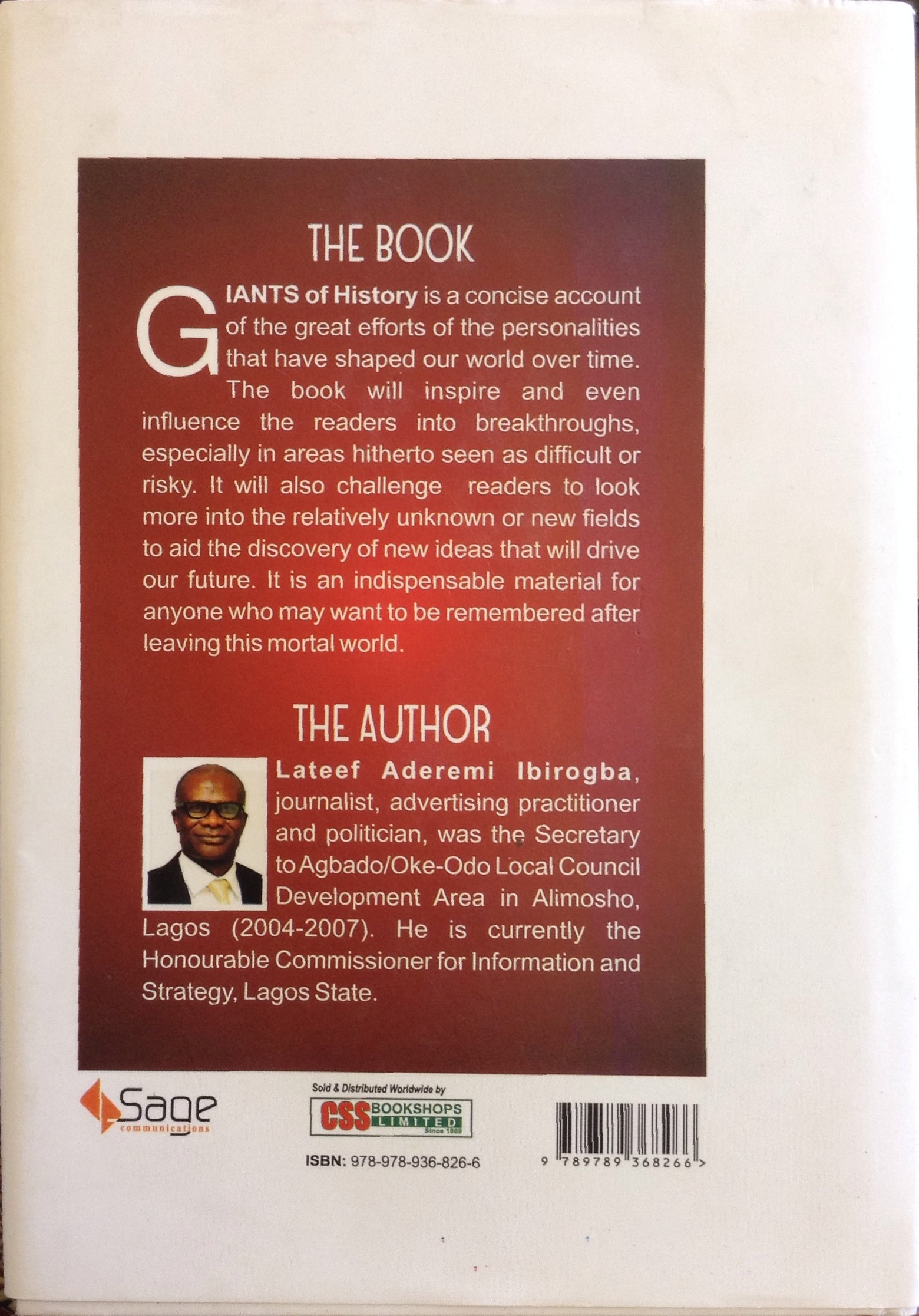
On the “Giants of History” – Book Review

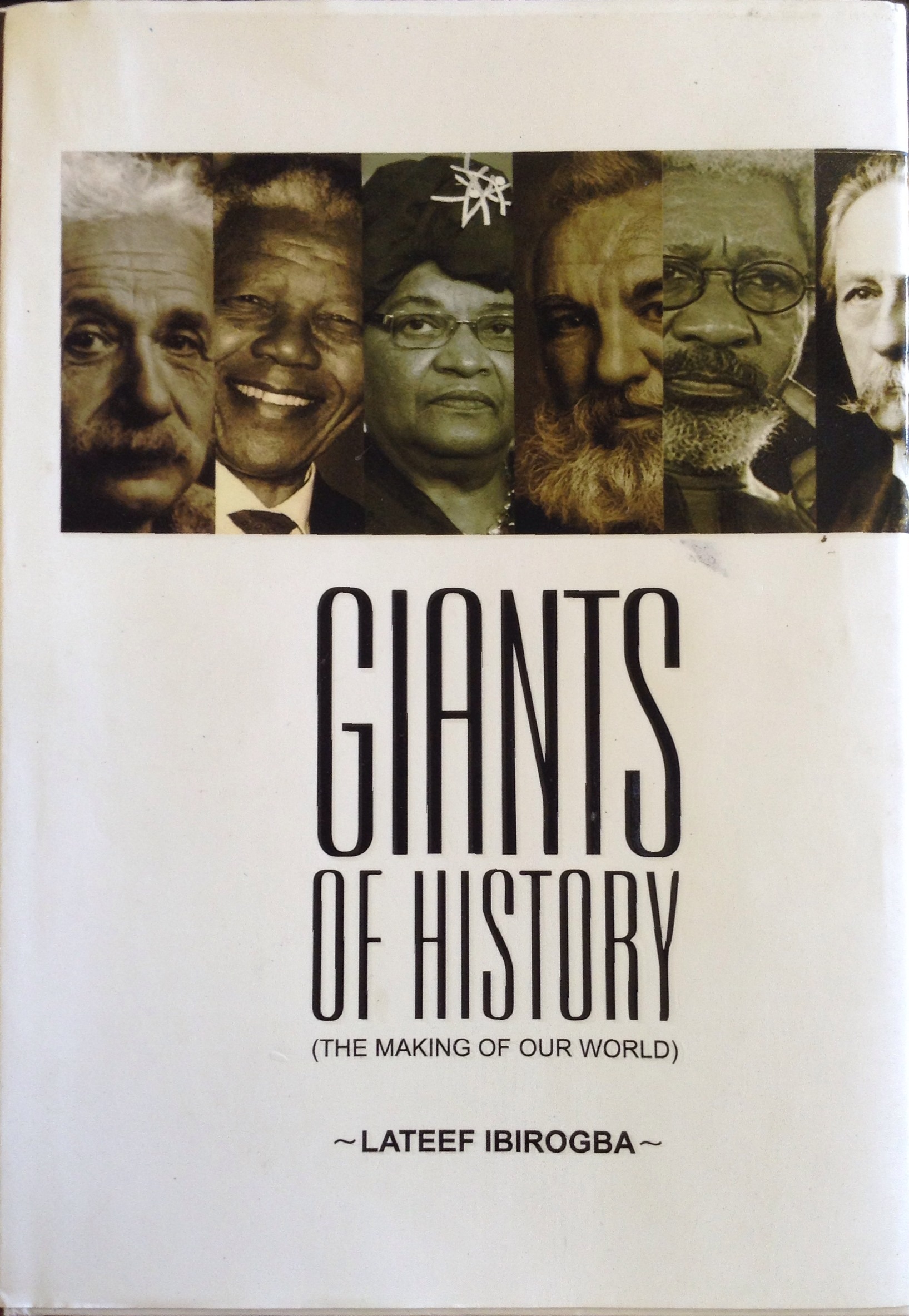
One of the projects I worked on from the middle of last year (in many capacities, most notably as an editor and all-round busybody) is a book of profiles and biographies titled Giants of History. (322 pages. Sage Publishers. Lagos)

WP_20140220_001 (1)

Written by journalist, and politician, Lateef Ibirogba (Currently the commissioner for Information in Lagos State), it is a look at 150 selected great men and women in history whose lives were exemplars of tenacity, dedication, leadership, and hard work – most of them. Readers who pick up the book will see why these descriptors don’t apply to all of the “giants” selected. The only thing that ties them together as deserving of being in the book is the extraordinarily notable lives they lived, the number of lives they touched, the power of their example, and their tremendous influence on the generations that followed them.

I was drawn to the book because of a number of reasons. When I was young, one of the most notable books I read that opened my mind to the idea of doing great things, and living a life worthy of being written about, was a book by Sanya Onabamiro titled Philosophical Essays (1980), and another by Tam David West, also with a similar title: Philosophical Essays: Reflections on the Good Life (1980). What both of them did – and I can’t tell one apart from the other anymore now – was lay down arguments supporting or opposing particular events in history, while highlighting why they had to happen and who was responsible. I will get those books again if I can ever find them, but one of the most important things they did for me was to open my mind, and challenge me to dream. They also informed me about a number of relevant historical events and their effect on the world. When I was invited to work on Giants of History, I had flashbacks to my delight with these great books. The format that Lateef Ibirogba chose to use in presenting this book in was just as important, and the role of his book serves just about the same purpose as highlighting history for those interested in it, and giving credit where due to the important human precursors to today’s important inventions and achievements.

frontThe book has now been published, to be launched in Lagos on April 22nd. I will be there at the launch, which should feature a number of heavy names in politics, publishing, and writing in Nigeria. The book reviewer, Tade Ipadeola – a lawyer and creative writer – was the winner of the 2013 Nigerian Prize for Literature (the highest literary prize on the continent, which carries a prize money of $100,000). I expect that the governor of the state will be there as well, along with a number of other still-living Nigerians whose names also made it into the book. It is important to mention that one of the impressive nature of a work of this kind is its good sense to include in the work not just historical figures from older civilizations around the world, like Plato, Aristotle, Isaac Newton, Mahatma Gandhi, Abraham Lincoln, but also notable historical figures from our own national environment, like Obafemi Awolowo, Nnamdi Azikiwe, Mary Slessor, Funmilayo Ransome-Kuti, Madam Tinubu, Fela Kuti, Chinua Achebe, among many others.

backI invite you to look out for the book, and to buy not just for yourself, but for your relatives, especially the young ones not yet sure of where life would take them, or what the point of everything is. If I could still remember the influence of a book on me as a thirteen-year old reader, then precocious thirteen year-olds around you will definitely appreciate you giving them a gift of such work.

A contrarian case might be made as to why publish a book of biographies when there is Wikipedia and the world-wide web to inform us – in multimedia richness – of the lives of living and dead heroes. The answer would be that the book is not dead. It is movable and presentable, and it is still the closest way to reach a reader, not hindered by access to electricity or the internet. It can be read in the village as in the city, and thus its relevance.

The book is available for purchase for now at www.digitalbooks.com.ng.

Zadie Smith meets Chimamanda Adichie

In this hour-long public event, British-Caribbean writer Zadie Smith (White Teeth) sat with Nigerian writer Chimamanda Adichie (Purple Hibiscus, Americanah) to talk about a number of things, from hair to feminism, from race to immigration. Watch below, via LiveStream:


How to Kill the Nigerian Publishing Industry

This comes from new article by Jeremy Weate (founder, Cassava Republic Press) published on Africa is a Country in which the hypocrisy (or counterproductive measures) of the Nigerian administration is laid bare in the new series of tariffs placed on book importation, in contravention of a treaty signed with UNESCO.

Here’s an excerpt:

The reality is, Nigerian publishers who wish to sell good quality books at an affordable price are forced to print overseas. There’s nothing particularly innovative or unusual in this: many Western publishers now print in Asia too. Cheap electricity and labour, access to international paper markets as well as technical know-how limit globally competitive print facilities to a small group of countries. Nigeria has no hope of competing with these countries any time soon. A wiser alternative policy decision would be to not even try. Nigerian paper mill and printing companies catering to local (non-book) printing needs can be supported through tax breaks and subsidies to nurture market development, without the need for protectionism. The lesson learnt from other sectors in Nigeria (such as textiles), is surely that tariffs and import bans stimulate piracy, rather than local market development. It is therefore also likely that book pirates may benefit from the punitive tariff. In other words, authors as well as Nigerian publishers will suffer.

More here.