Browsing the archives for the adventures category.

Two Nights in Paris

Last week, I visited Paris as a guest of UNESCO’s International Conference on Language Technologies (#LT4All). It was a large gathering of language practitioners — from linguists to teachers to tech gurus and other executives — under one roof to share ideas, discuss obstacles, and showcase current activities in the sphere of language technologies. The theme “Enabling Linguistic Diversity and Multilingualism Worldwide” was part of the framework of the 2019 International Year of Indigenous Languages.

It was my first time in the city and in the country (since layovers don’t count).

At the Eiffel Tower during one of the conference breaks.

The conference was co-sponsored by Google (as a Founding Private Sponsor), The Government of the Khanty-Mansiysk Autonomous Okrug-Ugra (as a Founding Public Donor), UNESCO, Japan, France, and NSF as public donors, and others like Facebook, Systran, Microsoft, Amazon Alexa, Mozilla, IBM Research AI, etc, as regular sponsors. Team leaders from many of these companies were around to speak and share ideas from their ongoing work. It was a delight to be able to listen to many of them, and make connections. I met, for the first time, Daan van Esch, who leads Google’s GBoard global efforts, and with whom I’ve worked in some capacity on these efforts while I worked at Google on some Nigerian language projects. His presentation was about GBoard and how it has empowered more people to write properly in their languages on mobile devices.

I also made acquaintance with Craig Cornelius who has done some work for the consortium, but now works at Google as a Senior Software Engineer. This was during a panel on Unicode where I mentioned the fact that Yorùbá writing on the internet has suffered greatly because of Unicode’s inscrutable decision not to allow pre-composed characters. Because Yorùbá diacritics are usually both on top of the vowel and beneath it, one usually has to find so many different Unicode characters to match before one properly tone-marked character can be typed. Beyond the fact that this would be a nightmare for someone having to type a whole passage (or a novel — imagine!), it is usually often still impossible to find the right combinations. And when one manages to find the combinations, the difference between how one computer system or word processor codes its software often makes it impossible for the text to remain readable by a second or third party. I encounter this problem every day while working on the catalogue at the British Library where many of the Yorùbá books listed there appear in a variety of fonts in the BL system, some of which make the titles unreadable or with a different intended meaning.

Craig Cornelius (left), Mark E. Karan from SIL (middle), and a guest.

GBoard has mitigated some of these problems. In Yorùbá on the GBoard app, for instance, we now have pre-composed characters like ọ̀ and ọ́ and ọ and ẹ and ẹ́ and ẹ̀, etc, which can be inserted instantly without any secondary combinations. What we need, as I said during the subsequent informal conversation about the subject, is something like that for Unicode so that every new computer user does not have to spend valuable time doing diacritic permutations from the Insert>Symbol field. Or for browsers (Chrome, Explorer, Mozilla, Safari, etc), so we can stop waiting for Unicode to change its ways.

In 2016, through the Yorùbá Names Project that I founded, we created a free tonemarking software for Yorùbá and Igbo, for Mac and Windows, which has been very helpful in writing on the computer — and with which I have typed all the diacritics in this post. It still combines character elements, however, but it is software-keyboard-based, and a lot more intuitive.
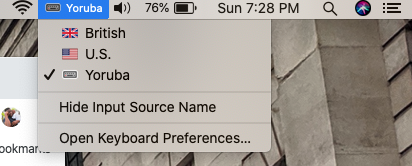
The Yorùbá Names Project Keyboard, launched in 2016, can be downloaded at http://blog.yorubaname.com/keyboard

Its limitations show up when a document typed with the software has to be read with another program (like Adobe or Microsoft Word, then the cycle begins again). It would be helpful if the functionality of this nature already came with the computer so there is uniformity. Imagine if every computer sold in Nigeria already suggests to the user to flip the language as I do above so that the keyboard automatically allows for diacritic markings that can transmit across different programs. That would be great, won’t it? The conversation with these gentlemen convinced me that it is doable, but would take time, and different companies coming together to agree that African languages matter on these platforms. It has not always been the case.

Speaking with someone from the Woolaroo team, a Googler, who now lives in Australia and wants me to come visit.

One of the other language products that was showcased there was Woolaroo, created in conjunction with Google Arts & Culture, which is a crowdsourcing visual dictionary for a small Australian language. When publicly launched, users will be able to take photos, and then use that photo to submit words for items in the image, which is then sent to a database and shared with other users. For languages with few speakers, but whose speakers use the tools of technology, it is one way of eliciting lexical items without having to do the physical fieldwork that has characterized most language documentation efforts in the past. There is significance for this type of approach for languages in Nigeria, for instance, where old people who know the name of items are not literate to write, but can perhaps be made to use the visual aid of phones to contribute as much as possible while they are still alive.

How the Woolaroo app works. It will be launched in 2020, and its API will be made available so others can replicate it in many language communities.

There were other Nigerians, and Africans, at the conference. I met Dr. Túndé Adégbọlá of the African Language Technology Initiative (ALT-i), Àbákẹ́ Adénlé of AJA.LA Studios, Professor Chinedu Uchechukwu of the Nnamdi Azikiwe University in Awka, Nigeria, Professor Sunday Òjó, and Adama Samassekou (the founder of the African Academy of Languages), among others. It was a diverse group of people working in different aspects of language revitalization, technology, and documentation. Mark Liberman, whom I was also meeting for the first time, shared my concern about Unicode, having done some work himself in Nigerian languages, and been frustrated by the problem of finding the right diacritics in a simple and accessible way.

Dr. Adégbọlá and Prof. Sunday Òjó

Paris is beautiful at night — perhaps much better looking at night actually. The monuments are lit up, and the beauty of the city shines out from within the glow. The language of the city, naturally, is French, but the tourist who speaks not more than a smattering of the language doesn’t run into much of a problem.

It was cold most of the time, which made walking around a bit of an ordeal. It reminds me a lot of the other global city I once attempted to walk around in 2009. A day before I arrived in Paris, there had been a massive strike that paralysed the entire country and rendered public transportation useless. This could explain why Uber appeared a lot more expensive that I’d experienced elsewhere. Would have been nice to see how different the Metro was from the Tube in England. But the strike also meant that the city was less crowded — at least the usually touristic areas — and the public trash cans seemed always in need of emptying.

The Arc de Triomphe ahead, and a trash bag nearby.

I had got a travel grant of £1,011 to attend the conference — which covered my visa (~£295), hotel (~£270), food (~63), train (~£500), and Ubers (~£81.77) and was helpful and convenient, especially since I had to pay for the highest end of many of these things due to the rushed arrangement. My visa was issued on the 4th, so I was only able to attend the sessions on the 5th and 6th, leaving the city in the evening of the 7th. Still, it was enough to take in the fine city, sample the food, make connections, and make future plans to return for more adventure.

The benefit of the strike is fewer tourists, but more overflowing trashcans.

The train ride on the Eurostar from St. Pancras to Gare du Nord, which took just under three hours, is a story of its own.
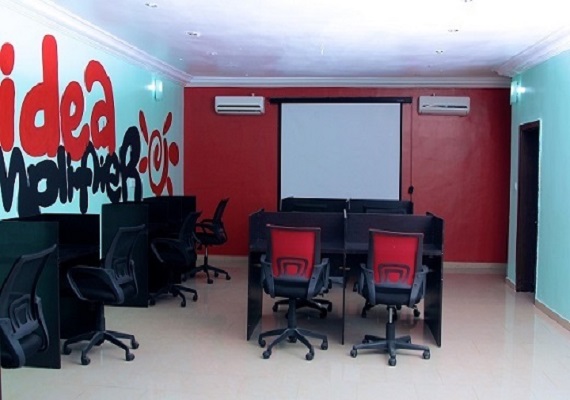
Chapter 11: A Reading Space in Lekki

By Anthony Azekwoh

Perched comfortably on 39A Awudu Ekpegha Boulevard Street is Chapter 11, a workspace, training area and 24-hour library rolled into one.

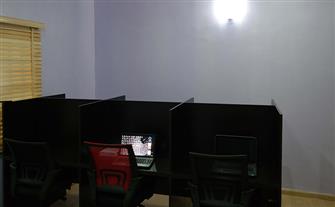
Walking in, I was immediately greeted by the warm atmosphere such a cosy space promised: air conditioning, brightly coloured furniture and secluded workspaces to allow people do their work in peace and privacy, not to mention the free WiFi. So basically, it was heaven. Getting a membership is also very easy, for three thousand naira (3000) a day you have access to all their facilities or you could opt for the fifteen thousand naira (N15000) a week plan or even the twenty-five thousand naira (N25000) a month plan. Annually, you can also get access for two hundred thousand naira (N200,000).

Met with their friendly staff, I was shown around their space. The largest room was a kind of lounge area where members could eat, drink, talk and basically relax. There were cubical seats arranged with spaces all around with work cubicles too. I was then brought to one of their workspaces equipped with pigeon holes and work areas, everyone with their head down focused on their work. There was also free coffee and other refreshments available so that was also a plus.

Being the only one of its kind around the area, Chapter 11 shines as a versatile and comfortable space for learning, working and resting. Shifting easily between its many roles and managing still to perform perfectly. Definitely, a place to be to get good work done fast.


Leaving Lagos

by S.I Ohumu 


I came here on the shoulders of many, great, expectations. It was the glow-up. Smart Benin girl who never fit in with a talent in the arts must move to the big city. But you lose when you do things that are expected of you.

I should have learnt this lesson from my experience juggling being in my first year of university and last year of secondary school, simultaneously, to give my parents bragging rights, though I didn’t. Or I forgot to. So I moved.

Now I am moving again.

I am leaving Lagos. It is lonely. Alone with 20 million hurrying bodies. Inside of a room, a flat, with persons you know in their own rooms, their own flats, the great distance caused by traffic jams enough to keep you apart. Alone with yourself so you run to whoever you can be with, taking the shit, grateful for a body to see, touch, talk, fuck.

I am leaving Lagos because it is noisy here . And in my head. There is too much. Of everything. Too much hurrying. Too much worry. Too much of cars. Too much of agents. Too much of no friends. Too much of want. Too much of the feeling of keeping up but falling short. There is not enough of anything. Not enough of actual air. Of space. Of quiet. Not nearly enough of peace and joy. Freedom to take flight. There is not enough freedom in Lagos. Not enough of the things which make us truly much. Solid hefty things. Lagos is noise and too much and not enough. It is a shiririrrrrr. It is many stones joined together, haphazard, with no weight. Nothing at the middle.

***

It is my last weekend in Lagos and I have come to move my things. For months I have been afraid to be back here. I left on a bad note. I didn’t finish a manuscript I was editing. I didn’t say goodbye at my job. I told the people at my house nothing. I wrote that deeply flawed essay. I absolutely do not want to be back here.

But fear will always be there. So I do what I am slowly learning to do: allow myself somethings, hold back others. I do not confront former work or abandoned manuscript. Not yet. I stay with Ayọ̀ at Ìyànà Ìpájà. On Sunday night I have wine with a married man–bad tasting white wine–while sitting beside a pool in Lekki, and talk to him for hours, until it is too late to go home. And because I don’t want us to get a room, I say, ‘to the beach’!

We walk. I think I belong to the water. He says everybody thinks that when faced with the sea. There is a line of rock I am unwilling to walk. We look at sex workers. At how the wind makes their cigarette fire fly. Sit on a log. He touches my butt. We sleep in his car. The next day, I’m sick with fever. Can mosquitoes live in saltwater?

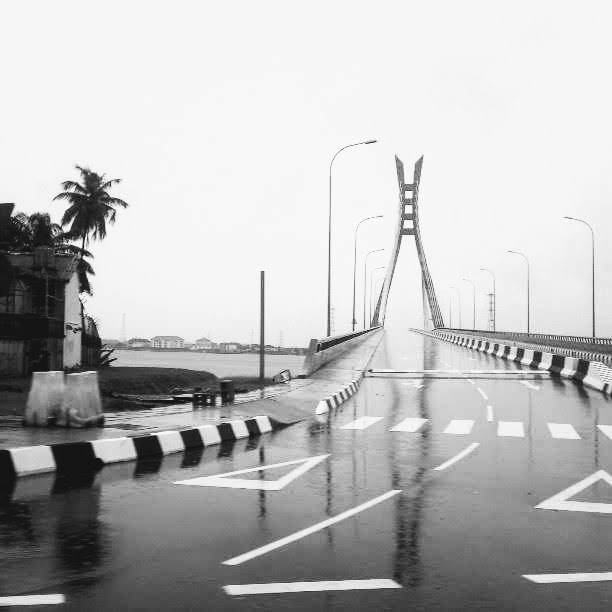
On Tuesday I uninstall Uber and Taxify. Forget Rele. My heart holds on to Freedom Park.

***

Hearing Edo being spoken became a balm. A balm given to a bus conductor at agege. A smile returned to boy with blue glasses at Cafe Neo. A celebration of familiarity. Everything else was the other.

***

I am leaving Lagos because I am happy now. I have cleaned the room in my head. Put the hangers in the wardrobe, the broom in its place. I am able to wake up every morning. Go to sleep without crying. Look at trees, touch the sky, love a man who loves me back. I am able finally to be accountable. To understand action, reaction, consequence. Interested in navigating the fragile maze of growing up while retaining my childlike wonder. Realizing clichés come from good places. I am able to think good. Solid. I am leaving Lagos because only the solid can fly. You are fraught and froth and secured to the dirt floor in a city with everything but what is required.

I am leaving Lagos because it is not for me. It is this simple. Do not speak in absolutes. No city is the sunken place. This one is magic to many others. Now the question: But is that you? Are you here because you want to be or you think you ought to want to be? Because you need to be here? Sync like a mac to an iPhone to this rollercoaster of a coastal city? When last did you let yourself rhyme?

I want to rhyme. I want to go home. I only know home is home by having been in a place that isn’t home. I am leaving Lagos because it isn’t home.

Lagos isn’t home. Not to me. Is it to you?

N.B: To the ones not squares, wearing boots at ring road, counting down until the big move, why are you leaving? Your family doesn’t feel like family? To find your tribe? Opportunities? Your difference does not mean you must live in Lagos. Granted it’s a hub but is it the only? Should it be? The country big. Ask Fuád, e big. If you want to create, bad air fast bus quick fingers frothy people fun hangouts may be the way. Trees, slow paced, quiet may also be the answer. I am not saying do not go, only consider. Place it side by side another. It is not a given. Sometimes the way to start anew is to stay. Sometimes it is to go.

Go home. But first, find it. Wherever that is.

_____

S.I Ohumu is a mostly happy twenty-two-year-old living where art, food, and environmental sustainability meet.


My Korean Nostalgia

It has been about two weeks since I returned from the Korean Peninsula as a guest of the Ministry of Culture for the PyeongChang Humanities Forum, a culture Olympics of sorts, but my heart has remained in the country. It had dawned on me, long before I got on the plane that took me out of Incheon Airport, that this is a special place. From the first welcome, through all the stops at Seoul, Pyeongchang, Busan, and other places in-between, the country warmed itself (a curious word since it was freezing cold in the subzeroes for the duration of my trip) into my bones. And now, I realize that I will never be able to read any news story about the Korean crises without a personal pull.

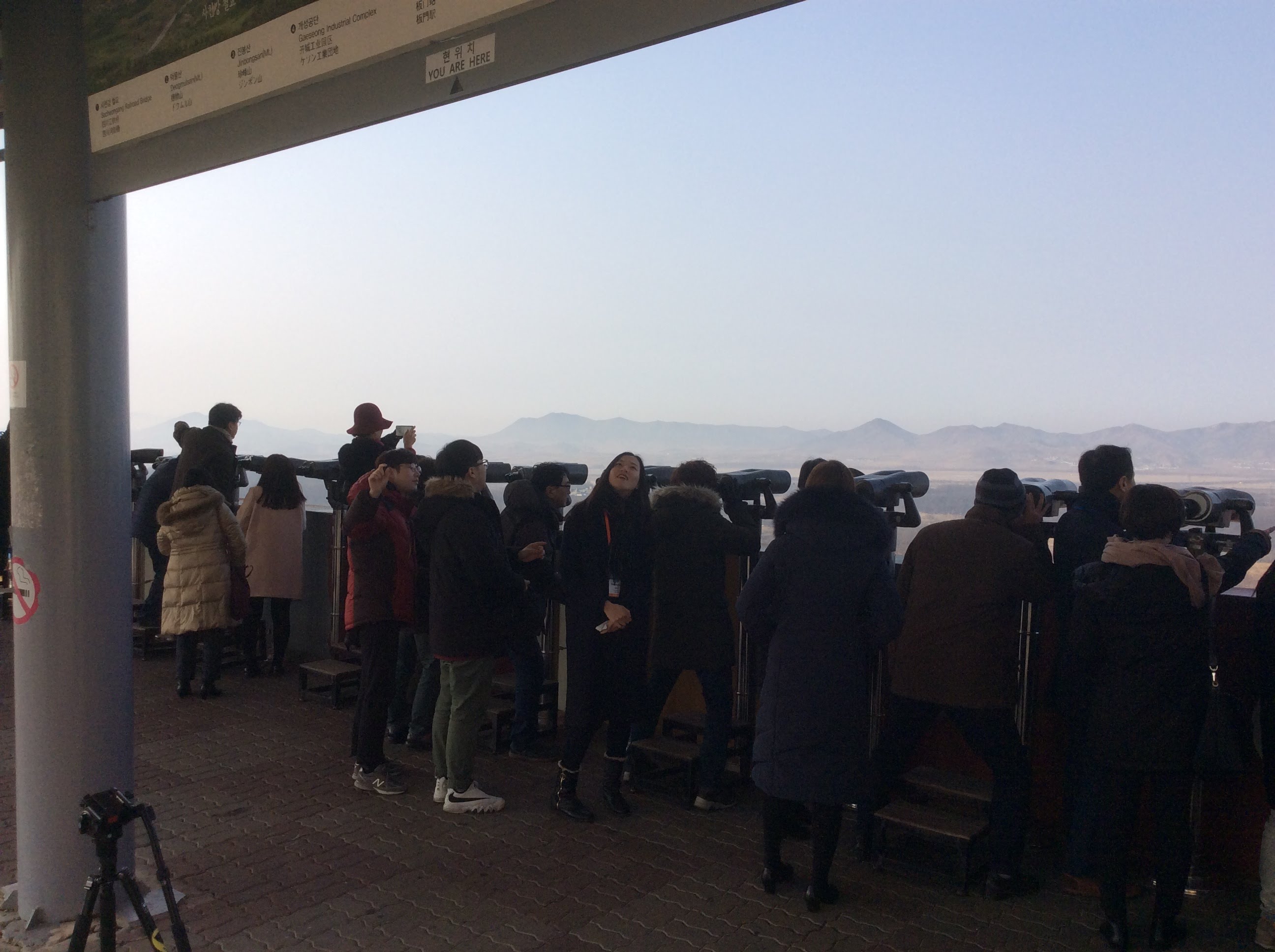
There is a story in the Wall Street Journal this morning about a successful concert at the at the Gangneung Arts Center by the North Korean orchestra attended by an audience of South Koreans of all generations in which the prospect of peace and unification again came within reach, even if only sentimentally. While I was in Korea, we had taken a trip to the Demilitarized Zone and learnt through a television in the bus, right before entering the Civilian Control Line, that a delegation from the North had entered the country through the same entrance just a few minutes earlier. They had been sent by Kim Jong Un as an advanced team to prepare grounds for sending the athletes that the North had agreed to have participate in the Ice Hockey event under the same (unification) flag along with the South, and in the same team. It warmed my heart up. (This has happened, by the way).

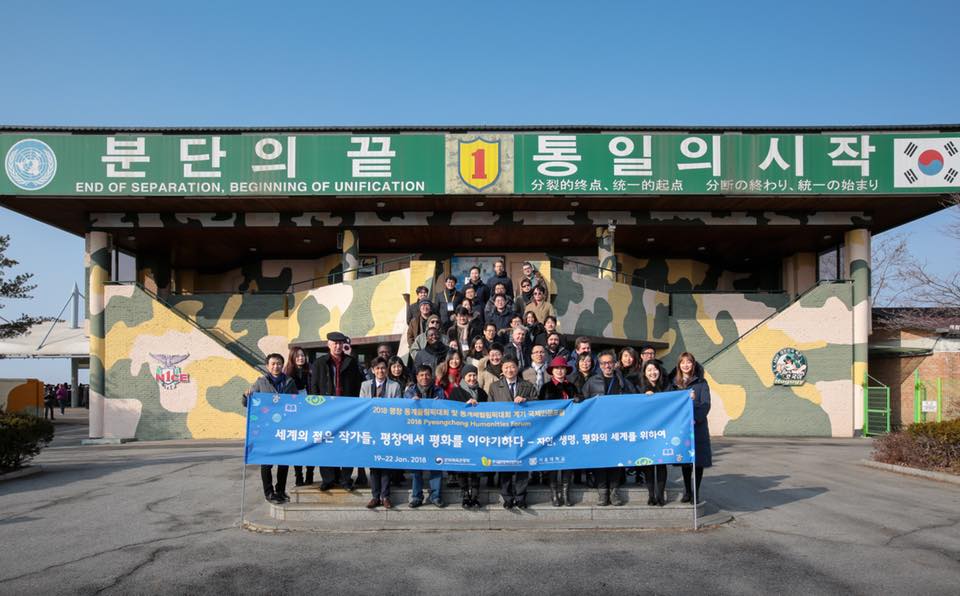
Almost everywhere we visited in South Korea, but none more pronounced than the DMZ areas, there is a palpable sense of hope for an eventual unification of the two countries under peaceful terms. It sometimes felt too jarring when compared to the rhetoric I’d been familiar with, from outside looking in, about a prospect of war that appeared real almost every day and with every tweet from the POTUS. Almost everywhere at the DMZ had something about ‘unification’ or ‘freedom’. The road we were on was called Freedom Road. There was a house at Paju that had boldly written on it “End of Separation, Beginning of Unification” in English, Chinese, and Korean. It’s unlikely that any North Korean would see it from across the border a few miles from there, but it showed an attitude that permeates everywhere I looked. The people of the South would want nothing more than a chance to reunite with their long lost national siblings.

A question I’ve been asking since I’ve been back is not just the North feels the same way (we have seen many defections to know that some appetite for this exists) but whether the outside forces will let it happen. In this case, we have China on the one hand whose communist hegemony is threatened by a unified Korea under capitalistic/democratic terms, Russia (which, to my surprise at its enormous size, does share a national border with North Korea as well) on another who has formed an inscrutable relationship with Kim Jong Un and would want nothing more than another outpost with which to poke the US, and then the administration of Donald Trump in America who have done nothing more than stoke flames of war in a transparent attempt at shoring up support for their unpopular domestic and conservative agenda. Listening to the media tell us about the possibility of peace, it comes through an inevitable path of war or denuclearization where America wins and Kim Jong surrenders to the will of Mr. Trump. The latter seems improbable, leaving us only the possibility of war. But the situation on the ground didn’t seem to offer only this binary. Watching Koreans live their life as normally as anyone can, with nothing resembling the worrying anticipation with which others around the world look at the peninsula brings up the possibility that some other less inflammatory resolution to the conflict can be found. I don’t know what it is, but maybe we should ask the Koreans rather than saber-rattle from afar as we’re wont to do. By ‘we’, I mean Donald Trump and the US.

In any case, this was supposed to be a recollection of my fond memories of Korea, and not a rant on global politics. When I watch the winter games on television today, I will remember walking through the ski village in Pyeongchang, watching the workers prepare the venues for the athletes, and wondering why anyone will leave their house to come compete in such a cold weather. But I will also retain a hope for the eventual unification of the country on more favourable terms to those who live in it and whose futures are tied to its peace and security, away from the many competing interests of the global powers.

The Train to Busan

Apparently, there is a horror movie of the zombie kind, made in Korea, with the above-named title.

I discovered this by chance, through Sarge Lacuesta, a Philipino writer with whom I’d attended the Pyeongchang Humanities Forum in Seoul and Pyeongchang in late January. We had been informed a few minutes earlier as we sat in the Orchid Room at the Westin Chosun Hotel that a planned trip to Busan later in the week would take us through a newly commissioned bullet train ride from Seoul.

Train to Busan, the movie, Lacuesta said rather enthusiastically, exhibited some of the best of Korean cinema which, according to him, had come into its own over the last couple of years, with compelling visuals showcasing the brilliance of Korean storytelling. It would be my first time of hearing of Korean cinema and I expressed same to him. When we were young, in Nigeria, we saw lots of Asian movies, but it was hard for us as kids to tell which was Japanese or which was Chinese. When we grew up a bit, we could recognize Jackie Chan and knew that he came from China. For the other films we watched, it was enough to enjoy the synchronized violence of the entertaining martial arts the movies were known for. As an adult, of course, I’ve since figured out that some of the biggest brand names in electronics came out of Korea, from Samsung to Kia to HiSense to Daewoo to Hyundai.

I’ve also come to learn more about the really impressive story of the Korean entertainment industry, from Psy of the Gangnam Style fame (we did visit Gangnam too) to G-Dragon, Taeyang, and the many other popular K-Pop stars the country has blessed the world with. The Busan Film Festival, as well, has come to represent one of the most impressive annual gatherings of artists and moviemakers from all around Asia, making great and beautiful movies for a global market. These are things I knew little about until I visited Korea for the first time.

I never did see the movie Train to Busan though I intend to in the coming weeks. Neither did we encounter any zombies on the really comfortable train ride from Seoul to Busan and back (how often do you get to use fast internet on a moving bullet train without paying extra for it?). But a few weeks after I returned home, I was able to travel back to Busan a, nd to the Korean film universe through the current blockbuster Marvel movie Black Panther. Those who have seen it will remember some of the most action-packed scenes took place in Busan and featured phrases of Korean and fine pictures of Hangeul calligraphy.

The event I’d gone to attend in Busan was called New World Literature Beyond Eurocentricism, and it featured conversations with some of the city’s finest artists, writers, scholars, on the direction of the arts and literature in languages and schemas other than the ones dictated by English and other European thoughts. I enjoyed it. My recent knowledge of the successful and dynamic movie and literary culture from Korea – I realize now – is a fitting coda for that fascinating trip.

____

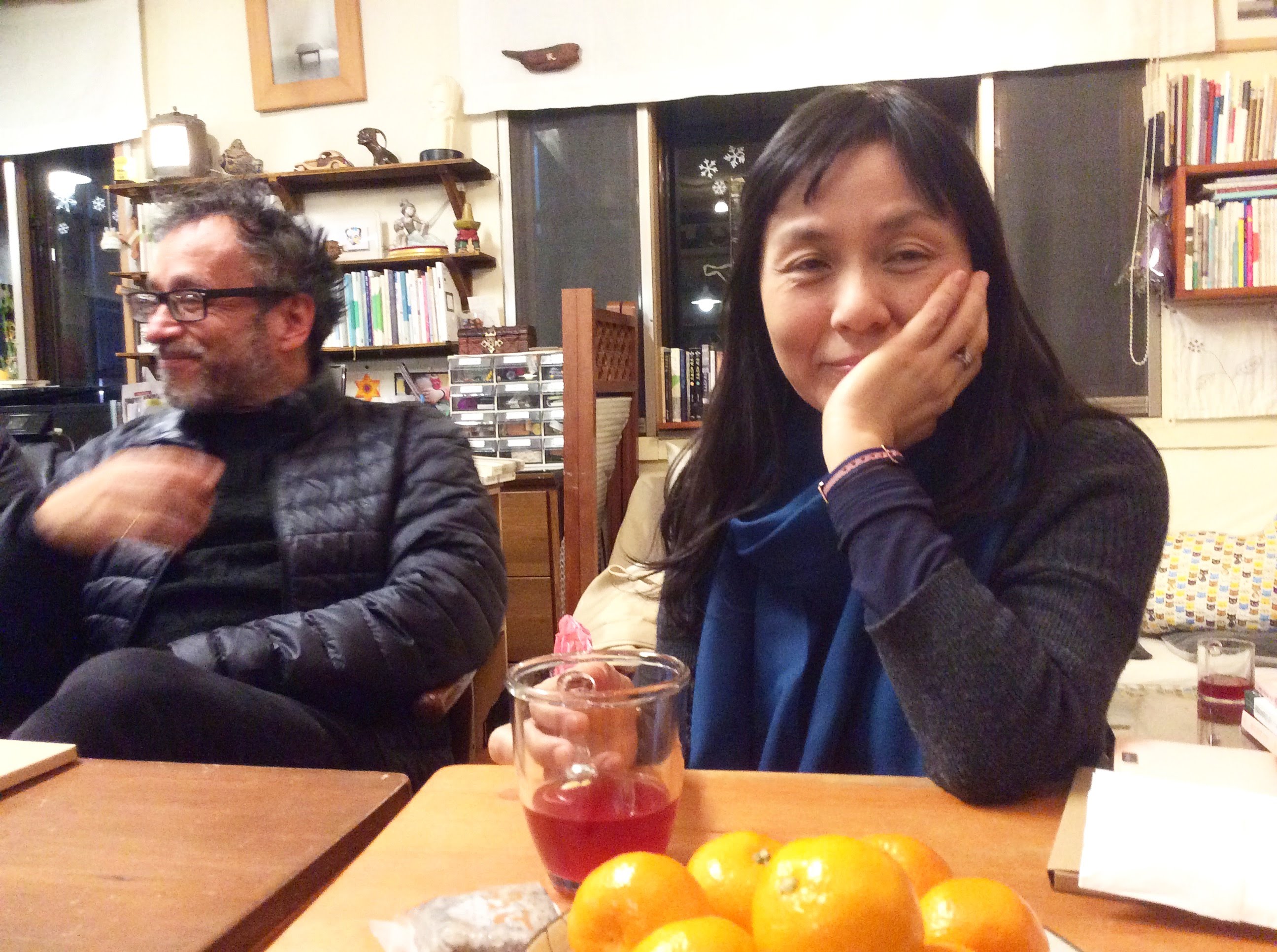
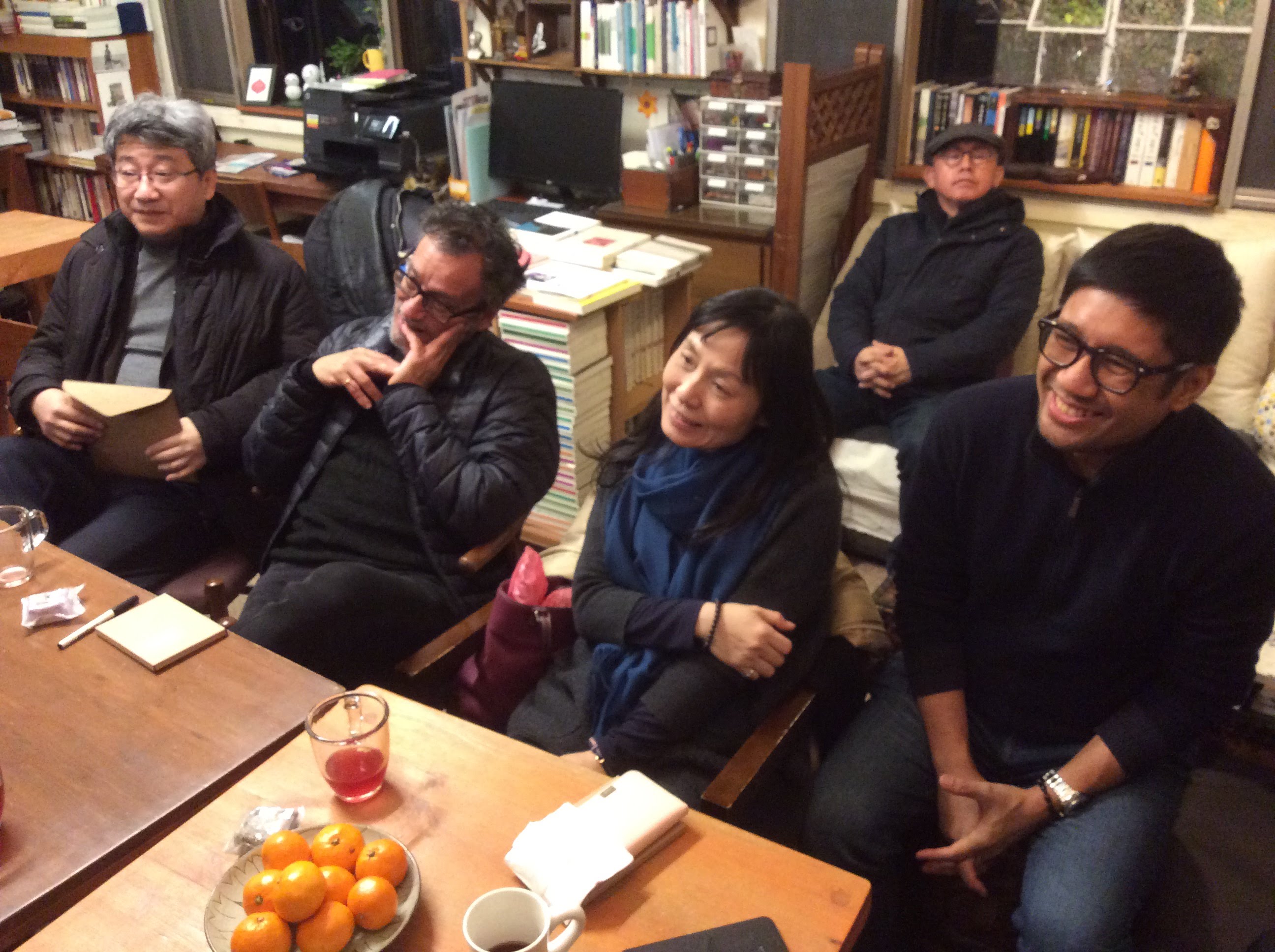
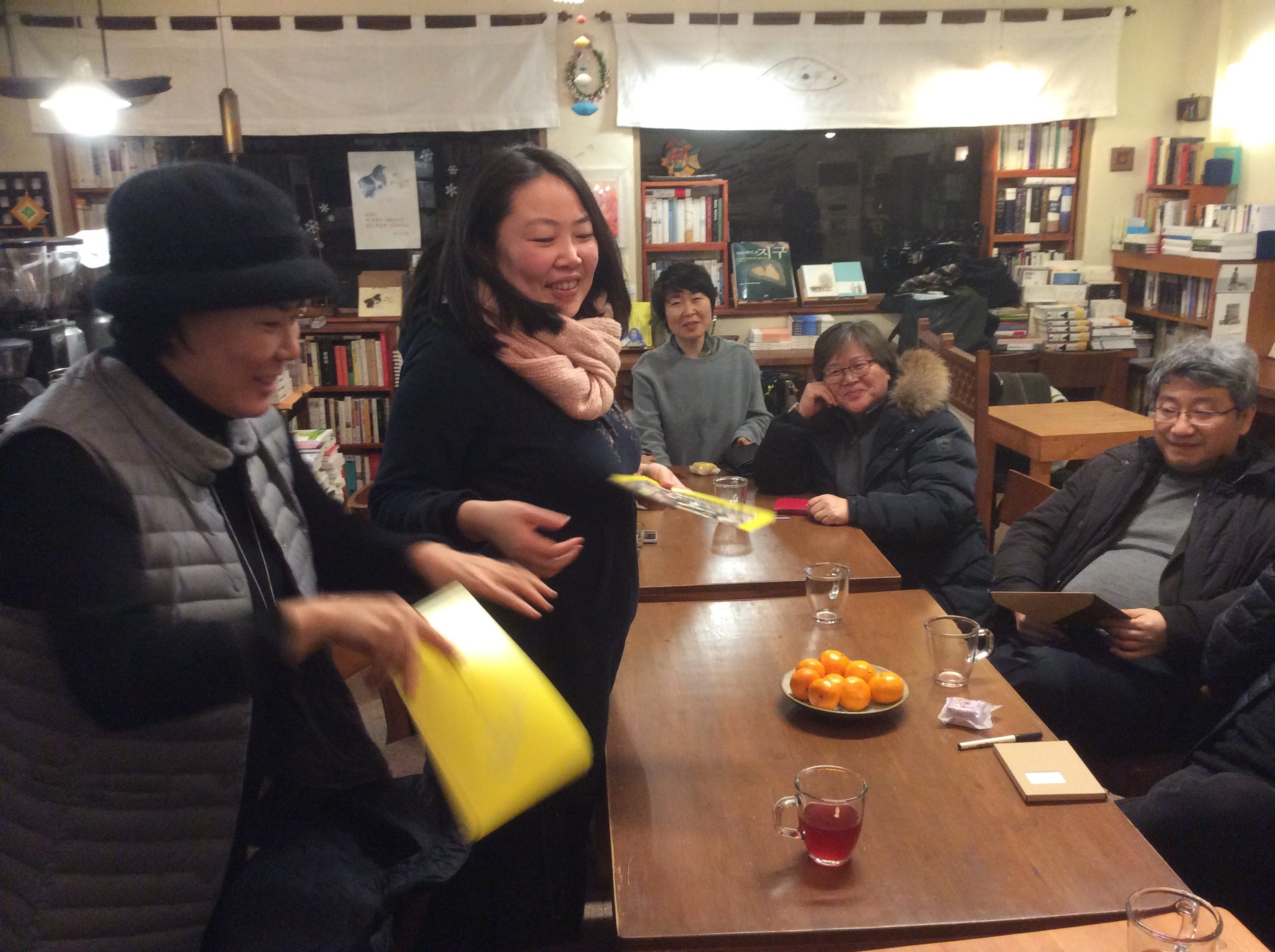
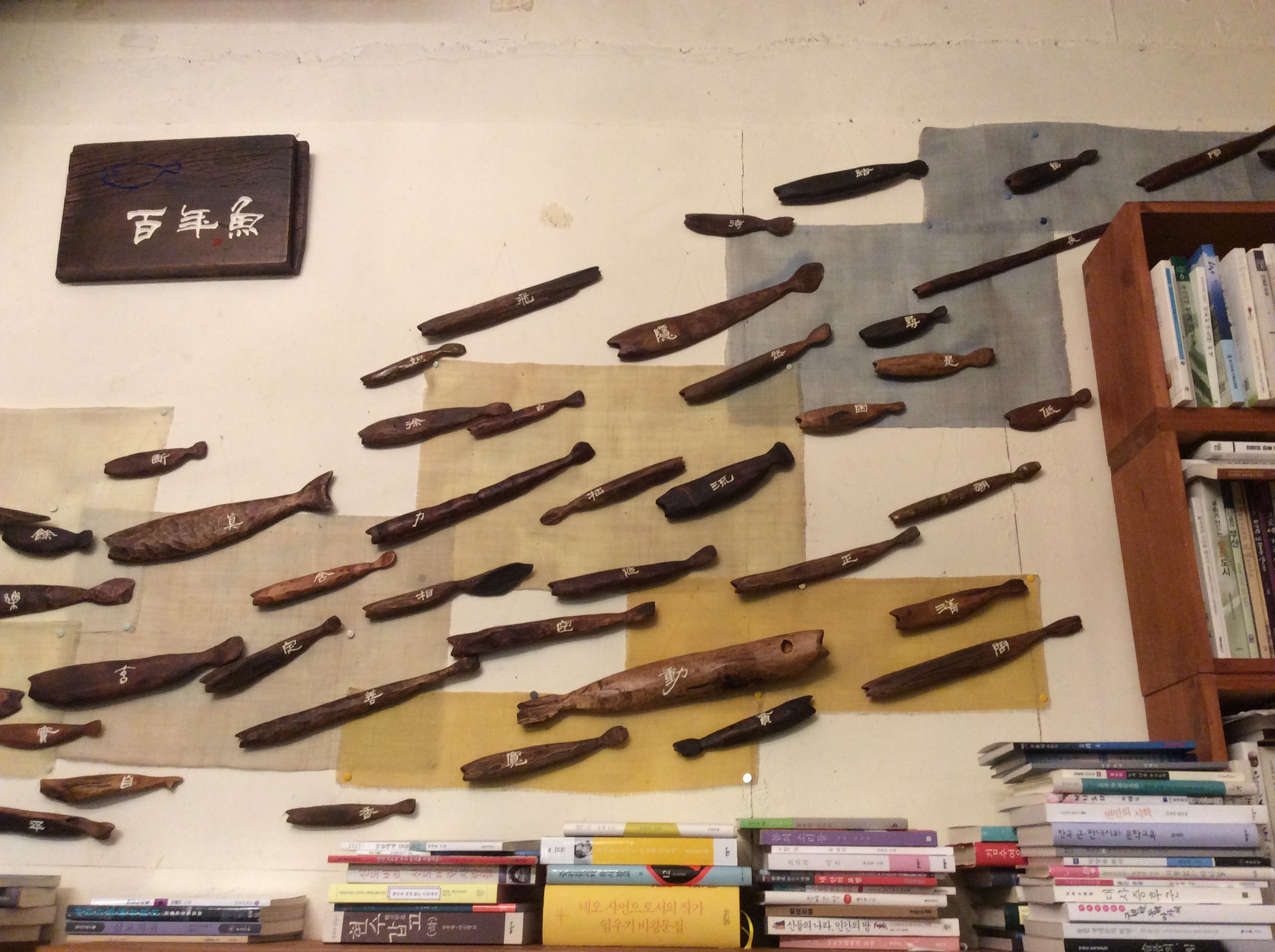
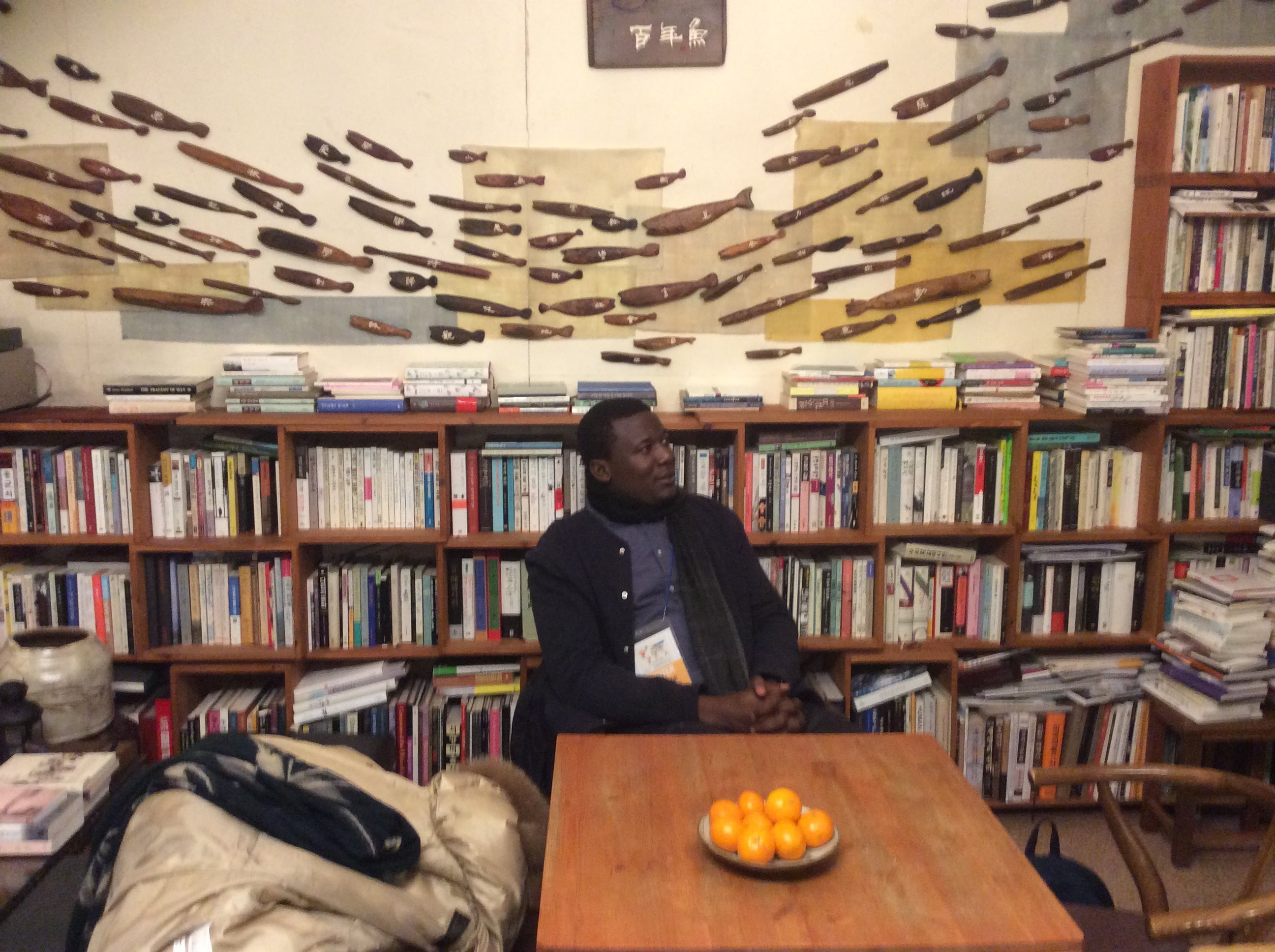
All photos taken at a Book Café run by Kim Soo Woo, Korean travel writer and translator, one of our hosts in Busan.