This piece of news in the Dispatch of today highlights the success of a new kind of special public education in Missouri addressed mainly to black and African-American students with focus on African culture and values. According to the piece, the Missouri example follows the success of similar successful projects in Detroit, Kansas City and Los Angeles. Kinda reminds of specialized schools and institutions around Nigeria offering American-type or British-style education. With a widening achievement gap between white and African-American students, and research showing that the gap is not as much a gap of intelligence as it is a gap in teachers being able to address students’ needs, maybe this is not such a bad idea.
Browsing the archives for the Academic category.
Rethinking African Popular Culture and Performance: A Colloquium in Honour of Sola Olorunyomi at 50
In spotlighting the contributions of Sola Olorunyomi – author of the seminal Afrobeat!: Fela and the Imagined Continent and other influential texts – to literary and cultural studies, this colloquium intends to incite a debate around the ferment that Olorunyomi has generated as an idea, a scholar, a teacher within and outside the classroom, a performer, a social activist and a fifty-year-long insurrectionary event.
 Popular culture and performance in Africa, more intently, are isolated as the hub around which the colloquium’s sub-themes will revolve. We also want to look, beyond the normative cultural forms, at para-artistic sites such as television reality, telephony, virtual interaction (Facebook, Twitter, etc.), open-market hawking, etc. The colloquium’s immediate objective is to update critical engagements with popular modes of culture, taking into consideration the recent emergence of new forms such as hip-hop, on the one hand, and the transformation of other forms such as home video culture as exemplified by Nollywood, on the other.
Scholars are free to account for the itineraries of borrowed forms and explore the implications of such practices on indigenous cultural modes in relation to the global political economy of culture, as well as the double layers of local and Western cultural hegemony. In this regard, highlighting the role of virtual communication and cyberculture as rallying points of counterhegemonic sentiments in the mass revolutions recently witnessed on the continent will be pertinent, given Olorunyomi’s credentials as a site of transformative action.
While presentations are not restricted to any themes or art forms, we expect participants to adequately problematize existing debates on key issues of the theory of African popular arts, the question of aesthetics, ideology, reception, as well as the place/role of technology and the media in the ongoing reconfiguration of the field. In their investigations, intending participants are encouraged to explore any national, regional or virtual community model relevant to the colloquium’s focus.
We therefore seek panel and individual presentations from scholars and practitioners that address issues relating, but not limited, to the following:
– Performance (Music, Drama, Disc Jockeying, etc.)
– Virtual Communication/ Cyberculture
– Reality Television
– Telephony
– Advertising
– Stand-up Comedy
– Slogans
– Home Video
– Football Fandom
– Body Art
– Fashion
Abstracts of not more that 250 words should be sent as email attachments to lorunyomiat50@yahoo.com.
The colloquium will hold at the University of Ibadan in late November, 2011. A festschrift of presented papers will be published afterwards. Deadline: Friday, September 30, 2011 (12 midnight, Nigerian time). We will respond to applicants regarding acceptance not later than Monday, October 3, 2011.
Direct all enquiries to lorunyomiat50@yahoo.com. Alternatively, contact Senayon Olaoluwa (PhD Wits), Department of Languages and Linguistics, Osun State University or Tunji Azeez (PhD Ibadan), Department of Theatre Arts and Music, Lagos State University.
Announcer: Olorunyomi@50 Carnival of Friends
I got this mail from Nick about another personal peculiarity in English pronunciation in response to my recent post. Enjoy.
_______________________
I enjoyed your post about spotting Nigerian accents by the pronunciation of “man/men”
(https://www.ktravula.com/2011/
This doesn’t have anything to do with Nigerian English, but I know you like American English accents, so I thought I’d write. I ran into something similar to the “man/men” issue when I moved from my home town of Portland, Oregon to Pittsburgh, Pennsylvania (you should visit both cities if you get a chance). Having lived in Pittsburgh for ten
years I still find myself having to consciously use more of a “aa” sound, particularly with the word “bag”, which my wife tells me I pronounce too much like “beg”. I do it pretty automatically now, but I actually find myself exaggerating it to prevent comments. I think I sound like a sheep, going “baaaaaa-g”. The vowel sounds more open and I hold my tongue farther back in my throat than I would naturally.
This might not be exactly the same as the “men/man” thing, but it seems similar.
This is just my experience and not evidence of a regional accent issue, but at least one of my friends reported something similar after moving from Portland to the east coast. Other significant factors are that I may have picked up a bit of my mom’s New England accent, and also that Pittsburgh is home to a slight local accent and some cool local vocabulary like “yinz” instead of “y’all”.
Thanks for your always-interesting blog,
Sincerely,
Nick.
_____________________
Notes
This mail reminds me of one other distinct pronunciation difference in Nigerian and Ghanaian English. Growing up in the early to late eighties, I remember a common assumption that Ghanaian English sounded closer to the British standard than Nigerian English, and Nigerian parents paid more to send their children to private schools that had Ghanaian teachers rather than ones that didn’t. And though they paid so much for the “privilege” for us, we never understood much of the obsession beyond the fact that our teachers insisted on pronouncing “Church” as “cherch” (as it rhymes with “perch”), the as “the” (as rhyming with the “e” in “wet”, hamburger as “hamberger”, luck as “lack”, and but as “bat” rather than the Nigerian “bot” among very many others that I can list if I get the time. We students also didn’t gain much from the hubris that the teacher brought with them either. It however provided plenty moments of comic relief in classroom sessions when it didn’t come along with punishments for deviation. We had some good laughs as I am sure did Ghanaians who had listen to us speak English as well. I have been to East African and I think that the English there – along with its own amusing peculiarities that knocked Nigerian and Ghanaian versions to a corner – comes the closest to British English pronunciation standard in all of the Englishes I’ve heard on the continent. But then, I’ve never been everywhere.
Thank you Nick.
Sincerely,
KT
I am reading “As I Please”, a collection of essays written by George Orwell between 1943 and 1945 and edited by Sonia Orwell and Ian Angus. In the first essay titled The English People, the author explains some benefits and demerits of being an Englishman speaking English:
“But there are also great disadvantages, or at least great dangers, in speaking English as one’s native tongue. To begin with, as was pointed out earlier in this essay, the English are very poor linguists. Their own language is grammatically so simple that unless they have gone through the discipline of learning a foreign language in childhood, they are often quite unable to grasp what is meant by gender, person, and case. A completely illiterate Indian will pick up English far faster than a British soldier will pick up Hindustani. Nearly five million Indians are literate in English and millions more speak it in a debased form. There are some tens of thousands of Indians who speak English as nearly as possible perfectly; yet the number of Englishmen speaking any Indian language perfectly would not amount to more than a few scores. But the great weakness of English is its capacity for debasement. Just because it is so easy to use, it is easy to use badly.”
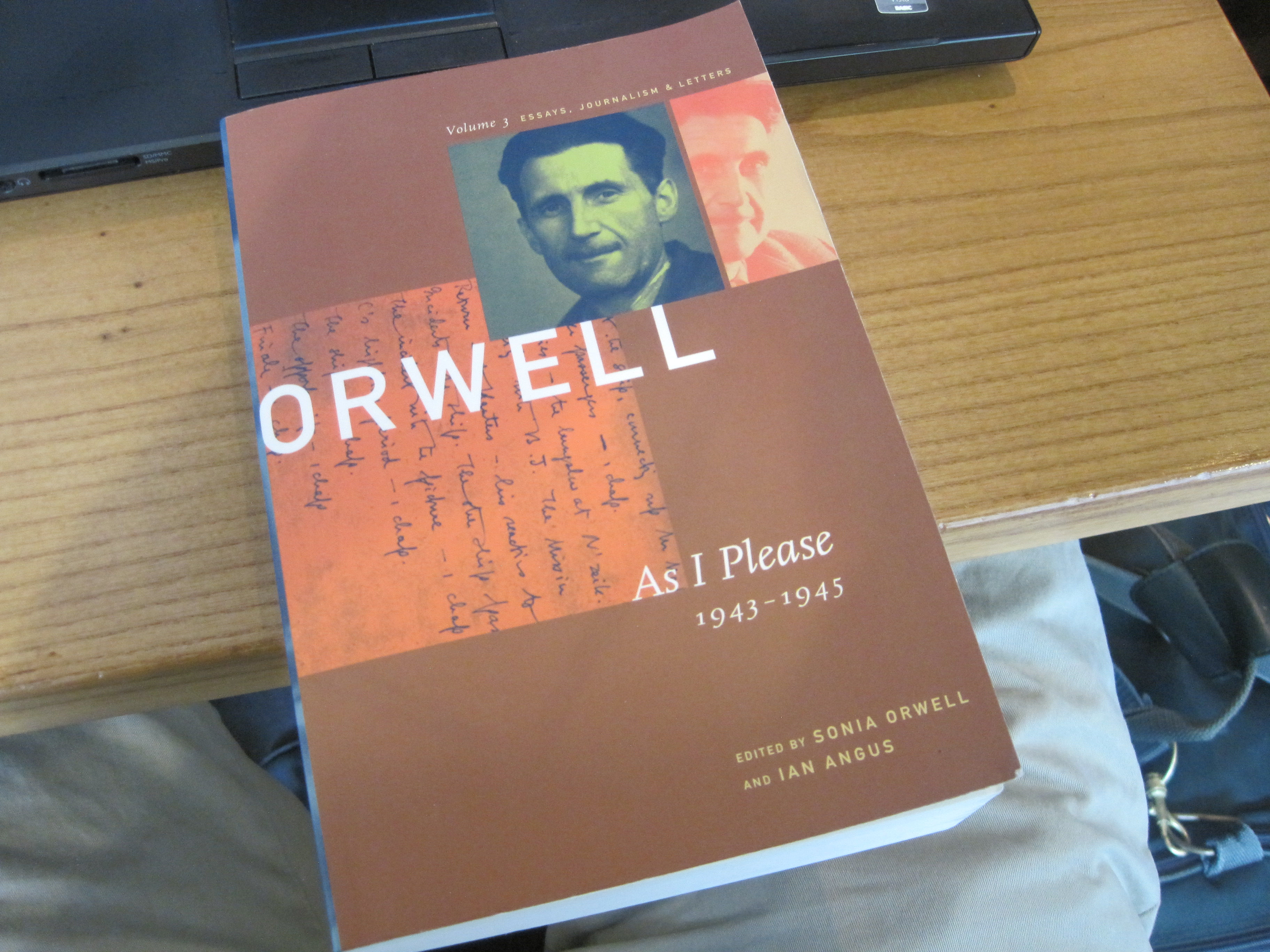 In the essay with parts that read like an epilogue to his earlier essay Politics and the English Language, Orwell complains about English being influenced by “American” pop culture words. Although written about six decades ago, it is fascinating how Orwell’s perception of the English life, language, and culture seems to remain as applicable now as it was then, even seeming applicable to other new post-colonial societies elsewhere.
Here is another quote:
“The temporary decadence of the English language is due, like so much else, to our anachronistic class system. “educated” English has grown anaemic because for long past it has not been reinvigorated from below. The people likeliest to use simple concrete language, and to think of metaphors that really call up a visual image, are those who are in contact with physical reality. a useful word like bottleneck, for instance, would e most likely to occur to someone used to dealing with conveyor belts: or again, the expressive military phrase to winkle out implies acquaintance both with winkles and with machine-gun nests. and the vitality of English depends on a steady supply of images of this kind. It follows that language, at any rate the english language, suffers when the educated classes lose touch with the manual workers. As things are at present, nearly every englishman, wheatever his origins, feels the working-class manner of speech, and even working-class idioms, to be inferior…”
An engaging read.
I want to be able to talk about the field of Second Language Acquisition, my encounter with it last semester, and how much the questions it raises are more than the answers it provides. I am back into reading extensive materials in the field many of which didn’t make as much of a dent as they should have during that first encounter. I won’t now, not just because my knowledge is not yet as comprehensive as it should, and that a carry-over from a daunting first encounter is unhelpful in allowing me open up more to its possibilities, but also because I’m afraid of misrepresenting the extent and influence of what I already know. My MA thesis will have very much to do with SLA and I need all the concentration I can get.
But talking about what I’m doing always helps, as I have found out. Having less time to travel around the country discovering places now like I did before, all I have now is my research and the hard work of creating relevance in a field that gives me the freedom to think, and the tools to make a difference. This time, I’m looking at tonal acquisition. The fact that not much has been done in the area so far is also as positive as it is challenging. So while the research process begins to take shape, let’s see what Krashen and Chomsky have to say again.