Browsing the archives for the Academic category.

Occupy Twitter Translator!

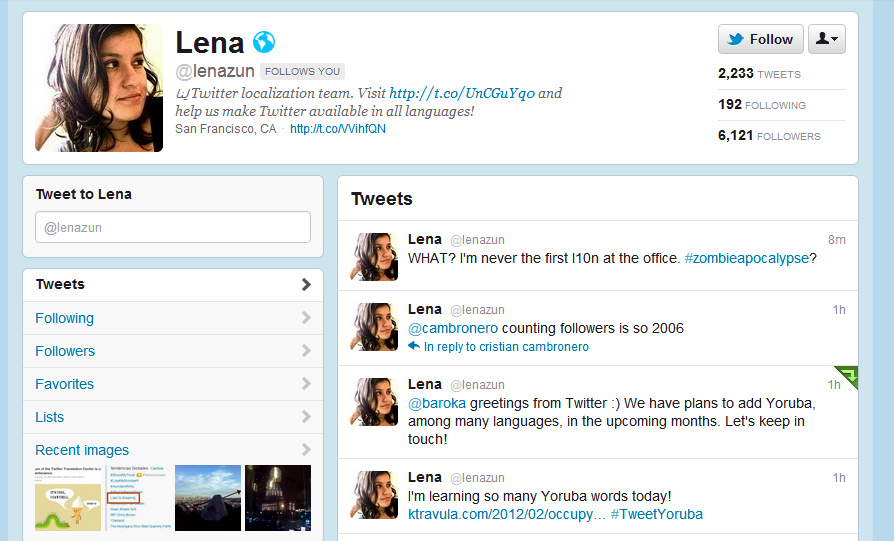
Akitiyan láti mú Twitter fi Yoruba kún ikan lára àwọn èdè tí oun èlò náà ti le di mímúlò. E darapò mó wa ni twitter pè#twitterYoruba, kí ẹ sì fi tweet náà ránsẹ sí @translator àti @twitter.

Twitter’s global platform is already available in over two dozen languages: Arabic, Danish, Dutch, Farsi, Filipino, Finnish,French, German, Hebrew, Hindi, Hungarian, Indonesian, Italian, Japanese,Korean, Malay, Norwegian, Polish, Portuguese (Brazil), Russian, Simplified Chinese, Spanish, Swedish, Thai, Traditional Chinese, Turkish, and Urdu.

Here’s a twitter bomb to bring Yoruba to the attention of the techies at that social media platform. Beside having over 30 million speakers all around the world and producing a Nobel Laureate in Literature, the language and culture has also produced a host of language professionals and cultural representatives in the world today to whom translating the program into Yoruba at their free time would be a delight. Here’s putting ourselves forward.

We are declaring tomorrow March 1, 2012 Tweet Yoruba Day. To participate, tweet in Yoruba as much as you can, and use the hashtags #twitterYoruba or #tweetYoruba. Tweet at @translator and @twitter (preferably to both of them) with the hashtag #twitterYoruba and #tweetYoruba and tell them why Yoruba is an important language that will add to your Twitter experience. The aim is to make our twitter presence known to the decision-makers at the twitter translation desk.

Tips: It doesn’t matter if you are not confident in your competence in Yoruba. As long as you have something to say, say it in the language and include the hashtags, and copy @translator and @twitter. If you run out of things to say, tweet songs, poems or names of your favourite Yoruba book titles with the same hashtags and copy @translator and/or @twitter . Participation is key. Join us, and please spread the message. Remember that this will succeed or fail on participation. Ẹjẹ ká lọ!

If you are reading this from Twitter’s translation desk, thanks for stopping by. We look forward to hearing from you and having Yoruba join your list of languages. E se pupo. Thanks!

Update (10.58am Central Time): We succeeded. We finally got Twitter’s attention (See below). Thank you everyone who participated, (including but not limited to @mw_indigo whose enthusiasm moved it beyond just the realm of a public conversation into a tangible project).
 

End of Classes, and More

My presentation in class on Wednesday was my last in this Master’s program (baring a thesis defense, of course). It focused on a hypothetical lesson plan for second language teaching in a foreign country. One of the advantages of such assignment that allows for creativity is the chance it gives the student to make conjectures on things that may actually become future research areas. I am a teacher of English language in a high school in Kigali, Rwanda. That country emerged just a few years ago from a brutal civil war that tore the country into many ethnic parts. It has now adopted a policy of English language (over French and Kinyarwanda) in order to forge a more united country free of a colonial past, and with a view to a more globalized future.

What problem does such a job pose for both the student and the teacher, even beyond the usual problems of language acquisition? Socio-cultural attitudes of parents still hung up on ethnic and cultural identities and resistant to change? Government bureaucracy and a typical political gamesmanship that might deny funding for much of the initial experimentation that could amount in success? A problem of communication between teacher and student? (It’s hard enough for students to be learning a new language. If the teacher offering guidance for such teaching does not even share the linguistic identity of the students, the baggage of his “otherness” might be a little hard to overcome). What else? There are actually far more positives to the experiment, one of which is the delight of sharing cultural similarities and differences while at the same time sharing the knowledge of a connecting international language. Cultural exchange is after all always an learning stimulant.

I have good memories of my first major teaching experiences in the Nigerian middlebelt as a Youth Corper. Students delighted in their ability to communicate in Hausa and Berom even in our English classes. It was a battle that I struggled with all through the year, frustrated that the purpose of English education is defeated when students choose instead to resort to local codes at every moment of convenience. Other linguists working in the area of Second Language Acquisition have argued that there are positives in this model of acquisition where the pressure to always be right is taken off the shoulder of students and they are allowed to subconsciously acquire the second language. The problem in the application was the reluctance of the students themselves to even try since their mother tongues provided an easy alternative. (But then, a prominent educational research in Nigeria, particularly the Ife Six-Year Primary Project of 1989, showed that students taught in their mother tongues performed better in learning other subjects).

I find Second Language Acquisition extremely fascinating, and the prospect of teaching English in another country equally enticing. Rwanda presents a fascinating example of such intervention because it combines education with social work. A country willing to ditch a dividing legacy of multilingualism for a second foreign language presents a fascinating study. One of the best rewards for teaching – as I have realized from my years of involvement – is not just in the knowledge that the teacher brings into the class, but the ones he takes out of his interactions with his students. I believe that in the next century, the language of the world will not be this English language as we know it, of course, but something richer, encompassing the form and world-view of all the peoples through which it has passed. There is something to enjoy in the process of bringing that to existence.

Fun Stuff: Google Ngram

Google has just come up with a great product called the Ngram Viewer (discussed in this equally fascinating TED video). What the Ngram Viewer does is to give users around the world the ability to sit at home and search through a database of billions of texts. These texts have been scanned into the Google database from all the books published in the world to date. Among other things, what this gives us is the power to discover the rate of occurrence of certain words, phrases or names in publishing history. Extremely fascinating, right?

I have been playing around with the program and here is my first experiment: to figure out which of these men in Nigerian political/social history is most frequently referenced in text, and since when. The men are Olusegun Obasanjo (who ruled the country for a record 11 years and played a crucial role in its political history), Chinua Achebe – Africa’s foremost novelist whose first 1958 novel Things Fall Apart is the most widely translated texts in English literature from Africa, Wole Soyinka – the continent’s first winner of the Nobel Prize in Literature, and finally Obafemi Awolowo – nationalist, politician and visionary. The result is stunning and will offer nuggets for discussion among people who have argued (many times without proof) that one person was more famous than the other.

There are a few more I have tried out. This graph showed that the word “nigger” got more usage in the mid 1800s (just after Lincoln set the slaves free, which made sense), dropped in usage in the 1980s, and is now coming back into use after the year 2000. Go figure. The word “nigga” however is a totally different matter. The word “Republicans” was initially more famous than “Democrats” but eventually fell around 1900 and has remained stably lower ever since. And what about languages/cultures? This graph shows how much the African languages/cultures Hausa, Igbo, Yoruba, Swahili, Twi, Edo, and Zulu have featured in texts through time.  Fascinating result, and not only because Yoruba leads the pack with a clear margin! Yoruba is not the biggest language/culture in Africa. The word “Nigeria”, according to the Ngram has been in use/print since around 1860 (contrary to what we have been told) although it finally gained currency at the beginning of 1900s. Finally, I did a search on my favourite comedians: George Carlin, Bill Cosby, Lenny Bruce, and Richard Pryor. The result puts Bill Cosby on top and George Carlin at the bottom. Oh well.

What Google has done with this project called the Ngram Viewer (I say again, an extremely fascinating project) is to endow the world with a new great tool to do anthropology and study history with nothing but access to the internet. Life, and history, just became even more enlightening.

Break Time/Tone

I will not blog much this week because I feel a little overwelmed. On the bright side, I have Steve Jobs’ authorized biography to get through to take some of the stress off, along with a few other materials in my thesis development.

On that last bit, a question for language students: does anyone have a guess as to why (American) English speakers have problem with tone in language? Yes, they are not used to tone languages because English is intonational. But they never have such problem with music which also works with tone levels, so what’s going on? Here’s more, when researchers who have looked at the matter say that one of the reasons for poor tonal acquisition by American/English learners is the limited “pitch range” of such learners, what exactly do they mean? English speakers are humans too and pitch is physiological and not something tied to race or skin colour. I have looked everywhere online for information about this and I haven’t come up with much.

I can do with some brainstorming session here.

Phonetics for Dummies

Students of a compulsory phonetics class have often asked me what the best strategy is to get through the course. I have often always responded with the same answer: open-mindedness, and focus. Phonetics happens to be one of the most interesting subjects in linguistics, and an important base for anyone interested in moving forward in the field.

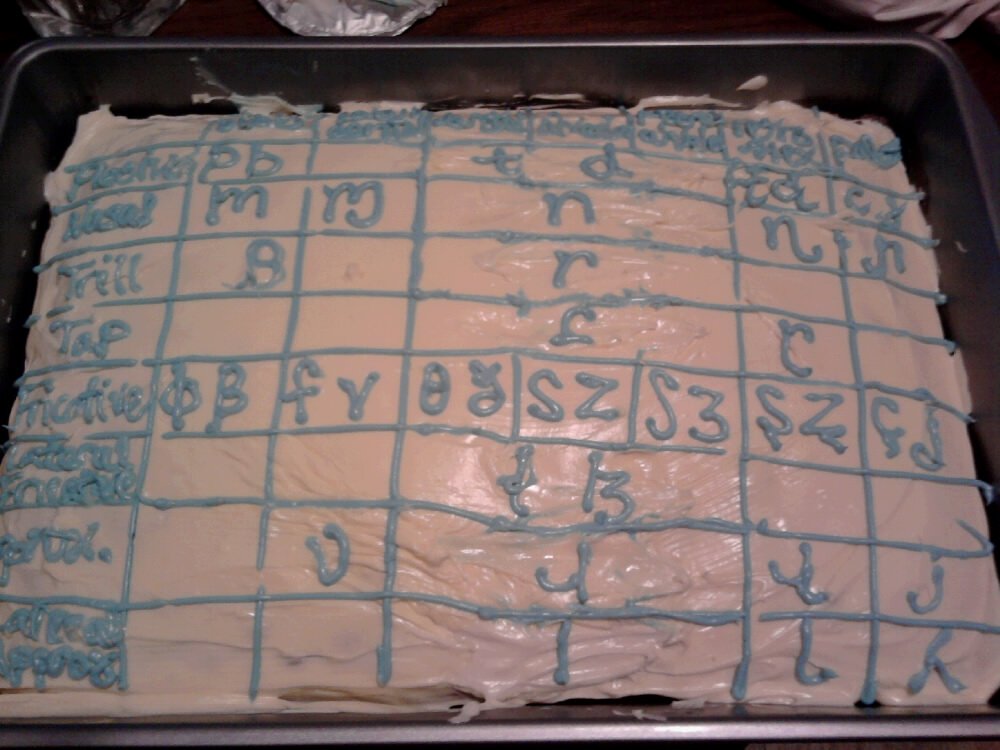
So what is special about phonetics? The answer is, everything. All the sound systems of the world are represented on the IPA phonetic chart, and even though one may not be able to pronounce all of them, it is important to realize that they are all legitimate sounds. And more, one can actually pronounce any one of them using the simple knowledge of their place and manner of articulation. Many of the sounds are not available in English – which explains the dilemma of most English-speaking and American students. The easiest way out is for them to realize from the start that they shouldn’t hope to be able to pronounce all the sounds, although it matters that they know how they are pronounced and what makes each of them unique.

[f] and [v] are different only in voicing. They are pronounced in the same place and with the same manner of articulation. It’s the same with [k]/[g], and [t]/[d], [s]/[z] etc. This makes it easy to distinguish between the fricatives at the end of “breath” and “breathe”. In text, they look alike, in sound, they sound different. A little step further into phonology, and we begin to ask what conditions exist that make it likely that a voiceless consonant becomes (or is realized as) a voiced one.

But for this phonetic beginning, let us just adjust to the fact that sounds are fascinating, and that our vocal tracts have evolved over the years to be able to make an almost infinite type of sounds. Our job in the phonetics class is to group those sounds according to stipulated categorization methods.

Picture of cake by Jenna Tucker