Title: Clinical Blues
Year: 2014
Pages: 88pp
Author: Dami Ajayi
Publisher: WriteHouse, Ibadan
Reviewer: Tosin Gbogi
Of National Neurosis and Private Psychosis: Preliminary Reflections on Dami Ajayi’s Clinical Blues[1]
At a time when a whole nation has become a nest of singing birds, when the same stylistic path is repeatedly trodden in the name of a certain kind of dubious ‘tradition’, and in poem after poem, the thematic character of a failed postcolonial desire called Nigeria constitutes the formulaic lens through which good poetry is (re)interpreted and ideologically legitimized, Dami Ajayi interrupts the dirge with a riveting collection of poems entitled Clinical Blues. As the title suggests, CB simultaneously drags a nation into the hospital and drags the hospital into a nation but also permits us—within that overlapping spectrum—to conceive of the two as irreducible to one another. Divided into five sections that draw on imagination, memory, history, and the quotidian wisecracks of a beer-parlour strain, the collection frankly interrogates love, sex, emotional longing, alcoholism, hypertension, amnesia, schizophrenia, and other clinical concerns. Of course, Ajayi is neither the first to bring his medical training into poetry nor the first to set poetry within the uncertain despair of the ward. The avant-garde Williams Carlos Williams, perhaps, remains one of the best known to date. Before him, Anton Chekhov had experimented with stream of consciousness and mood in both his short stories and plays, making him one of the key figures of early modernism. And to return ‘home’,[2] Lenrie Peters is not just famous for his ‘writing back’ gestures but also for his use of medical terminologies in poetry. The same holds true for Latunde Odeku, Femi Oyebode, Niran Okewole, and Tolu Oloruntoba. Ajayi connects with these poets in many remarkable ways. Consider, for instance, the first three stanzas of the ten-part title (and longest) poem, ‘Clinical Blues’:
Sing me a song
Not from your larynx;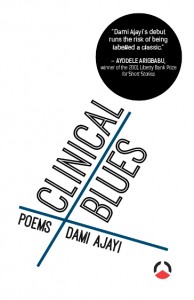
Probe deep,
Deeper into lungs
The recesses of your soul.
I am a lonesome observer,
The clinical sentinel
Who sits still to wage
Wars against infirmities
And your organic sax
Plunges snot and sounds
Into my drink of patience
The truth is eerie, tall
Like swabs of heavy winds (42)
The above introduces us to the caustic tone and medical register that permeate the entire collection. Like the Child-persona in J.P. Clark’s ‘Streamside Exchange’, the poetic subject of this poem asks us to sing, but from our lungs (the depth of our being), not from our larynx (voice box). With the task taken over by the persona himself in the second stanza, we soon realize that this is only a griot’s legerdemain to draw us into the performative, call-and-response space of the poem. The task remains the griot’s and the rule he sets for us also applies to him: to sing nothing but a sardonic song from the ‘recesses of … [the] soul’. Apart from this, the poet also permits us to extrapolate from the third stanza that this is a modern griot’s song, using such instruments as sax and harmonica to reproduce on the page an organic blend of Afrobeat, Highlife, Jazz, and folk songs. More importantly, this voice presents us with an observer’s account of an ailing health system and country. This is the point here:
The blip of an ailing heart
Tolls a symphony of symptoms
But I am no open chest surgeon
For I am a jazz pianist
With a little stint with blood (42)
In the above, a patient’s ‘ailing heart’ becomes symptomatic of the worsening state of a dying nation. Ostensibly a doctor, the persona informs us that he is no surgeon. He is a ‘jazz pianist’ and the alliterated ‘symphony of symptoms’ certifies just that. Beyond this, however, the confessional lines above intersect neatly with Chekhov’s oft-quoted dictum: ‘Medicine is my lawful wife, and literature is my mistress. When I get fed up with one I spend the night with the other’ (91).[3] Here, then, is where the fictional persona of the poem merges with the supposedly external personality of the poet. The result is a confrontational lyricism of stark honesty that speaks directly to one of the crucial centres of power:
I know of clinical meetings,
Not where doctors wage
Wars against themselves with literature,
But where diseases wield
Their many forms in a game
Of hide and sick (sic). (43)
……………………………..
Doctors wield wide bore cannulae
Plastic pistols don’t repair tissues
The clinical truth is Post-Mortem
At least we can lie that we tried. (45)
……………………………..
Three hearty cheers
To the Registrar who gave
Rave morning reviews
At the sitting of grey
Obstetricians and medical students
Who warmed his bed and beer table. (45)
Meaning-layered, the three stanzas bring to our attention a system that often evades critical attention. It is not uncommon, for instance, for doctors to assert their omniscient selves while dealing with their patients. Not uncommon either to find them constructing what Norman Fairclough calls passive ‘subject positions’ for their helpless ‘technical objects’ (one implicit meaning of the word patient).[4] The consequence, often times, is that in the minds of patients, doctors become gods. Ajayi shatters this illusion. First, he makes us realize that the petty politics of the trade might just be as dirty as any other. In other words, like any profession in Nigeria, doctors engage in petty battles, not with regard to best practices but for supremacy. Because these battles are symbolically oriented, it would seem that the one adjudged to have the highest epistemic and linguistic capital (within Medicine) dominates.[5] That, of course, is why it is a ‘war waged with literature’. But the poet is not interested in these battles (though he is, for the mere fact that he denies it!) as he tells us. He is interested in ‘clinical heavens/ where doctors’ hopes levitate when they die’ (43).
Second, his concern revolves around another of the illusions: Post-Mortem. Because we have, for the most part, come to accept science as infallible, Post-Mortem becomes a ploy used to absolve the doctor of culpability (at least in our own context) while transforming the cause of death into a medical puzzle and abstraction. Of course, anyone familiar with the Nigerian medical system might have heard stories of pathologists who, constrained by medical equipment, embarrassingly scratch their heads while trying to determine the cause of death. These are the same pathologists who, nevertheless, still go ahead to report a definite cause to the coroners. The second of the stanzas excerpted above jolts us into this reality and reverses the much-vaunted truth of Post-Mortem to that of a clinical lie.
In a way, the last of the three stanzas seems more troubling. Building on the frame of battle that he sets up at the beginning of the poem, the poet gives the familiar military salute of ‘Three hearty cheers’ to the Registrar in whose bed medical students finish their postings. Comically satirical, this stanza paints the rot that pervades not only the Nigerian medical institution but also the entire Nigerian educational system. It particularly shocks us with the unfortunate fact that what Okey Ndibe describes as ‘Sexually Transmitted Degrees’ is no exclusive problem of any one field of study in Nigeria’s higher institutions.[6] This is the level of the poet’s audacity.
‘Clinical Blues’ does not, however, stop at an external level of interrogation. By the sixth part of the poem, the exploration narrows down to the mind. Much like William Carlos Williams’ ‘The Mental Hospital’, in which the observed transforms into the observer, this part of the poem reveals a complex relationship between a patient and his doctor(s). It partly reads:
The Man with the bald pate
Is Ward Seven. We
Are mere gate-keepers.
Ro-ma-sin-der
Isn’t that Upper Room glossolalia?
But Keke says it’s a synonym
For God, the answer to all things. (46)
In this atypical encounter, the patient and the doctor reverse their hierarchical roles.[7] Keke, his name a reduplicated echo between whisper and silence, personifies the psychiatric ‘Ward Seven’ and his doctors are his ‘mere gate-keepers’. Although reduced to the characteristic clinical specimen, Keke generates a tedious equation—’the answer to all things’—for his attendants. At once, the equation—a ‘[n]ew differential for intactness’ (46)—points the doctor-persona(e) to the limitations of their body of received knowledge. That they ambiguously ask if the equation is not ‘that Upper Room glossolalia’,[8] a symptom of neurosis/psychosis subtly expressed through a Christian metaphor, shows their own level of confusion and helplessness. And in this confused state, the reader is transported into a national theatre of madness where the sane intersect with the insane at the crossroads of tongues: glossolalia.[9]
Importantly, this fantastic poeticization of schizophrenia reminds us of those moments, in the words of Michel Foucault, when we ‘come to notice [the] words of madmen in our own speech’ (217).[10] The poet-persona admits exactly this about himself when he croons, ‘[a]nything but Haloperidol/ For this schizophrenic poet’ (47). But apart from this, if as Mae G. Henderson opines, the ‘psyche functions as an internalization of heterogeneous social voice … [and] speech/writing becomes at once a dialogue between self and society and between self and psyche’ (350),[11] then Romasinder can be conceived of as the elusive answer/treatment to a national neurosis. The straightforward implication of this analytic mode is that Ward Seven at once becomes an allegorical setting for a nation while the patient and the doctors figure, respectively, for a confused, solution-proffering citizen, and the clueless elite who preside over Nigeria.
Besides ‘Clinical Blues’—my singular central concern in this preliminary note—there are many other interesting poems in this volume. There are the earthy, playful ‘Konji Blues’ series from the first section where a persona bids a ‘Baby, [to] take off your cool,/ That brief frock that abuts/ Above your knees. Let me unclasp/ You, free you of all earthly girdles’ (26). There is the androcentric ‘Love in Alcohol’ in which ‘[t]he future is shaped like a testicle’ (34) and so also is ‘Measuring Resistance’ in which we meet Rex Lawson and Orlando Owoh’s ‘Yellow Sisi’ sitting down in a corner of a poem,[12] her hand on her jaw! In the third section, similarly, are such remarkable poems as ‘House of Hunger, Revisited’ where we stumble on ‘a popular African street./ We’ve all passed by’ and ‘A Libretto for Fela’ in which ‘Fela christened a new breed of/ Mutated idiots who feed, eat/ And seek national cakes/ Dug from underground and water’ (67). The latter is specifically interesting in its deft appropriation and reproduction of Fela’s lyrics through what Julia Kristeva famously calls ‘a mosaic of quotations’ (37).[13]
This collection, however, clearly has its pitfalls. The most disappointing, for example, seems to be the conflation of ‘Romasinder Blues’—earlier published as a separate poem—with the other bits in ‘Clinical Blues’. Not only does this poem seem out of place in its new space, its full force is stifled by both the part that came before and after it. This point also connects with another: a couple of the poems in this volume are needlessly long. Generous editorial suggestions would have done well to cut them to shape. I have no doubt also that some of the poems ought not to have appeared in this collection for the simple fact that they are thematically repetitive. Further, the book’s title makes one ask a slightly different version of Louis Gates’ question to Joyce Joyce:[14] what has blues got to do with it? That is, reading this work, one wonders what kind of blues is being presented here. Are these the ‘work songs and secular songs of sorrow and tough luck known as the blues’ (Schuyler 662)[15] or the ‘field hollers, sacred harmonies, proverbial wisdom … elegiac lament’ (Baker 231)?[16] While clearly a couple of the poems fit into the blues matrix as we know it, many more clearly belong to different genres: Keneri, Afrobeat and Highlife, among others. However, Ajayi’s use of blues as part of this book’s title reflects a general tendency in new Nigerian poetry. As more of the older voices of modern Nigerian poetry cross the world into the Americas, re-uniting Black vernacular traditions with their ancestral origins and relatives (see Osundare’s Random Blues and Ojaide’s Delta Blues),[17] blues titles appear to be emerging as a new categorial feature. In other words, if the songs of the ‘traditional performer/raconteur’ (as Ekwuazi calls this group of poets)[18] dominated the last two decades of the 20th century, blues seems to be the new dominant trope since the beginning of the 21st century. Unfortunately, unlike the song motif that can be classified based on its use of traditional songs as backdrops, the new blues titles are structurally diffuse, correlating with the sort of ‘incoherences, contradictions and multiplicities without . . . resolution’ (65) that Harry Garuba has delineated as a feature of the ‘post-’88 poets’ (68).[19] Perhaps as we plunge deeper into the 21st century, a more definite schema for understanding this emerging aesthetic will be developed (or perhaps not)! But then, these few issues do not detract from the overall value of such a well-paced offering as CB.
Consistently, what seems to me the sheer exuberance of the poems, their vulgar character, their investment in the ribald language of the body—something that Charles Nnolim and Femi Osofisan have regretfully noted about the new Nigerian writing—is carefully counterbalanced by a tenor of contemplation that turns even the most mundane of these poems into the essentially sublime.[20] And what this collection lacks in terms of a spiritual focus, it gains in its deep concentration on the intra-psychic conflicts that both make and unmake the human subject. While CB will be particularly relevant to both faculty and students working in the field of Literature and Medicine, it will generally be appealing to all those who are keen on understanding the shifting vistas of modern Nigerian poetry in the 21st century. A pleasure to read!
Tosin Gbogi is the author of the tongues of a shattered s-k-y (Blackgraphics, 2012), Tosin Gbogi is a doctoral fellow in Interdisciplinary Linguistics at Tulane University, New Orleans, USA. His research interests cover hip hop linguistics, African literature, and literature of the African Diaspora.
____________________
Notes
[1] Far from the neat linearity that my title suggests, I like to think of neurosis and psychosis in this volume as always inscribing themselves on a national or personae’s psyche(s) in a criss-crossing, overlapping manner. In fact, I am more inclined to see the two as rhizomic, as schizophrenic, both disconnected and connected in ‘multiple entryways and exits’ (Deleuze & Guatarri 21). See Gilles Deleuze & Félix Guattari, A Thousand Plateaus: Capitalism & Schizophrenia. Trans. Brian Massumi. Minneapolis: Minnesota UP, 1987.
[2] I pun here on Lenrie Peters’ famous poem ‘We Have Come Home’.
[3] See letter to Alexel Suvorin dated 11 September 1988 on p. 91 of Letters of Anton Chekhov to His Family and Friends. Trans. Costance Barnett. Pennsylvania: PSU’s An Electronic Classics Series Publication.
[4] Norman Fairclough, Language and Power. Harlow: Longman, 1989; see pp. 58-62 for the discussion of subject positions and p. 103 for the connection between the word patient and helplessness.
[5] Just as Pierre Bourdieu notes (in Language and Symbolic Power) of the inter-class symbolic struggle over legitimate language, I hold that the same degree of struggle for domination takes place at an intra-class level. This is why it is legitimate and commonsensical that within the (Nigerian) medical practice, a sort of hierarchy will be set up: (a) Academic: Professor > Consultant > Senior Registrar > Junior Registrar > House Officer (a.k.a. Intern) > X & Y and (b) Non-Academic: Chief Medical Officer > Principal Medical Officer > Senior Medical Officer > Medical Officer > X & Y. Expectedly, the struggle to both sustain and dismantle this hierarchy has fuelled many crises within this institution. The last nationwide doctors’ strike is one clear demonstration of this. I suggest that this is equally one of the things that Dami Ajayi draws our attention to with the line that he foregrounds by pretending to background.
[6] Okey Ndibe, ‘Sexually Transmitted Degrees’. Sahara Reporters. Web. 11 Jul. 2011.
[7] For some discussion of this hierarchy and how Felix Guattarri sought to reverse them, see Franҫois Dosse, Gilles Deleuze & Félix Guattari: Intersecting Lives. NY: Columbia UP, 2010.
[8] I admit that this single question has the most plural of the meanings expressed in this poem. With the graphological cue in ‘Upper Room glossolalia’, the poet foregrounds the patient’s capital neurosis/psychosis. And taken together, the entire phrase, which may also be taken as a code phrase among the doctor-personae, suggests the ironical nature of the patient’s supposed madness, which though is unknown to him, is decipherable in his speech by the doctors. This interpretation works well when we consider that the same irony holds for glossolalia in the Bible: apostles spoke in tongues whose meanings were apparent to others but perhaps not them. As Apostle Paul notes, this phenomenon may mistakenly be interpreted as madness in the absence of such interpreters that the apostles had: ‘if unbelievers or people who don’t understand these things come into your church meeting and hear everyone speaking in an unknown language, they will think you are crazy’ (NLT 1 Cor. 14:23). Of course, in psychiatry, a radically disconnected, inaccessible speech that compares to glossolalia can be taken as a symptom of madness since this is not taking place within the boundaries of the church. I suggest, further, that the hasty connection that the doctor-personae draw between Keke’s speech and neurosis/psychosis sharply reveals the normalized habit of discarding words of psychiatric patients as hopelessly meaningless. The implication of this is that Foucault’s point about pre-19th century psychiatrists not critically analysing/listening to the content of one of the primary means—i.e. speech—by which they distinguished between reason and madness may still be very much true in today’s practice of psychiatry. Of course this is my argument about the psychiatrist(s) in this poem not being less mad than the patient they pretend to help.
[9] This is, perhaps, why a more ambitious reading of this poem will be to think of it as a fictional response to Fanon’s reading of the colonial subject. In other words, if Fanon is more interested in the psychological questions of colonialism as they affect the colonized subject, this poet is interested in similar questions but with regard to the oppression/violence/failure called Nigerian post-colonial project. See Frantz Fanon. 1952. Black Skin, White Masks. Trans. Charles Lam Markmann. London: Pluto, 2008.
[10] Michel Foucault. The Archaeology of Knowledge & the Discourse on Language. Trans. A. M. Sheridan Smith. New York: Pantheon Books. See also Foucault’s History of Madness.
[11] Mae Gwendolyn Henderson, ‘Speaking in Tongues: Dialogics, Dialectics, and the Black Woman Writer’s Literary Tradition’. African American Literary Theory: A Reader. Ed. Winston Napier. New York & London: New York UP, 2000.
[12] It is also possible, however, to read this poem as having gynocentric possibilities since the male sex is only left with a testicle!
[13] Julia Kristeva, ‘Word, Dialogue and Novel’. The Kristeva Reader. Ed. Toril Moi. New York: Columbia UP, 1986. 34-61.
[14] Henry Louis Gates, Jr., ‘“What Has Love Got to Do with It?’’: Critical Theory, Integrity, and the Black Idiom’. New Literary History 18 (Winter 1987): 345-62.
[15] George S. Schuyler, ‘The Negro-Art Hokum’. The Nation (1926): 662-663.
[16] Houston A. Baker, Jr., ‘Belief, Theory, and Blues’: Notes for a Post-Structuralist Criticism of Afro-American Literature’. African American Literary Theory: A Reader. Ed. Winston Napier. New York & London: New York UP, 2000. 224-241.
[17] I am of the opinion that Niyi Osundare has been more influential in both the songs (first with the publication of Songs of the Marketplace and later with both the Sunday Tribune and book versions of Songs of the Season) and blues directions (with the Sunday Tribune version of ‘Random Blues’ especially).
[18] Hyginus Ekwuazi, ‘The Portrait of the Nigerian Poet’. Nigerian Literature Today: A Journal of Contemporary Nigerian Writing 1: 123-8. See also ‘Modern Nigerian Poetry—A Long Night’s Journey into Creation Day’. Nigerian Sunday Guardian. Web. 31 Mar. 2013.
[19] Harry Garuba, ‘The Unbearable Lightness of Being: Re-Figuring Trends in Recent Nigerian Poetry’. English in Africa 32.1 (May 2005): 51-72.
[20] Charles Nnolim, ‘Chimamanda Adichie’s Half of a Yellow Sun: A Comment’. ANA Abia Review: Journal of the Association of Nigerian Authors, Abia State Chapter 1.1 (1st Quarter, 2009): 13-20. See also Femi Osofisan, ‘Wounded Eros and Cantillating Cupids: Sensuality and the Future of Nigerian Literature in the Post-Military Era’. African Literature and Development in the Twenty First Century. Ed. Joy Eyisi, Ike Odimegwu, and Ngozi Ezenwa-Ohaeto. Owerri: Living Flames Resources, 2009. 30-60.