Picture this hypothetical scenario:
A woman, suspected by her husband to have been cheating on him, is infected with a hate charm meant to kill the first man who sleeps with her within a period of nine weeks (including her husband if he so becomes stupid as to make love to her within that period). But wait, that is not all. If within nine weeks no man does so, the woman dies too, so it ends up as a lose-lose situation for the woman in question, and a sadistic win for the man depending on what his motives are.
Now picture this further conflict in the story: the woman, by some unexplainable coincidences, discovers that she has this charm on her, and later that her husband was the one who had put it there, since – on being given the chance to help her get it off in the presence of spiritualists waiting to remedy the situation once and for all – he had run scared, couldn’t do it and then didn’t deny his heinous crime when eventually confronted. Time is running down and she has only seven days to live, what should the woman do? Divorce, it would seem, is already a granted option. Here were the others…
a. Sleep with a stranger, a charming medical doctor, who has volunteered himself as the guinea pig for two reasons: He doesn’t believe in the existence of such charm anyway, and he had an eye for the woman since a long time.
b. Wait it out, disbelieving in such crap as a hate charm, especially since she is not from that culture that believes in such a thing as magun as the charm is called. The risk is a 50-50 chance that she might die.
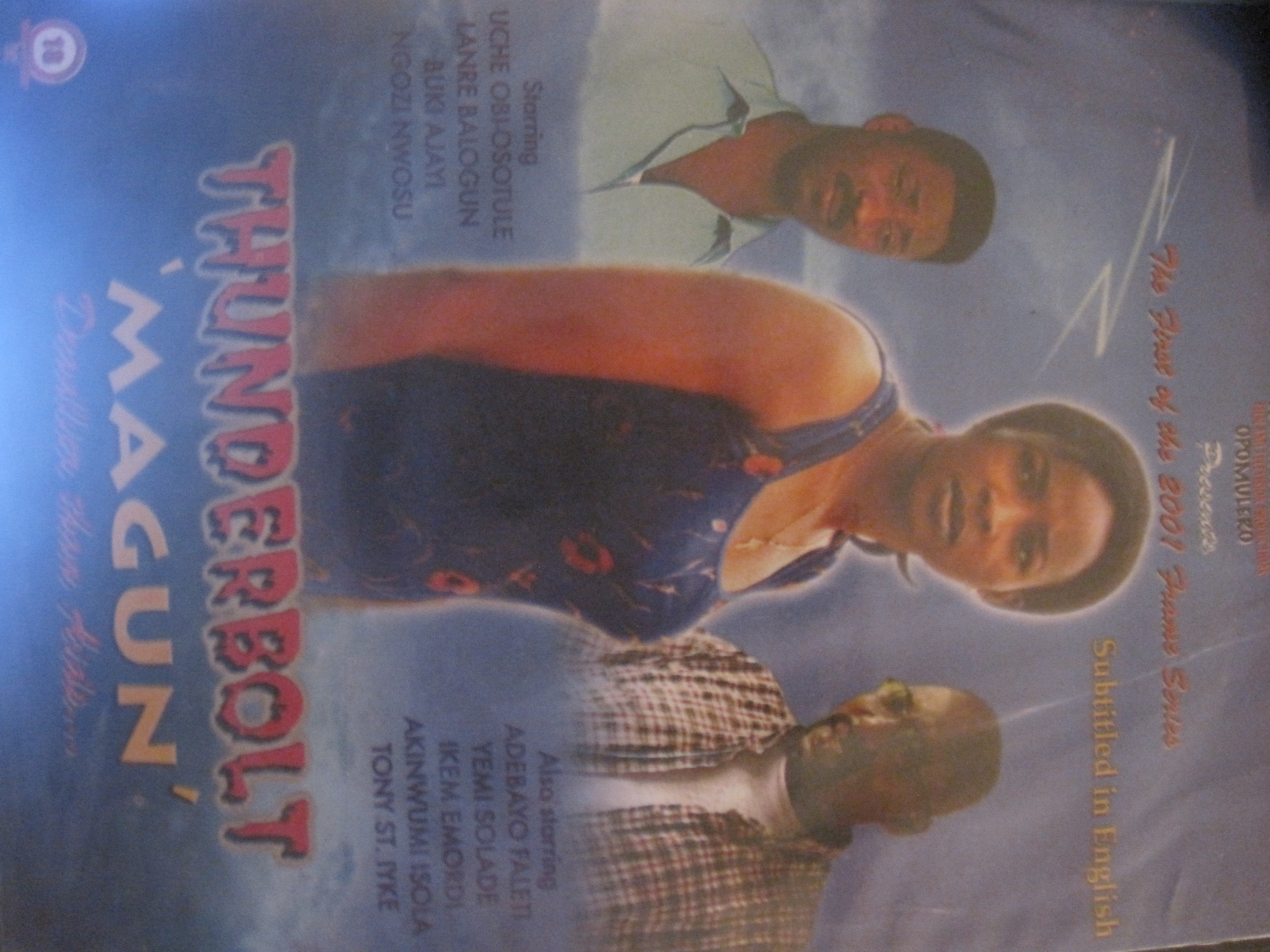
 This is the subject of a class movie that we just saw to the end on Monday. The 2001 movie is titled THUNDERBOLT (Magun) and is an adaptation of a story by Yoruba writer Adebayo Faleti, and directed by multi award-winning director Tunde Kelani. Magun (literally meaning “don’t climb”) is an old and notorious myth in the Yoruba culture, and it has been credited for all the strange or spooky things that have happened to people engaged in illicit affairs. The scientific verification of the curse is impossible since no one has ever claimed responsibility for its activation, nor narrated experiences of its infection. The men concubines are supposed to die immediately afterwards, and the woman shamed. Thus so far, it exists purely at the level of myths, literature, movies and academic papers. The movie is instructive in the way it brings the western culture into a spectacular clash with the local traditional medicine, and superstition, and how the love triangle of death, intrigue and betrayal was resolved in the end.
We saw this movie last semester in class, and the students loved it. This semester, they did too, but there was at least one objection to the way adultery was portrayed as the solution to the death triangle. “I just don’t believe that it is right,” the student said, having walked out of the class at the last scene where a medical doctor who didn’t believe in “such crap” had volunteered himself as the guinea pig to test the veracity of the myth and thus get a chance to write an academic paper about its demystification. “It is a marriage for God’s sake,” she said, not really in these exact words “and marriage is a sacred institution. To allow such portrayal of adultery as a solution to something that is purely mythical is barbaric and ridiculous.” And for a moment, it seemed that the fiction on the screen had taken a life of its own out in the real world of the classroom. What she didn’t see in the last moments of the movie as she walked out in protest was how the guinea pig medical doctor who had put the myth to test had come face-to-face with immediate death thus adding veracity to the myth, at least for the benefit of the story. Much of the conflict in the movie however was about that clash of civilization and tradition, and the extent of human tolerance, love, respect and curiosity.
I had brought it along from Nigeria because it was one of the my favourite Nigerian Yoruba movies, because of its drama, and because of the way it explores a cultural myth and its interaction with a modernizing world. I recommend it for watching for everyone, and not just because one of my (now late) Professors was one of the main characters, but because it raises valid questions of what is to be done when one is suddenly confronted with the a life-threatening, time-bound discovery that the world is not all good and kind.
PS: Said student is the only married student in the class, which could make it easier – or not – to understand her objection. That said, I’m glad that the movie provoked such a discussion. Theatre/Fiction tends to do just that.