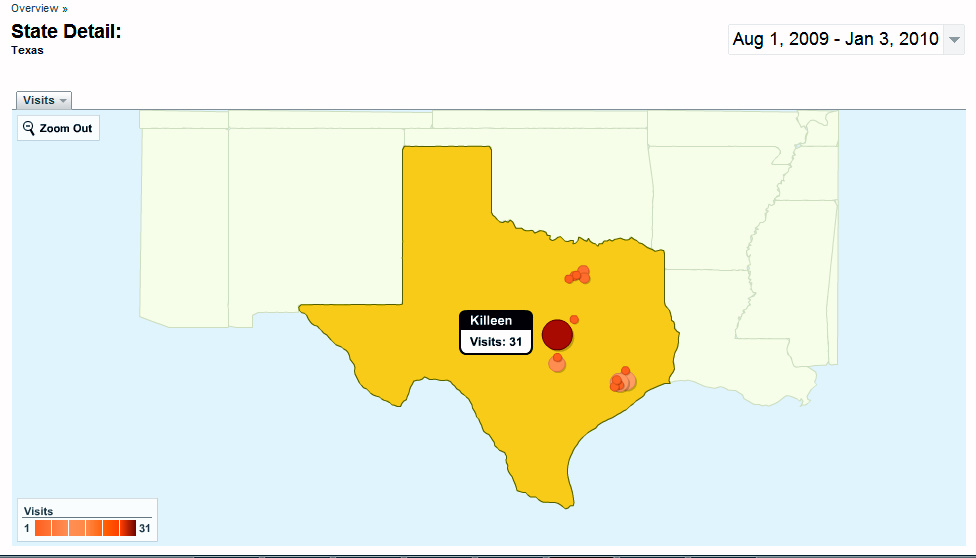
 There are many places that I may never get to visit on this one trip to the US because of schedule, finances and the constraints of time, as much as I would have loved. One of them is the state of Texas, which has however shown on my Google Analytics map as a place where not a few people have been reading this blog. So if my feet won’t get to the State of Texas, at least my words have reached there ahead of me. This post is dedicated to the readers in that state. My regards to Former Presidents George H. W. Bush, and George W. Bush. And to Governor Jeb who might one day become the nation’s President as well. Okay, I know that Governor Jeb lives in Florida, but that’s beside the point. (Click on the map to enlarge)
Browsing ktravula – a travelogue! blog archives for January, 2010.
What do the word “simian” and the name “Simeon” have in common, aside from a similar pronunciation? You guessed it – nothing at all, unless Simeon lives in the cage in a zoo or on a display plinth in a museum of extinct apes. If I were named Simeon, I would be very sad indeed if anyone were to laugh out loud every time they mentioned my name, especially if the person is a native speaker of English.
I remember my Kenya days, reclining under the mango trees on the grass lawns around the Margaret Thatcher Library on the campus of Moi University, Eldoret, discussing words and languages. All of us were guys, men, so the topic inevitably led to the risqué. All I wanted really was a chance to gather knowledge about the Kiswahili language to add to my vocabulary, and until then, everything was going smoothly. I would come out in the morning, lay on the grass while my informant, Ng’ash, a photographer (whose name also rhymed with nyash) did his work and dealt with my endless list of questions at the same time. After going through a list of over four hundred words in Kiswahili with him and his other equally fascinating and mischievous co-photographers in that spot of the campus, I found that ngozi meant “skin”, pole pole meant the same as pele pele (go gently), kiboko meant “buffalo” whose skin is used to make what we called koboko (the whip), Mungu meant “God” and jana meant the same as àná (Yoruba for “yesterday”), among many other amazing similarities. I also found out that kuma meant “vagina”, and that moto meant “hot”. The joke Ng’ash liked to make was that the first time a Kenyan found himself in Japan, he could not get his mind off the fact that the institution he was enrolled in was called the Kumamoto University. Kuma in Japanese is a popular name for children, meaning “bear”.
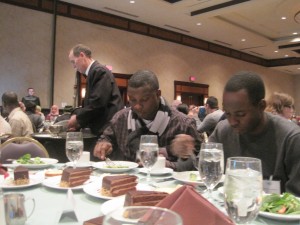
And so in Washington DC in December, I found myself on a dinner table with half a dozen Tanzanians who dared me to prove to them how much of Swahili I spoke. I did, starting with the everyday ordinary words. But they kept egging me on and I told them that I had actually learnt the private words first while I was in Kenya, and that I still remembered them even though I found a dinner table the least appropriate place to discuss such things. They would have none of it so I said, “I know that mbooro is for penis. Do you believe me now? I know that one for females but the point is proven, no?” The boys looked surprised, and the girls kept giggling mischievously, now resolved not to let me off until I gave voice to their body parts as well. It was an embarrassing almost awkward moment. But I did, and then shared the joke about the Japanese University. What else I found out afterwards was how easier to mention the word for privates in another person’s language. When asked to tell them what they were in my language, I could only tell them the word for penis. For vagina, I referred them to the Nigerian women in the hall, and as I correctly guessed, none of them took up the challenge to ask.
What I also learnt at the table was that the Nigerian name “Uche” in Tanzanian Swahili also meant the same as kuma, and that every time they heard the Nigerian name while watching a soccer game, they were giggling aloud not for the style of his dribble or the grace of his feet. Since I found out in Kenya in 2005 that Titi means breasts (as in matiti in Swahili), and “titties” in American English, I’ve always wondered what my name means in all the languages of the world if there was a way I could go on and find out. In American English, it means “a dark carbonated drink with a secret formula bottled in cans and bottles.” Not bad. What does it mean in Chinese, Malay, Emai, Nepali, Farsi, Akan, Ikaan, Uwu or Arabic? Maybe I should ask Reham about the Arabic part. I hope the meaning would not be too x-rated for her to tell me. I also remember one of my class sessions last semester when we were discussing colours. I had written the Yoruba ways of expressing colour on the board, and it included pupa for “red”, bulu for “blue”, funfun for “white” and dudu for “black” among many others. By the end of the class, I was told by the students why of all the colours we learnt that day, they would most likely remember dudu for a longer time to come. In American English (slangs), the word doo-doo refers to excreta, they said. Talking with my Swahili friend recently about these, she told me that dudu in Swahili also means “a large insect”, in addition to being the word now used to refer to the HIV/AIDS virus. Very nice. So now, although eniyan means “person” in Yoruba, all of a sudden, I am never going to refer to myself as an eniyan dudu ever again! Not in America, and definitely not in Kenya.
 I was not too surprised when I checked out the Facebook group created to denounce the Nigerian Terrorist today and found that from a meagre 700 members on Friday when I first blogged about it, there are now over 56,o00 members on the group. This is very nice, right?. Very impressive. It shows that we care about the implication of this unscrupulous scandal, or at least about our public image. It is not surprising. We are a patriotic people when something has to do with our image, most of the time. Right? Today on the BBC Focus on Africa, Mr Henry Omoregie, the creator of the group was interviewed for his perspective on the matter. In a matter of days, he has become the voice of “concerned Nigerians” eager to distance themselves from one unthinking act of an idiot. While speaking with my American friend, Chris, a few days after the incident, he told me how impressed he was by the Nigerian reaction. Few days after 9/11, he told me, there were televised celebrations of the event in some parts of Pakistan. Young men went to the streets jubilating that America was being attacked, he says. But in Nigeria, people are rising up to condemn the fool. It shows responsibility, or at least a form of liberality and freedom that is rare in other countries with a multi-religious population, he concludes, and I agree. That was until I heard in a line of comment on the same Facebook group that another Facebook group has been created titled “Free Umar Abdulmutallab. He is not a terrorist!”. I have not been able to find the group page so I am keeping my fingers crossed. But I won’t be surprised if such group now already exists. It’s still a matter of freedom of speech, I guess.
So now that Umar Abdulmutallab has got his fair share of vile from all “concerned Nigerians”, let us return to face the hard truths of the matter. We are not a nation of terrorists, but we have our own mammoth of problems which include poverty, drug trafficking, bad governments, militia unrest and financial crime, which are neither better than terrorism nor good for our global image as well. There are lots of things to do with my time now that the University’s resumption date is still over a week away, and the cold weather has confined the traveller to his now king-sized bed in a cozy Cougar Village apartment so I am discovering humour and satire, both as instruments of social transformation as well as personal coping device against inevitable idleness. Over the past couple of days, I have come up with a theme which would no doubt make some folks wince over there around the Niger river. But they are not just jokes. They are nuggets that should force a re-examination of the current state of the Nigerian polity. Feel free to copy them if you dare, design them with Corel Draw and appropriate caricatures, paste them on your car or shirts, and share them with your Nigerian friends on Facebook. Include, if it makes you feel better, the texts: “KTravula.com’s Politically Incorrect” or “KTravula.com’s Terror Humour“. This is for Nigeria.
After all, self-examination is really the best first cure for most anomalies.
Bumper Stickers You Will Never See
- “I’m Nigerian, not a terrorist. I don’t kill people that’re not from another part of my country.”
- “I‘m a Nigerian. I kidnap foreigners, but I don’t blow them up. That’s not my style!”
- “I’m a Nigerian. I’m a 419 Internet Scam artist, not a terrorist. Don’t spoil my image!”
- “I’m a Nigerian. I destroy oil pipelines, not airplanes.”
- “I’m a Nigerian. Whenever we blow ourselves, we are actually coming, not going.”
- “I’m a Nigerian. I smuggle cocaine, heroine and weed in my pants. Not explosives!”
- “I’m a Nigerian. I would kill and die for political positions, not for martyrdom.”
- “I’m a Nigerian. I murder for tribe, and not for cause. I can never make a good terrorist!”
- “I’m a Nigerian. The only virgins I want are the ones I can marry, or make into mistresses.”
- “I’m a Nigerian. I get my virgins before they head out to Italy. They’re not in Yemen, or Heaven.”
- “I’m a Nigerian. The only cause I support is the one that fills my tummy, not blow off my junk!”
- “I can never blow myself (up) to save my life. I’m a Nigerian, and not a terrorist!”
There could be many more ways to make them more sarcastic, and if possible, more biting. The more acerbic, the better. Talk about subversive self-humour! I would recommend this beyond the usual cry for the head of Abdulmutallab which by now should be nearing its climax. When all is said and done, it is who we are that would matter as we return to our routine lives in the course of the coming weeks and months. What will stand the test of time? Do we move forward in some way or do we return to the inner inequalities and lesser evils that make this particular case just a case of the first among equals of evil?
NOTE: This post is meant to be throughly politically incorrect, so I would not be expecting nor accepting any pats on the back this time.
Away from the first two depressing posts of this year, here’s really how this decade will begin on ktravula.com: fun.
Hat tip to Bukola O, a regular commenter on this blog from Aberdeen, Scotland, who sent me this lovely song, along with a mail of appreciation, and who called me her favourite blogger of 2009. What can I say? It has been good for me as well. Thank you so very much.
I have downloaded the song from iTunes and is now on constant replay on my laptop.
I wrote this poem last January for Susanne Wenger when news broke that she had passed, and sent it to a couple of friends.
LIKE CHALK IN THE RIVER
For Susanne, Olorisha!
They said it rained when Susanne was buried.
It poured.
They spoke of a rumble of the heavens
as the orisa osun swam back, again, to her pristine source.
They talked of art.
They spoke of beauty.
They mentioned hands
That sculpted spirits.
But now when the forests have stopped dancing with the rain,
See the wind escape from that storied grove.
Look, amid the hallowed haze,
at a turning twirl of her spirit gaze.
Gone is the eye that looked out for the standing stems
When greed called for arms, and men scorned sense, and all she wove.
Today, the Spirit it was that left, again,
To return. To return: a time-bound god, or else a traveling dove.
NOTE: Susanne Wenger was the Austrian artist who lived most of her life in Osogbo Nigeria as a priestess of the river Osun. Born in Austria and was married to the artist Ulli Beier who brought her to Nigeria in the 60s. She died last January at the age of