Browsing ktravula – a travelogue! blog archives for January, 2010.

Earthquake in Haiti

Here’s a link for those who can afford any kind of monetary donation to help the people of Haiti deal with their devastating earthquake that has left hundreds homeless and many dead. The website and the donation/relief effort is hosted by Planusa.org.

https://www.planusa.org/contentmgr/showdetails.php/id/1189150/tp/VE1HUj0xLHRpZD0xMTg5MTYyLA%3D%3D

It may be the sign of the end of times, but it doesn’t have to be the end for those now helpless folks. They need our help.

We’re No Longer At Ease

Here is the text of an open letter released by Nigerian Writers in reaction to the current political situation in Nigeria. Over thirty writers have currently signed up to the letter which has this morning been released to the media. It calls on concerned Nigerians to add their signature, and support, in a comment box beneath. You can also listen to and download an audio version by clicking on this link: audio. I support this because I think it represent some of the best aspirations of all Nigerians in pursuit of happiness, good health, success, and aspiration for country worthy of its name and one that lives up to its potentials. I like the introductory paragraph, especially.

An Open Letter from Nigerian Writers

Nigeria’s failure to make the progress commensurate with 50 years of nation-building is not just a failure of leadership. It is first and most catastrophically, a failure of followership.

As ordinary Nigerians, we have failed to create an environment where good leadership can thrive. By glamorising fraud and ineptitude, we have created a country hostile to probity. Our expectation from Government House is mediocrity, so that good government surprises us pleasantly and excellence continues to amaze us. Instead of an environment of accountability, we have fostered sycophancy. We have been content to follow every stripe of leader, from the thief to the buffoon. The consequence is that for months we have been happy to be ruled even in absentia.

Today, we say, no more.

Protest is not a dirty word. Even babies have a voice, long before they learn language or discernment. The child that is too docile to cry when it hungers or ails might die in the hands of the most benevolent mother. A leadership, however benevolent, requires an intelligent, demanding, and courageous followership to excel.

It is the responsibility of every Nigerian to voice the legitimate expectations of nation and to establish the standards to which our leaders must be held. We must expect great things from this country, so we must look for the leaders who can deliver. There is an acceptable standard of leadership, and then there is an unacceptable standard. We must honour leaders who excel, and censure leaders – at every level, and in every arm of government – who betray our trust.

If failure is not censured, there is no incentive in pursuing excellence. If sacrificial leadership is not recognised, then leaders of merit will not come forward, and the heroes in our cenotaphs will be the very architects of our failure as a nation. Although we are justly famous for our generosity of spirit, for our ability to forgive and forget the gravest transgressions, Nigerians must also now boldly condemn the errors of leadership, and end the complacency that has brought us so low as a country. The only reason for the existence of political leaders is to offer service to nation. Leadership is not an end in itself. It is a privilege to serve your country; leadership is not a right to be served by your country.

Today, Nigeria stands on a precipice. Behind us is a history that can push us, irrevocably, over the brink. Yet, we are writers. If we bring anything collectively to society, it must be the imagination and the inspiration to bridge impossible gulfs. Today, we must plumb our history, not to evoke despair, but to inspire resolve. Today, we call on Nigerians to hold hands across the trenches of our deep divisions and, somehow, find the resolution to dream again. Let us, as ordinary Nigerians, reject the ethnic fictions that local despots have used to colonise this country over the past five decades.

Let us dream a simple dream made fantastic by our present circumstances. Let us dream of a Nigeria that works, that evokes pride, and that inspires faith. Let us dream of a Nigeria of servant-leaders and sacrificial statesmen, a Nigeria which calls the best characteristics out of ordinary men and women. Let us call on that capacity for renewal to bring opportunity out of this crisis.

Let us recreate the excitement – and the possibilities – with which we approached the Independence Day of 1960. In 50 years, the resources and destiny of this great country have been hijacked by private carpetbaggers and adventurers. Let us take back the sanctity of our polls. Let us rejuvenate the recall process. Let us police our resources, our leadership. We must liberate Nigeria anew. Today, we must take back our country.

As writers, the past and the future are fertile fields for the work of our imagination. Today, in this love-letter to our nation, we call on all Nigerians to take authorship of our nation’s next 50 years. Our destiny is in our own hands. Shall we write into it a bigger civil war? Another half-century of mediocrity and international disgrace? Then we need do nothing.

But if we, the people of Nigeria, must write an inspirational epic of a humbled nation on her knees, who, breaking free of bondage, soars into the keep of eagles, we must begin by demanding only the best of our leaders. In the days and months to come, we the people must find our voice, our votes, and our true values. And we must make them count.

Thank you.

(Culled from African-writing.com)
A Review

I love this review of the book A Mouth Sweeter Than Salt by Toyin Falola. It was done by Nigerian writer Ikhide Ikheloa in 2008. By the the time I was writing my mini review of that book last year on this blog, I had no idea that some other person had written something longer, deeper, more expressive of my earlier perception of the work.

Like last semester, we shall be reading the book again this semester for the foreign language and culture class. It is a fascinating account of a man’s childhood in the Nigeria of the 50s, 60s and 70s. Get and read the book if you can, and take a very wild ride in the serene happy days of my country’s early nationhood.

At the end of last semester, I asked all my class students to write a two-paged review of their experience in my class. The following is an excerpt from the submission one of them.

“The one thing that I did not like about the class was the book, “A Mouth Sweeter Than Salt.”  I know you did not pick it out, but it was the worst book I have read in a very long time.  If you could, I would get a different novel for your class to read next semester because every chapter I read felt like pulling teeth.  Well it was not quite that bad, but it was not enjoyable.  Besides the book though everything else was very enjoyable.  I cannot remember a class more enjoyable than this one, or a class that I laughed so much in.

Overall I could not have been more satisfied with the class.  The material that I learned helped me grow as a person and made me see a part of the world how it should be looked at, and not just from a “single story.”  My perception of the Yoruba and Africans in general was corrected.  After going through the semester I could not have been happier in my choice to take this class.  It is a great feeling knowing that I can communicate in Yoruba, even if it is at a rudimentary level.  The class was more than fair in difficulty and work required.  When looking back at the first day of class I realize that I never had anything to worry about and the man who walked in with the traditional attire on was a lot like me.  Although I may have not changed the place where I sit in the class, almost all of my views of the African culture have been altered throughout the semester.  I am thankful that I chose to take this class because it has made me a better person as a whole and have come to greater appreciate people of different cultures.”

Needless to say, he was the only one of nine people who felt sufficiently annoyed by the book to write about it in a final essay. Others passed their displeasure to me outside the class about the often winding and distracted writing style of the author. Nevertheless, it’s a great book. I recommend it.

Word of Wisdom

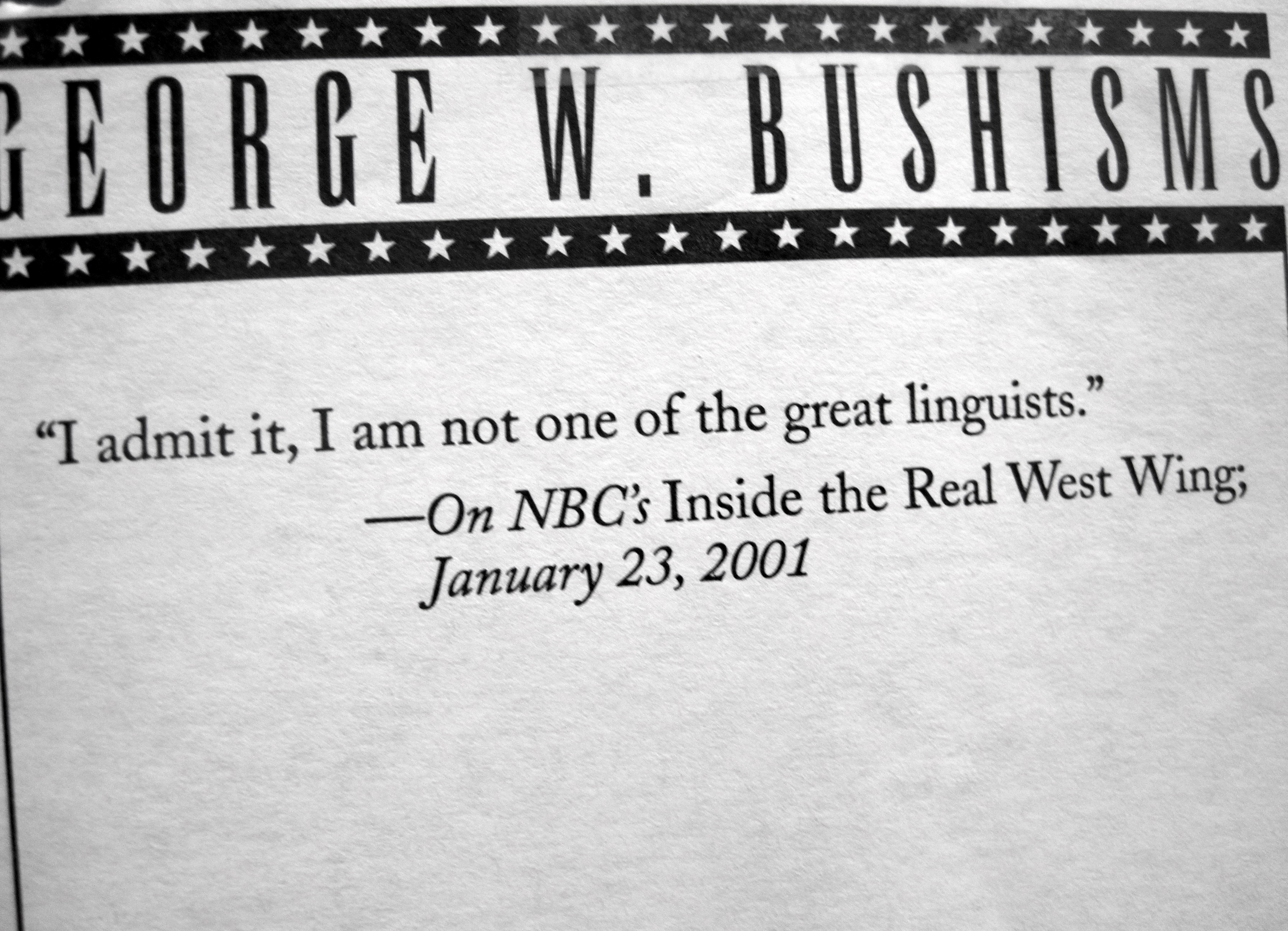
“I admit it, I’m not one of the great linguists,” he said.

Yea right?

I found this on the office door of my Linguistics professor.

Just Like Old Times

“There are three major reasons why I wear this cap wherever I go, around the University, and when I come to class as I will from now on. I’m about to tell you.”

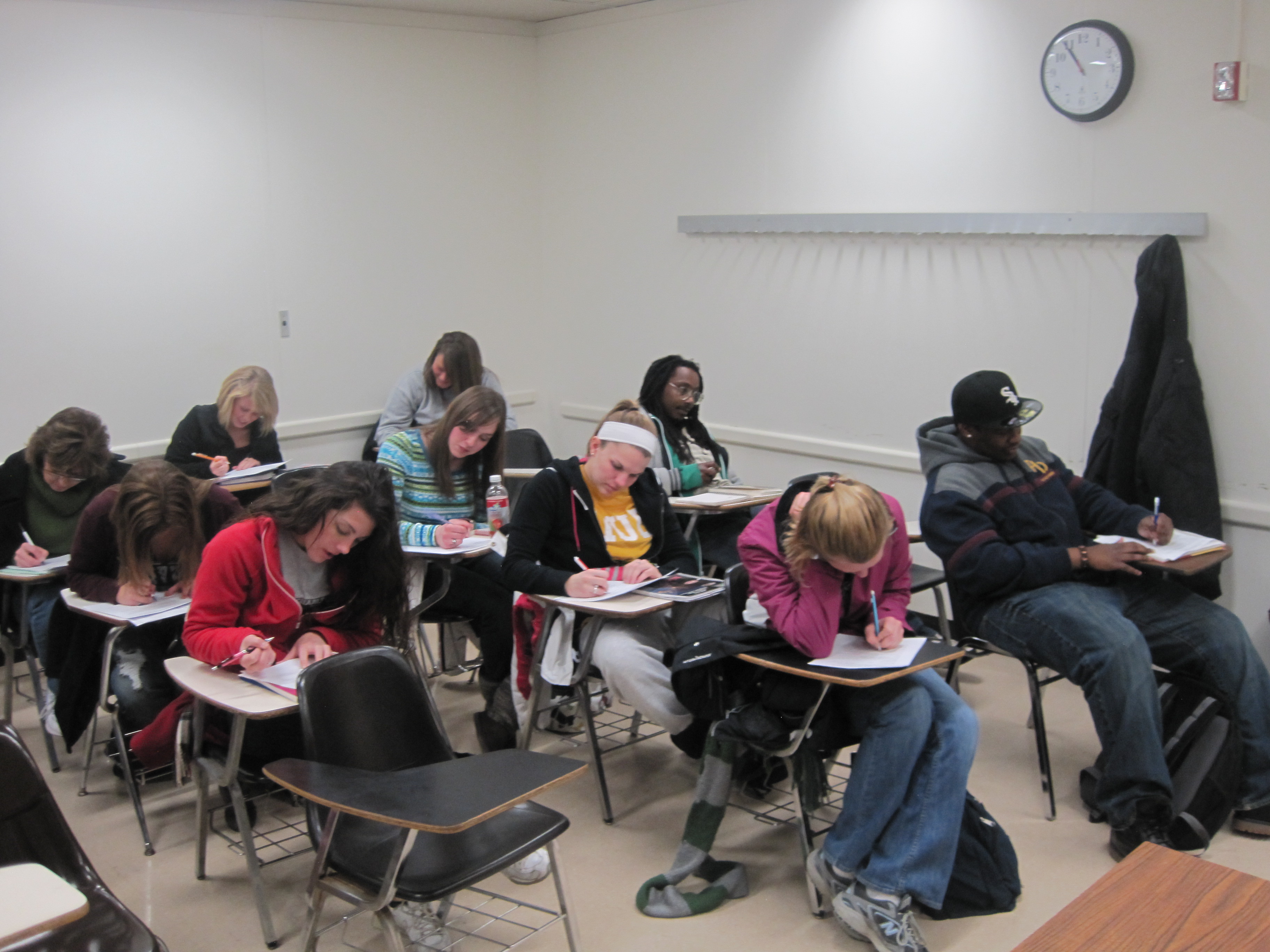
That was one of the first things I said to them them, a few seconds after I walked in to the full class where a horde of quiet, curious looking faces of attentive students stared back at me, none of who knew what exactly the class was going to be like. It was just like old times. They gave me rapt attention, they smiled when they had to, they had random looks of wonder and intrigue. But they probably had never seen anyone wearing this kind of cap before. It’s African, made of the finest aso oke, from Nigeria, West Africa. The class was full. I had prepared only seventeen copies of the syllabus, hoping that there would be at least fifteen students in class, and I’d have a few to spare. There were nineteen of them. No kidding! The twentieth student signed up a few hours later. This is a long shot from my previous nine students of the Fall semester! I took in the sight of them, fidgeted for a few seconds, and found a way into an introductory talk that was meant to put them at ease while providing an insight in the content of the course, and what it would take to pass, and to enjoy.

“The first reason why I wear this cap is that it is cultural. Yoruba people like to complement their dressing with a matching cap.”

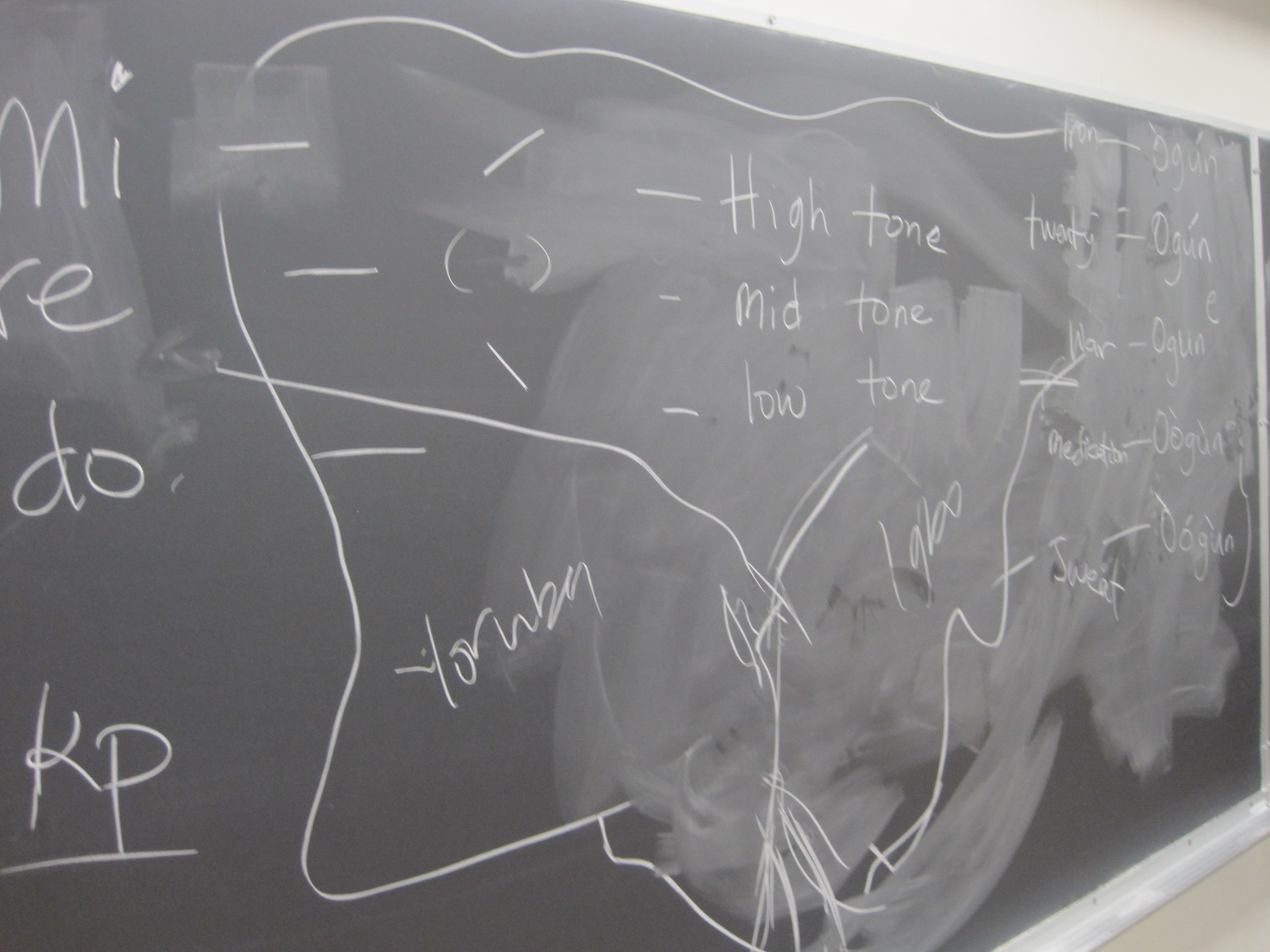
Before I told them where I’m from, I first asked them to take a guess, and none got it right. So, I wrote it out on the board, and I heard a gasp, and random giggles. “Yes,” I said, “By now, all of you are familiar with the name of this country since Christmas day, right?” They all agreed. “Well, what you probably didn’t know,” I continued, “Is that we have over 250 ethnic groups, and over 500 languages. You also didn’t know, perhaps, that Yoruba – the language you would be learning for the rest of this semester – is spoken by over/about thirty million people both in Africa and all around the world. We have also produced a Nobel laureate in literature.”

“The second reason – as you can guess – is that it’s winter, and I don’t want to kill myself by exposing my head to the harsh cold weather”

They laughed at this one. It was the first victory. “It’s true,” I continued, “I’ve never lived in any place colder than 20 degrees Celcius before. It’s a wonder that I’m still alive now in a temperature of sometimes minus twenty.” That seemed to shock and surprise a few of them, and I continued. “Has anyone of you heard of a singer called Sade Adu? What about the musician called Seal? Oh, you have? Good. Does anyone know who Hakeem Olajuwon is? He played for the Chicago Bulls, I think. Oh yea, many of you do? Nice. What about Adewale Akinnuoye-Agbaje, that very dark-skinned man that played an Egyptian mercenary in The Mummy Returns and a French Legionnaire in the movie Legionnaire? He was also in the first seasons of Lost, I think.” I counted them and smiled. “Well, great,” I said “one thing they all have in common is that they are Yoruba, originally from Nigeria. Are you excited already? In this class, we shall learn everything we can about the Yoruba people, their culture, way of life, and language. And the first step in that knowledge is that we all must have Yoruba names. Yes, indeed. I’ve told you mine, and you’ve told me your American names. Now, you have to go and look for Yoruba names, their meanings, and why you want to bear them. Go online, ask friends, read books, but by Wednesday, we will all begin the necessary steps to become Yoruba citizens. Who’s excited already? Great!”

“Well, the third reason is that I sometimes forget where I left my comb in the room when I wake up in the morning…”

And so it begins, just like old times!