This is how the story goes: Every human being on the planet is closer to any other person in any other part of the world by just 6 degrees, or six human beings. According to Wikipedia, ‘it refers to the idea that, if a person is one step away from each person they know and two steps away from each person who is known by one of the people they know, then everyone is at most six steps away from any other person on Earth. It was popularized by a play written by John Guare.”
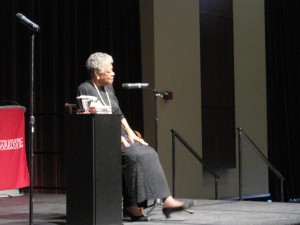 In the begining, there was just me, going to a University in Ibadan, Nigeria. I had gone through all my primary and secondary education in this same city, so it was just as well that I never knew – nor would have given any thought to – the reality, fact or fiction of the phenomenon of “six degrees of separation.” There was no way in the world that a little boy from that ancient town could relate to the likes of Martin Luther King Jnr, Roberta Flack, Bill Clinton, Oprah Winfrey, Coretta Scott King or Toni Morrison, even if by chance I knew a few of their names back then. The first American I could say I warmed up to was James Hardley Chase, and I didn’t know if we’d have gone along well if the chance ever presented itself for us to meet. Then there was Denise Robbins, whose many novels I read before I completed secondary school. The likes of Mark Twain, and Alex Haley came much much later, as did Toni Morrison, Eugene Redmond and Maya Angelou. I remember seeing Maya the first time while browsing through the now rested Microsoft Encarta Africana CD of 2002, and watching her read her poem, “Still I rise.” I was enchanted immediately, and while reading more about her, I realized that it was impossible not to be, considering how much of stories her life embodies. She was born in St. Louis, grew up in Southern California and Arkansas, then moved over to Ghana with her African Revolutionary husband whom she had met in the United States during the anti-colonial movement of the fifties. She returned to the States after her first son to the African, became a dancer, writer, teacher, public speaker, novelist, poet, film director and movie producer and later Inaugural Poet, the first African-American so honoured to recite for the in-coming president. She read her poem On the Pulse of Morning for the Bill Clinton in 1993.
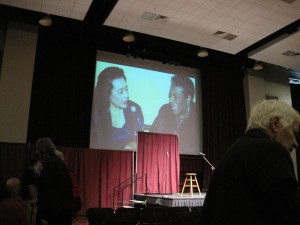 Now here I am in Illinois, less than ten years after that memorable introduction, now meeting the icon face to face in a campus auditorium. Looking at a slide show of pictures taken from the Eugene Redmond collection of photos of Maya Angelou on the big screen, I see a shot of her once with Coretta Scott King, the widow of the slain Civil Rights Activist, then another with Toni Morrison, then Oprah Winfrey, Eugene Redmond, Amiri Baraka and very many other famous names in African-American culture, and I remembered the rule of separation. If only because of this enchanting day, this time and this moment of fate, I can say that I may have finally connected my last branch of life’s six degrees, joining imaginary hands with all of the rest of the world, with everyone just six persons – or less – distant from me, no matter where they are. Oh how I like the sound of that!

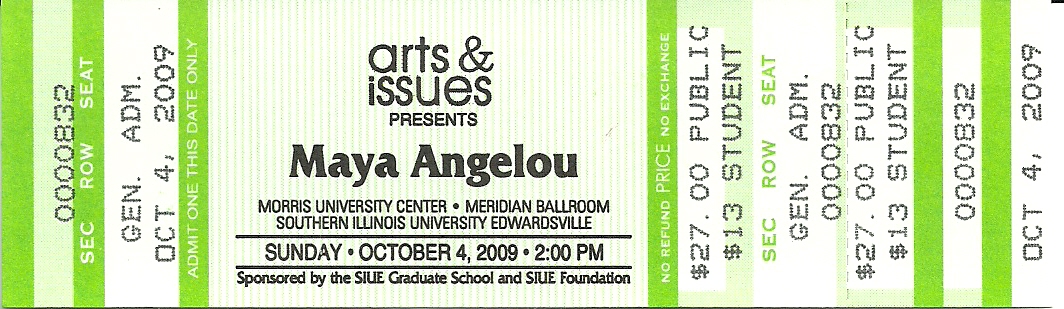 I have now returned from Dunham Hall, where I had gone to obtain my tickets to the programme, and where I discovered to my amazement that all the tickets have sold out. Completely. The organisers have just made arrangements for a hundred more seats, and I was lucky to get two of those. My hosts at the Office of International Programmes who had promised to get me tickets into the show are now nowhere to be found. If they ever come forward with any more tickets, then maybe I can afford to take someone else along to the show. But a most unfavourable part of this visit of the American Poet Laureate is the news that she might not be staying long after her talk to sign books or take pictures after all. Now this, if true, is just horrible, but I understand. She’s probably too old for all that stress of sitting though signings and photographs. But being young and tenacious, I’m probably too heady as well to let her go without a fight. Come, come Sunday!
 ALONE
ALONE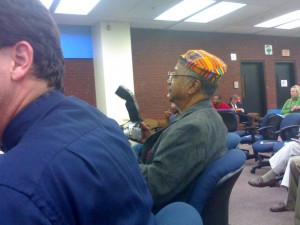 I stumbled onto a photo exhibition on campus on Wednesday, after a very stressful day of two classes. If not for a chance meeting with retired Professor Eugene B. Redmond as I headed home from Pizza hut, I definitely would have missed out. I had first met EBR last in Ibadan in 2003 or so when he visited the University campus there on an exchange programme, and to present new editions of DrumVoices Revue – a quarterly publication of poems from all over the world. I was with him and another professor from Ibadan when he visited the palace of the Ooni in Ife – which was the first time for me at the time. I have not been successful in getting him to grant me access to my digital copies of those photographs. Maybe they will end up in an exhibition someday. It will definitely be a pleasure to see them for the first time in over five years.
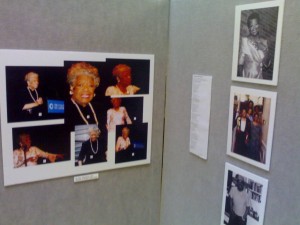 The exhibition was titled “Eighty Moods of Maya”, and it features eighty of the pictures taken of the poet and novelist Maya Angelou over several decades, and in many moods, some serious, some trivial, some private and relaxed, and some public and tense. Eugene Redmond has worked as a poet, journalist and photographer as well as a critic, academic and publisher. He first attended SIUE as a student. He was a student journalist with a camera at the 1963 March on Washington as an editor of The Alestle, a student publication here on campus. He has also taught many times at SIUE before he retired a few years ago. On retirement, he donated a collection of his photographs to the SIUE Library, and thus became a patron of the institution.