ktravula – a travelogue!

reflections on the world

Browsing ktravula – a travelogue! blog archives for March, 2011.

Seeking Writers

Hey dear blog readers, I am seeking short fiction from Nigeria (or around the world) written originally in Yoruba for a short project. Do you know anyone (contemporary or otherwise), upcoming or established, who write/wrote short stories in Yoruba? Do they still write? Are their works accessible online? Where can I find it? Where can I find them?

If the only person(s) you know write only novels and not short fiction, please send me their contact as well, as long as they write in Yoruba. Thank you.

VN:F [1.9.17_1161]
Rating: 0.0/10 (0 votes cast)
VN:F [1.9.17_1161]
Rating: 0 (from 0 votes)
Share

Here’s (to) The Future

“Unconfirmed reports that forces loyal to Cameron are attacking rebels in Trafalgar square.” – As seen on twitter (@ssafac)

Watching and reading daily news, I am wondering if this is the future we have all been preparing for. (No, not you already above thirty-five, please :) ). First Tunisia, then Algeria, and then Egypt, and Bahrain, and Libya. And Nigeria. And Wisconsin. And now London. Young people all over the world are standing up to define what their generation is going to look like. There is a pleasant bubbling feeling in my gut that goes with thinking about it all. I bet it must feel like this during the Industrial Revolution too.

There are snags though, for me: the still unclear role of the American might in Libya, the Saudi role in suppressing the Bahrain uprising, the silent “educated” population of Zimbabwe still dithering under Mugabe, Lauren Gbagbo’s iron fist over Ivory Coast, Moammar Gadaffi’s very elaborate family connection all over Libya, and the greed and tribalism that sometimes raises their ugly heads in my own homeland, among many others. What is promising however is the prospect of a new world, under which our children will grow, where the pursuit of happiness and the determination of our destiny would be in the hands of a new generation of well informed youths. Here is the beginning, it seems, and it is fuelled by the Information Revolution.

Forty years from now, I look forward to seeing the new kind of world we would have built by that time. In our hands, the youths of today, are the keys to that future in India, China, Mexico, Honduras, Jamaica, Korea, Japan, Haiti, Tibet, Benin, Iraq, and several other places in need of a new direction to the future out of the hands of the old, tired hands. The biggest challenge, of course, is being able to transition into a long period of stability and concrete global direction without a debilitating period of war the type that defined the post Industrial Revolution era. Maybe this Information Revolution will come with it the tools of negotiating world peace without bloodshed that the world has always seen. Again, now I’m mostly curious, yet jubilant that at least the generational hand of the clock is moving, and it is touching all corners of the globe as it must, one after the other. There’s something good about that.

VN:F [1.9.17_1161]
Rating: 10.0/10 (2 votes cast)
VN:F [1.9.17_1161]
Rating: 0 (from 0 votes)
Share

American Mean Time

Universal time used to be determined at a village of Greenwich in the United Kingdom, and everything was measured against it. I never could figure it out and I grew up wondering why Nigeria was always one hour ahead of the BBC clock. Later in the Geography class, I figured out why. It had to do with the equator or something like that. Then one day I came to America and found out that there is something called Universal Time (UTC). Again, like the old British hubris, Americans expected everything in the world to be measured in relation to that so called universality. A few weeks ago, I had scheduled a phone interview with Rosetta Stone and it was due to come at 2pm (UTC). All I saw was the 2pm, and I planned my day accordingly. I was sitting by my desk at 1pm when the phone rang. It was the representative of the company, and they were calling for the said interview. Good thing I was not still in the shower at the time. What I didn’t bother to wonder at the time was why I seem always to be one hour away from the standard or universal time.
There are other things that have changed. Yesterday I scrolled through a list of the world ranking of universities. In the 60s and 70s when the now ruling leaders and of the Nigerian society were going to school, schools in the United Kingdom and the Soviet Union among others in Europe were the leading citadels of knowledge in the world. A few people came to the United States to study. Now, according to the list, the first dozen or so universities in the world are universities located in the United States. I scrolled down for a bit before locating my own institution somewhere down on the list, and it was enough to inspire a little urge for schadenfreude at the other ones a little farther down the list. But then, it could be worse, we could be one of the British universities who used to occupy the pride of place in the top list of world class universities. Now, they are somewhere scattered on the list, sometimes even farther lower than Taiwanese, Japanese, Swiss and Swedish institutions. I will not try to hazard a guess as to why.

Chuks is a MacArthur foundation scholar from Nigeria now here in the US. He has his own ideas of why it is a better alternative to go to school in the US in today’s world, beyond the common knowledge that its universities are ranked far higher now more than before. The system of learning and studying are such that the student is built to become independent in thought and research. What is wrong with European schools? “I know of the British schools,” he’d say, “and the system is built in such a way that you get to regard the professor as some repository of knowledge – a person high up there who knows everything and who should not be challenged – rather than a colleague like you who only happens to have read more, and spent more time on the field studying the same things that are available to you if you work just a little bit harder.” Chuks has never studied in the United Kingdom.  The system in Nigeria is a mixture of both, with a slant towards the British, naturally, and unfortunately. I have been fortunate to have experienced the impatience with professors in Nigerian class who believe that just by the virtue of their age, experience or qualification, that they were beyond questioning or challenge. I have also been lucky to have met the right ones who would fix appointments with you in a bar so that you could both examine academic ideas over glasses of beer. I have met egoistic teachers who disallowed you from entering their class only because you didn’t scurry into the class when you saw them coming. I have also met those who set their evening classes under a tree just for a change of perspective. The progress in my academic development is mostly due to the inspiration and positive reinforcement of those good ones, and my rebellion against the hubris and negative reinforcement of the bad ones. At least, I survived.
Or so I think. The biggest misconception about the teaching and learning system of the American classroom today – at least from developing countries that I have some experience of – is that the presence of books and the internet makes it easy to get through. Well, it is true only to the extent of the student’s adequate balance of time and responsibilities. This takes me back to my title. American mean time refers not just to the new role of America’s very engaging, individualistic, and absolutely absorbing educational system in the world of academics. I am using it to refer to its absolute mercilessness when a student dares to take up more courses per semester than necessary. (Yes, this post is about me again). I have personally come to see the benefit of a more relaxed, yet ultimately absorbing schedule that allows the student to get all that is needed in, within a realistic time table that puts the least manner of stress on their mind. I do believe that I have become a better student of language due to the work of the past one year. And thanks to that is due to all my teachers, both the brilliant, open-minded ones, and the empty and needlessly hard-assed ones. At least I learnt something. Perseverance will get you through everything. Or almost everything. Brilliance (or modesty) plus an innate curiosity will compensate for the rest.

But maybe a few decades from now, we’d be talking about Chinese/Japanese Mean Time. Who knows?
 

VN:F [1.9.17_1161]
Rating: 0.0/10 (0 votes cast)
VN:F [1.9.17_1161]
Rating: +1 (from 1 vote)
Share

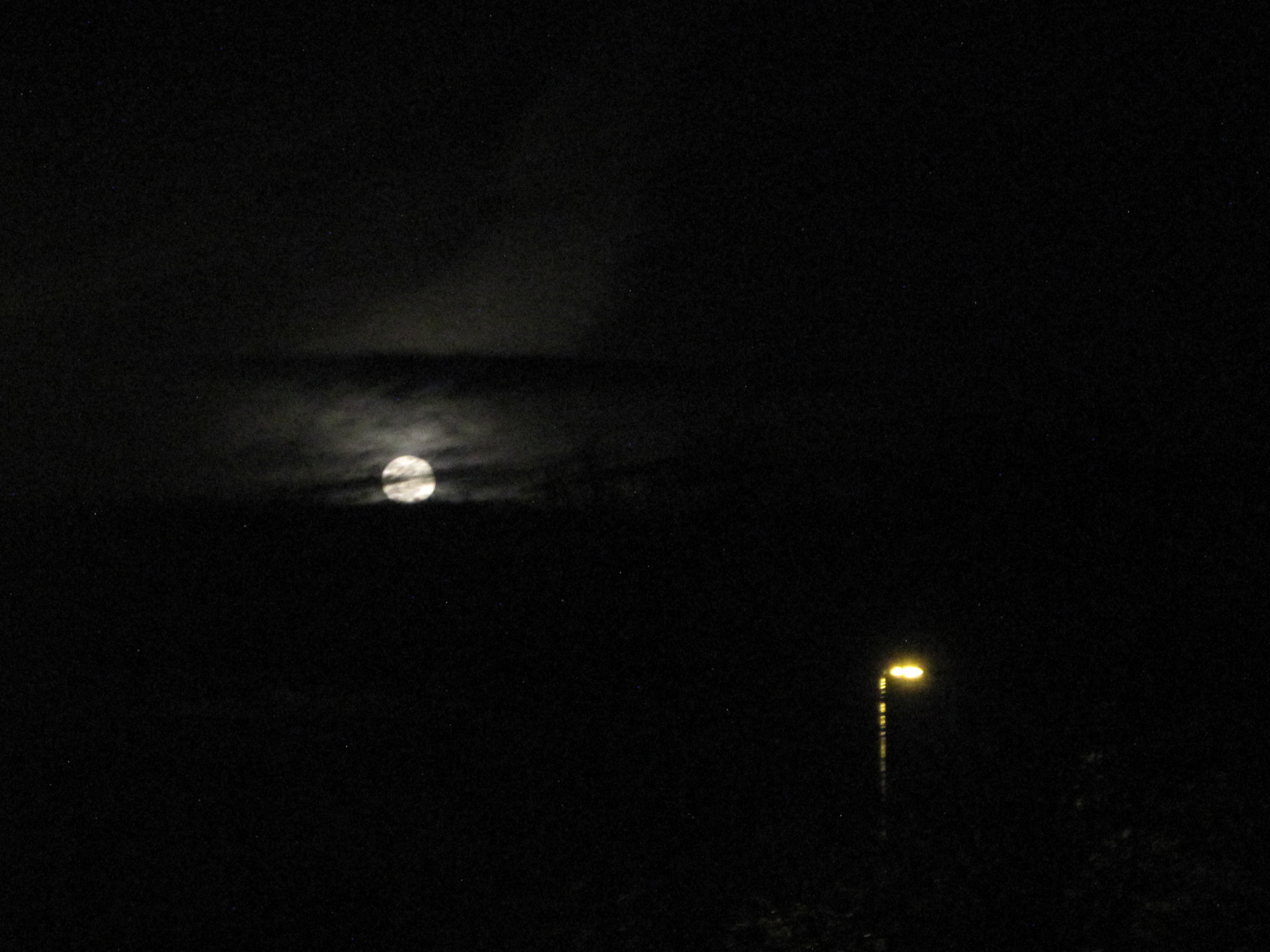
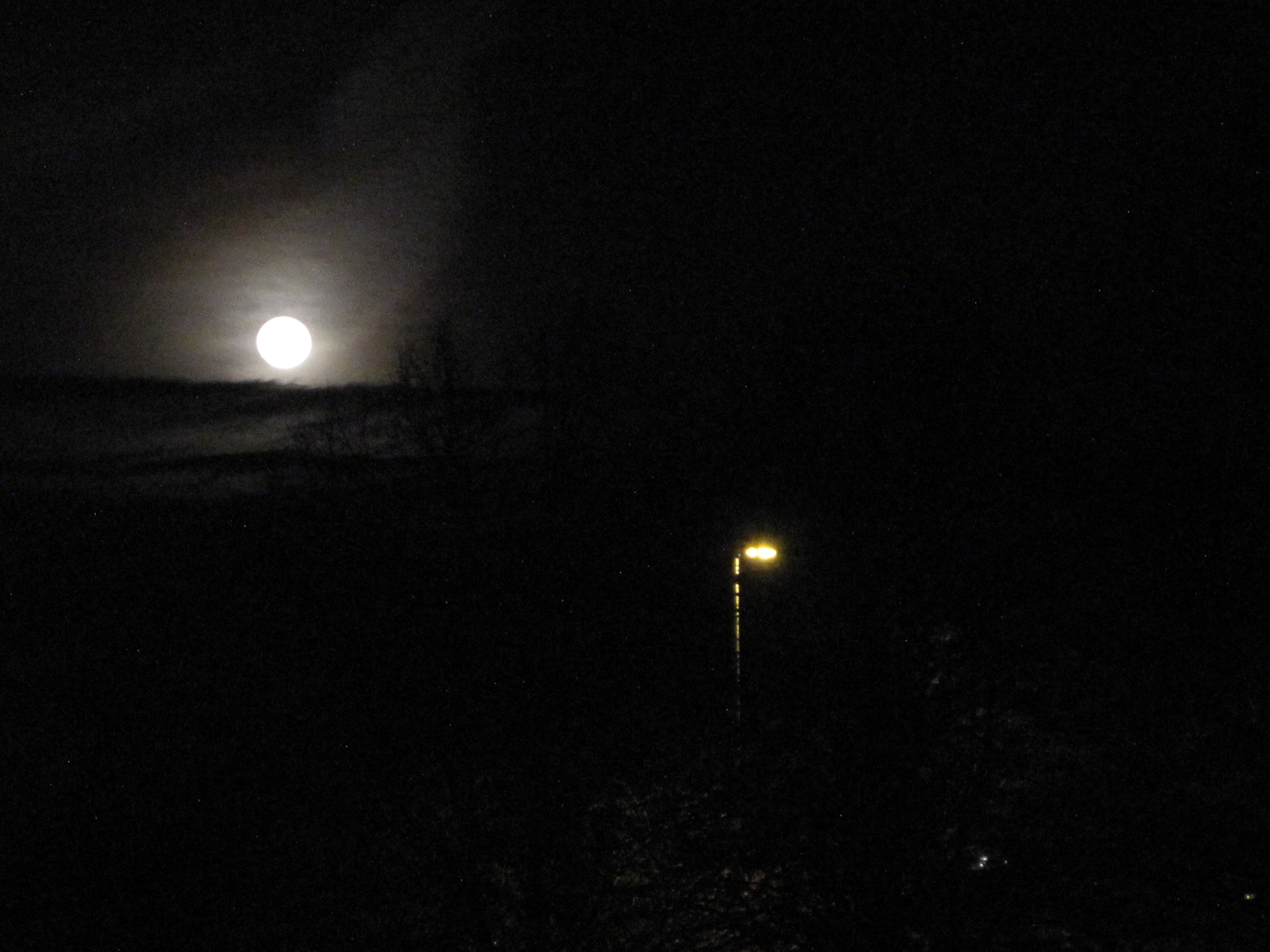
Full Moon

Two days ago, Edwardsville.

Best enjoyed with this song by Don Williams.

For my friend, the moon-gazer.

VN:F [1.9.17_1161]
Rating: 0.0/10 (0 votes cast)
VN:F [1.9.17_1161]
Rating: 0 (from 0 votes)
Share

On World Forestry Day

Kenya’s Nobel Laureate Professor Wangari Maathai’s Facebook update of a few minutes ago asked us all to plant a tree today. I live in the United States, so the message wasn’t meant for me. On the campus where I live at the moment, the gardens and things that have to do with planting are handled by a special group of volunteers who make sure that the campus remains green, and beautiful. It is the same for my University in Ibadan. The last time I visited it, I was greeted by fresh scents of breeze blowing through leaves of newly planted trees.

Were this not the case however, I still would not know how to plant trees. I do not know what a tree seedling looks like. I can recognize a few trees by name: mango, guava, iroko (barely) and teak but I have never been good at tree planting. Growing up as a child in a large compound with trees of guava, iyeye and a few others of plantain and banana littered around the house, I am appreciative of their enticing pleasures. The first time I was stung by a bee was from throwing stones at their mound seen on the iyeye tree within our compound. I spent other countless moments of childhood revelry bouncing on top of branches of the guava tree behind my mother’s bedroom. I can’t imagine what childhood would have been like without those experiences. Just thinking about them brings the feeling of cool breeze back around my head.

Plants, greenery add colour and lustre to our lives in many ways than one. On this day designated to celebrate the planting of trees and the contribution and value of forests and forestry to the community, I join those who know how, with only words alas, but also with fond memories of climbing on trees.

And oh, it’s also World Poetry Day. Now what does one have to say about that?

VN:F [1.9.17_1161]
Rating: 0.0/10 (0 votes cast)
VN:F [1.9.17_1161]
Rating: +3 (from 3 votes)
Share

Art Exhibition

It is a result of a competition of varying forms of art by students (graduate and undergrad) of this university. The winner gets a thousand dollars as price for buying the artwork off him/her by the university. Here are a few of the shortlisted artworks on display in the student university centre, yesterday.
One of the artworks has a picture of a pair of fancy women’s shoes and a bottle of perfume. The title reads “How To Kill a Man.”

VN:F [1.9.17_1161]
Rating: 10.0/10 (1 vote cast)
VN:F [1.9.17_1161]
Rating: 0 (from 0 votes)
Share

After the Cup: Post 2010 Perceptions of South Africa

A guest post by Jeff Norman who also writes for onlineuniversities.net and onlinecollegedegrees.net

Spain garnered the majority of press headlines from the FIFA World Cup tournament that took place last year. And for good reason — the Spaniards’ victory in the championship round was the country’s first ever World Cup win. Spain’s great finish also unfortunately marked a metaphorical dimmimg of the spotlight on the country that hosted their success, South Africa. Johannesburg, diamonds, apartheid, and Nelson Mandela being South Africa’s primary keywords, some might feel that the country’s decision to host this massive event did little to alter the world’s perception of the nation.

The fact that this was the first WC ever to take place in S.A., in all of Africa for that matter, remains the most salient detail of South Africa’s 2010. This article looks to shine a light on what is new and what is of import in South Africa, nearly a twelvemonth after its inaugural World Cup hosting. Let’s commence with that beautiful sounding instrument that melodicized its way into millions of international hearts, the vuvuzela (note sarcasm). Any adoration of this loud and obnoxious horn-like sounder seems to have remained in South Africa. Still, the fans of many countries took to the vuvuzela as a way of making it known that their team loyalty was, well, loud. Vuvuzelas stateside successfully made their way into the zeitgeist, landing appearances on nearly every nightly news broadcast and even a comic stint on Saturday Night Live.

It might not be the most glamorous way for Johannesburg to slip into Americana, but it’s for sure an indelible one. The people of South Africa took full advantage of exposure the World Cup inevitably brought on. Superstar siren Shakira composed one of YouTube’s biggest sensations in its history, with her effervescent tournament theme “Waka Waka.” The song’s styling and video made an attractive vehicle for traditional South African rhythms and dance to export themselves en masse to millions of viewers. But despite the increased attention to S.A.’s culture externally, it also seems that the country’s populace saw the World Cup as an occasion to turn inward as well. Throughout the matches, the post-apartheid flag could be seen waving with more pride than ever before. All indications seemed to depict a South Africa that had successfully turned its back on the senseless bigotry brought on by apartheid decades prior.

Word has it that before this tournament, only black South Africans participated in football with any real verve. Now, after the WC has concluded, citizens of all colors have taken to the patch and made the game their own. This societal shift and sense of freedom can be summarized in one elusive but always popular idea: democracy. Long before the World Cup, Oprah brought South Africa into American popular media, as the country was the location for the uber-powerful figure’s first-ever school. Now it looks as if South Africa, after the games, is schooling the world on what toughness, and togetherness, really mean.

VN:F [1.9.17_1161]
Rating: 10.0/10 (1 vote cast)
VN:F [1.9.17_1161]
Rating: +1 (from 1 vote)
Share

Blues: Of Love and Losses

For Granny (d. January 14), and Aunt Banke Akintunde, PhD (d. March 15)

How does goodbye begin? With love? With a kiss on the lips or a warm hug in public places?
How does goodbye begin? Sour drops of tears in the beer of a familiar place or worse?
Or streams running down the ugly face of a twice-recurring moment without a sound?
How do goodbyes begin? Do they run like a silent brook on a gloomy day, or bubble
like the fresh waterfalls of a once-forgotten hill? Do they fall like raindrops on a desert?
Do they hum like bees after the smell of fragrance, or like light glowing out of a burning wood
Do they burn? Do they pinch like flakes of snow? Do they, like birds, just pick up and fly?

How does goodbye begin? With a whimper? With a wave of hand or a cry in the night?
How does goodbye begin? Babbles and laughters that rise about the dark lonely room
When days and night merge into one, and strangers write the lines of tomorrow’s song?
How do goodbyes begin? Do they wander in the air, elusive to touch and description
like the wounded butterfly across the sight of an elder? Do they soothe or do they excite?
Do they waft across the oceans like a forgotten dream, or like the tired membrane of a drum
Do they tear? Do they itch like the rash? Do they, like birds, just pick up and fly?

There is a painful swelling in the dead of the night on my heart, ripe like a freshly open weal.
It is the goodbye mark of gems, with smears of the now bitter tears, too hard to heal.

(c) Kola Tubosun 2011

VN:F [1.9.17_1161]
Rating: 10.0/10 (1 vote cast)
VN:F [1.9.17_1161]
Rating: 0 (from 0 votes)
Share
.