Browsing ktravula – a travelogue! blog archives for February, 2011.

Africa Night – A Celebration of Cultures

Away from the news of uprisings and unrests in parts of the continent, students and faculty of my university gathered on campus on Saturday to feast and celebrate what unites us all: the beauty of music, the graciousness of fashion, the excitement of dance, and the great pleasure of diversity. It was the annual Africa Night event which took place at the Meridian Ballroom. I was the host, along with Jacob Moorleghen, a volunteer from the S.P.E.A.C club – a charming co-host.
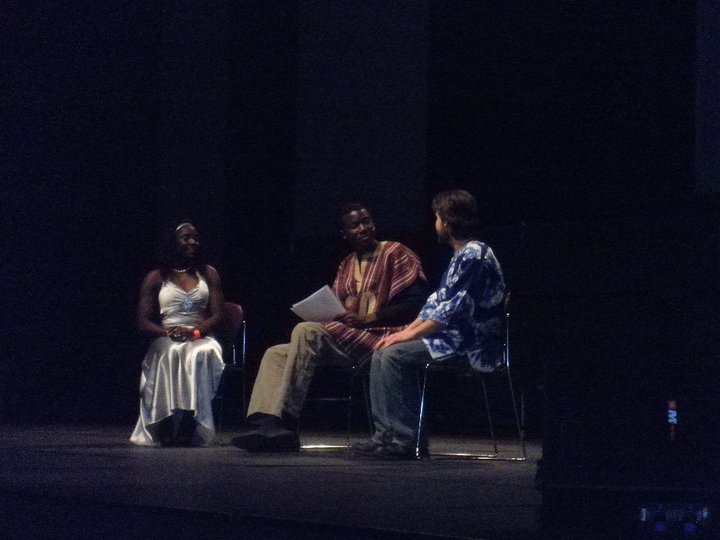
Written as a play of two friends from two countries travelling round the continent discovering places, people, food, artifacts and events, the show centred around showing the audience what they would usually not see on the news about Africa and its various people. A continent of (now) fifty-five countries is something that no one would be confident enough to claim to know without some sort of guidance, and the patience to explore. Jake was the American filmmaker, and I was his resource. A little tension of the “otherness” is added, and the drama of discovery begins. We went from Kenya to South Africa, to Congo and to Ghana, and to Nigeria, touching on sites of historical and economic significance along the way in other parts of the continent. The script was written by Julaine Fowlin and supported by a wonderful cast of students and other volunteers.

I am passionate about things like this – theatre, and such opportunities for social interaction and intervention, and I am very happy that it went very well. More than just the pleasure of bringing the beautiful aspects of the continent’s cultures to the appreciation of the most diverse audience, there is also a joy of being in company of such young people who hold the key to the next generation. It was a great night, and I thank the students for inviting/involving me.

On The Oscars

The King’s Speech – that great movie that explored the problem of speech impediments, the behind-the-scenes of British Royalty during a crucial time in world history, and a spectacular show of brilliant acting and grace – has been crowned by the Academy of Motion Picture Arts and Sciences. It won for the Best Director, Best Actor, Best Picture and for Original Screenplay.

Having seen the movie twice now, I can say that it is an honour well deserved, and more – not only because of the spectacular acting, but because of how it has brought into public conversation again, the debilitating problem of stuttering. I should also add that Colin Firth spent his first four years in Nigeria as a child – which should explain some of the brilliance he has shown in his career.

Five People in China

Five students of three countries from various disciplines sat down in a Chinese restaurant downtown Edwardsville today for dinner. It was the first time the five of them would be sitting together in one place, and it soon dawned on them that they were all beneficiaries of the Fulbright program. “Wow,” one of them said. “This is really interesting – three generations of scholars in one place at the same time.”

“By this time next year, if the current two return here, we’d be almost ten,” another person said, “and it would be interesting to gather around again for a discussion like this.”

“We could actually do something right now, you know.” The Egyptian said.

“Yes,” said the Moroccan. “I’ve been thinking of a public project involving us all and this environment, either on campus, or the public school system in the state. Some volunteer project in town, you know.”

“Why didn’t we think of this earlier? This actually sounds great. What do you have in mind?” I said.

“We can go to elementary schools to talk to them about where we’re from and what we do?”

“Or tell them stories, teach them songs, or share some cultural ideas. Or show a movie on campus?”

“It will enlighten them, I believe. I’m sure students will benefit from this. A cultural exchange. Something.”

“Totally.”

By the time the evening ended, they had discovered a new level of usefulness for the bond that they all shared. They had also figured out a more detailed plan of action and the path to putting the many ideas into practice. After all, it was right before their very eyes, and within their collective reach. They just hadn’t noticed it before because of individual commitments. Now everything had become clear. The day had served its usefulness. They cheered and partook of it with all relish.

On Teju Cole’s “Open City”

Here’s a few words on Nigerian writer’s American debut novel published by Random House books:

In Teju Cole’s novel “Open City” (Random House, 259 pages, $25), the narrator, a Nigerian émigré named Julius, says that he has developed the habit of “aimless wandering” through New York City. He is not being coy. “Open City” obediently follows him as he ambles through Central Park, browses in bookstores, strolls through museum galleries and tours the sights around Wall Street. He is in America on a fellowship to study psychiatry; when he takes a vacation, he goes to Brussels and wanders aimlessly there.

Julius finds that the more he roams the “solitary but social territory” of the streets, the more invisible he becomes. In part because he’s an expatriate and in part because he’s attracted to an existential philosophy that exalts “being magnificently isolated from all loyalties,” Julius feels alienated from the busy neighborhoods he passes through and the garrulous people he meets. Yet there remains a vague purpose to his purposelessness, a low-simmering desire to recognize himself in his surroundings: “I wanted to find the line that connected me to my own part in these stories.”

Not having read the book yet, what fascinates me the most about what I’ve read is the premise on which the book is based – the very nuanced nature of cities (and towns) and what they can offer us either at the level of imagination, or merely at face value. A new short story set in Edwardsville? Why not?

More on the book here and here in the New Yorker.

Meeting Eshu

Today a well-dressed man with a Sean Connery/Salman Rushdie look, beard, and an eerily similar Wole Soyinka/VS Naipaul voice walked into the language lab. He was accompanied by a colleague in the department who had brought him there to use the computer. I’d heard a little about him from the departmental emails. He is one of the prospective employees brought to take a tour of the department and meet members of staff. He had come earlier before I arrived at work. He stands a chance of being a new addition to our staff so I went to speak with him.

“Where are you from?” He asked after I’d introduced myself.

“Nigeria.”

“Bawo nee.” He said, and I was suprised.

“A dupe. How did you know this. Have you ever lived in Nigeria?”

“No. I’m from Brazil.”

“Wao. I didn’t know that you speak the language there.”

“Yes we do. The Yoruba religion is very big in Brazil. It’s a huge huge thing.”

I knew this, but was still very impressed. Then he went on.

“Do you know Shango?”

“Waoh.”

“And Orisha.”

“I’m impressed.”

“And Oshun.”

“Interesting.”

“And my personal favourite – Eshu*!”

“Hahahahaha.”

“I tell everybody about Eshu, especially the Christians I meet, and they look at me like an evil voodoo priest.”

We went on to talk for a few more minutes, and he then showed me a youtube video of a performance of the Yoruba religious worship in Brazil. The songs are a mixture of Portugese and Yoruba. One could pick out many Yoruba words, phrases and expressions in the song. The costumes however are a mixture of European and African. The drums were distinctly African.

The short conversation has given me a new appreciation of religion being the most enduring bearer of language. We’ve seen it with Latin and Catholicism, Arabic and Islam. Now we’re seeing it with Yoruba and Candomble.

It is was all just very interesting to me.

_____________

* Eshu is the Yoruba god of mischief, lost in the translation of the English bible into Yoruba as the devil himself.