Interlude

There is no writer’s block, just laziness. Perhaps.

A few weeks ago, I wrote an article for an e-zine on the motivations for blogging, the challenges it provides, and the general pleasure of having things to write (now just “almost”) everyday of the week. Here’s my experience. I sit down facing a blank sheet of paper trying to write something serious or concrete either for a newspaper or for a class project/assignment, and I get stuck. Nothing comes. The part of my brain needed to get the work done just blatantly refuses to start up, and I remain in one spot for as long as possible, beating myself up and wondering why on earth it seemed so hard to do something as simple as writing, and why I’d been so hated to have been given the task that offered no exit, and no mercy. Nothing else to do, I would then go to my blog, open a blank page for new posts, and write something long and pretty – in less then fifteen minutes – in relative ease, loosening my “writerly” tongue and allowing the brain the luxury of admitting that writing could actually be pleasant. It is the same brain which a few minutes before had locked itself up like a clam. It is also the same typing fingers now addressing a different audience. And that has always defied all explanation. Is the conclusion to be drawn that of the fact that life should be smooth, easy, and playful, subject to our moods and whims? Or should it be regimented and organized, subject to the wishes of a remote instructor waiting to mark our work with inks of red? Or that whenever faced with the latter, a mood of the former should be immediately invoked in order to get through the mood?

Here I am, unable to find the first word with which to begin my final class project due next week, writing without stopping for air on a blog that would give me neither an “A” nor a tuition refund. FML(?) Back to work now.
I Went to Hannibal

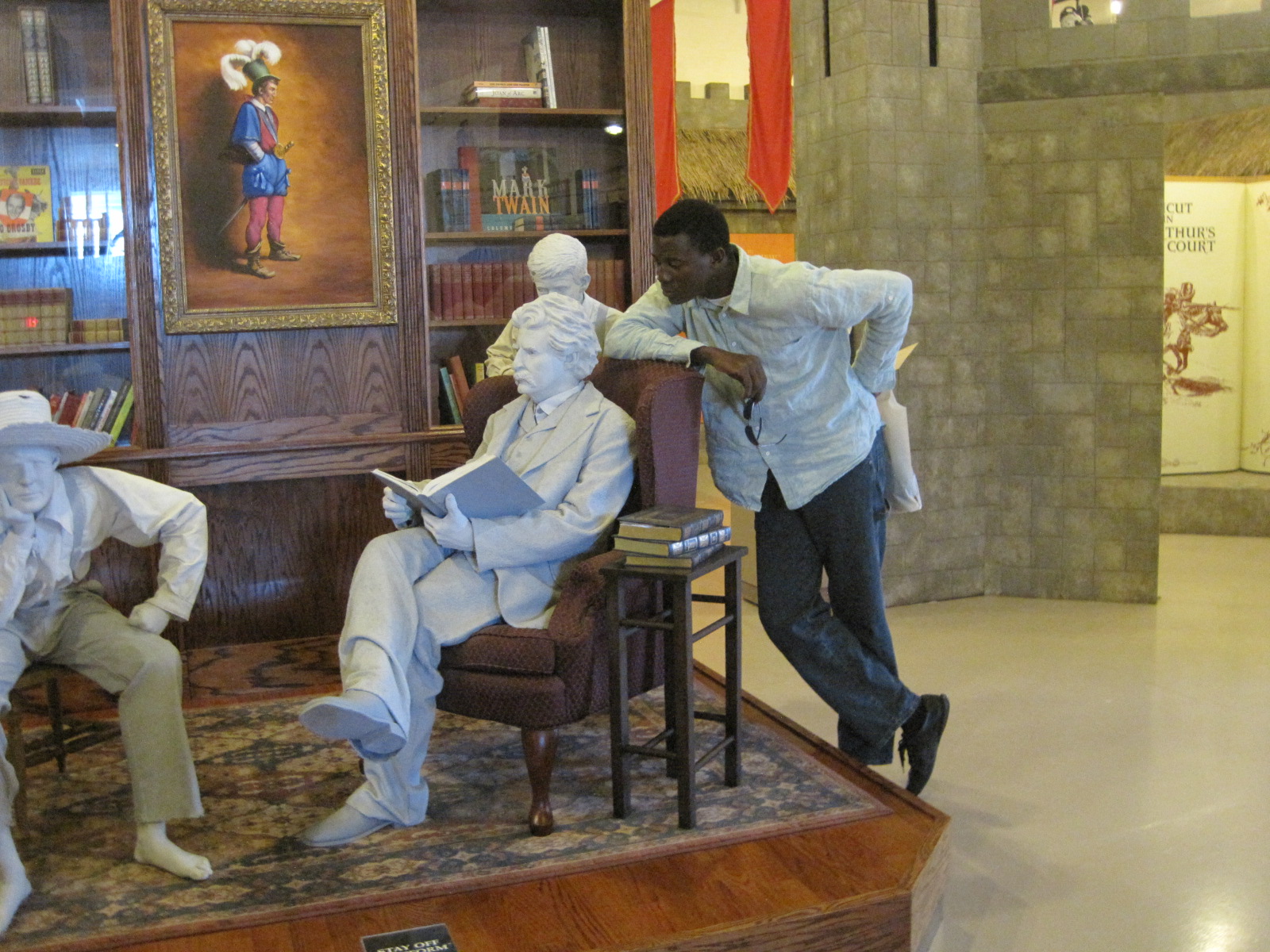
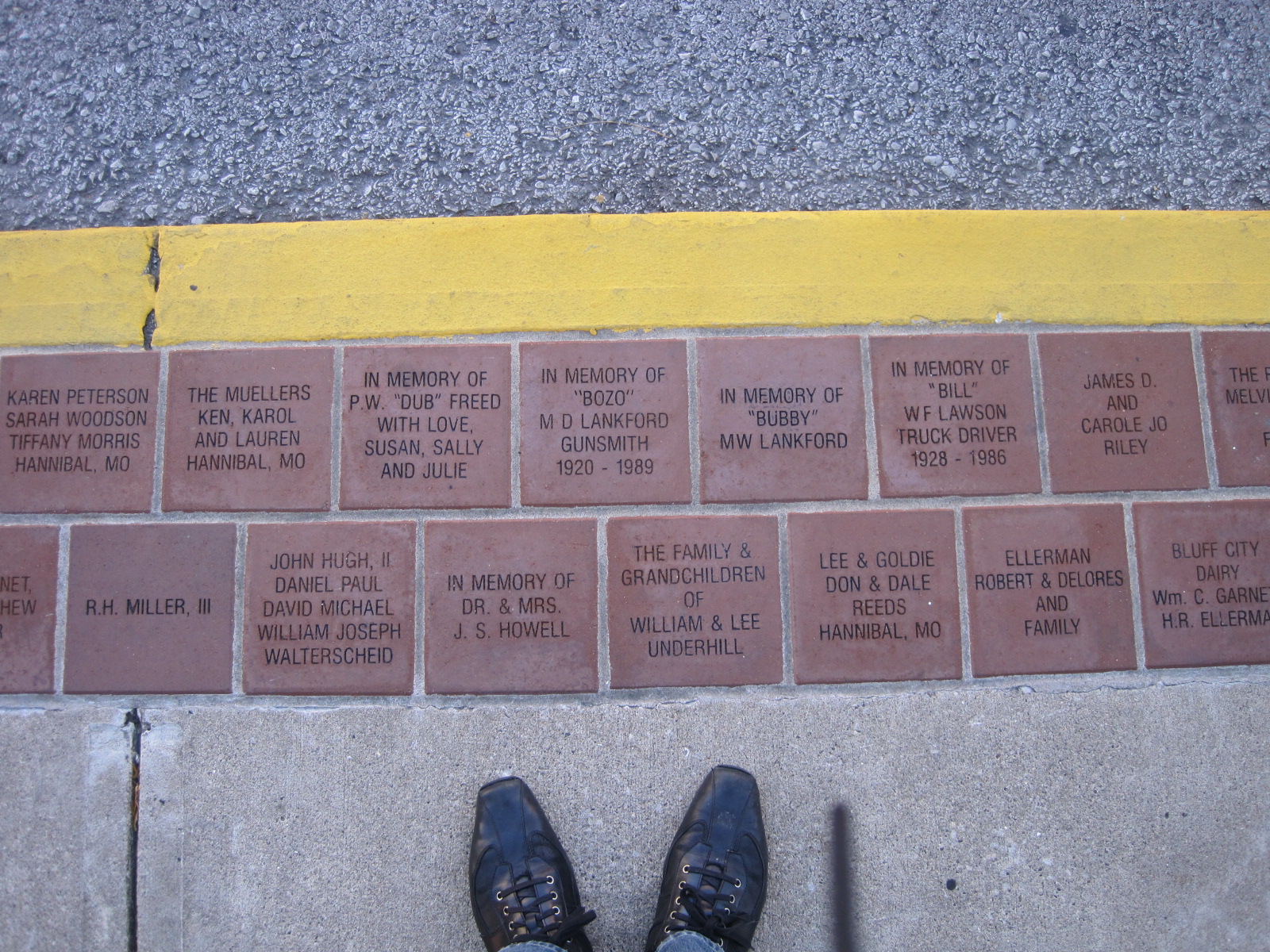
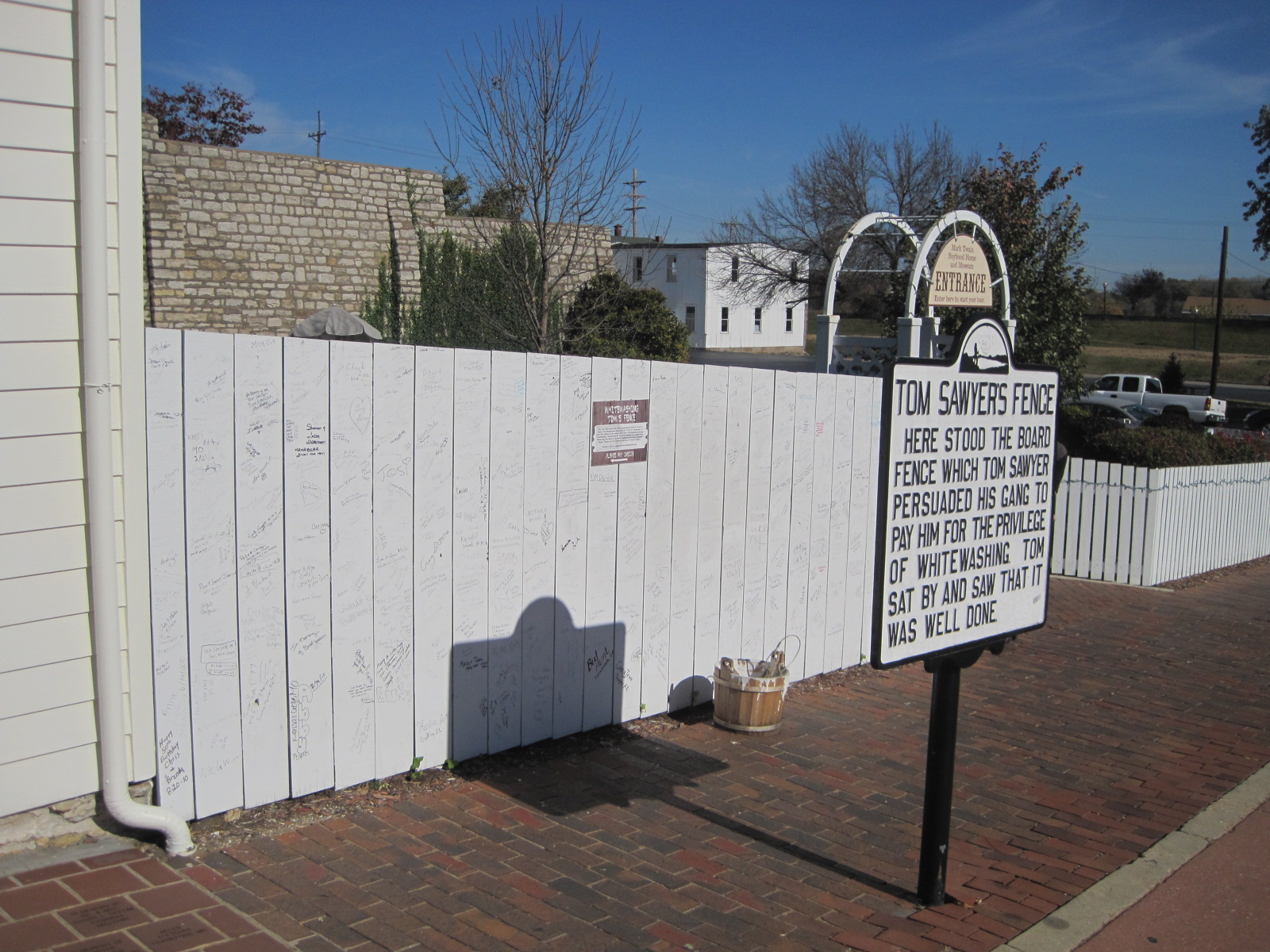
And so I went to Hannibal, a little town two and a half hours away (131 miles north) from my present location. More than anything, it is famous for being the birthplace of Mark Twain (born Samuel Clemens) and the site of his boyhood home with the famous white-washed fence. There’s so much to say about the journey, from the open land of the highway which reminded me of the trip between Kaduna and Zaria to the coolness of the fresh morning air on the way and back. Then there were the sculptures, the quietness of the town, the beauty of the museum building, and the amazing detail of the house as compared to the descriptions that Twain wrote about them in his books The Adventures of Tom Sawyer and Huckleberry Finn. The famous white-washed fence was there all right, now marked with names of visitors from all over the world.

For those not familiar with the story, the young boy Tom had successfully conned his bullying friends into doing his own chore of white-washing his house fence for him. Samuel Clemens grew up in this house in Hannibal, a son of a judge of a father living on a low income. He moved out of it in 1853 to seek his fortune. Twenty years would pass before he started writing The Adventures of Tom Sawyer, and he drew most of his materials from the events of his own childhood on the streets of Hannibal in a house overlooking the Mississippi river. This makes a lot of sense: living through a very hard but colourful childhood and amassing in the process a very large stash of memories, and waiting at least twenty years to set them down to paper, sometimes after returning to visit the place and reliving the memories. Now that’s an idea.

The museum had many fun sights: a marble sculpture of the man reading stories to kids, a boat deck to simulate the view of ship captains (the original inspiration for the name, Mark Twain), a gallery of famous quotes of the man, and a cave built to the type described in his books about his childhood days. It also has a gift shop filled with postcards, t-shirts, and countless books (including his autobiography. He had written it – The Autobiography – by himself and had instructed that it be published a hundred years after his death. It has now been published, and is the current #1 bestseller on Amazon and the #2 on NY Times bestseller list. One of the famous quotes on the t-shirts being sold there reads: “Travel is fatal to prejudice, bigotry, and narrow-mindedness, and many of our people need it sorely on these accounts.” Another one read: “Action speak louder than words but not nearly as often.” And there were many more.

I may not successfully exhaust my report of the visit to a place that holds much significance to me as a consumer of literature and the works of the man as a writer and a chronicler of a certain epoch in American history. His views on slavery, politics, and life in general have been highly documented in many of his books, including this final autobiography. But I can tell you this: that it was a worthwhile visit that I would gladly make again, if only to be able to spend more time in the town and see what else they have besides the very many resources of the Clemens. One more thing before we left (Temie and I) was to sign our names on the white-washed fence. The traveller was here. No, that wasn’t what I wrote. You have to go there to find out for yourself.

Oh, and one more quote now going to remain on my office computer: “To succeed in life, you need two things: ignorance and confidence.” Oh well!

Pictures by Temie Giwa

Of Lost Things

I’ve been thinking about lost things. Where do they go? When I lost my bunch of keys a few weeks ago, and I exhausted my patience in searching for them in the most unlikely of places, I pondered what Carlin, my favourite comedian had said on lost things: “where exactly do they go?” It didn’t help that when the police finally traced it to me and gave me a call, they didn’t say where they found it either. They just took it to where they felt it belonged, and then gave me a call to come pick it up in its mangled state. At least one car had run over it… Sometime last year in one miraculous instance of divine intervention, I lost my $10 leather gloves along with sunshades I had got to make myself look a little more sophisticated in the sun. In any case, not only could I not find it, I also never figured out where it went, especially since I had gone to only one place that evening, and I’d gone back there to check many times, and it wasn’t there anymore, nor had anyone found it afterwards. Where did it go? And more importantly, what else did I lose with it that evening. That has always been my bigger worry.

Since the incident of the key, I have lost a few more things still: a Nokia phone (which I got back a week later), and my new sunshades. I’m almost fed up with myself. Now, what prompted this musing is not even a desire for those material things, but the thought of losing even bigger things. There was a short play I wrote in 2002 titled The Sculptor. It was once performed in the University theatre by a handful of actors in a private production but I lost the manuscript of that play a few months after then and I’ve not come across it since then. Occasionally when I sit in silence, I can recall the lines long enough to write them down, but not in the right sequence. It was a three-man satire on the state of the nation’s politics and intolerance at the time when a religious law was introduced to some parts of the country. Some day, I know that I will come across it while rummaging through stacks of papers in a locked up suitcase, yet the thought of it totally disappearing unnerves me. Of course I’ve not written another play of its kind since then. It’s one of those consequences of movement, and changing seasons.

Today I discovered online an one old article about language, non-literary translation and computer based language technology which I wrote for a literary journal in 2005, and it brought back memories of an earlier even more fascinating experience. It was one of those writings of mine that I remember vividly because of the events around the time I’d written it. I was in a spiral limbo and needed to move forward, desperately. Writing it provided that avenue, unexpectedly, and I was set free. But it was the last paragraph of the piece that surprised me, because as far back as then, I had never even considered the possibility of finding myself as I do now at Uncle Sam’s neighbourhood. Lessons learnt: times also change. Fast.

I still keep that lesson in mind, everyday, as I search around for all my lost things.

Ethnicity as a Plus Factor

On reflection on the coming milestone in Nigeria in the coming days, I came to the conclusion that one of the biggest drawbacks in the national progress till date is the poor handling of the country’s diverse ethnicity condition. For many years, I’ve wondered what it would have been like to live in the times of Tafawa Balewa, and Nnamdi Azikiwe, and Obafemi Awolowo, and the many other earlier nationalists that struggled for the nation’s independent many times from ethnic,  but for the most part from nationalistic, standpoints. Eventually, I get to wondering how things could have gone wrong.

Tafawa Balewa remains one of my most admired men of those times not because I knew him, but because I didn’t, and because he was killed for no reason I could easily understand. And because he was one of the brilliant educated northerners who managed to get into the position of authority. And he was a simple man. Yet he was killed. Azikiwe was another one who became the opposition leader in a Western House of assembly in 1952 as a Nigerian and not as an Igbo man. When I think back to how things could have been different if the first coup hasn’t happened, or how things could have been if the coup had been bloodless, or if it had not had an ethnic slant, I sigh and get back to doing something else. Because I wonder if something beautiful and great could have evolved.

On invitation, I have written a post on my reflections on Independent Nigeria at 50 for the Nigerianstalk.org website. There are a few new posts there also by other Nigerian bloggers and I cherish the opportunity to join those distinguished folks in sharing my thoughts with the new generation of Nigerians to whom the future belong. I am not feeling as giddy as the government wants me to feel about these celebrations just yet, not surprisingly. I guess it’s because the country wasn’t born in 1960 anyway, and neither were those who had evolved their different ways of living together even long before any foreign forces stepped foot on the land area we now call our own. If 50 years of independence from the British could still be counted as an achievement, I guess it is a memorable milestone. In any case, check out the Nigeria@50 post series on Nigerianstalk and leave comments when you can.

Nnedi Okorafor on Censorship

In many cultures of the world, women damage themselves in order to appeal to men (which translates to “finding a mate”). And parents damage their girls to make them marriageable. In American society, much of this “mutilation” is psychological (though plenty is physical) but no less painful or harmful. However, plenty of people are writing about all this. I don’t feel enough are writing about female genital cutting.

This piece from fantasy and speculative fiction writer Nnedi Okorafor has made my morning not just because of the way she successfully defends her genre from the many ignorant attacks it has received from sections of the public, but the depth and fluidness of her thoughts. Listen:

First of all, I speak about what I choose to speak about. Let’s see you try to stop me. Secondly, if writers only wrote about what they’d experienced, then few people would write about wizards and unicorns. Thirdly, let’s be honest here, you can lace the practice of female genital cutting with whatever elaborate stories, myths and traditions you want. What it all boils down to (and I believe the creators of this practice KNEW this even a thousand years ago) is the removal of a woman’s ability to properly enjoy the act of sex. Again, this is about the control and suppression of women. And I do NOT have to be right there between a little helpless girl’s legs to know this to be true.

Read the rest of the piece here and see why the award-winning writer Nnedi is one of the bright futures of African literature.