There are several things to do when one is a “retired” foreign language teacher with time on his hands. One could begin to translate a book of English fiction into Yoruba just for the sake of it – never mind that many of our “modern” people don’t read in the language anymore. At least one can convince oneself that it is an effort in the furtherance of literature.
One could also begin to read old books, some of which one had bought over a year ago but had not got a chance to open due to the busy nature of one’s teaching and learning commitments. As much as catching up on old books is concerned, my bed at the moment is littered with open copies of “The Road” by Cormac McCarthy, “Slow Man” by J.M. Coetzee and Chika Unigwe’s “On Black Sister’s Street”.
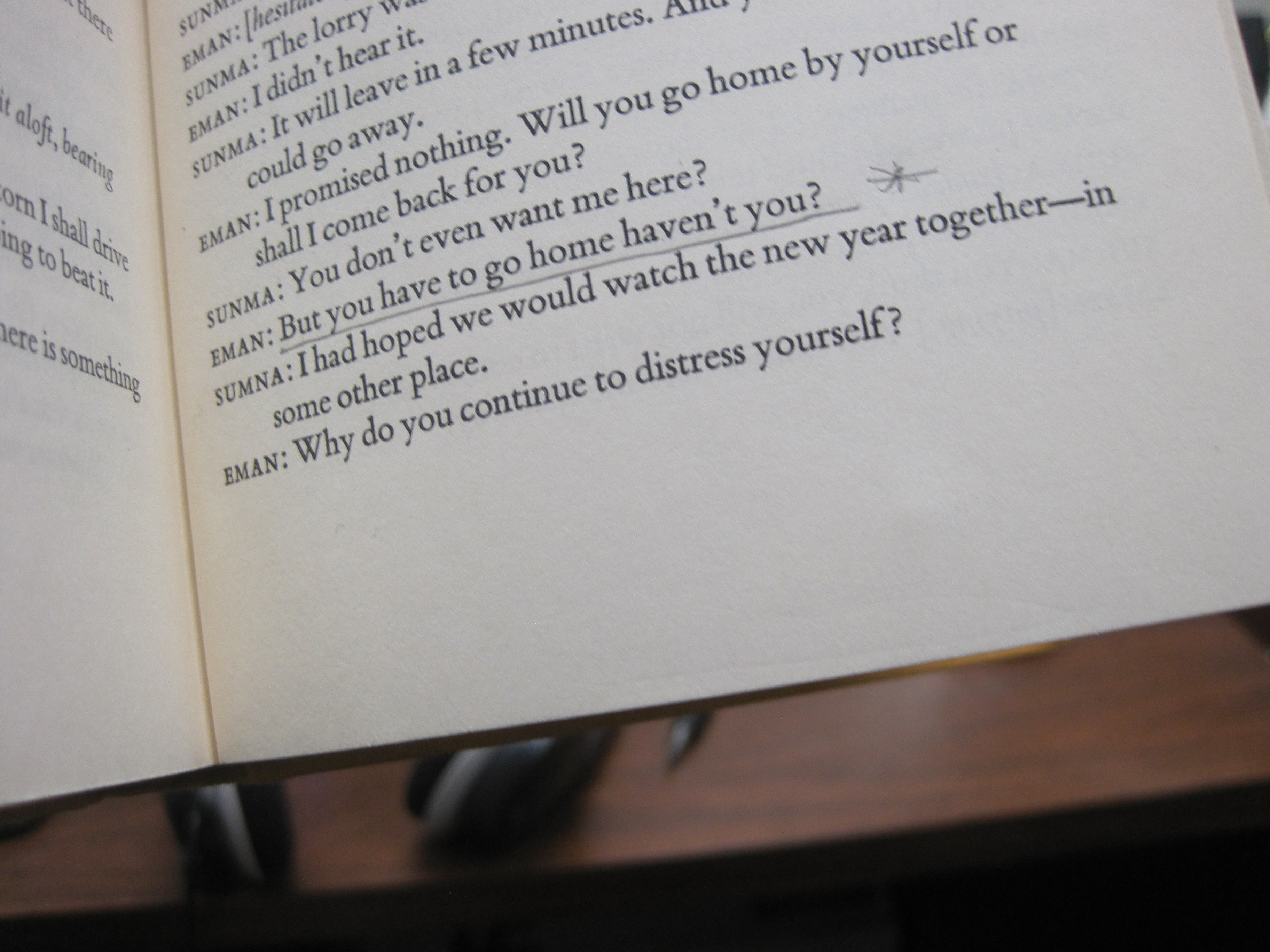 But yesterday, I stumbled on a copy of Wole Soyinka’s “Collected Plays 1” which I had bought from Amazon two months ago. It had in it A Dance of the Forests, The Swamp Dwellers, The Strong Breed, The Road, and The Baccae of Euripides. I’ve read all of them at one point or the other before, but it struck me that there was a part of The Strong Breed that once seemed very strange to me in grammatical accuracy. Today I began to look for it, and it didn’t take me too long for me to to spot. I’ve found it. Wole Soyinka, or his editor at the time, seemed to have missed an almost negligible grammatical rule for one of the lines in the play. Almost negligible, but not quite forgivable for an author that has now gone ahead to win the Nobel Prize for Literature. Here:
SUNMA: You don’t even want me here?
EMAN: But you have to go home haven’t you? *
SUNMA: I had hoped we would watch the new year together – in some other place.
pg 120.
The first time I spotted this in 2001, I was sure that it had missed the editor’s eye especially since a random internet search did not produce any result of anyone having spotted it before. But seeing it still in another edition of the book convinced me either of the author’s insistence, or on the forgivableness of the slip on some level. Or not. The character of Emma is neither a teacher known for grandiose language nor an illiterate known for the same. In fact, his ability to speak well was never in question throughout the short play so it couldn’t have been part of character. It could only have been an error. What surprised me was how it was repeated in all the editions I have read. So I’ve brought it here for debate. What special reason could be given for this sentence written like this?
Of course after this, I shall be expecting a cheque from the publishers for my eagle-eyed spotting of a faulty line in a book more than four decades old.


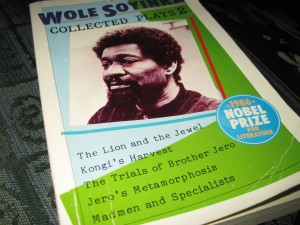 Checking my post mailbox this morning, I found an envelope postmarked from Pennsylvania. Since I wasn’t expecting anything so soon, I was surprised to discover in it Wole Soyinka’s Collected Plays 2. I had indeed ordered it a few days earlier from Amazon alongside books by George Carlin and William Shatner. That was fast delivery! The book wasn’t new, but it was in very good condition. Back in Nigeria, Amazon was never my friend since I didn’t have a credit card, and they won’t ship goods to Nigeria anyway. The book contained The Lion and the Jewel, Kongi’s Harvest, The Trials of Brother Jero, Jero’s Metamorphosis and Madmen and Specialists, that last one being an all-time favourite.