On Memory, Identity, and Home: On Tope Folarin’s “A Particular Kind of Black Man”

Tọ́pẹ́ Fọlárìn’s debut novel A Particular Kind of Black Man, previously titled The Proximity of Distance, was very easy to read. Crisp sentences and accessible language. The novel, which is a kind of meditation on identity, memory, and the definition of home, continues the conversation started with his two previous short stories Miracle (2013) and Genesis (2016), both nominated for the prestigious Caine Prize for African Writing (the former winning the top prize in 2013). The writer is fascinated with this subject — many would say because he has lived it — telling me in an interview after his first short story was shortlisted that “I’d love to inaugurate—or at least continue—a conversation about identity, and how we all share an essential desire to ‘place’ people.”

This is a fair place to begin, and — as he stubbornly, inexplicably, continues to insist — the best point from which to interrogate this book. This context was not always welcomed in the past.

The novel begins, like Genesis did, with “the elderly white woman with frizzled gray hair” who looked at a young black boy in Utah and dangled to him what she thought was hope: the chance to serve her in heaven. This, as the boy, Túndé Akíntọ́lá, realized later, was taken from Mormon teachings that reserved a place in heaven “if you’re a good boy here on earth” for black children only as servants to the white ones. From there, it takes the reader deeper into the life of the child, his family, and the mental health issues that affected his mother, endangered his father’s life, traumatized his childhood innocence as the firstborn son, and eventually broke his parents’ marriage.

Those who have read Genesis are already familiar with this part of the character’s story. What follows, what is new, and what moves the novel forward is an exploration of the character’s own journey, maturity, and memory. And of his father, and mother, and the sacrifices made to give children a good and decent life in a new environment. Túndé’s father had a thick accent which he attributes to the many setbacks he had at work. At some point, he bought an ice cream truck with which to make ends meet. Túndé saw the truck instead as his chance to become popular within an all-white neighbourhood, a dream that also faced eventual setback.

The novel journeys through these moments and others, with affection and honesty, loss and longing. It also examines how we judge what is real and what is merely imagined, while leading us sometimes to experience it ourselves. The character, for instance, began at some point to experience something he called “double memory” where he started becoming unsure of his own sense of recall. How much can we rely on our own memories, and even things we have seen and touched, if it continues to change? In the book, this explains why the character began to set things down, for his own sanity, so he can tell the truth apart from what his mind is making up. But it also becomes the author’s literary trick to carry us along on this narrative unreliability, cleverly deployed in a show-than-tell style. When Túndé tells us earlier in the book about his younger brother, Táyọ̀’s, easy break from the family, from their stern but loving father, when he insisted on staying back in a city while the rest of the family moved on to another vicinity, and we find out later that it may not have been totally true, we discover that we may have become victim to this same deficit, or trick, of recollection that bedeviled the character — deployed to keep us on our toes, keep us from pretending to know more than is shown to us.

But by bringing the novel back into the conversation around the Caine Prize and the alleged controversy around the Fọlárìn’s heritage when he was first shortlisted for the Prize (for the record, I was attentive to that particular process, and any insinuation — if at all — that the author wasn’t “African enough” was not by any notable critic as was alleged in this review at the LA Review of Books. Maybe internet trolls, at best), Fọlárìn wants us to look at him anew and give him his due as just an authentic African as any. It is not necessary; no work of art will do that anyway. He is African in every way one can possibly be an African — and in every way the Caine Prize describes it for the purpose of their prize. It was never in doubt, and we did not need the novel to realize it.

What the work does — if he had allowed us to enjoy it on its own merit — is show us one person’s story, and journey, through an immigrant experience he did not choose nor have much of a say in, to a place of peace and satisfaction — or some closure. The question of the extent of fiction in the work has been rendered moot by his tacit embrace of the label, if only as a point of departure. (Sana Goyal’s aforementioned review calls it “an autobiographical coming-of-age, immigrant novel”), perhaps in the traditions set by Angelou and Ṣóyínká and other memoirists. The category does not diminish the work, but it doesn’t totally capture it either.

There’s a way in which parts of the book remind me of Bassey Ikpi’s recent book which nods to a similar idea of the unreliable narrator challenged by bipolar or schizophrenic disorder. Even Ikpi’s title I’m Telling the Truth But I’m Lying makes an explicit case for a wary consumer. Where Fọlárìn’s work differs — more than just the label (one is called a “novel” while the other is called “essays”) — is that the exploration of mental illness in the latter exists as a running thread under layers of other family issues than a most dominant narrative. This is arguable of course. Both are different explorations of life as a Nigerian in an all-white environment, and in America — not always the same thing.

A Particular Kind of Black Man is an immigrant story. It is a coming of age autobiography. It is a story of love and forgiveness and a search for home. It is both a public testament to survival and discovery as a personal record of the journey that took him there. It is also a well-written book, raw at times, and moving. Its tender and thoughtful meditation on displacement, loss, memory, and belonging is universal, as is its exposure of the pain of finding home in a new place. For many people — and it was for me as well — the novel is also a kind of tragedy. Not just for Túndé and his brother this time, but for their parents. This review will not do enough in capturing the pain and vulnerability of how lives get irrevocably changed by migrating to a new place; the effect on marriage, on personal growth, on the sense of self. In that way, the most memorable character, in the end, was his mom — in what she struggled through, and survived — if only barely — with the scars and losses that came with it.

The angle of the quest for personal faith, brilliantly recounted in Miracle, was notably absent in this book — and it was never quite promised — but it might be just as well. In the place of this or other examples of Túndé’s wandering towards what is true, we have family — his distant grandmother’s voice on the phone — and a romantic encounter, both adding a tender element to the journey that took him from Utah through Texas to Lagos, and through his own mind and doubts, to a place where home finds him, or — we’d rather believe — he finds himself.

___

A Particular Kind of Black Man was published in August 2019 by Simon & Schuster. Get it on Amazon.
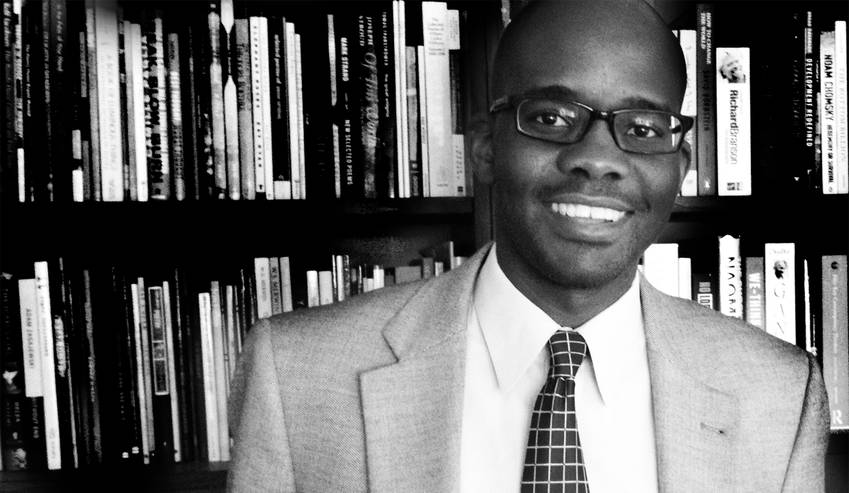
Tope Folarin on Accessibility

topefolarinIn this long but compelling essay in the LA Review of Books, Nigerian-American writer and winner of the 2013 Caine Prize Tọ́pẹ́ Fọlárìn discusses the challenge faced by new African writers trying to gain international recognition and being judged against a standard of “accessibility” set by selected role models.

The long essay slash book review is written in a smooth and accessible – he won’t like that word – style that sustains interest from beginning to end, making a valid argument against a single-story stereotyping of African stories that inevitably happens because of a conditioning of taste by the gatekeepers of the profession.

Here’s an excerpt:

It can be said that black artists who live in the United States or produce art that is consumed in the United States are “expected” to create certain kinds of art, but the reason these expectations exist is because some black artist has produced a pioneering work that, for any number of reasons, garners significant attention and is thus perceived by a predominantly white Western audience as the height of black achievement, the precise standard that every other black artist in the same field must strive to achieve in order for their work to be accessible to an audience that otherwise knows next to nothing about the community the black artist has emerged from.

I don’t know whether his conclusion in the essay point more to the laziness of popular culture that chooses instead to anoint one messenger in every generation and move on rather than spending time sampling every offering for a varied taste, or whether there indeed a nefarious effort against the thriving of a diverse minority voice from around the continent. What he insists on however – as the crux of the essay – is that thriving as a prominent voice in African literature often requires a combination of luck, accessibility in the right kind of way, and talent, not necessarily in that order.

Still worth a read.

_______

Photo: DailyMaverick.co.za

Losing a Faith You Never Had – A Review of “Miracle”

This week, as part of my five-week blogathon on the five shortlisted stories in the 2013 Caine Prize, I present some thoughts on the second story: Tope Folarin’s Miraclefirst published in the Transition Magazine Issue 109, an excerpt from the forthcoming novel The Proximity of Distance. Read it at http://www.caineprize.com/pdf/2013_Folarin.pdf

___

The plot of Miracle is a very simple one, a familiar story told however in a deliberately slow fashion that builds expectation from the beginning to a deft crescendo finish at the end: an infidel (also, a realist) gives faith a chance in public at one vulnerable moment, and is disappointed. I have experienced it, however in a different fashion. Most people who grew up in the pentecostal socialization process of southern Nigeria have experienced it in one form or the other. In the beginning, there is doubt, then there is a little benefit of the doubt, which leads to a “leap of faith”, and then a final denouement that sends the accidental believer headfirst into the bosom of disbelief, and reality.

My first thought on Miracle is that is is well written, well-edited, and well presented on the page – credit to the author, and to the Transition Magazine editors. And although I spent much of initial time reading the story wondering where it is headed, it is one of those stories where patience is rewarded at the end. The initial aimless wandering gradually morphs into a recognizable direction, and the reader is satisfied. Or is he/she? If you are a devout pentecostal church-goer, you would probably force your laptop close as soon as it is all over, and head to church for a confession of sins, or a needed exorcism for the sin of indulgence. Tope Folarin has just eased you into empathizing with a churchgoer whose faith wasn’t strong enough to set him free, who laughed at the pastor’s theatrics even as he wished that they would yield fruitful results, and who in the end relapses into the ways of the flesh to deal with carnal troubles. If you are reading the story on a sheaf of papers, and as soon as you read the last sentence you crumple the sheets and throw them as hard as you can against the nearest object, you might be a Nigerian Christian.

IMG_2323

A “Nigerian Christian” is not the same as a Christian who happens to live in Nigeria. No. He/she is one to whom the word of the priest/pastor/prophet is law and holy; one whose first response to an irreverent joke is to either cross himself/herself, give you a dirty look while praying for the salvation of your soul, or to walk away with a loud hiss while reminding you of your place in the hottest part of hell. They are not peculiar to Nigeria either. In the US, they may also go by the name “Social/Religious Conservatives” or “Evangelicals”. I love Miracle because the universality of the short episode that makes up the story is one that many people would recognize, whether they be devoutly pious folks, or resigned agnostics to whom miracles are television advertisements to church services and bountiful offerings. Replace the old pastor in the story with a chief priest in an Ifa shrine, and the hero of the story with one visiting a shrine for the first time in pursuit of some advertised miracle, and you have the same story. A human story of effort, of a “leap of faith”, and disappointment.

It is a familiar story because many people we know, if not ourselves, have experienced it before. It is familiar in fiction too because it has also been told before, sometimes though through foreigners experiencing the evangelical brand of faith for the very first time. In this case, the hero is a Nigerian in a foreign country. The situating of the story far away in the United States when it could have worked just as well in Nigeria is a curious one. I find no justification for it other than the added dramatic effect of the diversity of backgrounds, which makes the agnostic reader’s bewilderment at their followership, and complete acceptance of faith and miracles even more enhanced. Written for “Nigerian Christians”, it is trash literature assaulting the belief of devout Christians. In the hands of more discerning faithfuls however – those not afraid of having their faith questioned and challenged – it is a fascinating parable illustrating the benefit of faith and work, as the bible itself recommends. Muslims, or people of any other faith (or disbelief) who read it should see beyond the caricature of pentecostal church service, to the simple problem of the conflict of expectations, peculiar to many more circumstances than the house of worship. Even the brightest teacher of economics might not always succeed in converting a student most conditioned to writing poetry.

Here is my favourite part of the story:

I begin to believe in miracles. I realize that many miracles have already happened; the old prophet can see me even though he’s blind, and my eyes feel different somehow, huddled beneath their thin lids. I think about the miracle of my family, the fact that we’ve remained together despite the terror of my mother’s abrupt departure, and I even think about the miracle of my presence in America. My father reminds my brother and me almost every day how lucky we are to be living in poverty in America, he claims that all of our cousins in Nigeria would die for the chance, but his words were meaningless before. Compared to what I have already experienced in life, compared to the tribulations that my family has already weathered, the matter of my eyesight seems almost insignificant.

Right there, in the acceptance and celebration of the little blessings in his life, with or without any further additions in form of a miracle wrought in the presence of an anticipating crowd, is contentment, is nirvana, is a kind of inner peace that the nominal public miracle the crowd so wished onto him may not even have provided. Hence unfortunate, any commentary that dismisses the story solely on the basis of the final, absolutely necessary, embrace and celebration of pragmatism.

There is only one question left to be asked: Is this an important story? My answer is “yes”, without a doubt. It might help explain (or at least describe) why many people throng to churches: chasing miracles. It beautifully illustrates the mindset of the agnostic/realist, and shows today’s churches as less than a homogeneous body of like-minded people. It gives an insight into the level of religious and spiritual development of today’s Nigerian (and Nigerian/African immigrants abroad), and can be pointed to one hundred years from now as a record of one part of that cultural, religious, movement. Every culture went through one. And as far as Nigerian/African religiosity is concerned, this is certainly not one of its most ferocious archetypes, but it’s it’s one of the most relatable. It will also rank as one of my favourites.

Having known how the story ends, I may not read it again, except as part of the longer novel from which the story was culled. However, that initial process, and the little perks of re-reading parts of it, carry a certain premium that I now wish on all my pious friends.

_________________

Also reproduced on the Nigerianstalk LitMag