Farafina Releases Three New Books

Press Release


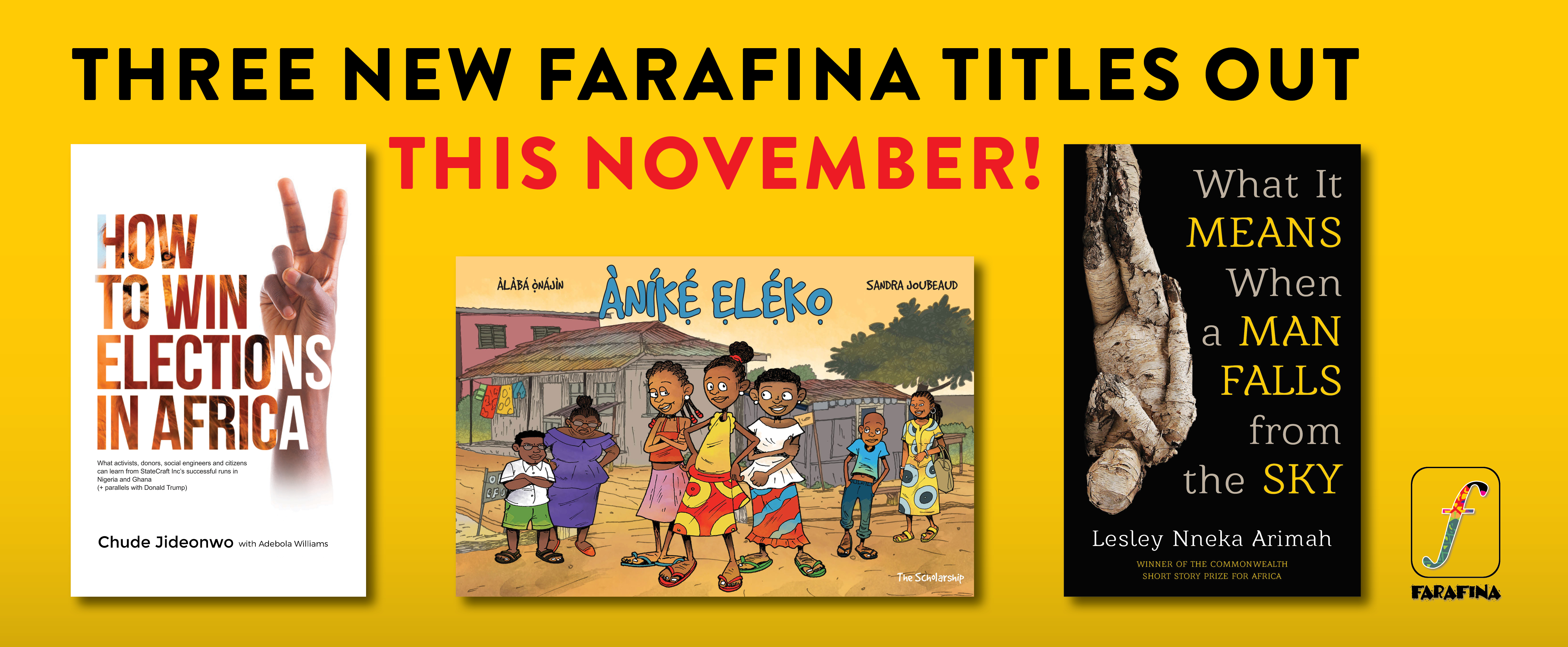
Kachifo Ltd is pleased to announce the release of three new books – What It Means When A Man Falls From The Sky (Nigerian edition), How to Win Elections in Africa and Àníkẹ́ Ẹlẹ́kọ under its Farafina, Kamsi and Tuuti imprints.

The three titles were released on 13th November 2017 and are available on online platforms and in selected bookstores nationwide.
The Books

WHAT IT MEANS WHEN A MAN FALLS FROM THE SKY by Lesley Nneka Arimah

The collection of short stories, which was shortlisted for the 2017 Caine Prize for writing, boasts of powerful storytelling, unique female protagonists, and a world where women are depicted as the center of the society.

Reviews:

From Tendai Huchu, author of The Hairdresser of Harare, and The Maestro, The Magistrate & The Mathematician:

“Arimah has a gift of crafting intimate familial relationships . . . and the pressures and strains of those relationships form the most intricate and astonishing narratives. The powerful stories in this dark and affecting collection will show you that magic still exists in our world.”

From Chinelo Onwualu, editor of Omenana Magazine: “Masterfully moving between the speculative to the mundane, this is a riveting read that will stay with you long after you’ve put it down.”

From Igoni A. Barrett, author of Blackass and Love Is Power, or Something Like That:

“From the very first story in What It Means When a Man Falls from the Sky this thunderstruck reader began to glean the answer to the question embedded in the book’s title. . . Lesley Nneka Arimah has landed in my rereading list like a blast of fresh air.”

About the Author

Lesley Nneka Arimah’s work has received grants and awards from Commonwealth Writers, AWP, the Elizabeth George Foundation, the Jerome Foundation and others. Her short story, What It Means When A Man Falls From The Sky was shortlisted for the 2017 Caine Prize for African Writing. She currently lives in Minneapolis.


ÀNÍKẸ́ ẸLẸ́KỌ

Àníké has to hawk ẹ̀kọ every morning but that does not stop her from going to school. She loves school and wants to be a doctor. However, her mother has decided her fate: once she finishes primary school, she will join her Aunt Rẹ̀mí in the city as a tailor.

When a mystery guest visits Àníké’s school, she has the chance to win a scholarship that will change her fate. Will the help of her friends Oge, Ìlérí and Àríyọ̀ the cobbler be enough?

Written by Sandra Joubeaud and illustrated by Àlàbá Ònájìn, ÀNÍKÉ ELÉKO tells a colourful story of one girl’s courage in the face of opposition to her dreams.


About the Authors

Sandra Joubeaud is a French screenwriter and script doctor based in Paris, France. She has also worked on Choice of Ndeye, a comic book commissioned by UNESCO and inspired by the novel, So Long a Letter (Mariama Ba).

Àlàbá Ọ̀nájìn is a graphic novelist with a diploma of Cartooning and Illustration from Morris College of Journalism, Surrey Kent. His work includes The Adventures of Atioro, and other collaboration projects with UNESCO and Goethe Institut. He lives in Ondo State, Nigeria.


HOW TO WIN ELECTIONS IN AFRICA

Democracy involves the process of changing custodians of power from time to time in order to maintain a useful equilibrium of performance and accountability. But the post-colonial narrative in most African countries has been one of the strongmen and power brokers entrenching themselves deeply across the crucial levels of society. The past few years have however seen citizens become more aware, and some revolt against these systems.

How To Win Elections in Africa explores how citizens, through elections can uproot the power structures. Using examples from within and outside Africa, this book examines the past and present to map a future where the political playing field is level and citizens can rewrite existing narratives.

Politicians have been handed their notice: It is no longer business as usual.


About the Authors

Chude Jideonwo is the managing partner of RED, which brands include StateCraft Inc, Red Media Africa, Y!/YNaija.com and Church Culture. His work focuses on social movements shaking up and transforming nations through governance and faith, with the media as a tool. He teaches media and communication at the Pan-Atlantic University. In 2017, he was selected as a World Fellow at Yale University.

Adébọ́lá Williams is the co-founder of RED and chief executive officer of its communication companies – Red Media Africa and StateCraft Inc. A Mandela Washington Fellow under President Barack Obama, he has been a keynote and panel speaker at conferences across the world including at the London Business School, Wharton, Stern, Yale, Columbia, Oxford and Harvard.

A Review of Tendai Huchu’s “The Intervention”

“The Intervention”, a short story by Tendai Huchu, which can be read here, was recently shortlisted for the Caine Prize for African writing. Here’s my take on the work.

_____________

“Intervention” could be read in many different ways: as a tale of distant compatriots grown impotent by time and distance; the futility of armchair activism or the inevitability of same in the face of real challenges; or as a common allegory on the state of the continent in tumult.

It could, however, be read simply as a story of love, lust, disappointment, and one man’s care-free interrogation of it all. That man was Simba in this case, a poet, along with his friends, Z and Tamu (and their girlfriends).

The texture of Huchu’s story goes from casual to mundane to judgmental observations of people made by the principal character, Simba, who lives in the United Kingdom, far away from the scene of electoral action in Zimbabwe, his hometown.  The story climaxes at the end of a national election in Zimbabwe where the president who has ruled since the country’s independence in 1981 was “elected” into office for another term. Then it descends gently into the chaos of domestic dispute between lovers and friends: a not so subtle subplot that had followed the story from the start.

So, is this an allegory on the state of our impotence and confusion on the continent? I’m more inclined to that conclusion. Or, in trying to find other ways to appreciate a story so ordinary yet representative of a slice of some immigrant life from a failed African country, I might be forced to dismiss it as a neophyte attempt at storytelling (at worst) or an effort carefully riddled with levity, for particular effect (at best). The characters are naïve if not simple, and prosaic if not uninspired. An example:

“…I never cast a single stone in this entire charade. I was consumed with overwhelming fury, seeing what Tamu was doing to this little princess. How could he sit there, chatting nonsense about his privacy, as she trailed the list of names from his phone.

Apart from the fact that the last sentence is missing a question mark, the expression itself is not that striking, especially in a work of fiction aspiring to Africa’s largest literary prize.

In an earlier scene, Simba says: “I gave him my wtf face”, written exactly as quoted, with small letters for “wtf” which one assumes does not mean “Welcome to Facebook”.

Maybe the pedestrian storyline of a bunch of immigrants in England watching and pontificating about their home elections does call for equally carefree characters speaking in insipid turns of phrase. Or maybe the primary character is an extension of a writerly experimentation that didn’t quite achieve its goals. Either way, one is left with a feeling of deep dissatisfaction when it all ends. This is 2014. A failed African state and the disappointment of its emigrated elites isn’t such a tantalizing storyline except something new is added in the form of great and captivating writing.

More:

“The kids didn’t speak Shone, so we were introduced in English, and check this out; I was “Uncle Simba”… The kid just looked at me blankly like I was talking effing Zulu.”

Effing, really? Who is this character? A twenty-two year-old Zimbabwean visiting England for the first time and intent on convincing us of his acquisition of street and teen lingo?

So, maybe the writer didn’t care much for inspiring our imagination or challenging our capacity for linguistic fireworks. Or maybe he couldn’t. We may not know until we read his other offerings.

Or maybe the story is a deliberate simplistic portrayal of simplistic existence. Zimbabwe goes on in its charade of a government. AIDs continues to ravage the continent. Sudan is now two countries. Egypt has changed its government more than twice in three years. Boko Haram has turned the fragile Nigerian state into a colander of dust and dead bodies. Kenya is fighting Al-Qaeda on its streets. Somalia is a violent ghost of whatever was there before, and Libya after Gaddaffi hasn’t lived up to Western (and African) hopes of its survival. Yet here we are in a quotidian cycle of daily vanities: dating, cheating, smoking, etc, and goofing around in our new realities, too impotent to act in any meaningful way. On this level, I understand and appreciate the effort and direction of the work. Otherwise, I should also probably go for a smoke (and hopefully not “cry like a pussy.”)

In any case, if it is the writer’s first, it shouldn’t necessarily be his worst. Next, please.

___________

First published on Brittle Paper.