Nigeria: The Petroleum Storm

On January 1, 2012, the Nigerian government announced the removal of oil subsidies that have hitherto kept gas prices in the country to below fifty cents per liter. To citizens of the world’s sixth largest exporter of crude oil, government subsidy of gas prices is one of the inalienable advantages of belonging. Other basic government amenities in the country are virtually non-existent. Power supply is abysmal. Security of lives and property is terrible. Roads are bad, and the educational system is not one of the continent’s best (as it was a few decades ago).

Like I said on twitter two days ago, and as everyone knows, the problem is really not the fact that the subsidy was removed. It was the way in which it was removed: abrupt, and total, plus the fact that no one in the country trusts that the money that will accrue to government from this increase in fuel prices will be used to improve social amenities and the life of citizens. Nigeria is probably the only large exporter of crude oil without access to stable and affordable electricity, good roads and an affordable healthcare system. It is disgusting.

So here it is: today all around the country, students, workers, middle and working class people are storming the streets to protest the price hike and to demand that government restores some (if not all) of the subsidy. A government so insensitive to the pain of its citizens as to increase fuel prizes to over 200% on the first day of the year deserves all the outrage it gets.
The Davis Image

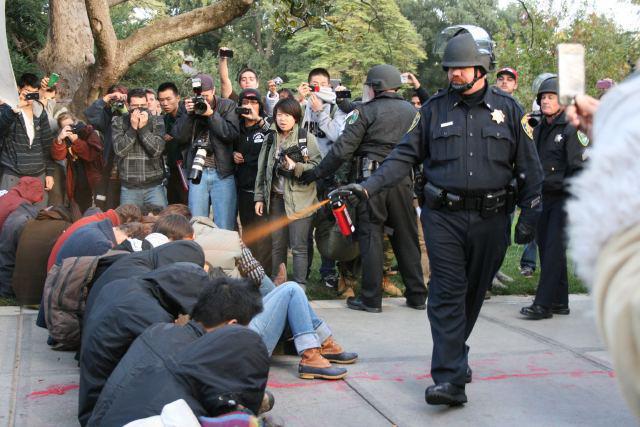
Two days ago, this image surfaced showing a campus policeman applying pepper spray to students of the University of California at the Occupy Davis protests who were just sitting still against police orders for them to disperse, and in compliance with their right to publicly demonstrate.

Words, it has been said, can’t successfully match the power of an image. The image of a student standing in front of a tank at Tinneman Square put civil disobedience in the face of brutal force into unquantifiable perspective. So did the images of soldiers hosing protesters in Egypt on a bridge in Cairo just a few months ago.

The Occupy protests all around the country haven’t always made sense nor always fully represented the outlook of all that are upset by the state of the economy in America today. They however have represented the genuine grievances of a country fed up with the state of things in government. Those who have criticized their methods have not been able to provide political alternatives, or successfully make a case for anything bolder and more effective than a public action that got everyone talking. There have been occasional loons and wusses, to use words from Fox News, and those who sought to paint the movement as anything but genuine and grassroots have used these isolated cases to demonize the movement. The real nucleus of this movement however has been a non-violent occupation of public spaces in order to make them uncomfortable enough for those concerned to take action.

When added to other pictures from around the world today where people are revolting against unsatisfactory government policies, the image above blends right in, except that the other places where brute unmatched force has been used on helpless civilians have been failed/police states. They have never pretended to defend or support human rights, life, liberty and the pursuit of happiness. America, this (more of the pepper spray incident in video) should shame you.

These students deserve credit for the extraordinary amount of courage and restraint it must have required to stay non-violent in the face of such brutal use of police force. Everyone should be disgusted. I am.

Occupation Blues

Open window peers into a blue evening through tiny louvre slits,

removed, it seems, from floods around the Nile and the Hudson,

Mississippi, Missouri and Victoria and other throbbing tributaries.


Open veins of revolt, serrated slivers of soul across the landscape

as far as eyes could see: a finger in the pupil of the surly present.

“Occupy this,” morning calls, blue with equal promises of dawn.


Occupy!

Every time I have to think about the “Occupy” protests which, although initially aimed at Wall Street, has now spread to many cities in the world, I inevitably think of the streets of Nigeria and wonder how this kind of protest would play out were it to be tried. And I have no doubt that it would eventually be tried. Having witnessed a number of public insurrections while growing up, I know the tendency of such protests to turn violent before anyone pays any major attention to it. We were socialized under a very repressive, military government, and it has become an unwritten rule of public protests that for it to have any impact – if only to capture public attention and sympathy – it must have an element of tension.

Here is a guide however, culled from one of my favourite texts of all time: Martin Luther King Jnr’s Letter from Birmingham Jail. For everyone considering a public reaction to systematic oppression:

I had hoped that the white moderate would understand that law and order exist for the purpose of establishing justice and that when they fail in this purpose they become the dangerously structured dams that block the flow of social progress. I had hoped that the white moderate would understand that the present tension in the South is a necessary phase of the transition from an obnoxious negative peace, in which the Negro passively accepted his unjust plight, to a substantive and positive peace, in which all men will respect the dignity and worth of human personality. Actually, we who engage in nonviolent direct action are not the creators of tension. We merely bring to the surface the hidden tension that is already alive. We bring it out in the open, where it can be seen and dealt with. Like a boil that can never be cured so long as it is covered up but must be opened with all its ugliness to the natural medicines of air and light, injustice must be exposed, with all the tension its exposure creates, to the light of human conscience and the air of national opinion before it can be cured.

I’d recommend replacing the racial references in the text to economic/social or whatever the situation is wherever oppressed people live, and the message works just as perfectly. The full text of the letter is here. Protests like the present Occupy are usually a watershed/crossroads of a new era. I can not imagine a better place to stand than on the right side of history.

I write this in response to the high-handedness of NYPD cops arresting peaceful demonstrators who had occupied Citibank premises to close their bank accounts in protest. It would seem that the agents of state have learnt nothing at all from the lessons of history.

Next, Bahrain!

It cannot be emphasized enough how horrible it is that agents of state in places where citizens are peacefully protesting against misrule are opening fire on them. This is totally heartbreaking, and no words can condemn it enough. I have just seen a few Youtube videos in which totally harmless protesters walking on the streets of the country are shot at with live bullets. Are these soldiers mad? Have governments gone totally demented now? Whose interests are these shooters protecting? What are they trying to say? That protest is illegal and people should merely shut up and comply like goats? The underlying justification for citizen’s protests and revolt becomes even clearer when a simple thing as a peaceful march is met with merciless sadistic force. We should be outraged.

Since Egyptians toppled Mubarak through that sustained popular revolt, the world has once again directed its attention to the prospects of non-violent revolution. Unfortunately, not all governments got the memo. Bahrain is a small country on the Persian Gulf with a population of just over a million people, lying close to Saudi Arabia. It is ruled by a royal family that now seems threatened by a demand for a better way of life. These killings are unacceptable, and will only bring more pain and suffering, not to mention strengthen the citizens’ resolve. Here’s one more dictatorship to go, and as soon as possible. I call on the citizens and governments of the world to stand firmer on core values of human rights, more so now in the face of blatant disregard of the government for dissidence. Same for Libya, and Yemen. Compared to the ruling princes of Bahrain, Hosni Mubarak’s autocratic rule now looks like heaven in hindsight.