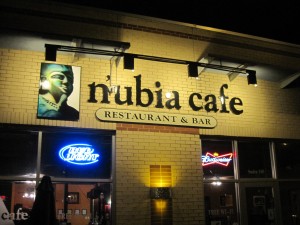
 And so tonight after a drought of three months and more, I arrived home, and in heaven, with all but the seventy welcoming virgins, of course. It started as a jest and mild daring that we would drive down to St. Louis to check out the “African” restaurants. I had had a few apples and was just hoping to go to bed but the trip proved a little too tempting to pass, so we – Mafoya the Beninoise, Ben the American and I the traveller hopped in the car and drove to St. Louis, seeking a place called “Nubia Cafe.” The name did not suggest anything other than African so believed that I was going to at least find something to my taste, just like I did in the Indian restaurant in Chicago. At least it was peppery (read spicy) enough to my African tongue.
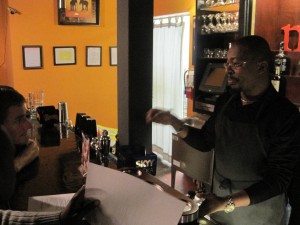
It was the smile of the woman who welcomed us in that gave a first hint. And then the smell from the kitchen, and then the ambiance. Then finally, as we stood staring at the host – a tall and handsome black man with a goatee standing behind the counter, whose smile and sense of mischief led us on a false trail of his true identity – I heard the concluding part of the song Lele by a Nigerian Igbo musical group Resonance seeping in from the surround speakers in the room, and knew at once that I was home. “You’re Nigerian?” I asked, and he nodded, extending his hands. “My name is Henry Iwenofu. Nice to meet you.” And he indeed was a nice personality, well read, smart and articulate.
From then on, things went smoothly, from the overdrive hyperactivity of finally landing on home soil so far away from home to the mellowness of deep conversations that you’d always find among Africans meeting on a distant land.
 HOW LONG HAVE YOU BEEN HERE?
“Over twenty-five years”
He should be like forty years himself.
WHEN WERE YOU LAST IN NIGERIA?
“In 1995, briefly.”
I doubt that he remembered much of the June 12 crises, but he has some Youtube videos of the Biafra soldiers’ songs on his phone.
WHERE ARE YOUR PARENTS?
“They were here since a few weeks. They stay with me.”
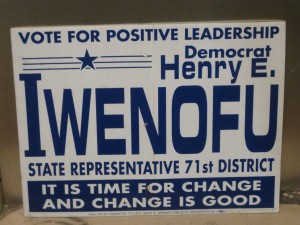
 There is a little board sign beside the counter bearing his name. “I contested in the last election for a council seat.” He said. “I didn’t win, but I got some votes.”
DO YOU STILL SPEAK IGBO?
“But of course!”
He also happened to speak a bit of Hausa and Yoruba, and he’s an American graduate of a Political Science equivalent course, with a Master in Law. “I’m a barrister” he jokes, “and that’s why I’m now working in a bar.”
HOW LONG HAS NUBIA CAFE BEEN HERE?
“About eighteen months.”
 DO YOU SERVE PALM WINE?
“We used to do so, but since demand slipped, we have discontinued it as well as Edi-kang-i-kong and Star Lager Beer.”
Still unable to believe my ears, the music changed to Asa’s eponymous album and the songs filtered in one after the other while we enjoyed the meals that came in succession after a few minutes of banter.
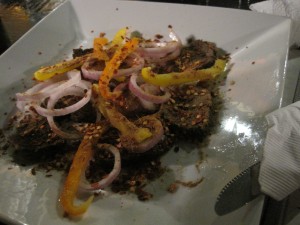
Appetizer: Suya/peppersoup (Comments: Very very good, but not the best I’ve had. Ben however loved the soup, even though he had to quickly ask for plenty water so that his tongue/throat doesn’t bleed.)
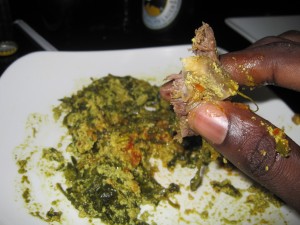
Main course: Pounded yam and egúsí soup. (Comments: OMG! The Nigerian host even had the audacity to provide forks and knives to eat it with. What? Are you kidding?)
 Drinks: Tusker beer from Kenya (Comments: none)
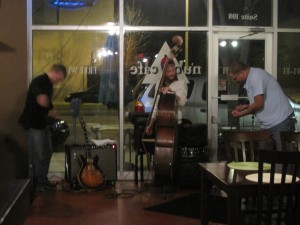
After the meal, which was accompanied later by a live band in the corner of the room, we got down to the real African past-time: arguing. It took the whole hour and even though we agreed on little, we shared much, and Ben just looked on, sometimes bored, and sometimes animated. It was his first time in an African restaurant, and it could as well have been his first time seeing two Africans argue, on such an unimportant topic as whether or not we were different, or the same even though we come from different places… This argument must have arisen from a question as to whether he would be going back home. No, he says, but not for reasons I expected (political instability, poverty etc), but because, according to him, “I don’t have the money. I can’t afford to make such trips regularly.”
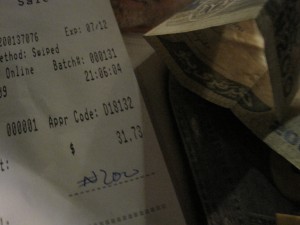 The other woman who had welcomed us in with a smile turned out to be from Tennessee, and she found the whole show we had put up to be very amusing. She was going to find it a lot more amusing when, as it was time for us to pay and head back to Edwardsville, I looked at the bill and had a very bright idea. Since I’ve been in the US, I’ve been gradually initiated into the tipping culture and found a certain joy in leaving little change for the people who had made effort (don’t tell me it’s their job) to provide good quality service. So to show my appreciation tonight, I looked into my purse and brought out the crispiest – well, not necessarily the crispiest – of my Nigerian currency notes. It was a two hundred. I had brought the Nigerian currency notes along to the States only to show my students (and some of them have actually “won” a few of them for keeps while answering questions in class), and for other unexplainable reasons, but as I looked at the space for tips on the bill, I could think of nothing more appropriate to give back to this long range traveller like me than a small piece of home.
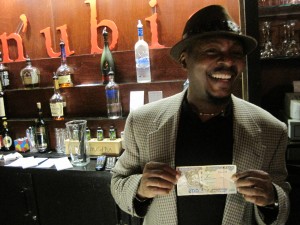
In American currency, it is less than $2, but from one traveller to another – albeit one more temporarily resident than him – I was handing him a touch from his distant past.
“I’ll frame this,” he said, as he posed for a photograph, and the Tennessee woman who sat beside him kept grinning from ear to ear, looking at me with a mixture of thrill and quirky interest. She definitely didn’t see this one coming, and much as she tried to find out from me how much the note was worth in American currency, she failed, to my delight. It was my first experience of home away from home. And from this heaviness of my tummy now as I return from the eating and all the merrying, I feel the warmth of home. Hello Nigeria.
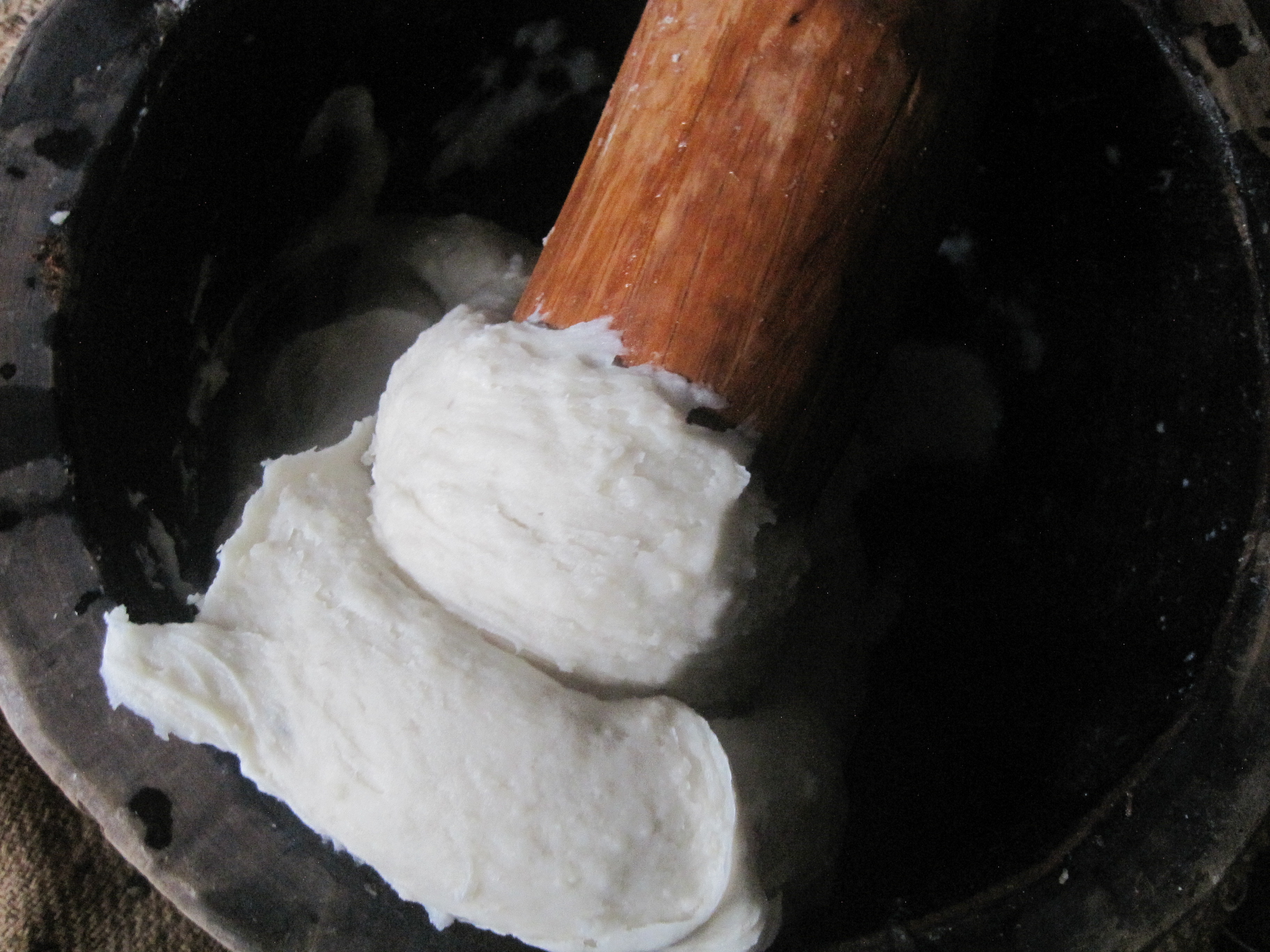 So a friend from Jamaica had encountered pounded yam for the very first time, and looked bewildered at the suggestion that each handful of a rounded ball of the dough already coated in soup had to be swallowed in entirety. “This is too large for my throat,” she said. I took another look at pounded yam today and discovered that she was right. Contrary to the suggestion that all you do is throw the ball of food in your mouth and swallow it, the process before the swallowing is actually a little more complicated. It starts with a swirling on the tongue of the food in order to separate what’s “food” and what’s “sauce”. A little teeth-work takes place afterwards to press whatever is necessary into the right shape for the throat. Everything else follows.
 This is the first part of the tale of my visit to the State of Maryland, where food engaged me in a contest of wills and I almost ran for cover.
 But we made it to his house in one piece, Vera Ezimora and I, with the aid of a talking GPS device. I have never been so humbled by the power of technology, where a little device as small as a mobile phone can lead a car driver to a location of more than an hour away, and where we had both never been before. We were coming from her University where we had gone to participate in one of her class tutorial sessions. (Needless to say, after that almost boring hour of listening to different accents of her classmates discussing the varying definitions and types of empathy, I am now convinced that I am never going to see that word in the same way ever again. Ever. And this is not a good thing!) No matter where anyone lives in the United States, a GPS device can lead anyone else there, without fail. It’s takes just a little imagination to conceive of how much of a leap we would achieve in Nigeria and Africa in general (in criminal investigation, business or even social relations) if we could just get adequate electronic mapping of the landscape.
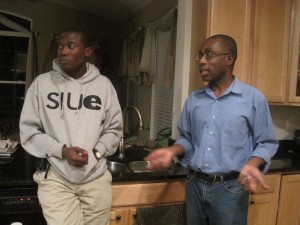 The man Ikhide Ikheloa who met us at the door turned out to be a simple, likeable man just like I had assumed from a distance. He was warm, and down to earth. He is a simple man with a very good taste, and humour; a family man in his middle age. A photo of Barack Obama rests beneath the television in the living room. He ushered us in with his still authentic Nigerian Pidgin English, and I felt immediately at home. His last visit to the country of his birth was just last September, and our first conversations dwelt on the impact that had on him. They were enormous, it seemed, and we listened to his tale of bad roads, generator fumes, LASTMA harassments, malaria, roadside vendors, friendships and many other highlights of his trip. Born and raised by a military policeman, he is no stranger to discipline. The tales he told during the few road trips he and I later made around town were of the memories of his childhood in the old Midwestern Nigeria, especially before, during and after the civil war where he had to survive alone with his brother as a young boy without any parent in sight. He is an avid reader. He also considers himself a compulsive writer, who just can’t help himself. On his critical reviews he says: “I’m a consumer of literature,” and I consider my critical opinion on the work I read as being within my rights of response to what I have spent my money and my time to consume.
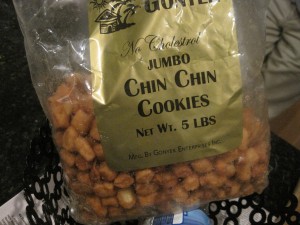
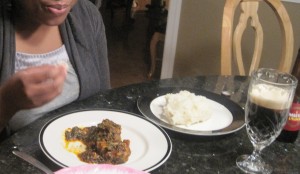 Again, I should say that he did make the pounded yam himself, and it was very good, but Vera and I have never agreed on whether the accompanying vegetable soup and sauce (which included snails, cow legs, and different delicious meats and fish) were also similar results of his culinary skills. I don’t doubt it. He is not a typical Nigerian man by many standards, and he’s surely not a lazy man. However, the voices of opposition and skepticism abound to drown mine of hope and solidarity. The loudest of them ironically belongs to his own first daughter who, having overheard our confused wonder at the dinner table about who made such a delicious soup, had asked aloud without providing a corresponding answer to clear the air of any further speculation: “Is that what he told you, that he made the soup by himself? Ha!” And just as soon as I completed one plate of food, it was replaced by another with the words. “K, here. Have and eat these too. They’re very good, and there’s more where they came from.” By the time I updated my Facebook status some minute later, it read: “KT is not drunk, but this drink of bottle will not wine itself…“. I however survived it by some miracle, but almost couldn’t get up on time the next morning to catch my flight. But in all, it was a memorable experience of a visit for many reasons. Not only because it was a day that I engaged food in a battle of wills, and I was almost roundly defeated.