Two Poems for Wenger

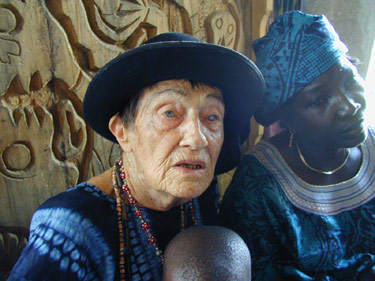
I wrote this poem last January for Susanne Wenger when news broke that she had passed, and sent it to a couple of friends and a few listservs. Friend Benson Eluma was one of the people who wrote a response in poetry to my offering back then. Click here to read his poem, now published in Nigeria’s NEXT newspaper. The poetic meeting of Benson and I on the campus of the Ibadan University is a long story for another day.

Here below is the final version of what I wrote back then, thanks to a few suggestions from Lola Shoneyin.

Like Chalk in the River

For Susanne, Olorisha!

They said it rained when Suzanne was buried.
It poured.
They spoke of a rumble of the heavens
as the Orisha Osun swam back, again, to her pristine source.

They talked of art.
They spoke of beauty.
They mentioned hands
That sculpted spirits.

But now when the forests have stopped dancing with the rain,
See the wind escape from that storied grove.
Look, amid the hallowed haze,
at a turning twirl of her spirit gaze.

Gone is the eye that looked out for the standing stems
When greed called for arms, and men scorned sense, and all she wove.

Today, the Spirit it was that left, again,
To return. To return: a time-bound god, or else a travelling dove.

NOTE: Susanne Wenger was the Austrian artist who lived most of her life in Osogbo Nigeria as a priestess of the river Osun. Born in Austria, she met and married the German artist Professor Ulli Beier who brought her to Nigeria in the 1949. The couple quickly assimilated in Nigeria, he as a teacher and she as an artist, but they moved from Ibadan to the nearby town of Ede in 1950 to escape what Wenger called the “artificial university compound”. In Ede, she met one of the last priests of the rapidly disappearing, ancestral-based Olorisha religion. She quickly became engrossed in his life and rituals, even though at that time she spoke no Yoruba. “Our only intercourse was the language of the trees,” she said later.

Her work in Osogbo for the many parts of her life included an enormous effort to protect the sacred grove of Osun, a forest along the banks of the Oshun river just outside Osogbo, which she turned into a sculpture garden filled with art made by her and others. The sacred groves of Osun are now UNESCO World Heritage Sites thanks in most part to her efforts. (Read more about her life here).

She died last January in Osogbo, her adopted home, at the age of 92.

Pete-Pete

It was inevitable that I would eventually blog about (my love for) this song. As at the last count on my iTunes, I have listened to it for a total 293 number of times in less than three days, after songs by Chris de burgh, Fela Kuti and Michael Jackson. That is no mean feat. I usually begin playing it in the morning, and keep it on reply throughout my work on the laptop till evening when I sleep, and then leave it on to lull me to sleep as well. This is only surprising if you take into account that I did not like the song at all the first time I heard it. I thought it was too slow. In hindsight, I now think that I it was who was too slow.

The song by two unique Nigerian singers 9ice and Asa is a classic. It is a solemn lamentation of the state of things. But where the song derives its greatness is not even in its political preoccupation but in its artistic triumph. Poetry of words and the rhythm of proverbs in the Yoruba culture is already a given. But merging it with the art of rhyming, which I believe is a fairly Western art concept, and coming out with a tune which is both melodious and deep is a great endeavour indeed. I will not even try to play this in class to my students because the poetry it contains is above them. (Heck, it’s above many of the people I know.) The real beauty of the track however is in the words, the message, the proverbs, and not in the perhaps equally moving rhythm of the instruments. For non-Yoruba speakers, I give you only the music. 🙂 Enjoy.

NOTE: The title pete-pete is taken from a Yoruba proverb that says that “As soon as pete-pete (a muddy water/liquid dirt) is beaten deliberately with a rod, you can never control whose clothes it soils.”

Re-Reading Myself

Re-reading oneself can be such a boring chore that I’ve always tried to avoid because of the emotions it inevitably brings back. Most times, one is just too glad to be rid of the overwhelming feelings that make one write in the first place to go back at will. I’ve just finished looking through all the poems that make up my first collection of poetry and all of a sudden I’m back with the overwhelming nostalgia of pre-University and University life. Maybe this year would be a good time to re-issue the collection into the public after five years of hibernating fermentation.

I am now officially looking for publishers for the electronic and print reissue in America, Europe and in Nigeria. Here, below were the lines I penned for the year 2000, written a few hours into that year while I sat in church on that December evening, bored to my bones.

The Year of the bug

It’s a new dawn because a year is born,
But are hours years for zero to mark one?
Men have flown to realms of high imagination
with anxiety and snippets of loose contrite illusions.
Of human clock, a stroke of the thin long second hand,
Or the gradual droop till the final grain of sand
Marks a whole new start – a thunderous landmark.
And new time commences, yes it remains dark.
Here begins a new dull span of restless days
Of ends unseen, unsure even when one strongly prays.
Called it a new phase, named it a new rolling life –
new day into pay; new life into more human strife.
And yet remains too cryptic and strange remnants
of words, thoughts, fears and imagination parts,
And of pregnant signs, sights and sighs unblown –
of things not yet seen and yet all unknown.

(c) All rights reserved.

Lethargic Thursday

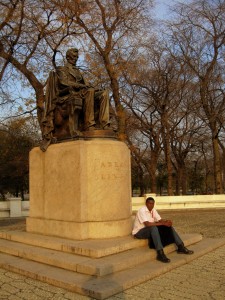
By the Lincoln Statue at Grant Park, Chicago

I woke up today with an overwhelming sense of lassitude which has characterized my Thursday mornings. I have named them lethargic because they are usually the day of the week when I’m most useless to myself and to society. For the past three months, I have spent the better part of this day in bed with my earphone in my ears and a laptop on my lap. Or sometimes on the sofa flipping through the interminable channels on American television. Maybe it is from working all day on Monday, Tuesday and Wednesdays till late in the night, but whenever I wake up on Thursday, I only think of getting back into bed. Today is one of those days, and minus a little occasional effort around the bathroom and towards the door to get delivery of ordered food, I have been indoors.

It could be the cold, the gradually reducing temperature. It could also be the change in seasons that makes sure that it is already dark by 3pm. It is mostly the fact that I don’t usually have any campus obligation on Thursdays. And to cap up the already lazy week is the fact that next week is totally work-free. Yes indeed. By this time next week, we will be celebrating the annual Thanksgiving Holiday in the United States. It is however a week-long holiday that ensures that no one goes to school or work. Everyone stays at home to eat, drink and be merry. For my apartment, it will be very lonely as my two American housemates are heading home. It will be this traveller alone in the large apartment, pondering time, paces and spaces. This is usually a time when poetry descends from its high realm of the heavens. It will definitely be a long week.

IMG_2139

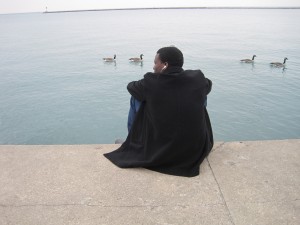
It could also be the withdrawal symptoms from the open spaces of Chicago. Truly, my Thursdays are usually lethargic, but this particular level of slowness is unprecedented and could only have resulted from my three days on Chicago’s streets. So what if I had spent a week there, or even a month? I probably would never have wanted to return here in a hurry. That city is endearing in a way that is not too pushy, yet it entices. I can’t say the same of Lagos, Nigeria where I usually always seek to escape from at the slightest opportunity. Next month will find me in Washington DC, New York (probably) and the state of Maryland. It will be a chance to compare the differences in the behaviour of big cities. Of course, thinking only of the cold, I would probably just wish that I can stay here in Edwardsville where somehow I’ve been able to adjust to the gradually lowering temperature.

I need ideas of something fun to do for one whole week, besides the Turkey-eating activities of Thursday which will take place as scheduled in the right homes of my host parents at Edwardsville.

Oh, K-the-Poet

Once upon a time, before I ever learnt to write a single word in any language, I was just a little son of a published poet. He was not always a poet to me however. He was just a man who embodied several characteristics at different times. Most times, he was just a voice on radio every Saturday. Over a period of time, I was known all around the neighbourhood of my upbringing as the son of so-and-so-the-poet-the-broadcaster. Most of those times, it was an annoying tag to have not just because it didn’t say who I was as a person but a reflection of someone else’s shadow, but also because in calling my name that way, they called unnecessary attention to me that I always sought to escape. There was no way I could enjoy the privacy of a harmless gathering of mates in a public gaming centre without being spotted and called out, like a public property: “Oh, K-the-son-of-the-famous-writer-poet-the-broadcaster. How are you today? What are you doing here? Where did you leave your shoes?” In many ways, those kinds of hide-and-seek from known faces defined my childhood, and I always swore to change my name sooner or later, either removing the connection to the-poet-the-broadcaster as a way of proving myself, or modify it in a way that left me the freedom first to be myself. I am sad to say that the scheme has not worked to total perfection, but I sometimes delight in the conceit of its pseudo-ingenuity.
IMG_0980

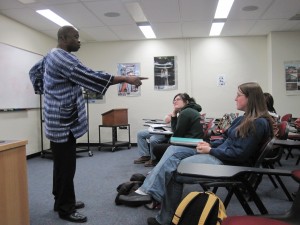
One day then, last year while applying for the Fulbright programme, I included a short anecdote of my father’s bold and brutal intrusion into my private bubble of innocence while I was young and impressionable at about seven years of age, and how that little act of defiance that he exhibited in the presence of us in class that day somewhat defined my attitude to language. What I didn’t know while writing the essay in which I had deliberately refused to mention his name was that it was not just going to be read by the American Fulbright board, but the Professors of Yoruba in the Foreign Languages department of my host institution, whose decision it would be really whether or not they wanted me in their University. Those whose essays were not impressive enough were dropped at that stage of the application. I got wind of this little gist only three weeks ago when I invited Professor A. into my language class to both assess the students, and to share a little of his experience in teaching Americans the language. Big mistake! Along with the knowledge he said he had possessed all along of the content of my Fulbright application essay, he told the whole class of how he was able to decode from what I wrote that I was K-the-son-of-the-famous-writer-poet-the-broadcaster even though he didn’t know me as a person, as well as some other flattering stories of how rich in culture the man’s works are, and how he and many in his (the professor’s) generation had grown up in Nigeria reading my father’s published Yoruba poetry publications, listening to his poetry music albums and reading his books. While the professor spoke, and I listened silently in the corner, the students all looked in awe as if there was a sudden new knowledge being bestowed upon them about the young man who’d been with them all along without having disclosed this crucial part of his person, and once in a while they cast their sights towards where I sat grinning.
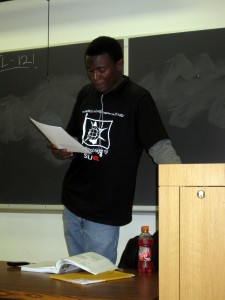
IMG_1620From then on of course, they troubled me to come to class with poems both from my father, and some from myself, and I warned them with apologies that if they were to listen to the poetry of this man in original Yoruba, the music would probably be the only thing they’d be able to enjoy, and nothing else. They agreed, and said that I’d been dishonest to have held out on them for so long a time while they told me many things about themselves. I felt guilty, went to my apartment and printed out stuff that I always kept for my own amusement, and we spent the next class listening to me read from some of the poems I had written, some from long ago, and some from recently. I also read for the first time in public, an English translation of my father’s famous love poems which I had done in 2002, and they were thrilled. One person asked if the poems were written for my mother, and I answered in truth that we like to believe so, even though the fact is that they were written long before both of them were supposed to have met. I guess that’s for him to explain.

Today, on the internet – the main reason for this post, my first literary translation effort was rewarded with a publication. I got involved in this project through a tip by friend and poet Uche Peter Umez. Hard and daunting as it looked at first, I had the task of translating a poem, Volta, written in English by Richard Berengarten, into my native Yoruba. I am finding out now that the work was translated simultaneously into seventy-five languages, including Ebira, Pidgin, Igbo, Ibibio and Hausa which, along with Yoruba, are also spoken in Nigeria. I feel quite privileged to have participated in the project because it also offers some encouragement to my reluctant muse about the prospects of literary translation – mostly of thousands of lines of poetry, this time from my native Yoruba tongue into English, for the benefit of a larger world audience. It also gives me the benefit of somehow finally being able to lay claim to being K-the-poet-translator-himself-in-person. But maybe it’s true that a goldfish has no hiding place. Ask me, I’d rather be a hummingbird.

Find the project here.