On the Election

Like the last time Obama won in 2008, I am in Nigeria when his victory was confirmed after winning Ohio. It was about 5.12am, Lagos time.

About a week after the election, the news seems to have faded, at least in this part of the world. For many people, this time around didn’t have the same fierceness as the last one anyway. Many who seemed passionate about it either didn’t know why they should care this time around since “Obama hasn’t done anything significant for Africa since the last four years”, or have strong opinions on the president’s stance on gay marriage and abortions. Somehow, it seems that the GOP’s message of social conservatism has found its way out of America which has now rejected into every other part of the world open to imported beliefs.

I have had a number of short but bewildering conversations with Nigerians about the election. One of the most bizarre went somewhat like this:

“Obama is the anti-Christ.”

“What?”

“It has been signed. By 2013, everyone will now have the mark of the beast. It’s Obama’s law.

“What on earth are you talking about?”

“You didn’t hear? This program that he signed… this… Medicare. It’s the end of the world we’ve been warned about.”

“Oh my!”

I gave up a few minutes later when it became virtually impossible to get past a perception that the president’s healthcare law was anything but that. A few months ago, under the bridge at Oshodi, I had come across some “calendars” and posters sold by local artists in which the president was portrayed with the numbers 666 on his head. Many of the other inscriptions on the poster said that the president signed a bill into law in 2009 that will mandate people to henceforth take a mark before they can be attended to… This was new to me, and till date, I still haven’t figured out how this piece of crap became news, and has now grained currency even among supposed educated folks.

I blame the cost of internet access.

In any case, back to reality, I suspect that the same reason many smart Americans elected Barack Obama is the same reason some smart Nigerians now dislike him: oil exports to the US from Nigeria has declined every year since 2009. As seen in this newspaper headline, the US economy is now on its way to some form of energy independence. If not for anything else, this piece of news should at least convince anyone who has any doubts that the president puts his country first. And that makes him a right choice for the country.

The Lost Country

This post, originally intended to be titled “Mitt Romney Hates Me” in response to the decision of whoever manages his Youtube channel to ban me from leaving any further comments after I spent last week debating with some of the commenters on one of his videos. There’s something else in the news however that is a little more disconcerting than being banned from further debate by someone who wants to be the president of the country that champions free speech and democracy. It is about the so-called investigation in the corridors of power about someone in the Obama administration leaking “sensitive” foreign policy information.

It began about a week or more ago when two consecutive New York Times articles came out one of them boasting that President Obama has a “Kill List” of wanted terrorists marked for death by the US drones that he personally supervises. The other talked about an extensive cyber war conducted by the administration and Israel in which computer systems in Iran were targeted with debilitating viruses. Responses to the two articles were mixed. The response to the Kill List article was definitely very mixed, and very weird. Republicans and other right-wing conservatives who had tried to paint the president as otherwise soft on terror suddenly found themselves faced with a well-done reportage that showed that the commander-in-chief had actually been personally conducting a strong, brutal, foreign policy. The  Left however, the otherwise human-right touting base of the president who beat up on George Bush for being such a hawkish man who misled the country into war in which innocent lives (and of some bad people too, no less), kept curiously quiet. They found no contradiction whatsoever in the image of a president who won the Nobel Prize for Peace in 2009 personally supervising the killing of suspected terrorists not yet convicted of any crimes.

Therefore, in a weird twist of fate, logic, and political identity, Democrats silently cheered that their president finally locked down the foreign policy cred (nevermind that his supervising of the killing of Osama Bin Laden already wrote him into the history of decisive leadership), while Republicans – otherwise usual supporters for whistleblowers who leak government information that show abuse/misuse of power – are now up in arms, jumping up and down, and making loud noises that the leaker of the said information should be found. Why? Because the leaked information made the president look good. Of course if the information “leaked” to the New York Times had included some embezzlement or some sort of information, these same Republicans would have been the first to find ways of protecting whoever the person is, touting him/her as a hero.

So, here’s where we are. The biggest developing news on TV today (bipartisan, nevertheless) is about the call for a private investigation, not – as you would imagine – to examine the rationale for the president himself personally supervising the life/death decision on who lives or who dies in Yemen, Afghanistan or Iraq tomorrow, but to punish whoever made that information public. The Republicans making the most noise about the call for this panel do not care much for those accused bad guys (and the innocent collateral deaths accompanying it), but they hope on some level that the investigation would lead to the president himself, and he would thus be embarrassed. Again, not so that the killings would stop or become more open, but so that he would be painted as a weak, narcissistic leader. The president himself, calling the insinuations that he purposefully leaked classified information “offensive” is investigating the leaks so as to plug it, and not really to stop or modify the draconian policy that made some mockery of his 2009 Nobel Prize and his earlier stance on the policies of the George Bush administration.

It all just seem weird to me. But what do I know. I’m just one naive observer. But all liberal observers now keeping quiet would do best to remember that Obama won’t be president forever. The spy and killer drones however, and the capability for government abuse, will.

Amercia’s Language Problem

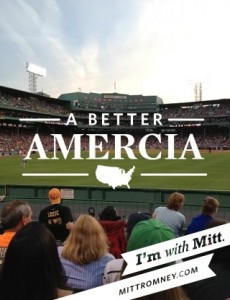
It made news sometime last week that Mitt Romney’s campaign app spelt the name of the country he is aspiring to lead as “Amercia”. A likely honest mistake, perhaps, but an unfortunate one for someone who “believes in America” and wants to “restore” it. Yesterday, they also misspelt “sneak-peek” as “sneak-peak”. One thing I’ve noticed for a long time in my internet interaction with fervently patriotic citizens of the country is how they have consistently been the most grammatically incapable. I have not been able to wrap my head around it.

On the one hand, a case can be made for the laziness of online forums, and the ease of textspeak in most cases, but when those who consistently want to “take the country back” from foreigners and immigrants are the ones most unlikely to speak the language correctly, it gets worrisome. I was old enough to remember the days of Bushisms and the profundity of ungrammaticality. Somehow, it is just seemed unbelievable that the leader of a country is not able to speak the language of its people. Yesterday, I found this, from the Mitt Romney website (emphasis, mine):

As president, Mitt will work to expand and enhance access and opportunities for Americans to hunt, shoot, and protect their families, homes and property, and he will fight the battle on all fronts to protect and promote the Second Amendment.

There was something similar said by George W. Bush sometime in the early 2000s:

Our enemies are innovative and resourceful, and so are we. They never stop thinking about new ways to harm our country and our people, and neither do we. — Washington, D.C., Aug. 5, 2004

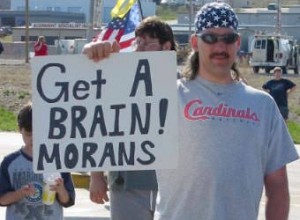
Politicians are the easiest to make fun of, not just because they are the most visible, but because they represent the collective culture of a people. I imagine that if the Queen of England made a statement of stylistic or grammatical importance on television, it will either spur a flurry of linguistic dialogue all around the academic circles of the world, or just get accepted into popular usage just on the basis of the reputation of its user . What goes on in online forums (and Tea Party rallies) however is more inexcusable. It is either that the standard of English usage in America has gone horribly low among “native speakers”, or that it has always been like that, and other world users of the language have just been fooled for centuries that a mere access to the language equals proficiency, and is also a symbol of prestige and access. After all, the same Tea Party folks (think Rick Santorum, Herman Cain, Rick Perry) are the same ones with the hardest policy positions against immigration and multicultural education.

To be clear, I have nothing against the tendency of language to move towards simplification. Heck, I even favour pidgins and creoles. It’s just a little interesting that in a world where being a native speaker of English today is still defined more by where you’re born than your level of proficiency, as many ESL teachers not from the US (who have tried unsuccessfully to get a job here and elsewhere) have sadly discovered, those people who have fought the most to keep the language/culture pure are the ones most publicly embarrassed by the repercussions. That is some poetic justice, I think, pun intended.

Exceptionalism is Overplayed

There is this weird notion that Americans are exceptional among peoples. It is one of the oft-repeated catch-phrases one would most likely find among politicians these days. Something like “unlike our president who believes that we’re just like every other country, I believe that as Americans, we are exceptional.” I have paraphrased Republican presidential candidate Mitt Romney, but he’s not alone. Heard repeated again and again, it often begins to sound something like this, between two children on a playground: “My daddy will beat the hell out of your daddy!”
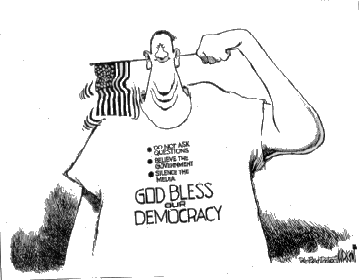
Here is a problem though: the vapid mantra has been taken so seriously by many citizens that a leading politician now thinks that it is something with which to impugn the credibility of an opponent. “Hear that America, he thinks that you’re human like everyone else. I, however, believe that you’re supermen. You’ve always been.” Before this post is accused of being anti-American, let me give a few more examples of these delusions of exceptionalism as I’ve found them all around the world:

  • Nigeria is the giant of Africa (said to a tone/attitude of superiority derived from nothing else than the fact that one in five persons on the continent today is a Nigerian or that the country has produced some of the continent’s most accomplished citizens.)
  • We are the chosen people (an oft-repeated phase associated with Judaism and Jewish identity. According to the bible, this conviction could be traced to hundred of wars and pogroms in the bible led by the leaders of the nation-states acting on direction of God. It is also a source of immense national pride).
  • A ji sebi oyo laa ri… (a saying from the Oyo people in Nigeria, translated fully as “Oyo is known only to be emulated. Oyo never emulates anyone.”)
  • We’re the superior race (from Adolf Hitler and the Third Reich)
  • Arab Exceptionalism (“a phase that prescribes that Arab nations are immune to economic modernization and democratization, or that these concepts form part of the ‘clash'”)
  • Polygamy is an integral part of our culture/Homosexuality is not a part of our culture. (One of the many vacuous polemics that surface around the African continent whenever any of those issues are raised in public discourse).
  • “Rang de Basanthi” (Hindi: “Colour it saffron” – a badge of nationalism, pride and racial exceptionalism among Indians to the exclusion of everyone else).
  • Once you go black, you never go back (A disgusting racial aphorism. Use google.)
  • I’m a man: that’s what we do/Don’t tell me what to do/What do you expect? (Gender exceptionalism?)
There are many more across different world cultures that I have come across but now forgotten. A thing common to all of them is the belief in a particular world outlook accepted as superior and as defining of the people who hold onto them. American exceptionalism, of course, falls into the same category as all of those above, and it is the reason for this post. The concept is usually defined this way: “Here is a country exceptional in its creation and survival, as well as its role in world affairs.” It is usually bonded with a demand for indemnity from all accountability. “Can’t you see? I’m American!” American television personality Chris Matthews, in debunking the Republican “slight” of anti-American exceptionalism on President Obama, often uses this defence: “Can’t you see? Didn’t you listen to the man’s election speech? He said that only in America was his story possible. President Obama himself is a product of American exceptionalism. Look at where he came from and where he is now…”

Where Chris Matthews got it wrong however is the better end of the same spectrum of Mitt Romney underhanded sneakiness. While America is really no more exceptional among other countries of the world with less colourful starting histories or world presence nor its people any more important than people in more obscure parts of the world, it is also not exceptionally unique just because a bi-racial young man from a poor home and a single mother could become its president after a long history of slavery. I agree however that these make for a very spectacular (albeit empty) polemics. There are a few more examples of such exceptionalism: Mother Theresa moving from Albania to live in India in service of the world’s poor, or Susane Wenger – an Austrian woman, who spent all of her creative life in the groves of Oshogbo learning and teaching art and spirituality (and in dying there become one of the forest’s eternal goddesses).
The undeniable fact is that humans will always thrive wherever they find themselves. The story of Steve Jobs making it out of an almost hopeless beginning to become an accomplished entrepreneur could equally have happened elsewhere (perhaps with much less flair). The son of a carpenter from a victimized culture becoming the most famous, venerated, victim of capital punishment (by crucifixion) is as much a story of Jewish exceptionalism as is the story of a black African from post-colonial Kenya making it through the ropes to become a PhD holder in the United States a case of Kenyan/African exceptionalism, as is the story of a previously obscure princess from a repressive patriarchal culture growing up in the world’s ugliest war finding herself, due to a series of coincidences, as the queen of a large empire on which the sun never set – a case of British exceptionalism. Here’s Brazilian exceptionalism: defy all odds of a third world/developing country and win gold in (almost) every World Cup in which your country participates.

My conclusion here – as might by now be clear – is that there either is something of a human exceptionalism – defined by great success in spite of all odds – common to every culture and people on the face of the earth, or there is no such thing as exceptionalism, and we’re all just as unique as we are different. Nationalism and patriotic/religious credos are usually more disingenuous than the words in which they are couched tell us, and they have not always led to an improvement on the condition of human well-being. Politicians should therefore find something more stimulating to spend their time talking about, as should all blindly-following fanatics.