Monolingualism Worries

This article in the New York times examines the oft-repeated claim that Americans are mostly monolingual, monolingual by choice, and fare worse in the world precisely because of it.

The claim, it seems, is the same as (or similar to) an old argument between whether literacy equals sophistication, or whether someone without (Western) education in a developing country is smart enough to correctly adjust to the complexity of the (21st century) world. There is no substantial evidence to support the “for” argument, of course, as those with brilliant, sophisticated yet uneducated grandparents will attest, but the discussion is one that underlies much of today’s governmental and social intervention in local, traditional ways of life.

I am a linguist, however, and thus will remain on the side of multilingualism – and multiculturalism – as an important, yet fascinating, catalyst of social change.

Exceptionalism is Overplayed

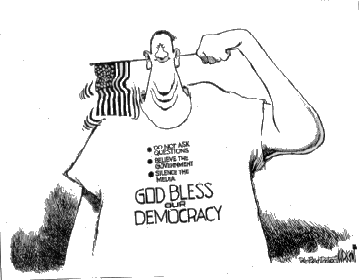
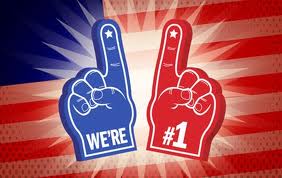
There is this weird notion that Americans are exceptional among peoples. It is one of the oft-repeated catch-phrases one would most likely find among politicians these days. Something like “unlike our president who believes that we’re just like every other country, I believe that as Americans, we are exceptional.” I have paraphrased Republican presidential candidate Mitt Romney, but he’s not alone. Heard repeated again and again, it often begins to sound something like this, between two children on a playground: “My daddy will beat the hell out of your daddy!”

Here is a problem though: the vapid mantra has been taken so seriously by many citizens that a leading politician now thinks that it is something with which to impugn the credibility of an opponent. “Hear that America, he thinks that you’re human like everyone else. I, however, believe that you’re supermen. You’ve always been.” Before this post is accused of being anti-American, let me give a few more examples of these delusions of exceptionalism as I’ve found them all around the world:

  • Nigeria is the giant of Africa (said to a tone/attitude of superiority derived from nothing else than the fact that one in five persons on the continent today is a Nigerian or that the country has produced some of the continent’s most accomplished citizens.)
  • We are the chosen people (an oft-repeated phase associated with Judaism and Jewish identity. According to the bible, this conviction could be traced to hundred of wars and pogroms in the bible led by the leaders of the nation-states acting on direction of God. It is also a source of immense national pride).
  • A ji sebi oyo laa ri… (a saying from the Oyo people in Nigeria, translated fully as “Oyo is known only to be emulated. Oyo never emulates anyone.”)
  • We’re the superior race (from Adolf Hitler and the Third Reich)
  • Arab Exceptionalism (“a phase that prescribes that Arab nations are immune to economic modernization and democratization, or that these concepts form part of the ‘clash'”)
  • Polygamy is an integral part of our culture/Homosexuality is not a part of our culture. (One of the many vacuous polemics that surface around the African continent whenever any of those issues are raised in public discourse).
  • “Rang de Basanthi” (Hindi: “Colour it saffron” – a badge of nationalism, pride and racial exceptionalism among Indians to the exclusion of everyone else).
  • Once you go black, you never go back (A disgusting racial aphorism. Use google.)
  • I’m a man: that’s what we do/Don’t tell me what to do/What do you expect? (Gender exceptionalism?)

There are many more across different world cultures that I have come across but now forgotten. A thing common to all of them is the belief in a particular world outlook accepted as superior and as defining of the people who hold onto them. American exceptionalism, of course, falls into the same category as all of those above, and it is the reason for this post. The concept is usually defined this way: “Here is a country exceptional in its creation and survival, as well as its role in world affairs.” It is usually bonded with a demand for indemnity from all accountability. “Can’t you see? I’m American!” American television personality Chris Matthews, in debunking the Republican “slight” of anti-American exceptionalism on President Obama, often uses this defence: “Can’t you see? Didn’t you listen to the man’s election speech? He said that only in America was his story possible. President Obama himself is a product of American exceptionalism. Look at where he came from and where he is now…”

Where Chris Matthews got it wrong however is the better end of the same spectrum of Mitt Romney underhanded sneakiness. While America is really no more exceptional among other countries of the world with less colourful starting histories or world presence nor its people any more important than people in more obscure parts of the world, it is also not exceptionally unique just because a bi-racial young man from a poor home and a single mother could become its president after a long history of slavery. I agree however that these make for a very spectacular (albeit empty) polemics. There are a few more examples of such exceptionalism: Mother Theresa moving from Albania to live in India in service of the world’s poor, or Susane Wenger – an Austrian woman, who spent all of her creative life in the groves of Oshogbo learning and teaching art and spirituality (and in dying there become one of the forest’s eternal goddesses).

The undeniable fact is that humans will always thrive wherever they find themselves. The story of Steve Jobs making it out of an almost hopeless beginning to become an accomplished entrepreneur could equally have happened elsewhere (perhaps with much less flair). The son of a carpenter from a victimized culture becoming the most famous, venerated, victim of capital punishment (by crucifixion) is as much a story of Jewish exceptionalism as is the story of a black African from post-colonial Kenya making it through the ropes to become a PhD holder in the United States a case of Kenyan/African exceptionalism, as is the story of a previously obscure princess from a repressive patriarchal culture growing up in the world’s ugliest war finding herself, due to a series of coincidences, as the queen of a large empire on which the sun never set – a case of British exceptionalism. Here’s Brazilian exceptionalism: defy all odds of a third world/developing country and win gold in (almost) every World Cup in which your country participates.

My conclusion here – as might by now be clear – is that there either is something of a human exceptionalism – defined by great success in spite of all odds – common to every culture and people on the face of the earth, or there is no such thing as exceptionalism, and we’re all just as unique as we are different. Nationalism and patriotic/religious credos are usually more disingenuous than the words in which they are couched tell us, and they have not always led to an improvement on the condition of human well-being. Politicians should therefore find something more stimulating to spend their time talking about, as should all blindly-following fanatics.

Break Time/Tone

I will not blog much this week because I feel a little overwelmed. On the bright side, I have Steve Jobs’ authorized biography to get through to take some of the stress off, along with a few other materials in my thesis development.

On that last bit, a question for language students: does anyone have a guess as to why (American) English speakers have problem with tone in language? Yes, they are not used to tone languages because English is intonational. But they never have such problem with music which also works with tone levels, so what’s going on? Here’s more, when researchers who have looked at the matter say that one of the reasons for poor tonal acquisition by American/English learners is the limited “pitch range” of such learners, what exactly do they mean? English speakers are humans too and pitch is physiological and not something tied to race or skin colour. I have looked everywhere online for information about this and I haven’t come up with much.

I can do with some brainstorming session here.

Defining Racism Wrong

I have come across this pernicious argument more than a few times now, and lately from Donald Trump and the “Hercules” actor Kevin Sorbo who appeared on Fox News yesterday to make the same point. The argument goes this way, that those who complain about Tea Party racism should direct their anger at what is the real racism: the fact that over 95% of black people voted for President Obama in 2008.

Sigh.

And there I was thinking that I live in a country that speaks English as its first language.

Sigh.

So here it goes, the real problem with that really pernicious argument: racism is defined as “the belief that inherent different traits in human racial groups justify discrimination.” I’ll break it down: racism is deciding that someone should NOT get something that everyone has access to, just because of the colour of their skin.

So, here again is a reason why it is less likely that it is racist that Obama was voted overwhelmingly into the White House by an overwhelming black vote: by the time he was voted as president, he was the first person of his race ever to get that close to a position that had been dominated for hundreds of years by people of a certain race.

I’ll make another analogy. Imagine these scenarios.

A: There is a school somewhere in the world which for four hundred years had admitted only people of a certain height/hair colour/dentition etc, and then one day, people who have for that period of time had been excluded from that process found a candidate that qualified as an outsider and was overwhelmingly supported – along with other support from the people who hitherto had that privilege. The student shorter than the average height requirement/hair colour/dentition is finally admitted, and everyone is happy.

B: There is a school somewhere in the world in which only one shorter/different-hair-coloured/wrongly-dentitioned student was recently admitted after about four hundred years. He is about to be removed by an overwhelming majority of the “establishment” regular people for no other reason that made sense, or had been applied for other “regular” people up until then.

Now, here is my conclusion. There is absolutely no evidence from the above to show that there is racism in any of the two scenarios A and B. Perhaps.

But…

It is MUCH LESS LIKELY racist that an underdog is collectively SUPPORTED to get equal opportunity, than that an underdog is collectively DENIED access to equal opportunity. And this is where Sean Hannity, Hercules, Donald Trump, and all the others got it wrong.

And here is one more thing. There is a clear difference between racial and racist politics. It is racial politics to vote for someone on the basis of their skin colour, but not necessarily racist. It is however clearly racist (as well as racial) to try to remove someone from a position because of their skin colour. The difference is the harm inherent in only one of them.

And here is one more thing I found on a Youtube comment: “black (and other minority) people, until 2008, have voted 100% for white candidates.” How racist is that?
Vernacular vs David Starkey. 1:0

This part of what British historian David Starkey said in a moment of careless rage at the weekend caught my eye immediately after he had initially said that a ‘violent, destructive and nihilistic’ black culture had corrupted too many of Britain’s youngsters:

‘A substantial section of the chavs have become black. The whites have become black. Black and white, boy and girl, operate in this language together . . . which is wholly false, which is a Jamaican patois that’s been intruded in England, and this is why so many of us have this sense of literally a foreign country.’ (Read more)

Some phrases immediately pop out here: “nihilistic black culture”, “this language… which is wholly false”, “Jamaican patois that’s been intruded in England…” It would take a very long essay to respond to the slight of “nihilistic” being used to refer to a culture which the British empire spent much of the last hundred years stealing from in form of artifacts that now decorate the British Museum and private collections over the country. No, the part that interested me the most was a claim that the Jamaican patois (1.) is a false language and (2.)  has been intruded (sic) in England (3.) is the cause of the violent culture among today’s youths black and white in England as well as a carrier of “black” culture. (Video here)

Coming from a layman, the false claim that any form of vernacular itself derived from English is so strange as to make an English speaking country seem like a foreign country seems silly enough, especially if that layman lives in a country that has some of the most unintelligible dialects of the same language in the world. But when a historian says it on national television to an audience already looking for a scapegoat in a national crises, then it takes on a totally different meaning more than just a rambling of the uninformed. What is more likely is that he was addressing his remarks not to the smart section of the populace but to the angry ones. I imagine a scenario in which any citizen of the United States would feel like s/he is living in a foreign country because all young people now speak in African-American Vernacular English as a result of a cultural movement. Highly unlikely. But that could be because the United States has evolved far ahead of Britain in its racial identity.

Yet, if that were the case, not only would it be an at least totally understandable social and cultural phenomenon, it would also be justifiable under one of the best known phonological facts: that language tend towards simplification. Most young people in America today have gone from using “You are” and “You’re” to using “Your” as a perfectly normal pronoun i.e. “Your the man of my dreams.” Other pronouns “he”, “she”, “it” have not yet undergone the same transformation. I have already started planning for a day when I would see the expression simply written as “Yor” while the rest catch up with the various forms of simplification: “Hez” “Shez” “Their” etc for “He is”, “She is” and “They are”. The ONLY thing it tells us is that humans like to make speaking easy and fun for themselves more importantly than anything else. It has nothing to do with skin colour, race or culture. Patois evolved howeve – just like other world creoles – as a pidgin made from an unusual contact of two strange languages. It is not by any chance an “easy” or “false” language. If its appeal has now spread to the level of popular acceptance within youths in a country far from its birthplace, it is more of a validation of its language status rather than its “falseness”. The English language as we know it today also evolved from the fusion of languages, dialects, and vernaculars from the old Germanic and Romance languages.

And we have not even talked about the (albeit annoying) false causality between speaking patois (or any vernacular for that matter), and gang violence. But then, David Starkey is not a linguist. He’s just a flawed historian, and more, even a poor speaker of English.