One of the things that fascinated me about Kenya – though it shouldn’t, since we share a similar trait in Nigeria – is the robust multilingualism of its streets.
 The peculiarity of the Kenyan experience is that there are at least two (actually, mostly three) layers of common languages with which citizens can communicate before they get to the local language (L1) on the fourth rung. On the top is English, which – through colonialism across the continent – has become the default language of contact, official business, and school. However, unlike Nigeria where the local language has seen a fast retreat, Kenya has another layer covered successfully by Swahili. Swahili is a trade language which originated from the coast, consisting of elements from Arabic, and a Bantu language of contact which no longer has an original indigenous speaking population. The third layer is what’s called “Sheng”. It is the closes to Nigerian Pidgin, and it’s used, mostly among young people, as a way to interact within the first two languages, and the local languages of the fourth layer. That fourth layer is the most fractured, just like in Nigeria. It is where the local languages flourish in different colours: Luo, Kikuyu, Kikamba, Kalenjin, Maasai, among many others. According to Ethnologue, there are about 68 languages spoken in Kenya.
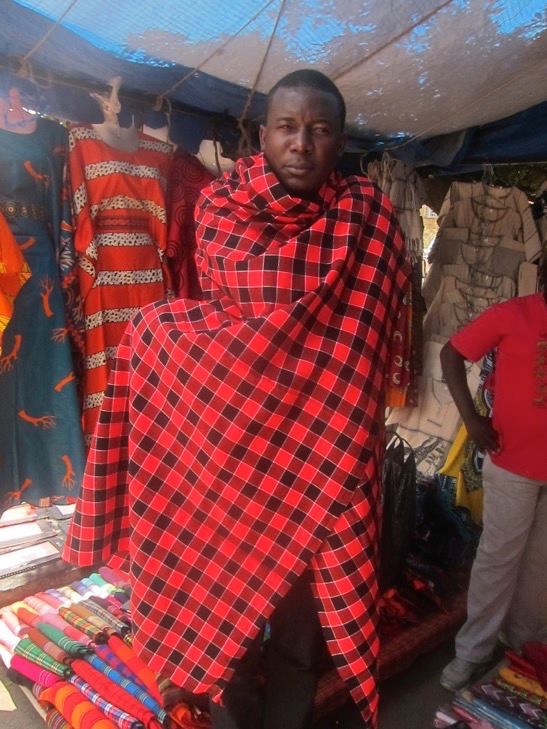 But no, what fascinated me the most is not the use of these many languages, with pride, by people around the country and in the schools, and government offices (though that already offers a stark contrast to the current Nigerian educational policy where local languages are no longer even offered as subjects in our high schools, leading to a future language extinction and cultural attrition. That was saddening enough.) I was more fascinated by the acquisition – in spite of this already complex linguistic situation – of even more languages by many Kenyans working in the informal sector, in order to make more money from foreigners wanting to go on a Safari. It turns out that the presence of foreigners from Italy, Germany, Spain, Portugal, India, etc in the country has created a demand for tour guides fluent in any of these languages as well as the local rules and survival guides needed for a successful expedition. Smart business consideration in the face of this huge demand then necessitated the existence of formal and informal schools where locals can acquire sufficient competence in these languages enough to earn foreign exchange for their tour-guiding efforts. Within the one week of my stay in Nairobi, I spoke with at least two people – one a cab driver, and another a seller of artworks at the Maasai market – who claim to have become fluent in Spanish and German respectively, which had helped them earn more money as tour guides of visiting foreigners. A fascinating discovery.
Swahili itself has already achieved international appeal, especially in Black America. For some reason, over several decades, the language imagined to be spoken by ALL of Africa has, for a while, been seen as Swahili. And from Lionel Ritchie’s Hey Jambo Jambo to Michael Jackson’s murmurs in “Liberian Girl”: Nakupenda pia, Nakutaka pia, penziwe (I love you, I want you, my love), to the famous Malaika song by Mariam Makeba and Angelique Kidjo, and even to the Kwanzaa holidays of African American families, Swahili already made its way into the international mind as the only umbrella African language. Taraji P. Henson’s middle name is Penda, the Swahili word for “love”. What’s next then, perhaps, is an enrichment of that language’s own home environment with this intermittent tourilingualism that brings with it a colourful open door.
In the end, everyone wins, mostly. For years to come, Nairobi (and the rest of Kenya, as a result) will become more multilingual, and visitors – by some luck – will also learn to speak some Kiswahili as a way to interact with their new host environment. No one is threatened, and both parties learn something of the other. Rather than a depletion of the linguistic heritage of this magical place, we have an addition, certainly in economic but also perhaps also in cultural dynamism. We may not be able to say the same for the fauna, of course, but let’s take baby steps, shall we?