Well, for a start, let us all agree that this fabled world doesn’t exist anywhere except perhaps on the internet. A Nigerian on a three-hour stopover at Heathrow will not be allowed into London for fear, perhaps, that he will suddenly ditch his American visa and decide to live in the fruitful fields of England forever, eating clover, beans and mangel-wurzels. A Turkish citizen hoping to visit any European capital will usually need a shengen visa or should just not make an effort. It all makes sense, doesn’t it? A few years ago, all anyone needed to visit Kenya from any part of Africa was a passport. Then after 1998 embassy bombings by a few radical thugs, everyone needed a visa, including neighbouring Ugandans.
 The concept of national borders is fascinating, and mostly annoying. Take for example the problem of driving from Lagos to Dakar, a stretch that will be similar to one from Minneapolis to St. Louis just as soon as we can ignore the useless police checkpoints along the borders of the “countries” along the way. Once upon a time, West Africa was just west Africa, with contiguous autonomous kingdoms and no fake borders manned by corrupt men in khaki uniforms. Now, the Yorubas are not just Yorubas. They are Nigerians, Beninoise and Togolese, and this doesn’t prevent them from the harassment of faux obstacles placed on a road leading from one part of the continent to the other.
The last time we had the Ambassador of Kenya to the United States on campus, I asked him why it is taking African politicians so long to realize that artificial obstacles at national borders created more problem than it solved, he gave a platitude. And then I switched on the news and heard that even the United States is now considering building a wall – yes you heard right – a wall between itself and Mexico, this time to prevent the problem of illegal migration. Yet, all migrations are legal, as we all know, as the basis of human civilization, and change. Is there a point to my rant on this post? I doubt it, but I’ve spent some time pondering the idea of human migration for a while now. I think my most recent motivation is the discovery of an interesting fact that humans – no matter where they find themselves – would always prefer migration at some point in their life, than staying in the same spot. Yes, that applies to Americans too.

 One day very soon, I am convinced, I will write a post on this blog that might begin with words like “tttoooeddydyy isssss teiehehe ffirissttt ddyofff snoeoow”, which would only mean that I was cold, freezing and shivering enough not to be able to edit simple sentences. I am convinced that that day is very, very soon. In fact sooner than I expect. Yesterday was my coldest night ever in Edwardsville and it reached -3degrees by my blog temperature meter, and 30degrees Fahrenheit. Even my bed now is too cold for comfort. Very soon I won’t have to go out to feel cold, and I am not looking forward to that.
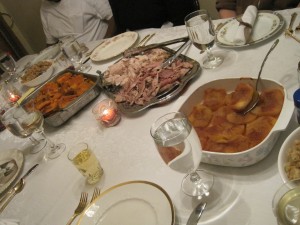 Meanwhile, I’ve just returned from another day of feasting – probably my last of the Turkey Genocide season. This time, to the house of my “official” host family: the Indian father and the American mother. The special attraction was another visiting family from Chicago, who were originally from Nigeria. It had a father, let’s call him Dr. O, his wife, and two kids who would not speak Yoruba to me however I tried to make them. They were born in Nigeria but have lived in the States for a long time that they have become Americanized in dressing, speech and conviction in a way that could have been bad if it had hampered their cultural awareness. Apparently it hadn’t, and although they would rather not communicate in the language, they had a kind of cultural awareness that could only have resulted from good upbringing and appropriate socialization. To them, I must however have been a special kind of attraction as someone sent specifically from the home country to teach Americans the language. But if that was the case, I didn’t notice it. It was mostly a gathering of laughter, wine, food, and practical jokes. The first born of the Dr. Os is married to a beautiful American girl who was also present, and who I am discovering to be a masters student of my University as well.
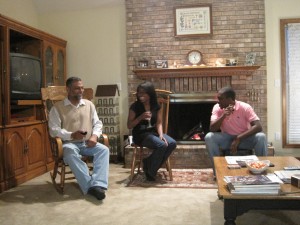 In gatherings like this, I am almost always bringing back the topic of language and awareness, and here’s how Dr. A, my Indian host rationalized it from his reading in German, Indian, Irish, French, and African migrations to the United States: First generation immigrants usually speak and understand the language, being a product of the two cultural experiences, and usually try to pass it along to their children. Their children – the second generation with little connection to the cultural experience of the homeland beyond their parents’ teaching usually become rebellious and toss out the language and cultural ideas of their immigrant parents while opting for the American way of life. It is the third generation however – without any link whatsoever to their original culture and language, according to him – who make the most effort to reconnect with their grandparents’ cultural base. This, obviously, is because they are usually the ones without an anchor. They most experience the feeling of homelessness and limbo, and usually find themselves going back in research to connect with what they feel most deprived of. According to this theory, it is only a most natural process when children of first generation immigrants try to become “Americanized”. And everything made sense to me.
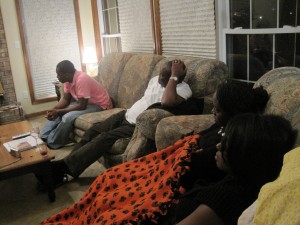 However, contrary to the seriousness of this last discussion which actually took place in the car drive back from his house, the atmosphere of the get-together was one more of conviviality, guitar playing, joking and generally fooling around. It was like one of those old times of my upbringing when I sat around my siblings on an idle night after a game of cards, just tossing around all the craziest ideas in the world, laughing, arguing and generally being silly. I bring it up here because now that I think about it, I suddenly miss those times when all that mattered was who had the silliest ideas, and we would stay up all night singing, scrawling on the wall, or decorating the house for Christmas with little coloured paper decorations cut out and sealed with pap syrup and stretched across the house ceiling sometimes with multicoloured Christmas lights. It is usually towards this time of the year as well when we begin to learn new Christmas songs or make a fool out of the old ones, all the time trying to be careful not to make too much noise that could get us the beating of our lives. Oh the times we had. Tonight, I’m convinced that we could never get back that memorable childhood in the same old form we enjoyed it, but I look forward to a grown-up future recreation of those experiences, this time along with nieces and nephews, and a bigger happier family. Some day soon folks…