Abayomi and I

In this guest post, children’s story writer Ayodele Olofintuade writes a autobiographical account of growing up with her brother in Nigeria. It’s reproduced her as cross posted on her blog totallyhawaya-haywire.blogspot.com.

_____________________________________

… At five years old

“What’s the west of the stowy?” He asked staring at the pictures in the comic book

“The oko baba dudu first!” I said making a grab for the sweet.

He clutched it tighter, “Who is that man standing behind Spiderman?” He pointed at the comic.

“Oh he’s just there.” I said dismissively. “You promised to give me the sweet if I read the comic to you.” I said eyeing the oko baba dudu anxiously. In spite of the fact that I am three years older than Yomi he’s always one step ahead of me.
“What is this man doing there?” he repeated holding up the comic.

“How will I know? There is no balloon coming out of his mouth.” Then it dawned on me that Abayomi has no intention of giving me the sweet, so I made a grab for it . Abayomi gave the loud screech that always fetched our mother from wherever she was … I snapped my fingers at him. “I will show you! Mcheew!!” I know when to run …

“Wale! Biodun!!” he called his friends. “I have finished weading the comic. But you have to give me one oko baba dudu each before I tell you the stowy … is it me that said you should not know how to wead like me? … This is spiderman and the other one is emm… emm, …superfly…!”

***

… And then he turned eleven

“But why is your cousin not talking now?” Jide said, eyeing my ‘cousin’ who is dressed up in a black mini skirt with a pair of very high heels and a big afro wig.

“I told you she’s mute, she can hear you but she cannot talk.” I said smiling at my ‘cousin’ as she applied … no smeared… more lipstick on already blood red lips and added powder to a ghostly face.

“But that your cousin looks like Yomi.” Jide said staring at the huge boobs straining at the tee-shirt.

“Wo Jide, I’m tired of this jare, do you want a girlfriend or not? She will allow you touch one of her breasts, just pay up.” I held out my hand for the twenty naira. Jide reluctantly handed over his life savings to me, his eyes still glued to my ‘cousin’s’ balloons… “Are you sure she will let me touch th…the…them?”

“You can take your 20 naira back if you don’t trust me.” I watched with disgust as Jide started squeezing one of the big pimples on his face … no wonder he doesn’t have a girlfriend.

“Where is Yomi?” He asked as he dipped a finger inside one of his nostrils.

“He’s in Lagos.” I said haughtily. “Come back around 8.30pm, my cousin will wait by that door.”

“It will be too dark.” He whined

“You did not say you want to see a breast you just want to feel it, so you don’t need light. You have to leave now, mummy is back.” I said pushing him through the door.

“Good afternoon ma. Bye-bye.” Jide said as he ran off.

“Abayomi what are you doing in my shoes … my wig and my make-up?” Yomi stood up from the chair and nearly fell off the heels he was wearing.

“Get that muck off your face. Go and change. What’s that on your chest? The balloons I bought for Oba’s birthday abi? Don’t worry; I’ll get to the bottom of this later. I hope you’re done packing because the taxi that will take us to Lagos is waiting outside…”

***

… Yomi at 34

What fun we had in those days didn’t we?

_____________________________________

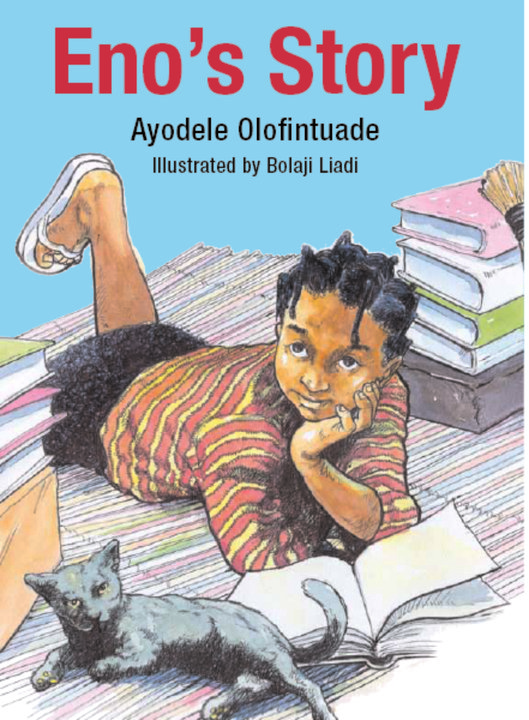
Ayo is the author of a forthcoming socially-conscious children’s storybook titled Eno’s Story scheduled to be published by Cassava Republic.
Knowing The Granite City

My first intimation with Scotland beyond the picture of men in “skirts” in glossy magazines must be in the movie “Rundown” where a Scottish pilot kept saying “There are bills on the grind” when he meant that there were bulls on the ground. And then there was Craig Fergusson and a few other guys whose accents just keep you glued to the television because you can’t get enough. In this guest post, my friend and blog commenter Bukola Olawuwo writes about her experience in Aberdeen, Scotland’s third most populous city. It has an estimated population of 210,400 citizens. Enjoy.

___________________________________________

I always had a good laugh in the months before my arrival in Aberdeen when I informed people that I was going to Scotland. Isn’t that the place where men wear skirts? They’d say. I laughed in part because it was funny and because although I knew that men wouldn’t be running around all day in skirts, I too thought of it as “the place where men wear skirts”

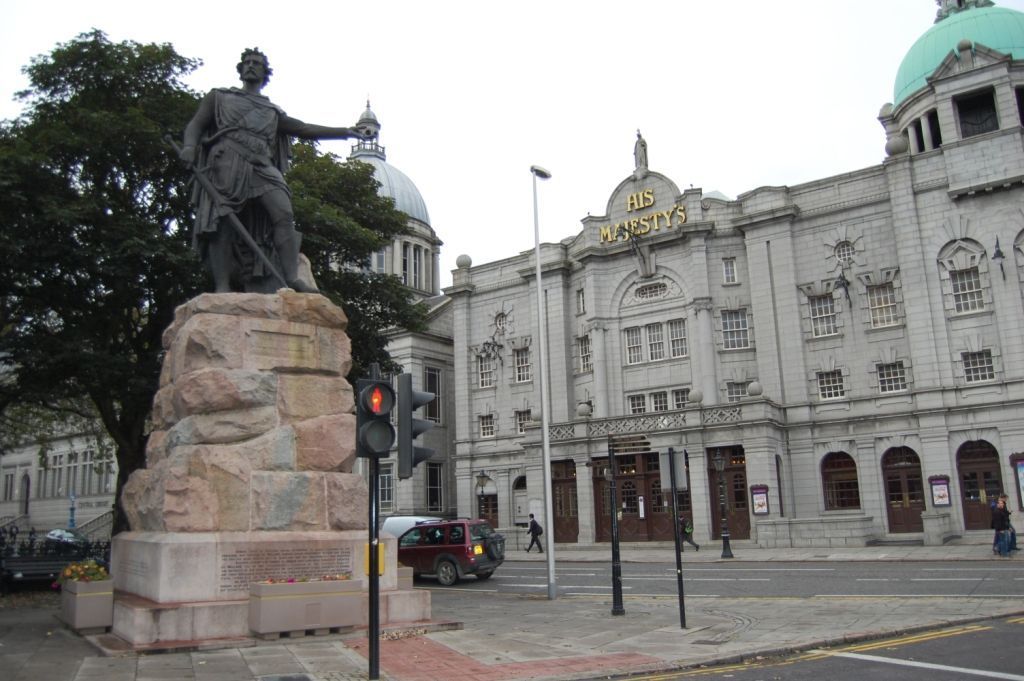
It was not the skirt-clad men that grabbed my attention on my arrival though. It was the colours – or lack thereof. Every building was the same colour. Grey. My first thought was that there was a law against paints in this city. I would later learn that many of the city’s buildings constructed between the 18th and 2oth century were built with granite sourced from the city’s Rubislaw Quarry which is also said to have produced granite for paving streets in London. This earned the city the moniker the Granite City.

Of course, new, painted buildings have sprung up but these are few and far between, creating the impression that all Aberdeen buildings are the same. I for one will never forget the confusion that my inability to differentiate one building from another caused in my first few weeks here. I got lost so many times that I lost count. And I’m clueless with maps, so there goes…

Since I can’t read a map to save my life, I had to depend on people. This was another induction into the city. I found that the Aberdonian accent is a complex one, depending on the indigene’s particular area of origin. It is characterised by harsh R’s and of course there’s Doric. Doric is the local dialect/accent spoken in Aberdeen city and county. It is a variation of English but an advisory warning would probably read “interpreter needed”! My friends and I have had fun trying to decode some of the words amidst thanksgiving that none of our tutors has the acute version of the accent – that wouldn’t have been fun. A personal favourite is the word sorry which if spelled the way it is pronounced could be either “sorree” or “sorrai”, with extra emphasis on the ‘r’. Whereabouts are you going would be “far aboots are ye gaun”; no equals “nae”; house equals “hoose”…and I thought I’d be the one with an accent!

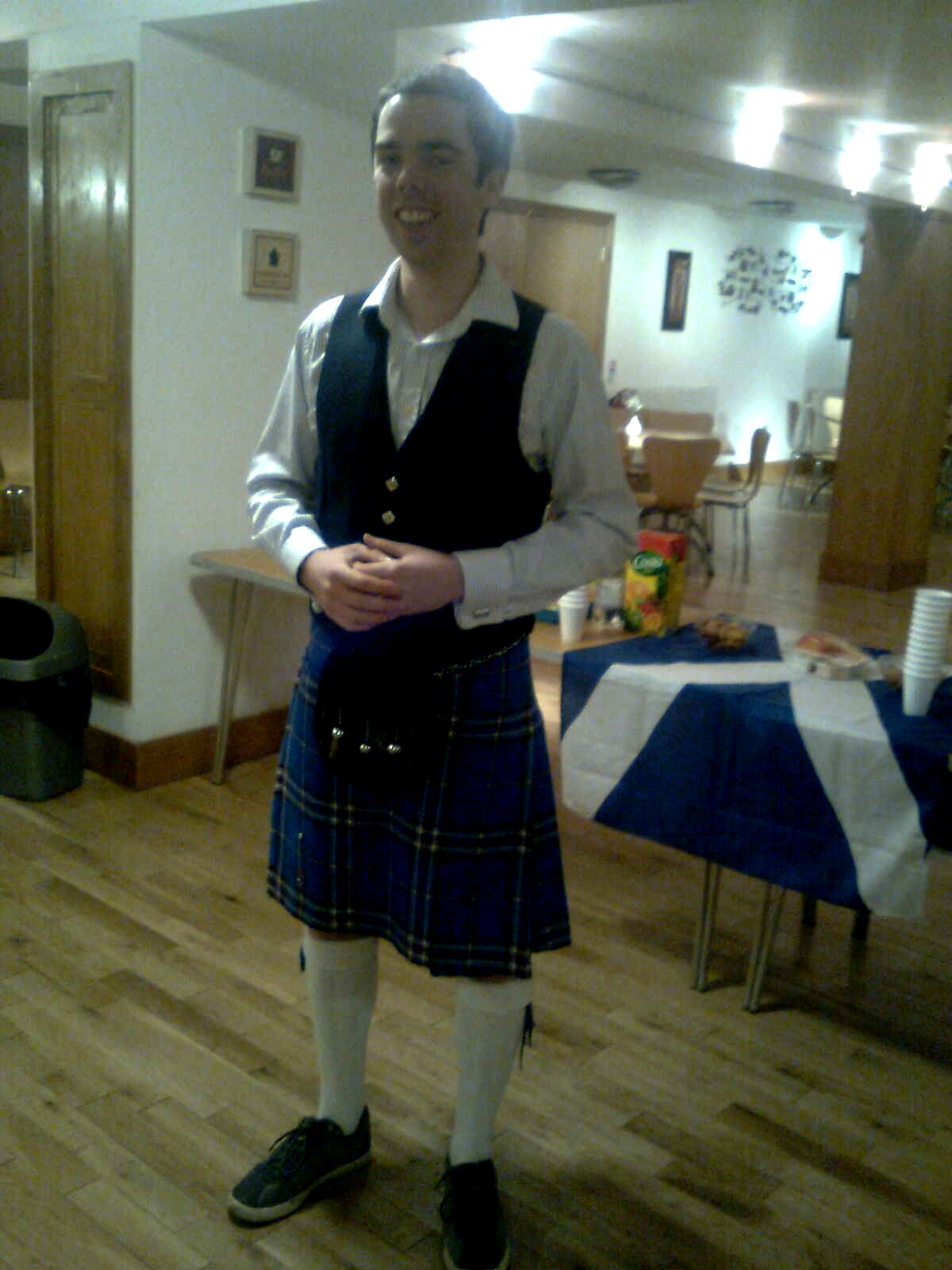
Behind the interesting accents are an equally interesting people. Aberdonians and indeed Scotsmen are very proud; of their culture and heritage. Such is their pride in their region that many are agitating for an independent Scotland; independence that is, from the collective known as the United Kingdom. This pride sometimes makes me feel a pang of shame at the new generation of Nigerian parents who proudly announce that their children don’t speak their native dialect or youths who refuse to wear African fabric. Yes, the men really wear kilts but only for ceremonial purposes and trust me, it takes either national pride or utter madness to wear a kilt in a temperature of minus 16 degrees celsius!

And madness is how the weather feels at times. We’re up North you see, so we have a customised version of the cold that’s a common feature of Scotland – an extremely colder version. And there’s the rain which never pours compared to what we get back home but is a fixture, regardless of the season. I once remarked to someone that I was living for the summer, couldn’t wait to feel warm again. She smiled at me and said “oh summer. In Aberdeen, we rock our sunshades and jackets simultaneously”. Oh well, I’ll survive.

Key to my survival here are the numerous African and Asian shops.  They cater to the needs of people like me who’re sceptical about experimenting with food and those who just want to give themselves a treat from ‘home’. I have tried some Scottish food though, my favourite being Pea and Ham soup. My reason for liking it wouldn’t be far from the fact that it tastes a lot like gbegiri with strips of meat in it; only this one is eaten on its own, not with some heavenly amala…(sigh). Haggis, a dish made from sheep’s innards is another favourite. I hear the younger generation don’t quite like it because of the ingredients used and a peculiar traditional method of preparation. Me? I grew up eating delicacies like shaki, ponmo and roundabout – of course I love it! 🙂

Seven months, snow, freezing February and lots of delicious haggis later, I can tell you that my story about Aberdeen has changed – to a large extent. When the day comes that we do not get four different seasons in one day, I just might love it but since the likelihood of that happening is almost zilch, I’ll just say, it’s a lovely place to be or as we say here, nae bad at all 🙂

___________________________________

Bukola is studying for her masters in Corporate Communication and Public Affairs at the Robert Gordon University Aberdeen. Previous guestposts can be found here.

Thank you very much Bukola. A lovely postcard from KTravula.com is coming your way.

Measuring Blackness

This is a guest-post by the brilliant Nneoma Nwachucku of Pyoo Wata Blog. She is an American of Nigerian origin, and in this article she explores the very many dimensions of being African American even though none of her ancestors was brought to the United States as a slave. Race obviously is still a very interesting issue since being African itself is not limited to being black, except we intend to exclude fair skinned Arab North Africans in Egypt, Sudan and Northern Nigeria; White, Jewish and Indian South Africans; and the now indigenous White residents of Zimbabwe – which won’t make any sense. Anyway, enjoy the interesting piece.

Previous guest-posts can be found here.

_______________________________________

Despite protests from my family members and other Nigerians in my community, I consider myself first and foremost African American. Personally, it has taken quite some time for me to embrace this realization. And personally, I grew tired of explaining the contradictions inherent in adopting dual citizenship from two very different nations.  You see, I straddle between two different communities, one foot in Nigeria, which I fondly refer to as home; and foot planted in the United States – where I currently pen from. I am African American in the truest sense of the word – an African living in America. Yes, if we parse it down, I could very well label myself as Nigerian American, Igbo American…Ohuhu American (?). It can get unnecessarily specific. In light of this I still, towards the end of a survey or application, proudly place my check next to “Black, African American.” <– Can someone tell me when the US Census will decide to drop the word “Negro” from its lexicon…forget being politically correct, it’s just redundant.  I get it, I’m black – I don’t need a reminder in Portuguese…anyway, I digress.

The African-American experience, I have come to find, is an incredibly diverse one. We include those whose ancestry stems from the trans-Atlantic slave trade, to recent Haitian immigrants, to black Londoners who now call the US their own.

Even those who find their roots strongly laid in the soils of long-forgotten Southern plantations are themselves brimming with a rich genetic diversity, featuring parentage from Caucasian, Native and other American sources. Though popular news sites and blogs during the 2008 US presidential campaign season continued to argue about whether to classify President Obama as black, white, or biracial, I still maintain that he is the first African American president of the United States. Heck, if word got out that Puerto Rican American Supreme Court Judge Sotomayor’s great-great-great-great-great grandmother may have been black, I’m claiming her too.  Lord knows we need all the good press we can get.

In light of our differences, I always thought that it would be a difficult task to pin any one cultural experience as that which defines our blackness, particularly here in the US. However, these days, I stand to be corrected.

“…uknowurblackwhen…,” read the title of a recent article from an online black magazine I read a while back. The article sought to explore the story behind a Twitter trend in which black twitterers would key the strokes #uknowurblackwhen followed by their perception of shared African American experiences. Being a moderately avid black twitterer myself, I was familiar with this trend before reading the article. Though my familiarity with this phenomenon was merely limited to the only “uknowurblack” tweet I received from a follower, who admitted we both failed to meet several of the standards posed by our fellow African American twitterers.

No, I don’t … “drink Koolaid from the pickle jar” (old butter tubs, yes).

Nope, I do not have in my possession…“a busted car with a bangin’ sound system” (both car and sound system are “busted,” thank you very much).

My fake hair pieces (weaves) are not the most expensive items I own.  See above re: busted car with busted sound system.

Later, upon checking out several of the “uknowurblack” tweets, I found I had more in common with those followed by the “uknowurnotblack” tags.

The quest to define what it means to be African American is not a recent phenomenon nor is the discussion limited to playground fights, casual tweets, and heated debates in the media. Many in the social sciences are aware of the African American Acculturation Scale (AAAS) which seeks to assess the extent to which an individual has adopted the culture, attitudes, and behaviors of blacks in America. The scale is based on eight parameters, which include items such as religion and superstitions, disposition towards race relations and interracial relationships, and interestingly – “a preference for African American things.” While this scale could be somewhat predictive health outcomes, voting behaviors and the like, I contend that it is hardly reflective of the actual African American experience, which comprises of a melting pot of different groups and nationalities. The notion of a “traditional” African-American who represents all of us, is one I find problematic. The traditional African American person flies in the face of our everyday realities as a varied group of black males and females living and thriving in the United States.

If there ever were to be a black version of the Statue of Liberty, I imagine that she would daily call out for the black, “huddled masses yearning to be free,” regardless of whether these masses hail from grassy New England suburbs, rural communities in North Carolina, or the cosmopolitan reaches of Lagos, Nigeria. “Send these…to me,” she cries. And she would take us – all of us – just as we are. (Take that, you anti-immigration psychos out there) …I kid ;).

____________________________

The piece first appeared in the Clutch Magazine. Nneoma can be found on twitter at http://twitter.com/pyoowata.

My Mum and I

This is a guest-post by Temitayo Olofinlua, who recently won the WLP essay competition in NY. She is also a co-administrator of the Bookaholic Blog, and she sends this from Lagos, Nigeria. Today is Mother’s Day in every other part of the world except the United States, I think, so this piece is just as apt. I can relate to much of what she says. How many of us have mothers like that? Also for one more thing: tomorrow is my mum’s 60th birthday. Enjoy the piece. Previous guest-posts can be found here.

___________________________

My mum and I are not best of friends. Yes, are you surprised? We are not. And we are not enemies. I am always amazed when other young women talk about and with their mothers—you can see that they are companions, almost like sisters. But not so with my mine, the equation is simple—she’s my mother and I am her daughter. Every time we are together, people say we look alike, she smiles but I don’t think so. Sometimes, I go and take a look in the mirror and I wonder to myself “where is the similarity now?”

When I was growing up, I felt my mother was too wicked, in fact sometimes I had some secret thoughts that maybe she was not my mother, that maybe I was adopted. Listen to this: how else can you explain your mother not allowing you to go out to play even after doing your home work? How can you explain the look she gives you every time she has a visitor and you just want to sit there to pick the adults brains—you know that look, don’t you? Or how do you explain it when she just emerges from nowhere when you are about to start watching your favourite soap opera? Or the trouble that she starts when she notices the boy that escorts you home from school? There is dinner but it just does not go down well because all is not well between the two of you.

Time to go to university came with much excitement but it was also advice time. “Remember the child of whom you are…be a good girl and don’t do what I wouldn’t do.” I looked at her when she said this (not that I intend to do anything other than enjoy my freedom once gained) as I remembered her pictures from way back: the high-heeled apolas, the thick dark afro shining with oil from sheen, the short mini-skirts and gowns that rocked many parties. “Men, they are dangerous, be careful and don’t trust anyone completely; put your trust in God alone.” “Yeah right, you had your time, let me have mine” I thought to myself. Today, I know better and understand that she was talking from experience and that’s one thing I didn’t have.

My Mum is no longer fashionable: she does not use lipstick, she uses lip balm (Robb during harmattan); she does not use mascara, she uses only a black eye-pencil thinned over her brows; she does not wear off-shoulders, the traditional iro and buba would do; she does not shave her eyebrows, why should you tweak God’s work? She does not believe in trends, she wears what she wants, however it fits; she does not believe you should starve yourself to get that ‘star’ look; she eats what she wants, however and whenever. I fear that I am like my Mum in this regard—I am not fashionable. Unlike most young ladies my age, I am what you call conservative when it comes to fashion. It took a while before I started wearing trousers, spaghetti straps (sleeveless clothes of whatever form) and short skirts (that means in any way above the knee); mini-skirts are a no-go-area. I am not an ‘SU’ or some extremely holy sister who yells ‘bless you’ at the unpardonable sinners. For me, wearing a cloth comes with a lot of internal conditioning: if I am not comfortable seeing myself in it; there’s no how I’d wear it as a part of me would feel it is ugly no matter what compliments I get.  So you see I may be as old school as my Mum.

Recently, I have been looking within and discovering that we are not as different as I thought. We are similar in other ways: our long beautiful dark hair; our self-will to achieve anything we set our hearts to; our laughter, loud without concern that we will wake the house. Now as she grows in years, the bond seems to get stronger; she is keener on seeing her once little girl grow into a courageous young woman “there’s nothing you can’t do, YES YOU CAN my dear.” She says in the Obama spirit beaming with a smile after I told her about my plans for the year. I have come to love my mother despite our differences. She is the best Mom in the world… (I no get choice abi?). But despite all odds, I will be her daughter again in a second life! I am more than sure that she loves me, and wants the best for me too.

______________________

You can find Tayo here on twitter.

Happy Mother’s Day too my mum, and all mothers and aspiring mothers out there. You make life worth living.

A Son of the Rocks

or Narratives Around My Childhood, a guest-post by Ibukun Babarinde, a Nigerian published poet, and friend. His first collection of poems is titled Running Splash of Rust, a sort of journeying around Ibadan and its human landscape. He sends this from Wolverhampton, United Kingdom, and he can be found on Facebook. Enjoy.

________________________________

One of the questions that troubled my young days was the mystery behind the enthralling view of the top of the rocks that peeped into the sky lines over my home town, Saki. There are many mountains towering into the sky in the town, and all of them stood in different positions. Their view like an alluring drama set, offer different scenes and sights at different time of the day, and also different views throughout the seasons of the year. The most fascinating to me is the morning view of the mountain tops, especially in foggy and hazy weather conditions. The cloud formation on the mountain would literarily make the mountain top look as though it had poked into the heavens.

On sunny afternoons, a clear view of the mountain appears in the brightness of the tropical sun, and the scanty vegetation along the mountain steep would flaunt its greenness and all together a very lovely scene to view.
The most prominent of the mountains is the Asabari, Asabari is believed to be to Saki as what Olumo Rock is to Abeokuta. History had it that the people of Saki had sought refuge in the Asabari in times of war, another rock of equal relevance is the Oloogun rock, but with a singular distinguished attribute, it is only natives of Saki that are allowed to climb the Asabari, while Oloogun accommodates every one.

Other mountains and rocks also exist; Isia, Otun, Aganran, Efun, Sangote, Ayekale, Ofeefe. These rocks sit in places as though they are survey pillars mapping the whole Saki town into quarters.

At different times of the year and season some of the mountains are worshiped, the tradition of the town ascribed some element of deity to the mountains. But to me, every day I worshiped them.

Some Christian sect also do their picnics and some other spiritual gathering on one of the mountains, they had some kind of legacy in a particular mountain called ‘Oke Adagba’ the Baptist missionaries had settled on the mountain side, and left some old college buildings and beautiful premises behind. Every Easter, all Christians in the town would gather on the mountain from morning to evening, in simulation of the Galilee where Jesus met His disciples before he ascended into heavens.

As I moved from one junior class to the other in my early school days, I had a profound preference for chairs by the window side, so that I could view of the mountains any time I wanted to. I had very close view of the Isia rock, and at quite a distance, the view of Adagba rock which has the pinnacle of the first Baptist church towering out of dark of its evening shadow.

By evident reasons, I chose to go to Ayekale Community High School, as though to retrace my ancestry. The school was built in a valley, with the Oloogun rocks on the hind side, Ayekale rocks merging into ofeefe rock, at left and front. The secondary school had a small entry road, steeply and winding, as though folding into a valley. I spent the first two years of my secondary education in this school environment before I was snatched away by the city life.

One of the most fascinating and point of my attachments to this environment is the echo that naturally occurs as a result of reverberations caused by the guardian rocks. Even now, I still remember how the period bells in the school would resound, echoing twice or more, and how the voice of the then school principal, Mr. Afonja would be snatched by the waves hovering over the valley.
_______________________

You can find previous guest-posts here. Thank you Ibukun!