My friend Diana and fellow FLTA speaks to the Voice Of America, here.
10. Why do you focus on Nigeria a lot these days?
A: Are you kidding? Nigeria has been in the news even before I started talking, but if you prod me a little bit more, I might tell you that it’s because I’m going to return there in less than three months, and I am interested in its success. Staying back in the US is not only not an option, it is escapist and does not really count as progress. There is a stipulation to spend at least two years in my country after this programme before any application for permanent residency in the United States afterwards. That way, beneficiaries of the Fulbright can get to contribute to their countries of birth and residence. The better Nigeria gets then, the better for me.
9. Are you really looking forward to going home?
A: Yes, actually.
8. What will you miss the most about the United States?
A: I’ll miss the friends I’ve made. I’ll miss my host parents, Papa Rudy and Laverne Wilson, I’ll miss Chris and his adventurous spirit. I’ll miss Olga even though we don’t see each other much these days. I’ll miss my students, my office, and my wonderful Professor Mattson who shares the space with me. I’ll miss my department and Belinda, its beautiful head and Sherry its cool and sometimes mischievous secretary, and also my friend Catherine in the language lab for allowing me trouble her many times. I’ll miss the genuine smiles and laughter I get from colleagues, and I’ll miss the days of uninterrupted superfast internet access. There are so many lovely people that will kill me for not mentioning their names here. I’ll mention them in due course.
7. What will you do when you get home?
A: I have a tentative plan, which is to go around my country to places I haven’t been before. I also hope to visit places I’ve been before but which hold a certain interest for me and for friends. I think I have only visited about seven states in Nigeria, out of thirty-six. I have a long way to go. I also hope to return to the University to complete my Master’s programme in Linguistics and/or Language Documentation. Would it not be better if I come over to do it in the United States along with a PhD? Maybe. We’ll see how that goes.
6. I love those your photographic artworks. How can I get one?
A: I am raising money with them for Jos, Haiti and for Chile. If you’re interested in participating in the project, check out the very simple instructions here.
5. Creatively, how have you been keeping yourself occupied?
A: I’ve been reading extensively because I’m afraid that there will be too many books to carry home when I’m done here. I may have bought too many. So it will make more sense to read them now, and give them away. I’m actually worried that my excess luggage will be filled with books. I don’t know if I can handle that. I have also been writing: a memoir, poems, and translations. You’ll be the first to know when they get published.
4. Are there any more places you will definitely visit before you leave?
A: Yes. That will be New York from where I hope to depart to Nigeria.
3. How are your students doing this semester?
A: Never been better. They murmured when I told them that this time the final exams will not be to write a short story like the other folks did last semester. In their own case, they will be presenting a short drama or a Yoruba song for an audience of their mates and former students. I like the idea, and they’re catching up on it too. I’ve finished grading the mid-term exam and I’m happy that they actually know more than I give them credit for. They’re the best students ever. We’ve saw Chimamanda’s TED video again last week. It was the first time of seeing it this semester.
2. I like your blog. I hope you won’t stop writing. I want to contribute in the form of a guest-post. What should I do?
A: All you have to do is to send me an inquiry, or just send in the guest-post and let me look at it. You can find the previous guest-posts here. What kind of guest-post do I prefer? I don’t have preferences. I just want to read other people’s interaction with the world, either in poetry, prose or rants.
1. What do you think of the Libya’s president Colonel Gaddafi’s suggestion that Nigeria be split like India along religious lines so as to bring permanent peace and stability?
A: Not only is the idea sick and repulsive, it is shallow and lacks the right substance needed for any permanent solution. First, organized religion is one of the biggest problems of the world right now, so to make it the basis of state is not only dumb, it is retrogressive. There is no doubt that the North is mainly Moslem and that the south is mainly Christian. However, the northern Nigeria is not totally Moslem, nor is the southern Nigeria totally Christian, and that is one of the causes of the Jos crisis. So this begs the question: where will the boundaries be drawn if such a division were to be made? At the Niger River? Where would Plateau, Kwara, Kogi, and Oyo States fall? And what purpose would it serve to have any part of the country run by a religion that has never been known to hold the elites and the politicians to the same standard expected of the poor uneducated citizenry. If the law is an ass, religious laws at levels of state are even dumber. What the country needs is to live up to its ideals of a true federalism where each component parts are autonomous to the extent of its fiscal responsibility and obligations. Organized religion is the enemy, as is ignorance, arrogance, and complacency.
“One day your life will flash before your eyes. Make sure its worth watching.” – Anonymous.
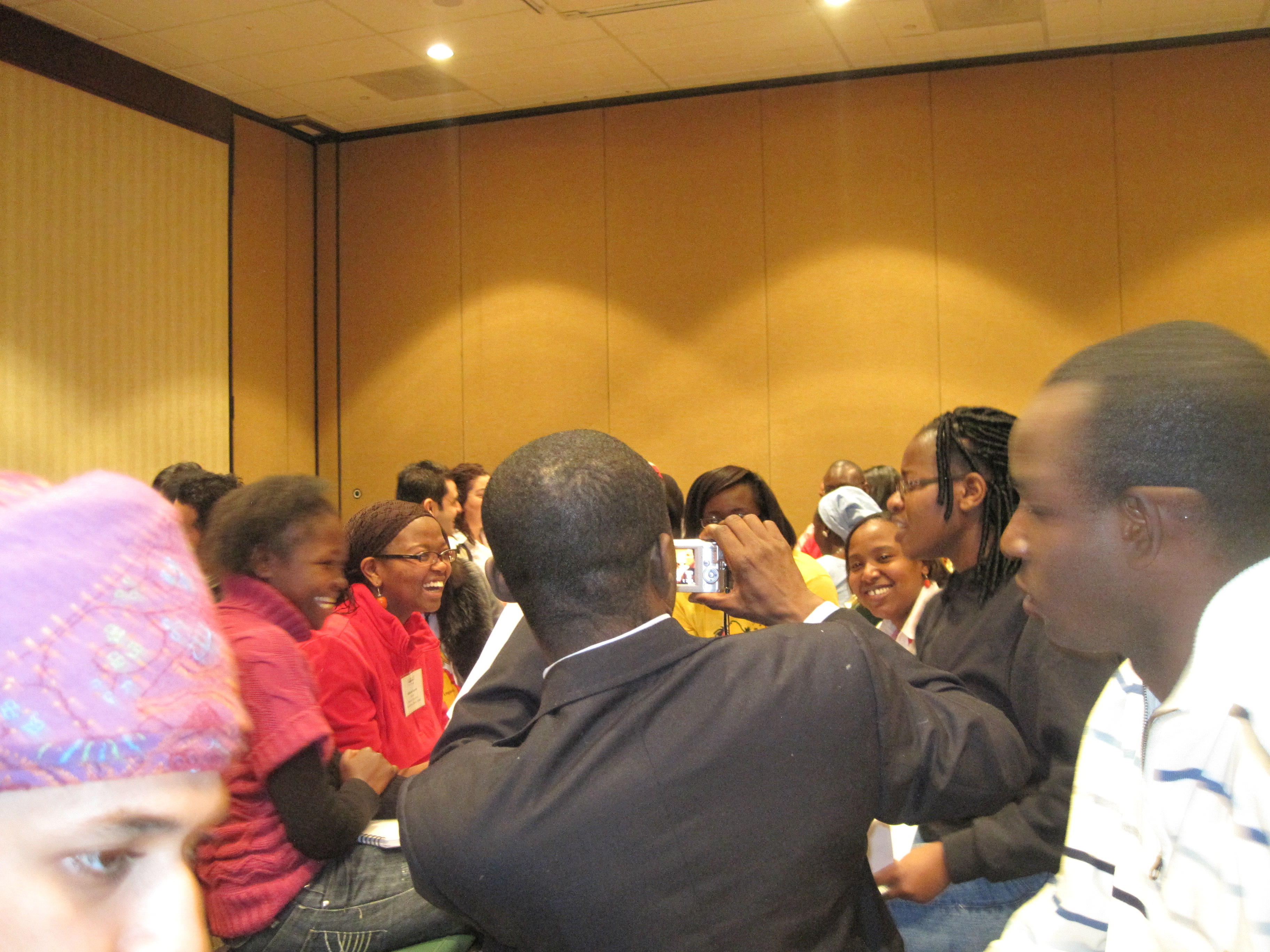
Picture taken during the Fulbright conference at the Hyatt Regency Hotel, Washington DC.
- I don’t usually write the word “Programme” as “Program.”
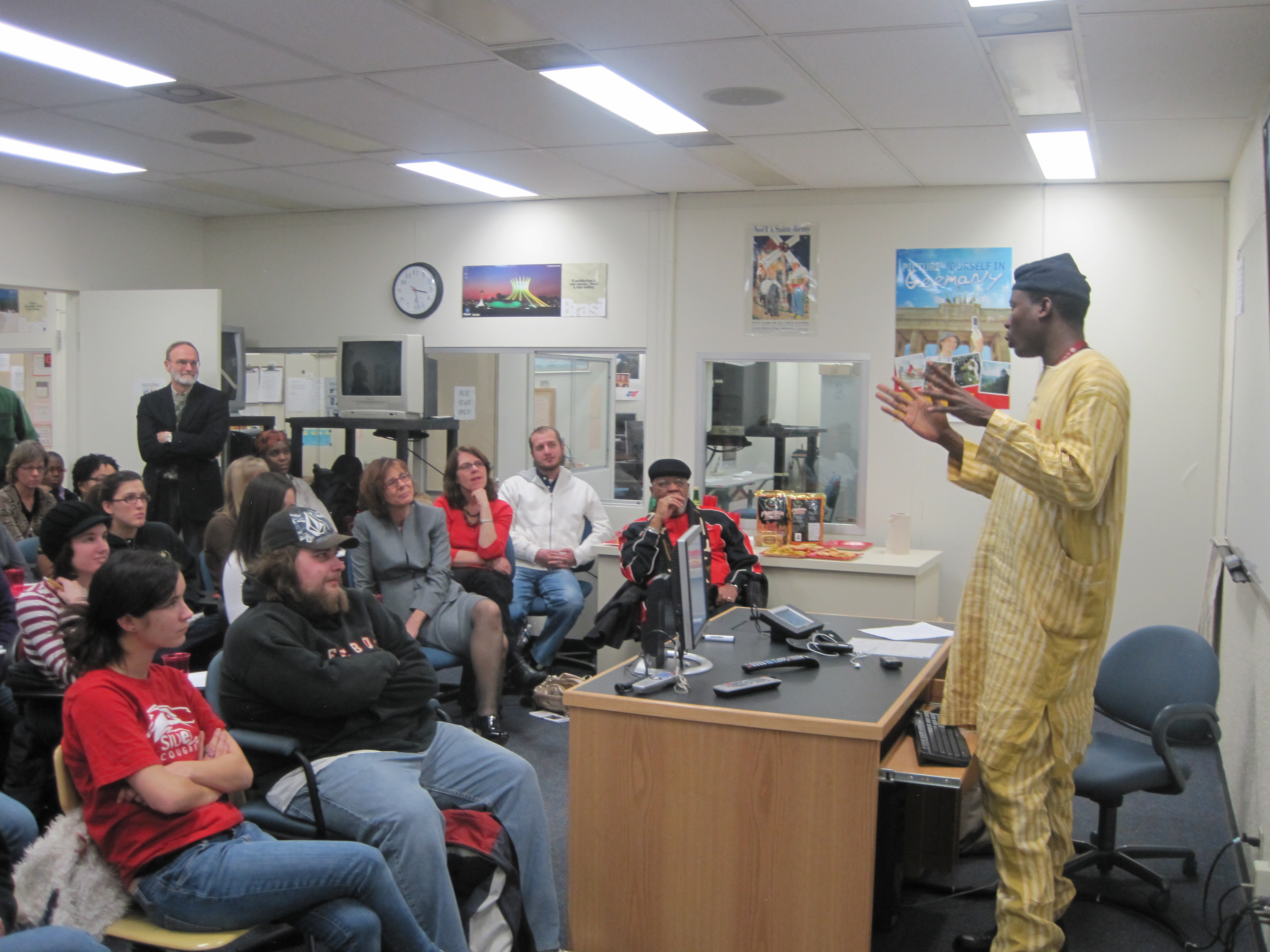
 The long process that became today’s presentation began a little over a week ago when Prof Tom Lavalle, a professor of Chinese language and literature sent me a mail asking if I would be willing to kick off the “Discover Languages Month” with a public presentation. I said yes. He asked me to suggest a title, and I did. He liked it. I didn’t have too much time to plan for it however, which would explain why I had spent a few nights sleepless putting everything in form. For this, I also owe credits to the pictures on my room wall who listened to my mock pre-presentation, and to Deola, Zainab, Tayo and Chris who offered valuable suggestions after previewing the presentation. I also thank Clarissa who sat gently and almost anonymously at the back, smiling at almost everything I said, and blogging 🙂 but whose presence along with that of other colleagues and friends gave me the needed encouragement; and Belinda Carstens, my head of department who barraged me with questions when necessary, thus inevitably pointing me to a few things I seemed to have been taking for granted talking to a people from a different background.
- My undergraduate project in the University was called “The Multimedia Dictionary of Yoruba Names.”
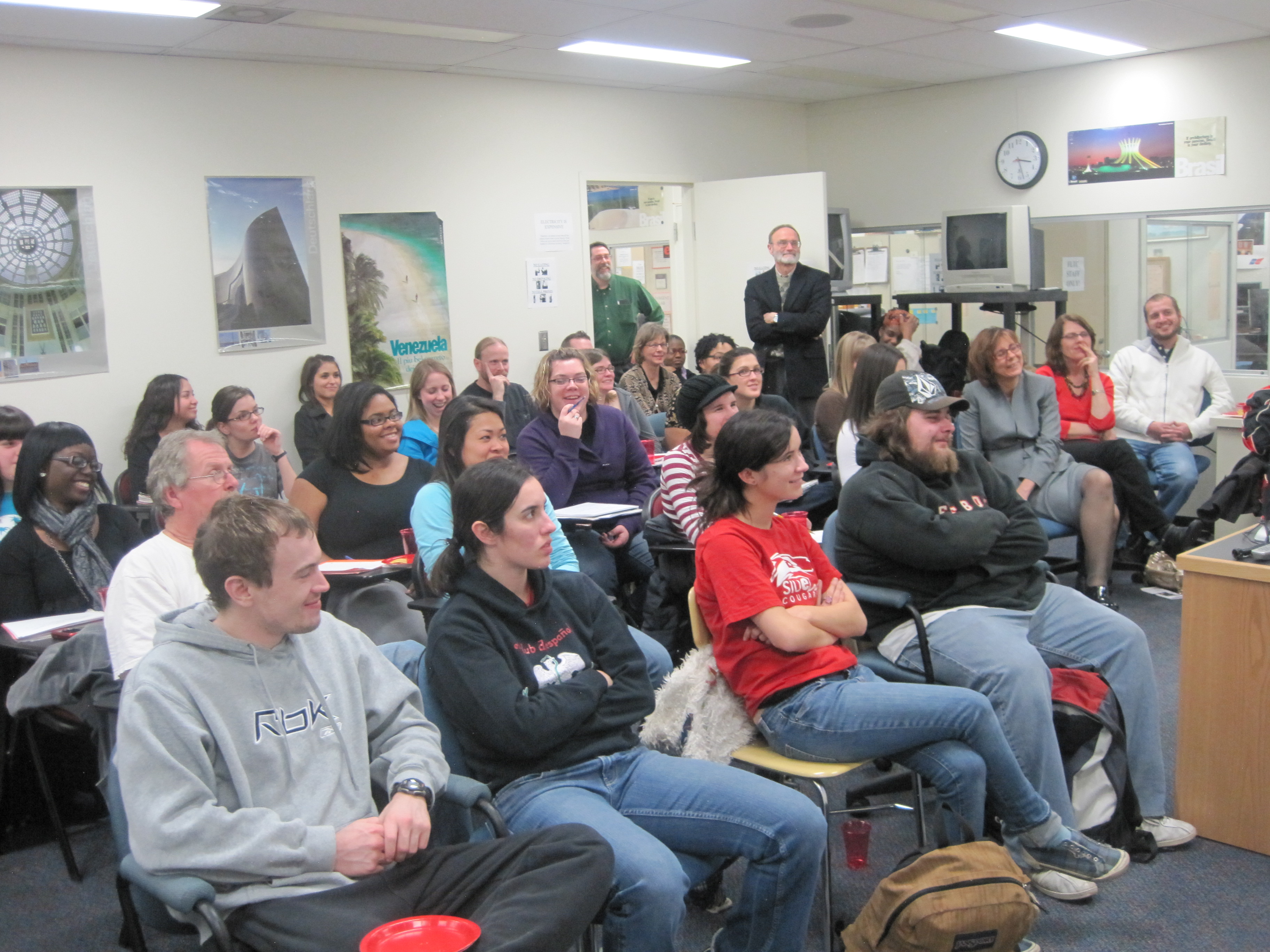 One of the most intriguing discussion from the talk came during the realization by a few members of the audience that we still had kings in Nigeria, within Yoruba kingdoms. “Are they all monarchies?” Someone asked. “No,” I said, and went into a long explanation about the peculiar (and prehistoric) republican nature of the kingship system in Ibadan in sharp contrast with the rest of Yoruba kingdoms in Oyo, Ife and elsewhere. Even to me, that was a moment of personal reflection and pride in the accomplishment of Ibadan ancestors who broke with tradition long before the British came, and did away with a succession system of government that is based on heredity like is practised in Oyo or Ife for a more meritocratic system based on long-standing and verifiable contribution to the society. Even at the end of the talk, a few more scholars came over to talk to me and ask questions about the kingship system. The kings, we discussed, do not have political powers as such in the country, but do occupy a status of responsibility that makes them indispensable in the proper governance of the country. There was also a question about spirituality. This elicited a response in reaffirmation of the Yoruba worldview: that which has never sought to impose its belief system on any other group of people for any reason. We had fought wars for women, for land, but never ever to spread a system of belief or to proselytize to our own way of life.
- Do you have Six Flags in “Yorubaland”?
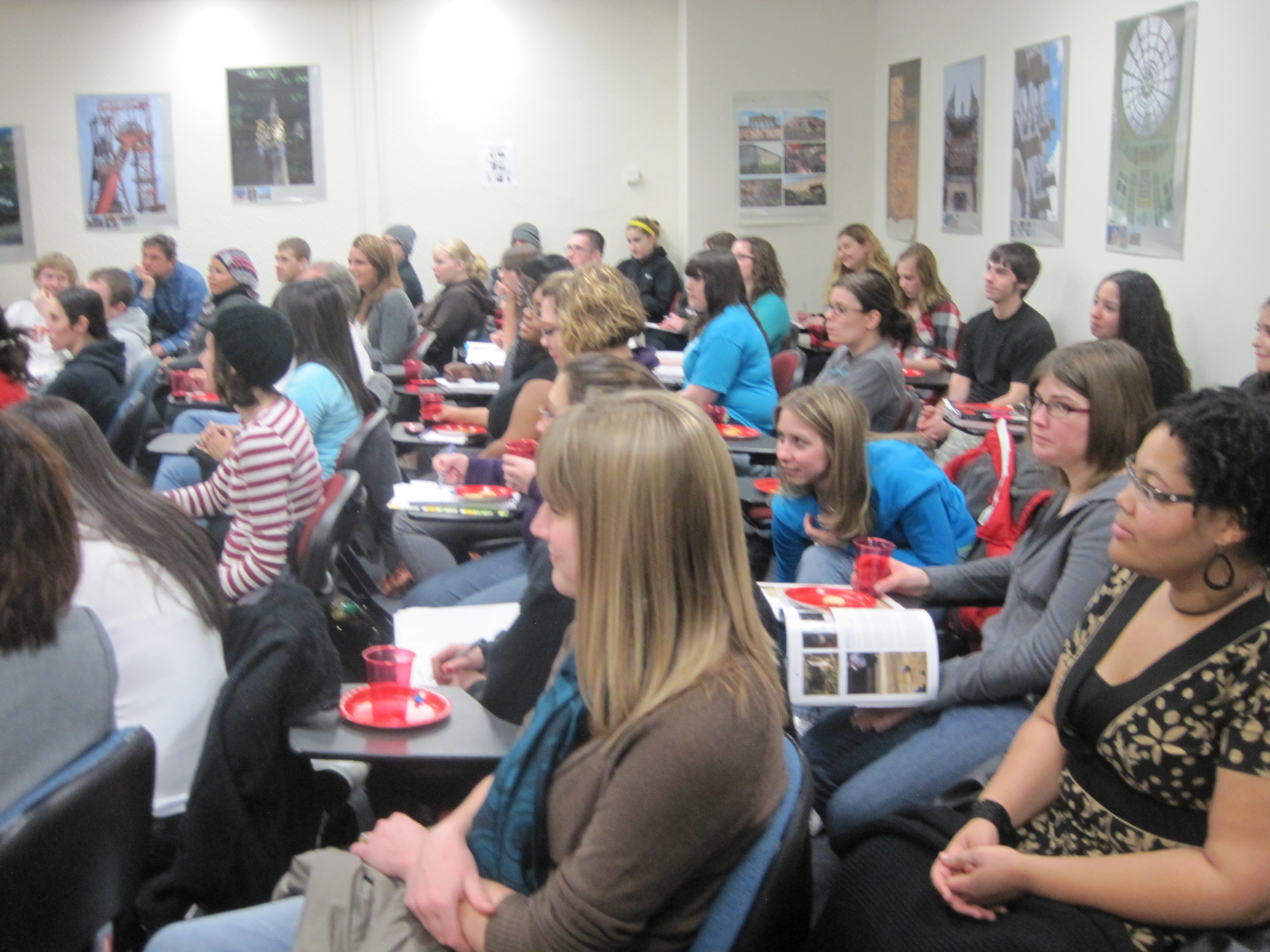
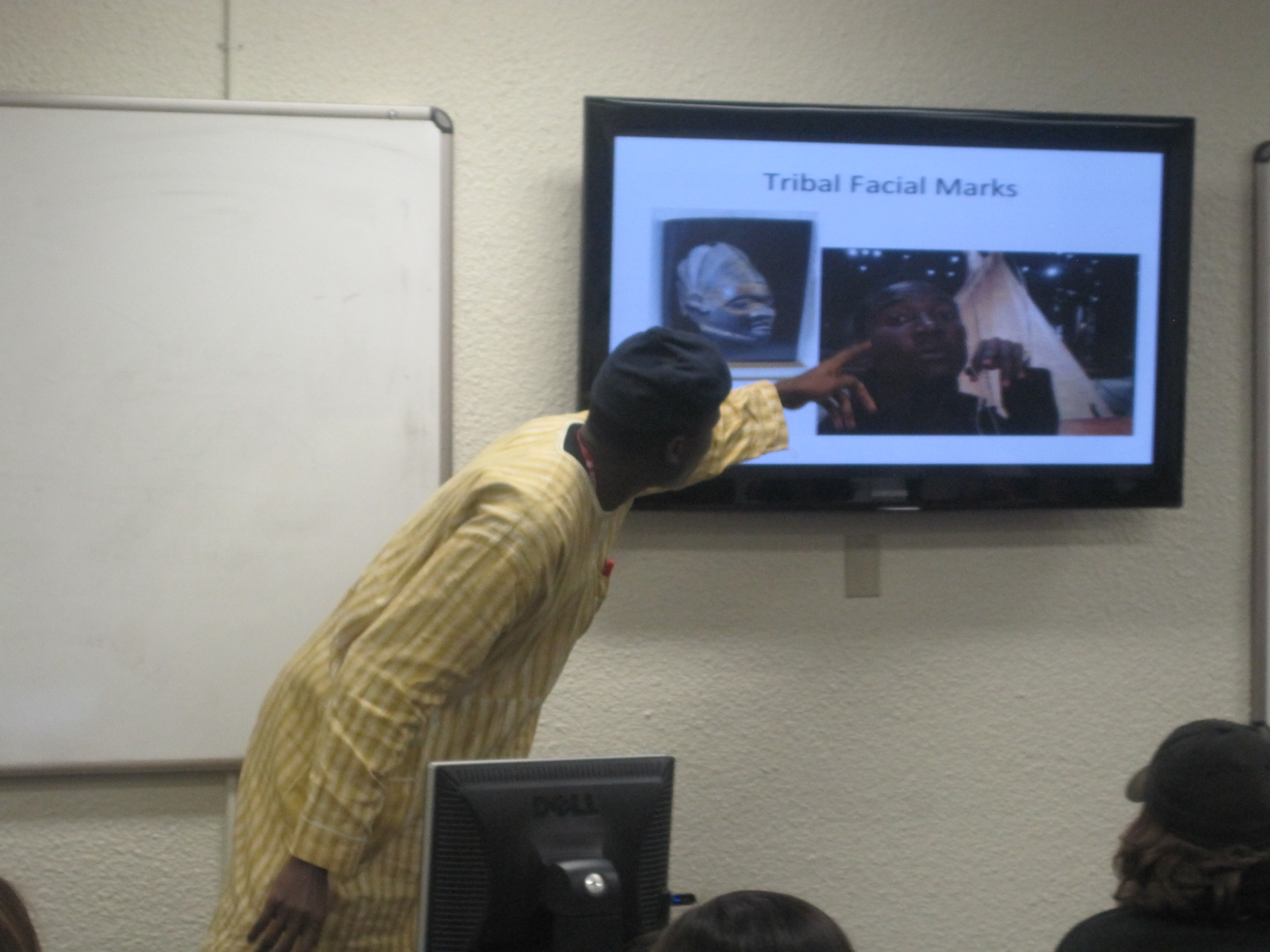 So there was food, plantain chips. There were over forty people in the audience, many of them standing. I saw a few old students in the audience, and a few current ones as well. How the old students knew about the event, I have no idea. Professor (Papa) Rudy showed up as well. It was my first time of seeing him this year. Also present was Prof Schaefer, professor of Linguistics, and SIUE Director of International Programmes who is no stranger to Nigeria himself, having taught at UNIBEN for many years and worked on the Edo language of Emai for a long time. I spoke about the mark on my face. I also spoke about the noted similarities between the Opa Oranmiyan and the Washington Monument; and about why I wear the cap in the United States even though I never did while I was in Nigeria; and about the meaning of names; and about masquerades, Lagbaja and the KKK (a little uncomfortable for me to broach); about Wole Soyinka and the many things he wrote about; among other topics. And then read a translated poem about The Owner of Yam and his Neighbour, which everyone seemed to have loved.
- Is “Yorubaland” like Disneyland?
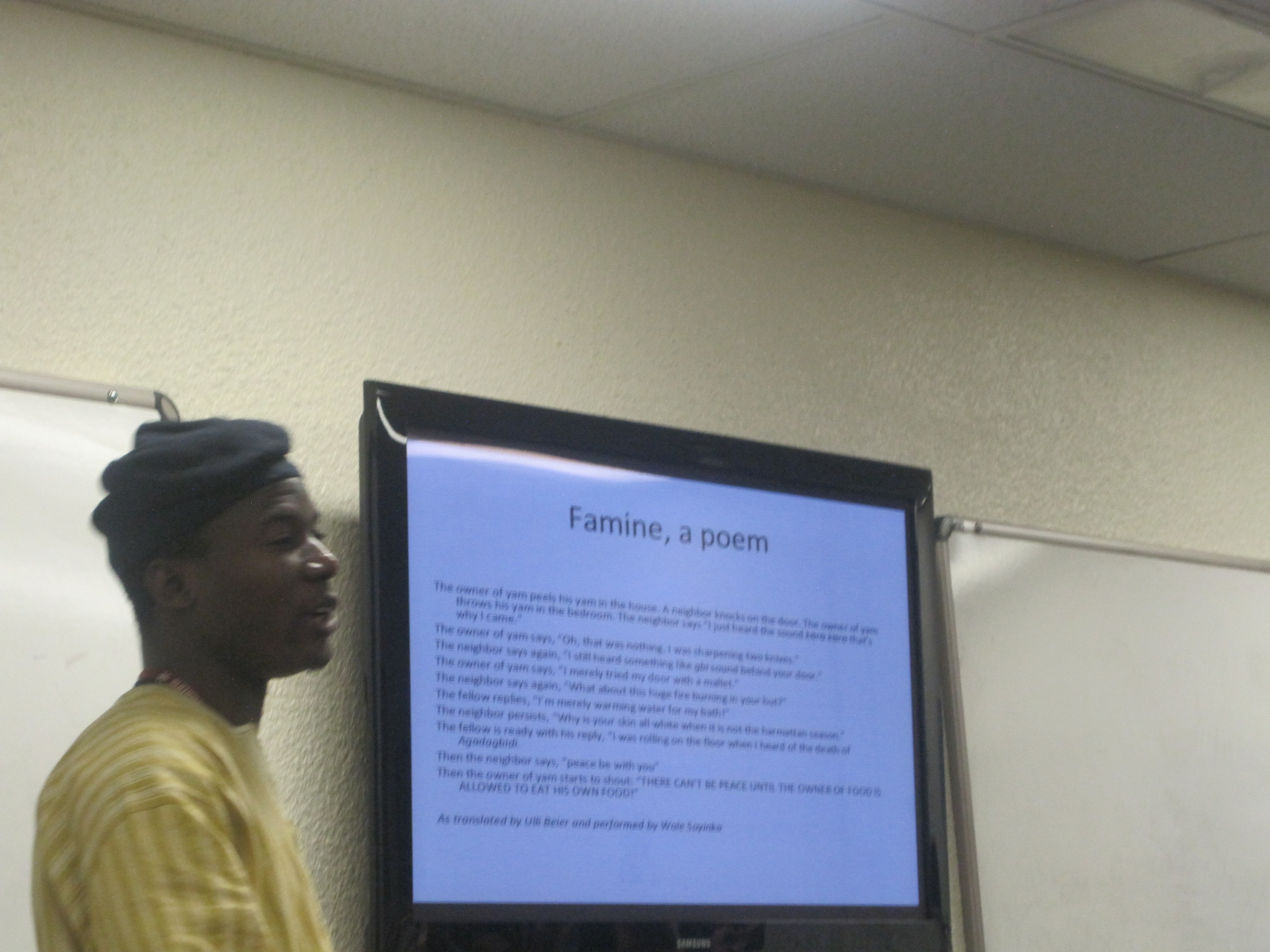 It was nice. I had fun. I’m guessing that from the response there will be more students next year registering for the Yoruba if the Fulbright commission decides to send more Yoruba teachers to this institution. I have also been told by professors whose students came to listen that they would be discussing what they learnt from the talk in their subsequent classes, and on Facebook groups created for the discussion of language ideas. I look forward to getting feedbacks from there. I enjoyed the talk. It was a nice but busy day. And oh, I also got the side pocket of my dress badly torn by a loose metal during the first jittery moments of sitting alone in front of the so large audience. Now I’ll need to find a good tailor to mend it, or leave it as a marker of this interesting speech-giving experience.
Well, there’s the report. I am glad to be here at this department of foreign languages at this point in time. You too should have been there.
- Q: Why learn a new language? Why learn about a new culture? A: The same reason why we learn anything new… to acquire new ways of interacting with the world around us.
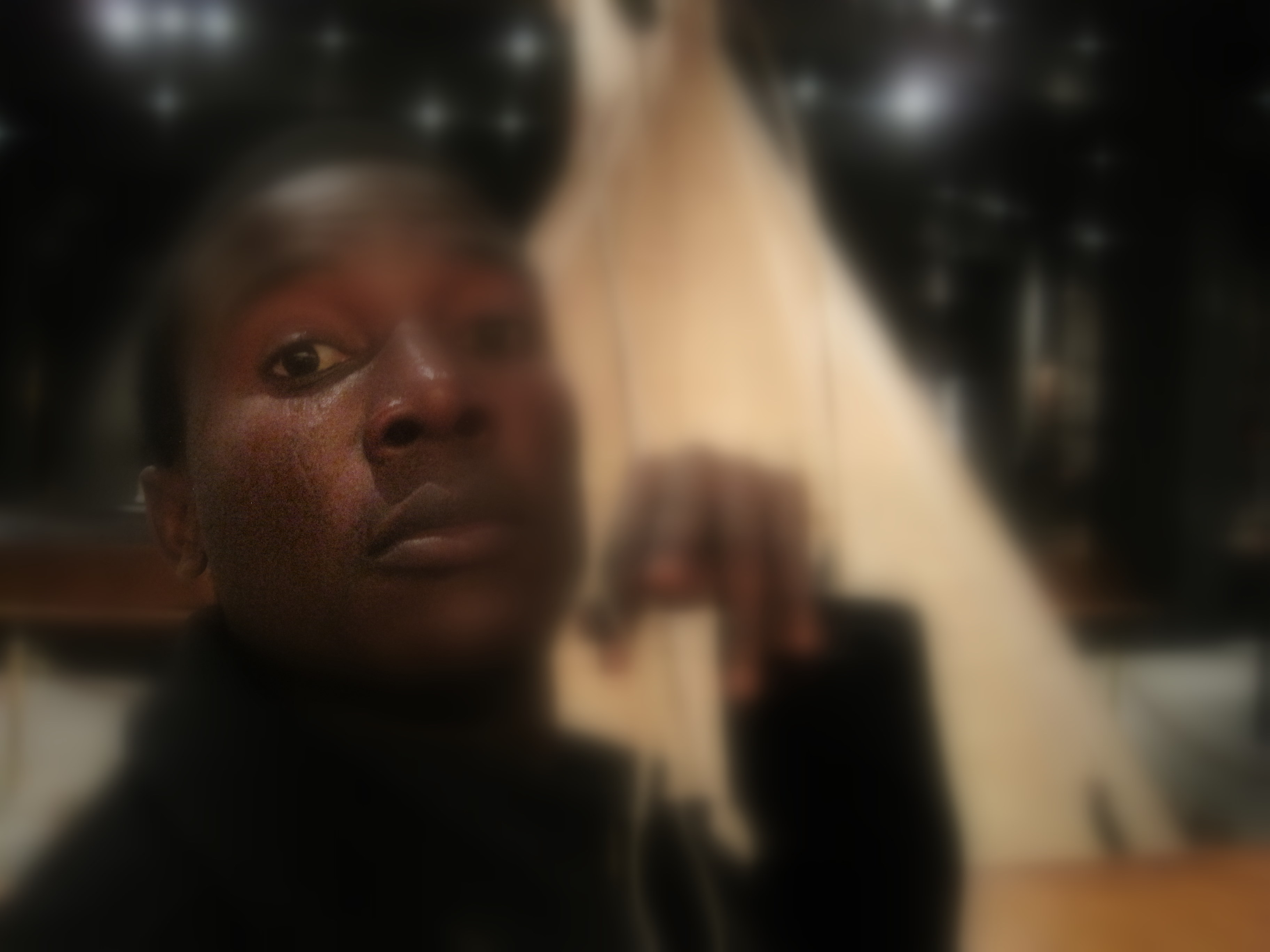 I looked in the mirror this evening and found out that I am good-looking. This doesn’t happen often. I am either in too crappy a mood to appreciate what the mirror reflects to me, or the mirror isn’t clear enough, because of mist or some imaginary dent, to give me anything substantial. Let’s just say that we had just never agreed in a long while. Today, everything changed. Heck, I even noticed a growth on my chin that haven’t always been that impressive. Is it because of the winter? A few months ago, in Nigeria, I could almost count every one of these wiry strands. Now, that has become an impossibility. In any case, sometime this evening, I found myself in front of my bathroom mirror and I noticed a few old and new things about my now good-looking winter-adapting still boyishly hirsute face.
One of the most prominent was a lone vertical mark on the right side of my face. It used to be a scar and it has been there since I was seven, or eight–I no longer remember–but I remember the incident that brought it up there. How could I forget it? It’s a long personal story, but it can be summarized in the following words: an otherwise crazy curious experiment in traditional science.
Earlier in one lone week out of the now many blurry ones in my childhood memory, my father had unknowingly satisfied too much of my recurring curiosity by telling me how he got the tribal marks on his own face. He was born in the early forties when it was still acceptable and admirable for parents from his side of Yorùbáland to scarify the faces of their children as markers of culture, tribe, social standing or just plain beauty. Well, beauty as decided by the eyes of the beholder! I had looked at his face that evening, perhaps even touched his hirsute cheeks too, and found the three pairs of horizontal marks there quite fascinating. How in the world, I wondered, could those scars made by a probing knife of the professional traditional scarifier remain on the face of his victim for that length of time? I had not the slightest idea, and I asked him.
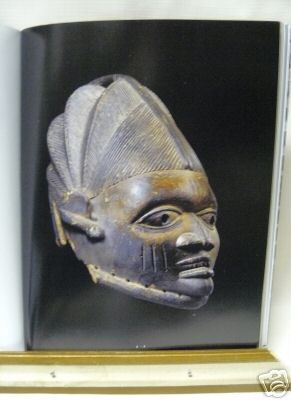 In those days, he said, the men who made the marks had a secret black paste/potion which they applied to the wound on the baby’s face while it was still fresh, to make the wound heal, and to make the marks truly stand out when it eventually healed. It was the effect of the dark paste/potion, he said, that ensured that the wounds never returned to the same nice state as the other parts of the bearer’s face. Thus explained the deep permanent marks on the faces of the very many grown people of his generation that I had met until then.
For days after I discovered this secret, I remained in utmost sleepless fascination, not just about the level of pain it must cause the newborn who must endure the ordeal, the cruelty of the adults who must hold them down at just a few months old to get them scarified for the rest of their lives in the hands of a trusted man with a knife, nor about the resentment the children must feel when they grow up and decide that they never liked those marks on their faces in the first place, but about the possibilities of putting to test the newly gained knowledge I had obtained. I believed my father, but I wanted to see it for myself how this worked. I expressed my thoughts aloud and he responded in a very mischievous and to me quite unsettling jest, asking whether I would prefer for him to call the local scarifier immediately to come and mark my face “for beauty” even though I was already past the required age. I shouted NO, and quickly fled.
But the fascination remained.
So one day while in my primary school, which was not too far from the house, something led to another in class and I had a really rough fight with one of my classmates over something that could as well have been as trivial as speaking “vernacular” in the classroom or reporting same to the teacher. I suddenly saw his hand in a flash towards my cheek. It was all he could grab so he scratched me as hard as he could, and I felt a deep searing pain. A few seconds later, I touched my face and saw a vertical stripe of blood on my hands. Then a few drops began to trickle onto my shirt. It was painful and I let the boy go. But it was also a brief moment of epiphany.
Instead of continuing with the fight which I could by now have won if only for the moral upper hand of rage, I bailed, and everyone stared at me, wondering what was happening. I ran homewards as fast as I could towards the storeroom where mother kept the charcoal fired up to put in the oven she used to make cakes and bread, with blood still dripping from my face. What I did in those fleeting moments of pain and panic was grind the few charcoal chalks into soluble powder, and apply it to my bleeding face.
Thinking about it now, I almost can’t believe the extent of my little daredevilry and stupidity, because if my grandmother had caught me there, she would definitely have panicked, and I would definitely have received some serious spanking. Now satisfied with the experiment, I grimaced in pain but smiled in satisfaction, and waited. The line had been drawn, no pun intended, and the traditional science had been put to test. My father could either be proven wrong and the scar would disappear eventually, or he could be right and I could now have a tribal mark of my own making.
Looking at that lone vertical stripe on the right side of my face today, I could only smile. It used to be a really prominent one. Now it’s just an almost indistinguishable scar, but it’s there alright, visible at the right angle to the source of light.
While applying for the Fulbright programme early last year, I wrote an account of this experience in my application to illustrate one of my first personal intimations with some of Yorùbá cultural practices, and only just hoped for some laughter when the board eventually got to read it. It was to my surprise on the big day of the interview when the board begged that the light be switched on in the room so that they could properly see the scar on my face. The anecdote had apparently made a memorable impression. I was giggling and grinning like an eight-year-old child as I let them bend and angle my face to get a better look. And while one of them huddled close almost hand-tracing the line on my face, I myself wondered why and how I could have been such an enfant terrible willing to put his own self on the line for such a curious experiment.
My face now bears one lone mark that wasn’t there since birth. But unlike that of many Yoruba people now wishing that they could erase theirs, or at least that they had got a choice in the matter in the beginning as they really should have, mine is worn with a certain pride.
Maybe I was really that terrible as a child, now atoning for those sins through the huge torment of the writing gene. The stripe on my face may be a fine reference point to some precocious point in my interesting history, but the real truth is that secretly, I really really just wanted to prove my father wrong.
Image Credits: http://www.vub.ac.be/BIBLIO/nieuwenhuysen/african-art/images/sothebys2008yoruba.JPG
