“In African fiction, the forests I encountered tended to be less about the trees and more about the lives and bodies of creatures, spirits, and plants. Forests in these narratives embody something liminal or inchoate, a site that resists mapping and boundaries, where beings meet and interact in ways that are unpredictable, chaotic, but also generative.”
— Ainehi Edoro
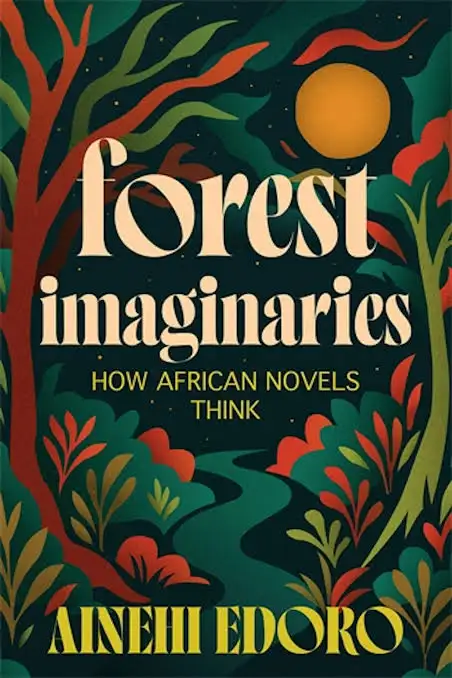 I’ve just finished reading Ainehi Edoro’s Forest Imaginaries: How African Novels Think published last month by Columbia University Press. Edoro, the publisher of Brittle Paper — an important platform for African literature conversations — takes a deep look at the role of forests in African literature, and the reader on a wild ride in this her debut scholarly work.
African novels have set whole revelatory scenes, important plot events and sometimes whole stories in the forest. But in Ainehi’s reading, the forest has played a still more fundamental role in African storytelling. Conventional criticism has reckoned the African forest “merely as setting, a stage where characters play out fantasies of magic and transformation,” fossilized and imagined “as a relic of a premodern, primordial, prelogical world, forever fixed in the past.” Edoro proposes instead a reading of the forests in these works as “spaces for the creative imagination” that “exert influence on the fictional worlds to the extent of being co-architects of the lives of the characters.”
And in about 284 pages, she makes this case quite convincingly.
Ṣóyínká’s 1967 poem Ìdanrè and his translation of Fágúnwà into Forest of a Thousand Daemons, Amos Tutuọlá’s My Life in the Bush of Ghosts and The Palm-Wine Drinkard, Chinua Achebe’s Things Fall Apart, Thomas Mafolo’s Chaka and Nnedi Okorafor’s Lagoon are all considered here. In each work, Edoro establishes associative connections between what is happening in the story and the role of the forest itself — as if a character of its own.
“Forest Imaginaries argues” the introduction says, “that the forest is a conceptual tool for rethinking the forms, histories, aesthetics, and critical methods of African literature… The book introduces the forest as a unit of spatial analysis in AFrican fiction based on the observation that the forest marks a distinct category of space in fiction. When characters enter forests in African fiction, something happens to their ability to imagine. There is something about the forest that suspends law, lets imagination run wild, transforms bodies, and collapeses time as well as distinction between the human and the nonhuman. The forest’s mythic and imaginative dimensions offer a different scale and context for analyzing a fictional world…”
In The Tragedy of the Forest, the book’s first section, Edoro explores the myth of Chaka, and Ṣóyínká’s mythification of Ògún in Ìdànrè; lso the role of the “evil forest” in Chinua Achebe’s Things Fall Apart — which I found quite compelling. In Things Fall Apart, the “evil forest” where rejects and the sick were buried and cast away from society was to eventually become the site of the first school in the village, when the systems of power changed hands from the local custom to the invading British army. Edoro teases out how the transition from that space of punishment and horror to one of communal progress impacted on many of the scenes in the book from Okonkwo’s relationship with his father and his society to other man-made tragedies that befell them, including his own eventual suicide.
“The failure of the evil forest to dispel the threat of the white man should have signaled that something much more sinister was afoot” she wrote in chapter two… Allocating land to the missionaries in the evil forest amounts to political death. By losing the evil forest and, by extension, the battle over death, teh clan loses the capacity to decide what is within or outside the law, what is threatening or nonthreatening violence, what is legitimate or illegitimate violence, who is a spirit of the wild and who is not, where the wild ends and where it begins.” — page 145.
In the latter section, The Love of the Forest, she explores Amos Tútùọ́lá’s joyful exploration in The Palm-Wine Drinkard as well as Nnedi Okorafor’s wild and futuristic storytelling through corals and aliens. I found this less compelling than the first part, but delightful anyway.
The bibliography is eleven pages long, while the end notes a little more than twice that, a testament to the depth of the author’s plumbing of these new meanings and significations
Edoro, a lecturer of African literature at the University of Wisconsin, founded BrittlePaper in August of 2010 as an African literary blog, an outlet for her postgraduate work at Duke University. It has since then established itself as a prime location for news and reviews of new writings. I myself have published reviews, interviews, and views on the platform, and found it a rich source of conversation in African literature. I find the subject of the book even more compelling since I’ve been working on a biographical nonfiction on Nobel Laureate Wọlé Ṣóyínka which uses the forest — and the writer’s relationship with it — as a springboard to understanding his work and his life. It is rewarding to find some congruence of one’s work in others’ delightful research explorations.
The rather predictable future of such an important book as Edoro’s, alas, is the likely prescriptive uses to which it will henceforth be put as a template of understanding all of the forests in African literature. I noted quite early in the book that its richest examples came from early African works in print, by authors who have now almost all ascended into ancestorhood. Does Edoro’s understanding of African forest roles in literature extend into modern works, written by writers who may never have inhabited the world of mystery, superstition, and regimented rules that characterized early pre-Western-contact African societies? This is, perhaps, where the mention of Okorafor would have been some consolation. The coral reefs that dominated the plot of Lagoon, Edoro argues, “invite us to reconsider the very nature of worldbuilding (as) an ongoing, collective process… not as a graveyard, but a living archive of creativity and survival.”
More derivative readings would layer Edoro’s work on new literatures like Akwaeke Emezi’s, Romeo Oríogun, Jide Salawu, Remi Ngamije, etc to see if the forest — even in the concrete jungles of modern living — continues to speak to us in much the same way as in these older cited works. My guess is that this will result in a radically-different book — maybe Edoro’s sequel — but would not be any less compelling.
Read an interview with the Ainehi Edoro here.
[This essay was first published on FlamingHydra on 24 February, 2026]