“A Parable from National Urban Reality” – An excerpt from Wole Soyinka’s new novel

Introduction

While the formal fact-finding panels pursue their assignment, and bewildered minds attempt to absorb the turn of events, reflect upon, and engage in informal caucuses on ‘what really happened’ during, and following the authentic #ENDSARS campaign, both in the Lekki arena and in horrifying dimensions across the nation, I believe that it will not be out of place to offer a parable extracted from a forthcoming work of fiction. A parable, yes, but an actuality that has become virtually institutionalized across the nation. It is offered as a public service before the events of the month of October 20/20 congeal in the minds of participants, onlookers and consumers of the Nigerian staple of the now mandatory UFN (Unidentified Flying Narratives).

The forthcoming novel from which it is extracted — CHRONICLES FROM THE LAND OF THE HAPPIEST PEOPLE IN THE WORLD (BookCraft) – will be published towards the end of the month of November, 2020. – Wọlé Ṣóyínká

Read on:
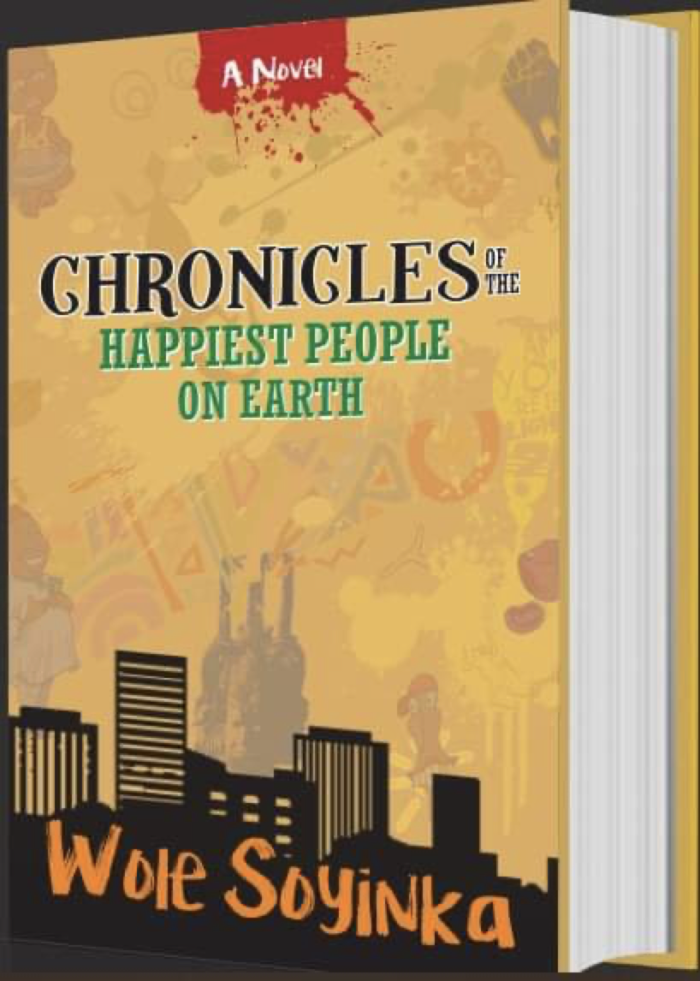
Excerpt from CHRONICLES

Adjusting to a new culture was his main concern, but not an insurmountable culture shock. Badagry, after all, albeit closely intertwined with Lagos, was still Badagry. Pitan-Payne was on hand, though keeping a frenetic pace to wind up his affairs and proceed to his UN assignment on schedule. The engineer seemed to thrive on interlocking calendars, and in any case, he now had Menka to pick up the loose ends for him in his absence….

  The timing could not have been more thoughtfully ordained. The unexpected and the planned seemed to dovetail neatly, like the finely adjusted sprockets or his mechanical prototypes. And while Lagos/Badagry lacked the excitement of receiving sudden cartloads of human debris from Boko Haram’s latest efforts to out-Allah Allah in their own image, one could count on gratuitous equivalents from multiple directions. Such as the near daily explosion of a petroleum tanker on the expressway or city centre. Or a roofless lorry bulging with cattle and humans tipping over on a bridge and dropping several feet onto an obliging rock outcrop in the midst of the river.  Sometimes, more parsimoniously, a victim of military amour propre – in uniform or mufti, it made no difference. That class seemed to believe in safety in numbers, and all it took was that even a low-ranking sergeant should take offence at another motorist, who perhaps refused to give way to his car, a mere ‘bloody civilian’, never mind that the latter had the right of way. An on-the-spot educational measure was mandated. Guns bristling, his accompanying detail, trained to obey even the command of a mere twitch of the lip, leapt out of their escort vehicle, dragged out the hapless driver, unbuckled their studded belts, whipped him senseless, threw him in the car boot or on the floor of the escort van and took him to their barracks for further instruction. However, the wretch sometimes created a problem by suffocating en route – which left society to develop structures for neutralizing such inconvenience.

The contradicting, ironic sequence occurred to Menka only for the first time – yes, come to think of it, the military hardly ever recorded a fatality – once or twice, maybe even three times in a month — yes, the accident of excess did happen, but mostly such terminal disposal was left to the police, whose favourite execution site was a road block, legal or moonlighting. Perhaps a recalcitrant commuter, or passenger bus driver had refused to collaborate in providing a bribe on demand, or insulted the rank of the demanding officer with a derisive sum.  And it did not have to be the original offender but some too-know grammar spouting public defender who had intervened on behalf of the potential source of extortion. The outcome was predictable – victim or good Samaritan advocate instantly joined the statistics of the fallen from ‘accidental discharge’. The expression was still current, but often it was anything but. Accidents had become infrequent and unfashionable. Oftener to be expected was that the frustrated, froth-lipped police pointed the gun, calmly, deliberately, at the head of the unbelieving statistic and,  pulled the trigger. Again, the inconvenience of body disposal.

But then, the community of victims themselves – what a specialized breed of the species! The roles, it constantly appeared, had become gleefully, compulsively interchangeable. Allowing him only a few days to ‘catch your breath and get your bearings’, Pitan-Payne lost no time in taking Menka to inspect the land designated for the Gumchi Rehabilitation Centre, for victims of Boko Haram, ISWAP and other redeemers – nothing like striking while the iron was hot! On their way, the familiar sight of crowd agitation – how would the day justify itself without some kind of street eruption somewhere, wherever! Trapped in the chug-stop-chug of traffic, the favourite commuter distraction was to attempt to guess what was the cause, and even place bets on propositions. That morning, Menka’s first in nearly a year down south did not disappoint. But for the milling blockage by intervening viewers, they could have claimed the privilege of ringside seats. Compensating for that obstructed viewing however was the sight of men and women trotting gaily, anticipation all over their faces, towards the surrounded spot of attraction. From  every direction they came, some vaulting over car bonnets, squishing their legs against the fenders, squeezing through earlier arrived  bodies or simply scrabbling for discovered vantage viewing points. They climbed on parked vehicles and the raised concrete median. Commuter buses slowed down and stopped, keke napep — the motor-cycle taxis — pulled aside, drivers and passengers alike rubber necking on both sides of, or in the direction of a wide gutter that sank into a culvert. The lights changed to green and Pitan-Payne drove on, their last shared image a pair of muscular arms raised above the bobbing heads, clutching an outsize stone, slamming that object downwards into the gutter. Very likely a snake, Pitan suggested. With the rainy season, quite a few sneaked through the marshes into culverts and slithered their way into parking lots and even offices. 

A police van came racing down the road, against the traffic, strobes flashing and sirens blaring, so Menka looked back, saw the crowd drawing back and drifting reluctantly away from the uniformed spoilsports. This opened an avenue just in time for Menka to obtain the briefest glimpse of an object slumped over the rim of the gutter, once human, but not any longer. Indeed the only human identity left him was his iodine-red tunic and black trousers, still recognizable as the uniform of a LASA officer, an unarmed unit whose function was simply to unplug traffic – stoppered as readily by truculent drivers as by the roadside markets, vendors of all the world commodities who had taken over the streets, haggled, negotiated, delivered change and goods at their own pace. If the activities delayed movement over half a dozen changes from red to green and back again, it did not concern them in the least. 

Later that evening, the television newscast narrated the full story. After futile spurts of preventive measures, Authority had commenced arrests of vendors and seizures of their wares. The LASA team, their van parked in a side street, had pursued several such malfeasants.  In a desperate attempt  to escape capture however,  one ran straight into the snout of a speeding vehicle, was tossed up, landed with an ominous thud on the sidewalk and remained there, unmoving. In a trice, a mob had gathered. They set the parked LASA vehicle on fire and worked up further appetite for vengeance. The unarmed officers had already fled. A hunt party pursued and eventually brought down a scapegoat, quite some distance from the actual scene of crime. They proceeded to the ritual battering of their catch. He broke free, ran into the gutter, tried crawling into the culvert for safety. They dragged him out by his feet, trunk and head smeared and reeking from the accumulated sludge of the blocked tunnel. Passers-by, totally ignorant of the beginning or mid-act of the mayhem, refused to be left out. They grabbed the nearest assault weapon to hand and joined in the gratification of the thrill for the day, a newbreed citizen phenomenon. The massive stone, raised above a throng of heads, quivered lightly against a Lagosian skyline of ultra-modern skyscrapers before its descent onto bone and brain. It took on an iconic dimension that stuck instantly to Menka’s surgical album of retentions, a rampant insignia of the transfiguration of a collective psyche. 

“I envy you” Menka remarked the following morning, as they confronted the print media coverage, their scalding coffee no match for the nausea aroused by the photograph sensationally smeared across the front page.  “You are going away for a while. You’ll be spared such sights.”

“I feel guilty”. confessed Duyole. “Guilty, but yes, that is one spectacle I shall not miss.”

“Careful!” Menka quickly cautioned. They have their equivalents over there. Ask the black population.”

“No. Not like this. Occasionally yes, there does erupt a Rodney King scenario. Or a fascistic spree of ‘I can’t breathe’. America is a product of slave culture, prosperity as the reward of racist cruelty. This is different. This – let me confess – reaches into – a word I would rather avoid but can’t – soul. It challenges the collective notion of soul. Something is broken. Beyond race. Outside colour or history. Something has cracked. Can’t be put back together.”  And then Pitan-Payne gasped, paused, folded over the pages and passed the newspaper to Menka. “Take a look at this. Not that it changes anything but – here, read it yourself.” 

There was a chastening coda. It altered nothing. The fleeing vendor, whom no one had even thought to help, was very much alive. He had picked himself up, salvaged most of his scattered goods, and found his way home despite a sprained ankle and some bruises. Most of the earlier spectators had retreated to a safe distance. They continued what they had been doing earlier – filming the action with their phone cameras. The police did however capture the Goliath with the terminating stone who had administered the coup de grace. He remained on the spot, to all appearance, admiring the evidence of his work. 

He vehemently protested the injustice of his arrest: “I thought he was an armed robber.” 

The END.
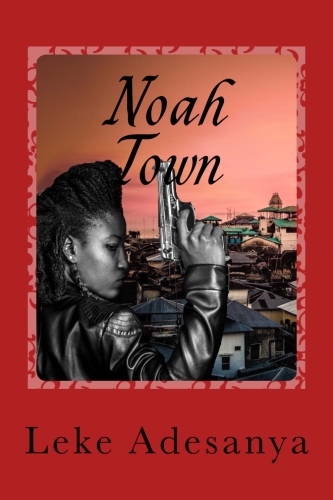
Excerpts from Noah Town by Leke Adesanya

bookcoverimageIf you ever come to Noah Town, you’ll probably arrive by coach. The long buses come off interstate  trunk roads from far and near, from smaller towns and villages were dreams of making it in the big city still has its allure.  The buses pour out streams of young men and women  hourly at almost a clockwork rate. They come with their dreams and aspirations, their bags and little savings. They are drawn to a metropolis where the street lights never go off and there is money to be made with beautiful bodies, willing hands or daring minds.   I know them. I was once like them.

Your coach should come to a stop at the terminal on Main Street, just at the beginning of the two mile stretch of long dual rows of hardware stores, fashion stores and business offices.  As you disembark , in the mornings, you might hear the dull drone of street sweeper trucks vacuuming the road. A soft feminine voice will welcome you to Noah Town over the terminal’s public address system , advising you to mind your luggage.

Touts may accost you, offering to help you get a cheaper hotel or unlicensed taxi , some with the intent  to unburden you of your few valuables. You would be better off strolling to the Visitor Centre to book a cab or walk a bit farther down the road to catch a local bus ride. Or maybe someone, perhaps a relative or friend has arranged to pick you up.  

Whatever are your options on arrival, you wouldn’t help but notice two old grey storey buildings situated almost opposite each other. Their Brazilian architecture with mock Roman marble columns  add a air of gravitas that make them stand out amid melange of functional matchbox shaped buildings. They are the two big banks of Noah Town.

Scores of men with crew cuts in blue or black suits march in confident strides  in and out of the two grand old buildings. On the right, if you are coming from the Terminus, next to the divisional police office is the local branch of National Bank.  And on the left,  behind a fibre glass  fountain cast of an elephant pumping water out of its trunk, is  the local land bank owned by former loan shark now turned legit financier, Mr Barido Freeman. Everybody calls him Barry.

He is reputed to be very influential. I have had occasion to meet him myself, informally of course, and I found him intimidating.  He owns a significant portion of the businesses and real estate in Noah Town. Sixty years old and not looking a day younger, Barry is big boned and tall, slightly balding but still working that regal look. What was left of his receding hairline, he grew into big white halo with brown dusts.

When you are told by your guide that he started out as an immigrant with nothing on him but a knapsack slung across his shoulder, you would probably be impressed too by what he has made of himself.  You would think, if he can, maybe you can. He is the stuff of which legends are made.

Barry manages to keep his family out of the tabloids.  Although he has never married , he had a love child, twenty years old Norah whose mother has been out of the picture since like forever.  Norah, I have heard, was worth her weight in trouble and then some. Twice expelled from expensive boarding schools abroad where Barry had hidden her, she eventually dropped out, called it quits and came back home.

Barry got her an office in the family business and engaged  Cuba, an ex-cop as her  bodyguard, mainly to keep her out of trouble. Cuba used to be an ambitious police officer on the rise till one day he shot a teenage kid playing with a toy gun and the top brass threw him under the bus. Taking care of Norah was a better paying job however and he intended to keep it forever. A shrewd guy, he kept Norah out of trouble mainly by making sure Barry never heard of it.  

A major challenge for Cuba on job was handling Nora’s long list of hangers-on, most of whom were willing to get whatever Nora requests of them even if it were illegal.  Prominent in that clique was Vera, her BFF and confidant.  Vera used to be a bartender at a night club on Boardwalk, Noah Town’s entertainment district, where she met Norah and the two hit it off.

Like any street hustler, Vera knew she had found a winning lottery ticket with Norah. How did I get involved with this clique?  Stay with me, I was going to explain.

Vera and I once dated, very briefly. Vera also happens to have a twin brother called Jude. Jude and I, we go way back to the time we were still hungry backpackers just come off a bus on Main Street. That was a life time ago, of course.

Jude and I are now business partners, we run a little taxi operation that is thriving very well, thank you very much. Nothing fancy, just a dozen old cars in great working condition and a long list of repeat loyal patrons.

We started out as two unlicensed cab drivers willing to work all night in what was then the notorious Boardwalk. Later we formed a partnership, got licensed and started adding more cars and drivers. We evolved into an effective relationship; he handles the drivers’ scheduling and getting of corporate customers while I take care of the back office and car maintenance issues.  

Once two guys have had a big fight and then gotten over it, they tend to bond well.  That was what happened to Jude and I. I could implicitly trust him to have my back, at least until the events I am narrating to you now started.

One ordinary Tuesday, Jude dropped by at lunch to inform me that we have an inquiry from a prospective investor. Barry – yeah, that Barry – wanted to buy out our little operation. Could I look at our books and come up with a working valuation, just in case this turned out to be a real deal?

Sure, I replied. I acted all cool about it though I was very, very excited.  I mean if the price is right, like five times annual revenues, surely why not?  But then he clarified.  What he really wanted to know was, at what price was I willing to cash out. They wanted to buy me out and let Jude run the operation.

By the way, by then, he was hanging out a  lot with Norah . And I was worried about her Daddy. Barry was like the king of Noah Town and rumour had it, he might or might not have had mob ties. If you don’t cooperate with his type, there was the unspoken threat that he might not be pleased. This was scary to me.  I don’t want to end up drowning in the Noah Lagoon like some overconfident yokel who dared above his match. And since I love the feel of fresh cash stacks in my palm like the next guy, I felt I had better play along.  

I doubled my calculated asking price, asked for not half but all of five times annual revenues. We shook hands over that and he said I should give him some time to iron it out with his principal, Barry. I started to look at Jude funny from then on. But I am getting ahead of myself.

I started to daydream of the day I’ll get to seat with Jude, Norah & co. , and firm up the terms of sale. I knew what I would do with the money when it hits my account. I would take a long holiday first, to somewhere far from Noah Town. I have earned it. I’ll go somewhere where it is cold in summer. Maybe I could learn to ski in middle age, who knows?  

Those were my thoughts until a Saturday, some days later, when I picked up a copy of the local evening tabloid and read the headline, “Barry’s Girl Kidnapped”. I had a premonition that, after that event, things wouldn’t turn out exactly as planned.

____

Blurb

It was meant to be a safe job. They  fake a kidnap of the millionaire’s daughter, collect the ransom and share it with her. But then things started to go wrong. As the body count continues to rise, Tony finds himself in the cross-hairs of a deadly gang as he tries to save his best friend’s widow.

Links

Available on Okada Books :

http://www.okadabooks.com/book/about/noah_town/12419

Available on Kindle ;

https://www.amazon.co.uk/dp/B01MG4KELQ

Of Nigeria’s Real Founding Fathers

I just finished reading this long (but totally worth it) piece by Dàmọ́lá Awóyọkùn, on the life of some of Nigeria’s founding fathers. Correctly, the piece begins by dismantling the myth that the triad of Awólọ́wọ̀, Azikiwe and Bello were the founding fathers of modern Nigeria, giving credit to where it is due to those who fought and survived slavery in order to birth a new country “bound in freedom.”

Here’s an excerpt:

Meanwhile as Crowther spoke about the horrors of slavery, a lady minimally dressed and too unassuming to deserve interruption of the narration came in and she listened to him with breathless attention. There was no voice speaking for the slaves in West Africa until the British rescued Crowther, gave him dignity, gave him culture and education and he became a voice, the voice. And when the Prince spread the map on the table wider to see Lagos, it blew out the candle light. As Crowther wrote in his autobiography, the Prince then said, “Will your Majesty kindly bring us a candle from the mantelpiece?” Then  it dawned on Crowther the unassuming woman who had joined them earlier on was Victoria, Queen of the United Kingdom and Empress of India.
Wrote Crowther: “On hearing this, I became aware of the person before whom I was all of the time. I trembled from head to foot, and could not open my mouth to answer the questions that followed. Lord Russell and the Prince told me not to be frightened, and the smiles on the face of the good Queen assured me that she was not angry at the liberty I took in speaking so freely before her, and so my fears subsided.”   After bringing the candles, the Queen then asked about what she can do about the slave situation in Lagos, Ajayi Crowther said seize Lagos by fire by force.  Captain Labulo Davies, the second of the founding fathers, was a lieutenant on HMS Bloodhound the flagship of the fleet that bombed Lagos.

There are many stories of this nature that need to be told and told again of people whose efforts gave (and continues to give) us the freedom we currently enjoy, linking the colours of the present to the struggles and sweat of the past. Why is Ajàyí Crowther not on the Nigerian currency again?

Read the full report here.

Famine – An Excerpt

Stolen from the text of today’s presentation titled “Exploring Yoruba Culture Through American Eyes”, about to begin.


The realities of life are not to be evaded. Rather, they are celebrated, even the negative or unpleasant. Appeasement? Magic, perhaps? No matter. Challenges are thus acknowledged and countered, often with humour, (and) certainly with resolve.

Famine

The owner of yam peels his yam in the house. A neighbor knocks on the door. The owner of yam throws his yam in the bedroom. The neighbor says “I just heard the sound kr kr that’s why I came.”

The owner of yam says, “Oh, that was nothing. I was sharpening two knives.”

The neighbor says again, “I still heard something like gbi sound behind your door.”

The owner of yam says, “I merely tried my door with a mallet.”

The neighbor says again, “What about this huge fire burning in your hut?”

The fellow replies, “I’m merely warming water for my bath!”

The neighbor persists, “Why is your skin all white when it is not the harmattan season.”

The fellow is ready with his reply, “I was rolling on the floor when I heard of the death of Agadagbidi.

Then the neighbor says, “peace be with you”

Then the owner of yam starts to shout: “THERE CAN’T BE PEACE UNTIL THE OWNER OF FOOD IS ALLOWED TO EAT HIS OWN FOOD!”

As translated by Ulli Beier and performed by Wole Soyinka