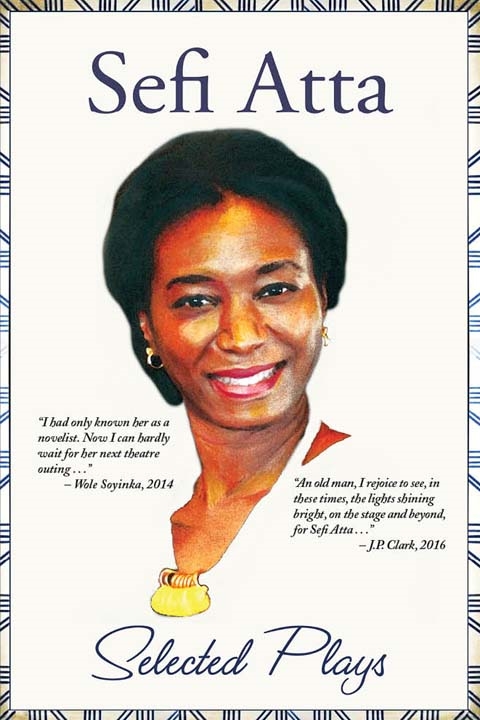
Book Signing for Sefi Atta’s “Selected Plays”

Save the date! On on Sunday, May 7, 2017, Nigerian writer Sefi Atta will be signing her new book of Selected Plays at the Art Gallery, Freedom Park, Lagos.

Those familiar with her work will know that the author has been known mostly as a novelist. Her third book Everything Good Will Come won the 2006 Wọlé Sóyínká Prize for Literature. Yet, her work credit includes a number of stage plays most of which have been produced and staged in Nigeria and overseas.

Credits for her work in drama include both for the stage and for radio. The Cost of Living (2011) and The Last Stand (2014) were produced at Terra Kulture in Lagos while An Ordinary Legacy (2012) and The Engagement (2005) were staged at MUSON Centre. The Naming Ceremony (2012) and Hagel auf Zamfara (2011) were both staged at the Theatre Royal Stratford East London and Theatre Krefeld Germany, respectively.

She has also done a lot for radio, including The Wake (2013) for Smooth FM radio, A Free Day (2007), Mákinwá’s Miracle (2004) and The Engagement (2002) all for BBC Radio.

The public book signing will take place from 5 p.m. to 7 p.m.

Three Days of Madness at the University of Lagos

By Péjú Láyíwọlá

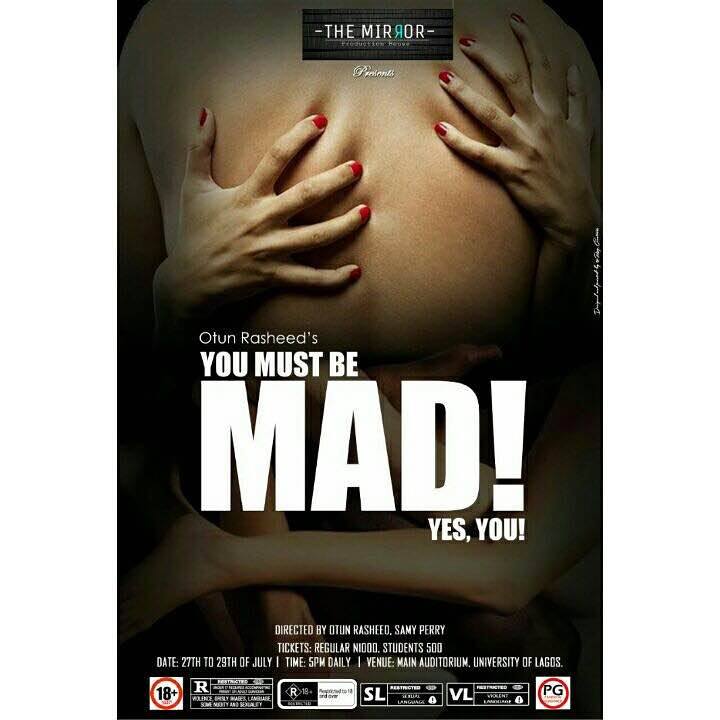
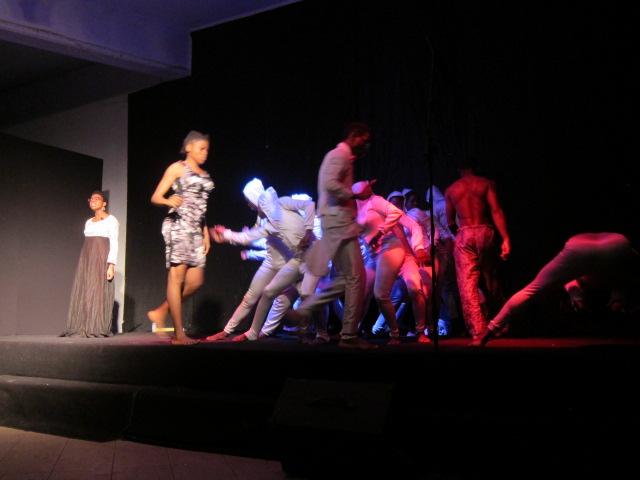
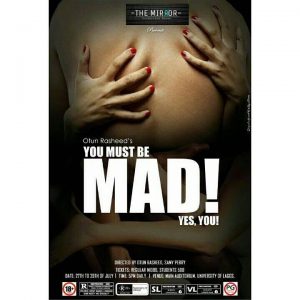
madI was first captivated by the posters and then I was warned not to watch the play because of the high level of vulgarity shown on stage. I braved it and opted to watch it on the second day of the three days that it was shown at the Main Auditorium, University of Lagos. Truly, if you survive the first few minutes of the play, you are likely to sit through this very captivating and bold attempt by a talented young playwright, Otun Rasheed, to shock, provoke, challenge, incite, and stir all manner of emotions through this breathtaking 70 minitues play. Given the very diverse critique of this play, one thing remains clear: sex is a tabooed topic in Nigeria. People prefer to talk about it in private spaces and not see themselves on stage.

You must be mad, Yes You! is the title of the play. While some might quarrel with the title, I think it is apt because really we live in a very mad world! It is a world full of paradoxes. The play was laden with foul language. The stark show of sexual pleasure and the rigorous scenes of obscenity and eroticism would make you cringe! But the message is loud and clear at the end: the level of promiscuity in the Nigerian society is high but largely ignored. Parents delude themselves by thinking their children are ‘holy’ and would not indulge in sex in this highly virtual and visual world of the internet. Infidelity, fornication, incest, pornography have become the order of the day. The level of incest within families is so high that you would be shocked. A few years ago, I attended a popular monthly camp meeting. When the altar call was raised, I was shocked at the number of people involved in incestuous relationship come out for prayers.

The cast comprised students of the Department of Creative Arts. Otun Rasheed is a lecturer in the department. What great mentorship! But does he represent the views of the Department or does he make any reference to it in any way? No! It is unlikely that such a play would see the light of day were it presented as an academic project. It is also not likely to receive a research grant. Yet, the academy should be a crucible for such phenomenal thinking.

Many thoughts crossed my mind while watching. Some of these discussed below reflect, in part, views of some of my colleagues when we discussed.

Why are people more likely to accept visual images of eroticism rather than a play with a similar theme? What role does sound and movement play in accentuating a message?

A bit of diversion: About eleven years ago there was a half nude life-sized female figure in the courtyard of the Visual Arts unit of the department. She was bare chested and wore a very well sculpted g–string that had a butterfly as motif on what I would consider the most significant part. A former Head of Department (also a visual artist) could not understand why that work should have been made. We all lived comfortably with the work for a long time. Over time there were signs of wear and tear on the nipples and lips of the figure. Several months later, the work collapsed. When I asked the students what happened they jocularly said. ‘She was raped and murdered last night and the case had been reported to the state CID’. Investigations are still ongoing till now.

Ọ̀tún Rasheed. Photo taken from Encomium Magazine

Ọ̀tún Rasheed. Photo taken from Encomium Magazine

Religiosity and fanaticism becloud our judgment. I was told that some of the staff in solidarity rushed to watch the play only to run out after five minutes. They couldn’t handle it. Jesus! Armageddon! This is Satan at work! The devil is a liar! This playwright must be mad! Yes, Otun Rasheed is mad! We were told in our elementary theatre class that theatre is make-belief. Yet, there is a meeting point between reality and fiction. Outside the performance, can I look at the most vulnerable of the cast without casting my mind back to the acts of violation on stage? Perhaps the change of cast for each production helped mitigate this.

Tunji Sótimírìn is concerned about the very graphic scenes and the perception of parents who are only just accepting theatre arts as a field of study. Are parents likely to allow their daughters study theatre arts after seeing such a play? As a former Head of Department, I have come to realize that the passion for some of these students far outweighs the choices of parents. I have seen students cry when offered courses other than theatre arts. Every new entrant into the Theatre Arts Department believes, and rightfully so, that he/she would succeed and surpass the achievements of former alumni and alumnae of the department. Several of them abound – Moceda, Stella Damassus, Fẹ́mi Brainard, Mercy Aigbe, Dáre Art Àlàdé, Fẹ́mi Oke, Wọlé Òjó, Helen Paul, Ọmọ́wùmí Dàda, Sambassa, Sẹ́gun Adéfilá and others too numerous to list. The successful careers of their forbears in the entertainment industry looms larger than the sentiments expressed by some parents. We are thankful for such great mentorship since the days of cultural studies. Both students and lecturers have enjoyed such great tutelage from Prof Ẹ̀bùn Clark, Prof Dúró Òní, Prof Àbáyọ̀mí Barber, Prof Délé Jẹ́gẹ́dẹ́ , Prof Alagoa, Prof Anthony Mereni, Prof Bọ̀dé Osanyin, Alaja Brown and Túnjí Ṣótimírìn. It is from this tradition that Otun Rasheed has emerged.

Many questions arise, a number of which I cannot answer: What role does theatre play in the society? What was the message of this play. Was it meant to be a corrective measure? Must theatre always have a message? To whom was this play directed? What binaries does this play throw up.

There are many points at which this play succeeds:

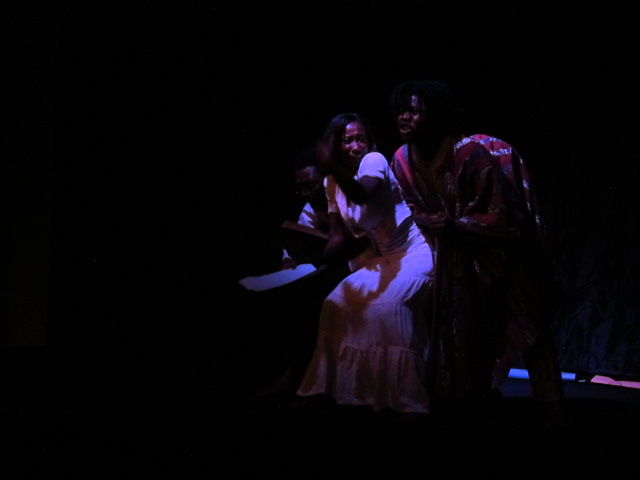
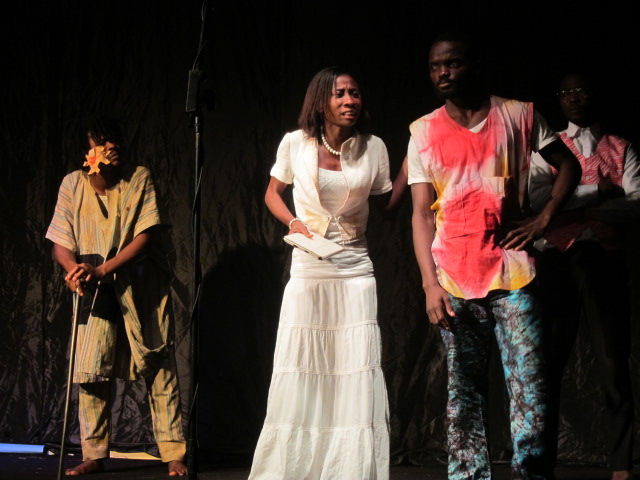
a. The use of space was amazing. Like an owl, the audience found themselves turning three sixty degrees. Many of the cast were seated amongst the audience and the audience were literally brought onto the stage. The stage could not contain the depth of actions Otun Rasheed offered. I also like the use of light and the special effects on the stage particularly in the opening scene.

b. Great publicity. Every day was a new message urging you to watch the play. The t-shirts and posters added pep to the show. The visuals were simply amazing! Social media aided publicity for this pay. Gone are the days when crude publicity was done by hiring a rickety university based cab with speakers mounted on it, while announcement are made round the campus through unfiltered microphones.

c. There was great synergy between members of the theatre unit and the students in bringing this idea to fruition. For this, I congratulate both students and staff of the theatre unit. Otun entertains much as he shocks his audience. His main aim is to call for the censorship of plays just like it is done with films. His personal experiences of taking his under aged children to watch adult plays without knowing it inspired this work. You must be Mad, Yes you! was rated 18+. Tickets were not offered to underage undergraduates, but a few still managed the gain entrance. That is the very point this play tries to address. How careful can parents be in bringing up their kids? What should be told them and what should be left for them to discover on their own?

The play lasted for three days. In my mind, it lasts forever. The final day had the main auditorium full to capacity. My only regret was that the madness was not sustained for a full week. Much as I like this work of art, I would like the directors to temper some of the violent scenes, particularly those couched within the audience area.

Peju-LayiwolaI salute your courage Otun Rasheed for bringing this play to the university environment. I look forward to watching it over and over again. I hope it would be viewed in a more pubic theatre and receive the sort of commendation it deserves. Did I hear you say condemnation? It is left for you to decide because you must be the only sane person in this very crazy world.

_________

Péjú Olówu Láyíwọlá is an artist, painter, and sculptor. She lives in Ibadan. Full text culled and edited from her Facebook page, with permission.
A Dance of Complexities

“One of the magical things about theater is that it gathers a crowd of people in a quiet space, and each member of the audience gets to see how people respond differently to the different things being said on stage. The person next to you will laugh at something that you’d never think of laughing at, and you’ll get a glimpse into all the different ways of viewing the world. Unfortunately, so much theater today is less nuanced. It gives you a large dose of one way of thinking, in hopes of getting as many of the same type of people into the theater as possible.” – a thespian recently features on the Humans of New York page.

IMG_2113 I begin my review of a stage production of Wole Soyinka’s A Dance of the Forest (1963) by Segun Adefila’s and the Crown Troupe of Nigeria from this, a succinct appraisal of theatre as a vehicle to entertain and inform a populace without catering to mass appeal alone, but rather individual tastes through a large but severally tailored offerings.

Perhaps no other play could be used as a poster example for the complexity of theatre and its ability to regenerate itself in a myriad of colours to diverse people than this production which, produced to mark the 80th birthday festivities of its playwright, was only one of the few other performances of the author’s play around the same time. In actual fact, another production of the same play, at a far larger and ambitious scale, was performed on the night of the celebrant’s birthday itself, right across from his front yard in Abeokuta, with trees, shrubs, and real life rock formations as a live set. Photos from that ambitious performance posted on social media depicts a throbbing energy of an audacious imagination, with an air of theatrical verisimilitude for which the author should be extremely proud: an ensemble of real life masquerades, for starters. But I digress…

IMG_2131Segun Adefila’s production was a far less ambitious enterprise, which shouldn’t be surprising giving the grand and colourful exertions the play itself embodies. A Dance of the Forest, first performed in 1960 as an iconoclastic satirization of Nigeria’s independence celebrations, has been described as one of the author’s most complex and most difficult to understand works. However, effort was made, not just in the utilisation of the small stage that Terra Kulture (the venue) provides, but also in improvisation on the script of the play itself. Most of the improvisations were with songs, jokes, costumes, and slangs. At one point in the play, a character sings from Omawumi, a contemporary Nigerian musician who was definitely not born in 1960: If you ask me, na who I go ask…? An obvious oversight that could have worked for great dramatic effect happened when the corrupt civil servant was presented a bribe in broad daylight. The token was… a loaf of bread. Audible gasps in the audience suggested that it could have worked way better with a bag of rice. I agree.

For a low budget production which, one assumes will not, except with some sponsorship, recoup its cost of production (even with the 3,000 naira, $20, gate fee), the play was well rendered. The hall was full, and the audience engaged, with songs, dance, drumbeats, and a dialogue that flowed in the right cadence, at least for most of the night  (except for a few understandable omissions or stammers here and there). For a member of the audience with no knowledge of works by Wole Soyinka, this might be a rough introduction, helped only by the dynamic acting of some of the cast. A green-white-green motif featured prominently throughout (a reminder to the audience that Nigeria is the real subject of this play), while the masquerades dressed in white fitting overalls.

IMG_2173For someone watching the production of this play for the very first time, not much is lost. In fact, a few things are illuminated; how, for instance, the two undead characters loitering around the forest in search of someone to take their case were actually metaphors for the evils of slavery from an earlier time. Why the author chose to depict the man as a castrated being is his to explain, but the depiction leaves no one in doubt. That explanation is just one of the many layered metaphors that earned the play its reputation as a difficult but ambitious experiment. Patient readers, and audience members of future performances will benefit even more unveiling of the work’s many nuances.

There are others head scratchers. Names of Fela! Awolowo! Balewa! were repeated at a number of times as chants to what came before. But there was no Azikiwe. Why? What defines this group which takes only three names: Fela, Awolowo and Balewa? In any case, by 1960, none of these men had achieved much of what gave them the great stature that eventually stamped them into immortality. Definitely not Fela. It is also highly improbable that the author had written the names of any one of these into a script written as early in the life of the country as 1960 when much of what toppled that first democratic experiment had not even unfolded yet.

IMG_2121And while we’re on oversights, why was there never a consensus before, during, or after rehearsals as to what the right pronunciation would be of Demoke the murderous carver, a major character in the play? Is it “Démoké”: [A + dé + ọmọ + kẹ] “We crowned a child to pet”, or “Démókè”: [Adé + mú + òkè] “Ade held onto the heights”. It seemed a bit distracting after a while, I would assume even for those who don’t speak the language of source, that the pronunciation of the character’s name changed at will without any logical, textual, or dramatic justification.

And there end the knocks.

“Movies will make you famous; Television will make you rich; But theatre will make you good.” Terrence Mann was said to have quipped. For me, as theatre typically guarantees, it was two and a half hours of mental and aesthetic stimulation. Definitely a well-spent time.

______

Read a review of the work itself here, and – even better – here.

Saro the Musical – the preview

WP_20130910_064[1]How long should a stage play last? What if it is a musical drama performance celebrating the fun and foibles of today’s city dwellers? How much of pedagogy should we put in drama today? How do we get Nigerians to imbibe the culture of theatre-going?  Today at Terra Kulture, guests at a preview of a musical drama called Saro – the Musical answered these along with their adulations and other brilliant observations on the short preview.  I was one of those invited guests.

Written by Bolanle Austen-Peters, Saro – the musical, is a story of hope, love, and adventure; the story of four young men migrating to Lagos with nothing but their hopes and naivete. According to the writer (who also shares the writing credit with two other young Nigerian thespians), the idea for the play came from her nostalgia for the good old days of Nigerian theatre: Hubert Ogunde, the National Theatre, and a number of other cultural art festivals and theatre that were the mainstay of Nigerian entertainment in the sixties and seventies. Saro, she says, is her way of bringing back the culture of theatre-going by investing time, money, and effort into the production of something that is culturally relevant, fun, and entertaining.

As we saw during the performance of four (out of the proposed fourteen) scenes in the musical drama, an enormous amount of work has been put into the production so far. There was dance, choreography, and a brilliant orchestra at the background. The play is directed by Makinde Adeniran (also working as the Executive Director), Ayo Ajayi is the Music Director, Kenneth Uphopho heads the Drama department, while Gbenga Yusuf coordinated the Dance.  ZMirage Multimedia Company led by Alhaji Teju Kareem, is the Technical Partner on the project, while the Cultural Advocates Caucus headed by Jahman Anikulapo is handling media and publicity.

Fullscreen capture 9102013 64508 PM.bmp

If what I witnessed today is any indication of the quality of the final performance, then those who go to see the play (coming unto the Nigerian stage between October and December of this year, and then touring the world afterwards) are in for a treat. My favourite part of musical plays is always the music, and in this case, I wasn’t disappointed. From the introductory sequence featuring a brilliant arrangement of horns and heavy drumming, to a number of other ballads and classical Nigerian musical tunes spliced in-between, if I am able to see it again, I will also look forward to going home with the complete soundtrack.

***

The number of questions raised by some of the guest called forward to proffer suggestions to the performance (guests who include veteran actress Joke Silva, Professor Ahmed Yerima – formerly of the national troupe, famous talk-show host Mo Abudu, veteral broadcaster and music writer Ben Tomoloju, and a host of other guests chosen from the arts) continued in the cafeteria where a lunch buffet was provided. What the consensus was, at least around my table where a few friends and I caught up after a long absence, is that genuine and dedicated theatre-goers and theatre-lovers will stay for any length of time to watch a play if the subject and production catches their fancy, and that the length of a production should never be decided solely on the short attention span of  a current crop of Nigerian theatre-goers.

In all, it was a beautiful, stimulating encounter. The musical is highly recommended.

(More information about the performance can be found at http://www.saroterrakulture.blogspot.com/ and http://www.sarothemusical.com/)

Africa Night – A Celebration of Cultures

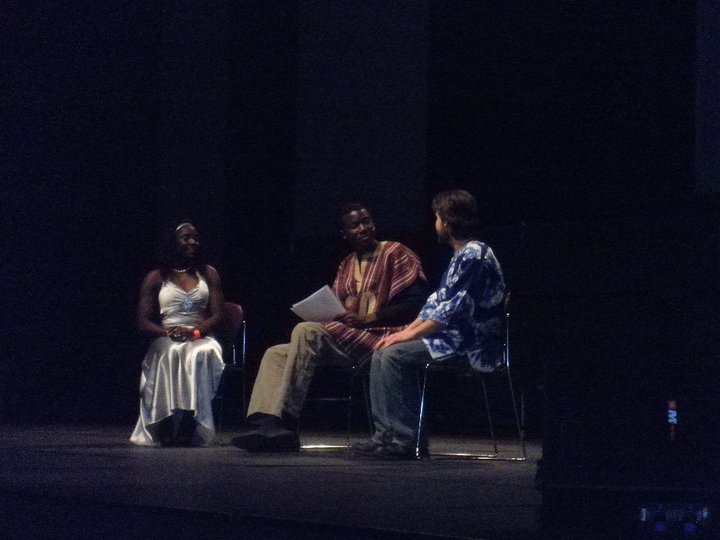
Away from the news of uprisings and unrests in parts of the continent, students and faculty of my university gathered on campus on Saturday to feast and celebrate what unites us all: the beauty of music, the graciousness of fashion, the excitement of dance, and the great pleasure of diversity. It was the annual Africa Night event which took place at the Meridian Ballroom. I was the host, along with Jacob Moorleghen, a volunteer from the S.P.E.A.C club – a charming co-host.

Written as a play of two friends from two countries travelling round the continent discovering places, people, food, artifacts and events, the show centred around showing the audience what they would usually not see on the news about Africa and its various people. A continent of (now) fifty-five countries is something that no one would be confident enough to claim to know without some sort of guidance, and the patience to explore. Jake was the American filmmaker, and I was his resource. A little tension of the “otherness” is added, and the drama of discovery begins. We went from Kenya to South Africa, to Congo and to Ghana, and to Nigeria, touching on sites of historical and economic significance along the way in other parts of the continent. The script was written by Julaine Fowlin and supported by a wonderful cast of students and other volunteers.

I am passionate about things like this – theatre, and such opportunities for social interaction and intervention, and I am very happy that it went very well. More than just the pleasure of bringing the beautiful aspects of the continent’s cultures to the appreciation of the most diverse audience, there is also a joy of being in company of such young people who hold the key to the next generation. It was a great night, and I thank the students for inviting/involving me.