The Light in Double Equivalents

The outrage that greeted Republican front-runner Newt Gingrich’s recent comment about poor people stemmed mostly from his condescension, and not from the fact of his assertion. Speaking at a campaign in Iowa last week, two weeks after he had called the labour laws in America “truly stupid”, Mr. Gingrich said:

Really poor children in really poor neighborhoods have no habits of working and have nobody around them who works. So, they literally have no habit of showing up on Monday. They have no habit of staying all day. They have no habit of ‘I do this and you give me cash’ unless it’s illegal.

Coming from a middle-class background and growing up in Nigeria’s lousy economy of the 90s, I relate with much of what he said with regards to the habit of working. The disingenuity of the argument he makes, however, is in the way it casually omits the truth in a similar argument for the other side. Read below:

“Really rich children in really affluent neighborhoods have no habits of working and have nobody around them who works. So, they literally have no habit of showing up on Monday. They have no habit of staying all day. They have no habit of ‘I do this and you give me cash’ unless it’s for partying.”

Did you see what I did there? I substituted the words “poor” for “rich” and other “negative” equivalents for “positive” ones. Does that little trick change the truth in the assertion of Mr. Gingrich? No. The problem however is that he did not make this balanced claim. By focusing only one side and demonizing poor children, he pits himself on one side of the argument, and thus muddles the issue he was supposed to be solving. If the focus of his comment was to breed a culture of working, is there a particular reason why it should focus only on poor children?

Let me make a second example, also from Mr. Gingrich’s attempt at political commentary. While speaking with a Jewish television last week, Mr. Gingrich said that Palestinians are, after all, “an invented people” who didn’t exist as a nation until after the exit of the Ottoman empire. Of course, he was right. The people now referred to as the Palestinian people, now craving for a state of their own, are just Arab people living in the middle east. However, so are the Jewish people as well! The Jewish State of Israel (at least as we know it today) was just as well “invented” in self-determination after the Second World War. So why did Newt Gingrich not state the second equivalent truth of his assertion? Because it is not politically expedient, and – like other Republican candidates – all he wanted to do was to sound Pro-Israel than the incumbent president whose job he seeks.

Now, to my final two examples on this matter, this time on race. I found out to my chagrin that the most popular post on my earlier wordpress blog (before moving to this domain) has remained this one where I wondered if oyinbo – a Yoruba word for “white person” was a racist word. I knew it wasn’t, but I was interested in reader perspectives on the way a word conditions the way we look at the world and other people. I got feisty, energetic responses. But what struck me earlier this morning however is a fact that I had overlooked for too long: that more than half of what is considered racist – even here in the United States – were anything but. Here are two quotes, the first by Donald Trump: “I have a great relationship with the blacks,” said a few months ago to public outrage, and Ann Coulter’s “Our blacks are so much better than their blacks” – a reference to African-Americans in the Republican party as opposed to those in the Democratic party.

It is easy for me as an African to take umbrage at each of these statements (as I undoubtedly did for a few days without being able to lay my hands on why the statements seemed so jarring). A few months removed from the uttering of those words however, I finally got it. It took a short memory trip back to the sociopolitical environment of my home country. “I have a great relationship with the whites” would not have elicited such a public umbrage in Nigeria but it would have raised eyebrows of social awkwardness. There is a consensus that there is something awkward with a citizen who felt the need to associate himself with a particular race for political advantage. “Our whites are so much better than their whites” would have elicited a similar response of awkwardness, albeit with a heavy dose of scorn and derision. It definitely would take some self-loathing and inferiority complex to make such a public proclamation. Implicit in these statements however is the acceptance of the “otherness”, and thus the problem. In Nigeria, this “otherness” is accepted, considering our colonial history The “whites” are not one of us. In America, it is not, because of the country’s history of slavery and civil rights. The “blacks” are also Americans, and undeserving of such “otherization,” thus the outrage. If Mr. Trump had said “I have a great relationship with the Nigerians”, or Ann Coulter, “our Nigerians are better than their Nigerians,” no one would have taken notice.

There is something to be said for double equivalents. Some things don’t make much sense until we put them in front of a mirror of polar equivalents. Some don’t make sense at all, eventually, of course, but it sometimes helps to pare them off all their political overtones. Mister Trump and Miss Coulter get a pass from racism but not from bigotry, and Speaker Gingrich gets all the blame he very well deserves.

Polysemy in Politics

Perhaps we all spoke too fast. Certainly not. The man who ran his mouth for several weeks demanding proof when there seemed to have been many available everywhere that a half-black man was born in the US finally got a certain “respite” when the document was released. After all, he played a role in it. And then, a few days later, he got some good bashing from the man he had spent the previous weeks maligning. Like a few other commentators (including Baratunde who made a personal video on youtube decrying the humiliation the “white privileged businessman” brought on the “first black president” by being forced to comply), I also thought it was racist. His further demanding the president’s college transcripts rather than asking more sensible questions about the economy or the direction of the country made it even worse. The whole “birther” escapade reeked of something more than just partisan politics.

A few days ago, former President Bush declined an invitation to go with President Obama to the site of the World Trade Centres where terrorists had knocked down two prominent buildings killing thousands of people. He was, according to reports, keeping up with his desire to stay out of the spotlight. He had lived up to this promise many times by refusing to comment on current topical/political issues in order to keep the focus on the president rather than on himself – obviously aware of the star power of his ex-presidency. Some other reports however saw it as a snub. The current president had refused to give enough credit to the former one for investigation procedures that led to this victory, and thus, he could as well go it all alone.

Last week,, I turned in a final semester paper in my Discourse Analysis class titled “Polysemy in All-Male and All-Female Speech” using evidence from elicited conversations to make judgements about how humans use ambiguous statements and expressions to achieve desired goals, and particularly how innocent and sometimes unintended speech acts are sometimes construed to very specific purposes by hearers and listeners. I guess it is only fitting that all of this news events are happening at this moment when the paper is sufficiently turned in. Yet it left an excess of active brain cells making perhaps needless connections to current affairs in the name of discourse analysis. Sometimes, a speech – or an act – is just what it is, without any underlying intentions.

Photo from http://bit.ly/kR4lyE

A Sad Day in America

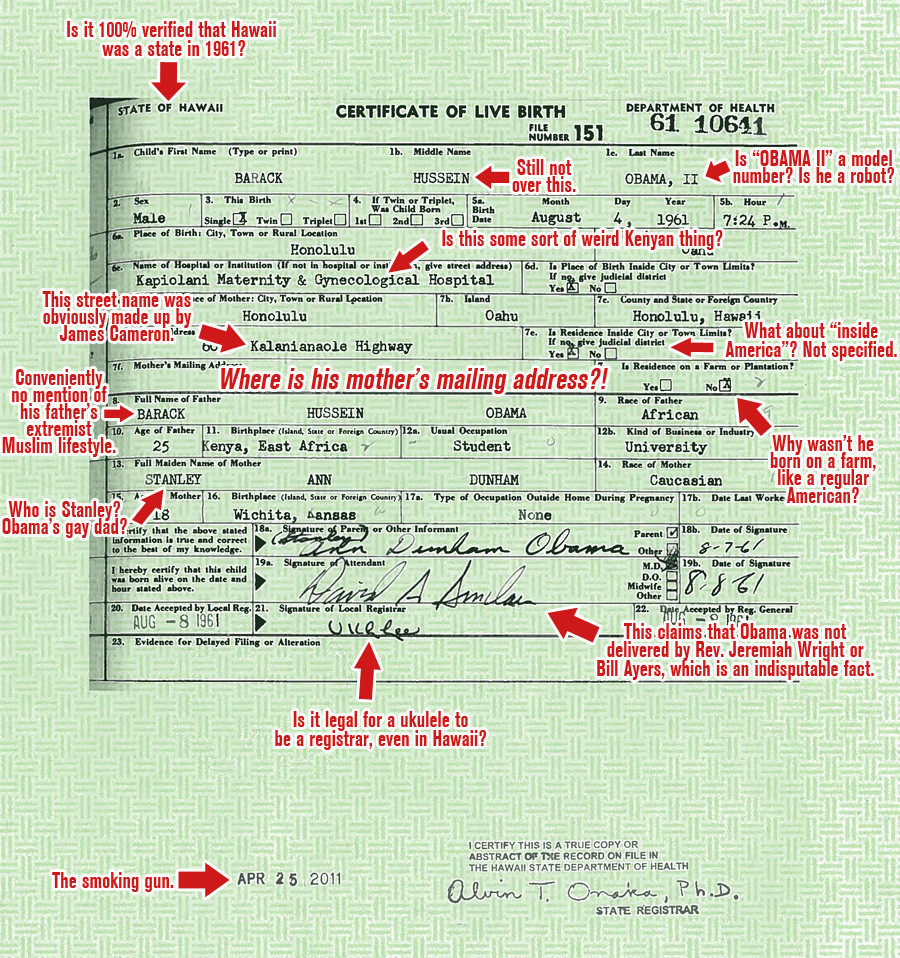
Today ended like a dream, a series of surreal hours that – one after the other – confirmed some of the worst fears of sane tolerant people. I’m disappointed like I’ve never before been in the political process and a certain intolerance best exemplified by what had just happened. It was unbelievable. The president of the United States had called a press conference, cutting into all live shows around the country, to show a final definite proof that he was born in the country as he had always said he was: a long hand birth certificate. It was the first of any president.

Obama's birth certificate in the eyes of a birtherFor me, this is sad on many levels, and race had a very large role to play. A few minutes after the White House released said birth certificate which they had got on request from the records office in Hawaii to put the controversy to rest, media mogul Donald Trump – also a contender for the next election – went to a press conference not just taking credit for the disclosure but also asking for the president’s college transcripts thus casting doubts on his qualifications as well.

I am a firm believer in the inner goodness of every human being in spite of their colour. I approached this country and people with the same open mindedness and was – like everyone else around the world – ecstatic and absolved when Obama was elected in 2008 in spite of what many considered his biggest obstacle: the colour of his skin. And then, from then, disappointed as to how every criticism of his policies seemed to come with something more than just a mere disagreement with economic policies. The press conference by Mr. Trump exemplified for me an unfortunate culmination of an underlying culture of intolerance.

First he said the president wasn’t born where he said he was, then he said the president had paid over $2m to prevent himself from having to show the document. A few weeks ago, he said he had sent investigators to Hawaii and he “couldn’t believe what they’re finding.” This, we found, was a lie, as Anderson Cooper found out after sending his own reporters to Hawaii. It turned out that Trump’s men either haven’t been there, or haven’t spoken to any relevant people as they should have. Yet he kept hyping the issue up for ratings in the media. Today, as the document finally surfaced, you would think he would back down. No, “we will get experts to examine it,” he said. For a moment there, I remembered another third world country – Ivory Coast – where Laurent Gbagbo had used a similar case of citizenship to keep his opponent away from the political process for many years. Many years, thousands of lives, and a brutal civil war later, we know where Gbagbo now sleeps, and in what bad shape his country is. It’s not the perfect analogy, but it’s not too far off either. The script is the same: “show us your papers and we’d let you play.”

I don’t think that many Americans realize just how bad this reflects on the country to the rest of the world, and that makes it a little more unfortunate. I’m not American and may never try to be one. But seeing how the country treats its own and one of its best leaves very much to be desired. This piece published today puts it in very good perspective. (Thanks to Nneoma for the link)