Abayomi and I

In this guest post, children’s story writer Ayodele Olofintuade writes a autobiographical account of growing up with her brother in Nigeria. It’s reproduced her as cross posted on her blog totallyhawaya-haywire.blogspot.com.

_____________________________________

… At five years old

“What’s the west of the stowy?” He asked staring at the pictures in the comic book

“The oko baba dudu first!” I said making a grab for the sweet.

He clutched it tighter, “Who is that man standing behind Spiderman?” He pointed at the comic.

“Oh he’s just there.” I said dismissively. “You promised to give me the sweet if I read the comic to you.” I said eyeing the oko baba dudu anxiously. In spite of the fact that I am three years older than Yomi he’s always one step ahead of me.
“What is this man doing there?” he repeated holding up the comic.

“How will I know? There is no balloon coming out of his mouth.” Then it dawned on me that Abayomi has no intention of giving me the sweet, so I made a grab for it . Abayomi gave the loud screech that always fetched our mother from wherever she was … I snapped my fingers at him. “I will show you! Mcheew!!” I know when to run …

“Wale! Biodun!!” he called his friends. “I have finished weading the comic. But you have to give me one oko baba dudu each before I tell you the stowy … is it me that said you should not know how to wead like me? … This is spiderman and the other one is emm… emm, …superfly…!”

***

… And then he turned eleven

“But why is your cousin not talking now?” Jide said, eyeing my ‘cousin’ who is dressed up in a black mini skirt with a pair of very high heels and a big afro wig.

“I told you she’s mute, she can hear you but she cannot talk.” I said smiling at my ‘cousin’ as she applied … no smeared… more lipstick on already blood red lips and added powder to a ghostly face.

“But that your cousin looks like Yomi.” Jide said staring at the huge boobs straining at the tee-shirt.

“Wo Jide, I’m tired of this jare, do you want a girlfriend or not? She will allow you touch one of her breasts, just pay up.” I held out my hand for the twenty naira. Jide reluctantly handed over his life savings to me, his eyes still glued to my ‘cousin’s’ balloons… “Are you sure she will let me touch th…the…them?”

“You can take your 20 naira back if you don’t trust me.” I watched with disgust as Jide started squeezing one of the big pimples on his face … no wonder he doesn’t have a girlfriend.

“Where is Yomi?” He asked as he dipped a finger inside one of his nostrils.

“He’s in Lagos.” I said haughtily. “Come back around 8.30pm, my cousin will wait by that door.”

“It will be too dark.” He whined

“You did not say you want to see a breast you just want to feel it, so you don’t need light. You have to leave now, mummy is back.” I said pushing him through the door.

“Good afternoon ma. Bye-bye.” Jide said as he ran off.

“Abayomi what are you doing in my shoes … my wig and my make-up?” Yomi stood up from the chair and nearly fell off the heels he was wearing.

“Get that muck off your face. Go and change. What’s that on your chest? The balloons I bought for Oba’s birthday abi? Don’t worry; I’ll get to the bottom of this later. I hope you’re done packing because the taxi that will take us to Lagos is waiting outside…”

***

… Yomi at 34

What fun we had in those days didn’t we?

_____________________________________

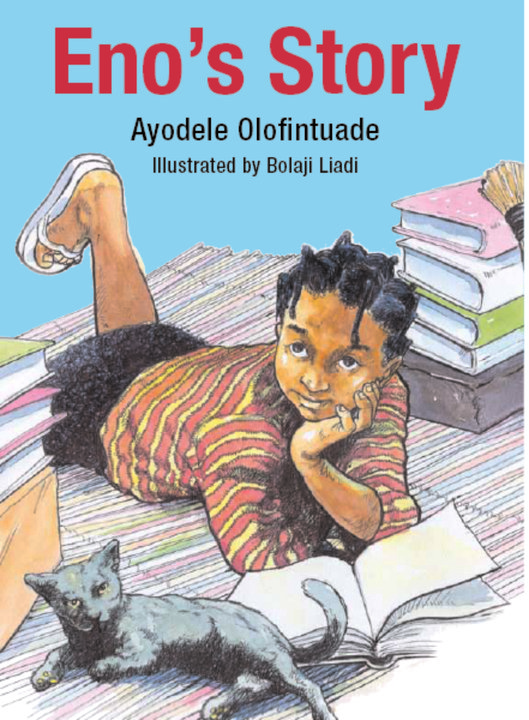
Ayo is the author of a forthcoming socially-conscious children’s storybook titled Eno’s Story scheduled to be published by Cassava Republic.
A Different Kind of Hoe

This is my post #400.

I have now lost count of how many times I used a perfectly clean English expression only to later discover that it meant something totally different in American English. Once upon a time, the “black book” was a place to write names of people you don’t like. But while telling a story of my first really brutal treatment in the hands of a woman bus driver in Edwardsville, I mentioned in passing that she had now entered my black book, and my students’ eyebrows went up. A black book, I was later informed, is a book where men wrote the name of their objects of desire. Surely that was new to me, and I immediately corrected myself. If I had a black book, the woman bus driver won’t be in it, definitely. Nine months ago, the only time you’d ever have heard me use the word “flashing” would be while remarking that someone had been calling my mobile phone without allowing me to pick it up before hanging up. In Nigeria, as in many other countries, that is “flashing”. I’m now aware – as I have actually been for a while even before coming here, from watching American movies – that flashing doesn’t have much to do with phones at all as with body parts. No, I don’t want to be saying that anyone has been flashing now. No sir, that’s why I have a voicemail. 😀

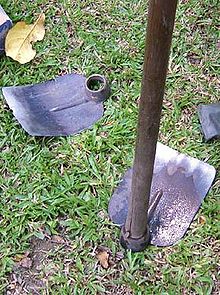
“This is a hoe.” Picture from Wikipedia

The influence of the mass media and their obsession with sex may have done irreparable damage to the innocence of words today. It is nows harder than ever to communicate without the risk of saying something totally different. Growing up in Nigeria in the eighties and nineties, I remember vividly that soda (soft drink) covers used to be called “crown corks” and that on radio during promotion, the jingles always were something like “Look under your corks and you might win a gift of…” (Hint: Nigerians typically don’t pronounce the ‘r’ in these kinds of words). Even to me today, that doesn’t sound to the ears as innocent as used to before, as neither is the use of pussies or doggys to refer to pets. Whatever happened to the language?

I am thinking of these things today only because during yesterday’s class, I was asked to tell the students the meaning of Ìwé kíkọ́ láìsí ọkọ́ àti àdá kò ì pé o and other lyrics of the song that they had learnt for the past three weeks from the class tutor. I painstakingly wrote out the translation on the blackboard (“learning from books without hoes and cutlasses is not a complete education”) and then suddenly realized that I could be wrong to assume that they all knew what kind of farm implements used in rural areas in Nigeria. The song itself came out an old culture of farming, and the grown folks who composed it had hoped to remind the young ones that farming is just as important as schooling. And so I asked, pointing to the writings on the wall. “You know what a cutlass is, right?” They didn’t. “What about a machete?” They did. “Alright, the cutlass is almost like a machete, and it’s used to cut down trees and to farm.”

And then it came. “What about a hoe?” Silence. Giggles. Laughter. Stares of horror.

He mentioned a hoe!

Then someone said, “yes” he knew what it was. I was at first relieved, until a few seconds later when I discovered that he actually didn’t, and it was my turn to be shocked. He definitely knew what he knew. And what he knew is neither used on the farm nor is supposed to be used in decent speech. Sigh. This is what has happened to my beloved English language. Oh, but how exactly did we get here? I’m going back to speaking only Yorùbá from now on, except that when written without sub-dots, the word for hoe in my language doesn’t fare better either on the scale of cleanliness.

A Tribute to Friendship & A Great Session

Chris and I seem to have  come a long way. We met after one of my first classes in the Fall semester, and even the first chance meeting was auspicious from the start. He has inquired how and where I had learnt to speak in English. Now, only a few weeks to my departure, I look at him and wonder how much fun we’ve had and how much I’ll miss the good times we shared from Missouri to Illinois, meeting different kinds of people from different parts of the world. What I’d miss the most are our weekly rendezvous as Starbucks sometimes in company of a few new friends, and sometimes alone, sharing wonders of the world. He’s an uncommon American – not that I have known many Americans on a personal level – but because he has an open-minded approach to the world. Could it be because he’s widely travelled, to Europe and to Mexico, or because being a descendant of immigrant German and Irish settlers, he already appreciates the benefits of diversity? I should marry him, and then both of us would be Nigerians and Americans at the same time :D.

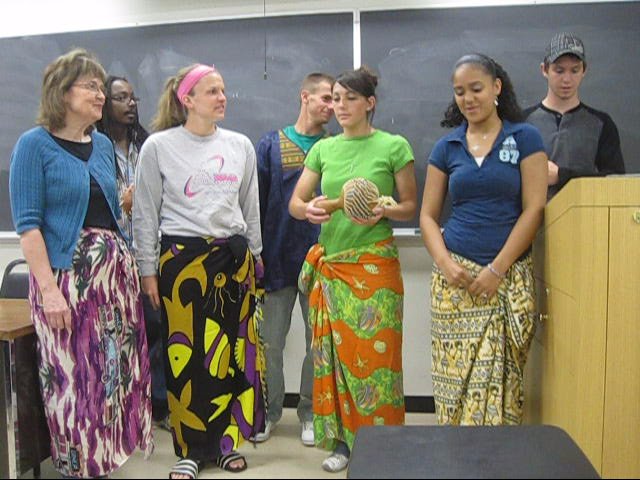
At today’s last class which ends my teaching this semester, and – oh, this session too, there was a singing presentation that was attended by the journalists from the Alestle campus newspaper who asked me almost all questions under the sun. The song the students sang were Ise Agbe N’Ise Ile Wa, Ki Loo Le Se Olurun Mi, Osuba Re Ree O and one more which was a total surprise to me – an American remix of the Ise Agbe song. They had learnt and rehearsed the songs with the help of a student tutor who is a Yoruba student of a different department, and today, I was listening to the songs for the first time from my students, much impressed. I’ve got their permission to put it on YouTube and I will do so in a few hours.

What was emotional for me was reading their perception of the class in a final paper, and how it fit or surpassed their expectation for the semester when they signed up for it. Like it happened last semester, most of them had signed up for the class without a knowledge of what awaited them on the other side. What made them wait till the end, they said, was that their interest was sustained, and for that I’m happy. I hope the next professor of the subject is as lucky as me to have so many fun students as I did, and to have a great one year learning and sharing different experiences of the American life.

The Best of KTravula

Out of fear that I may abandon this blog after my programme is complete, a friend suggested that I feature the some of my favourite post from over the past eight months and almost four hundred posts. That I will do beginning from this week. The most popular posts are already automatically listed on the right hand tab. But as has happened a few times on this blog, my favourite, or the most commented, sometimes do not always make it is to the list. So here we are. My top five favourites for this week. I sometimes go back to read them once in a while. What are your favourites?

A Short History of My Face

On the Origin of Names

How I Discovered the Value of a Quarter

Pumpkin

This Step, This Spot – A poem

PS: I just heard some horrible news about volcanic clouds all over Europe that is making it impossible for airplanes to fly. For me who would be going home via France (a welcome departure from the rudeness of London’s Heathrow Airport), I am worried. I do not want anything that will have to make me fly for 13 straight hours directly from the US to Nigeria. I don’t believe that anyone should stay for that length of time in the air, and definitely not someone with long legs and a resentment for cramped spaces.

Happy Birthday Clarissa!

A birdie told me that it was your birthday so I got you these songs. One in Spanish by a cute baby boy

And one in Ukrainian by a bunch of University folks somewhere.

Happy birthday Clarissa. May your dreams come true, and thanks for being a cool professor, brilliant colleague, and supporter of this blog. 🙂