A Walk to the Zayed Mosque

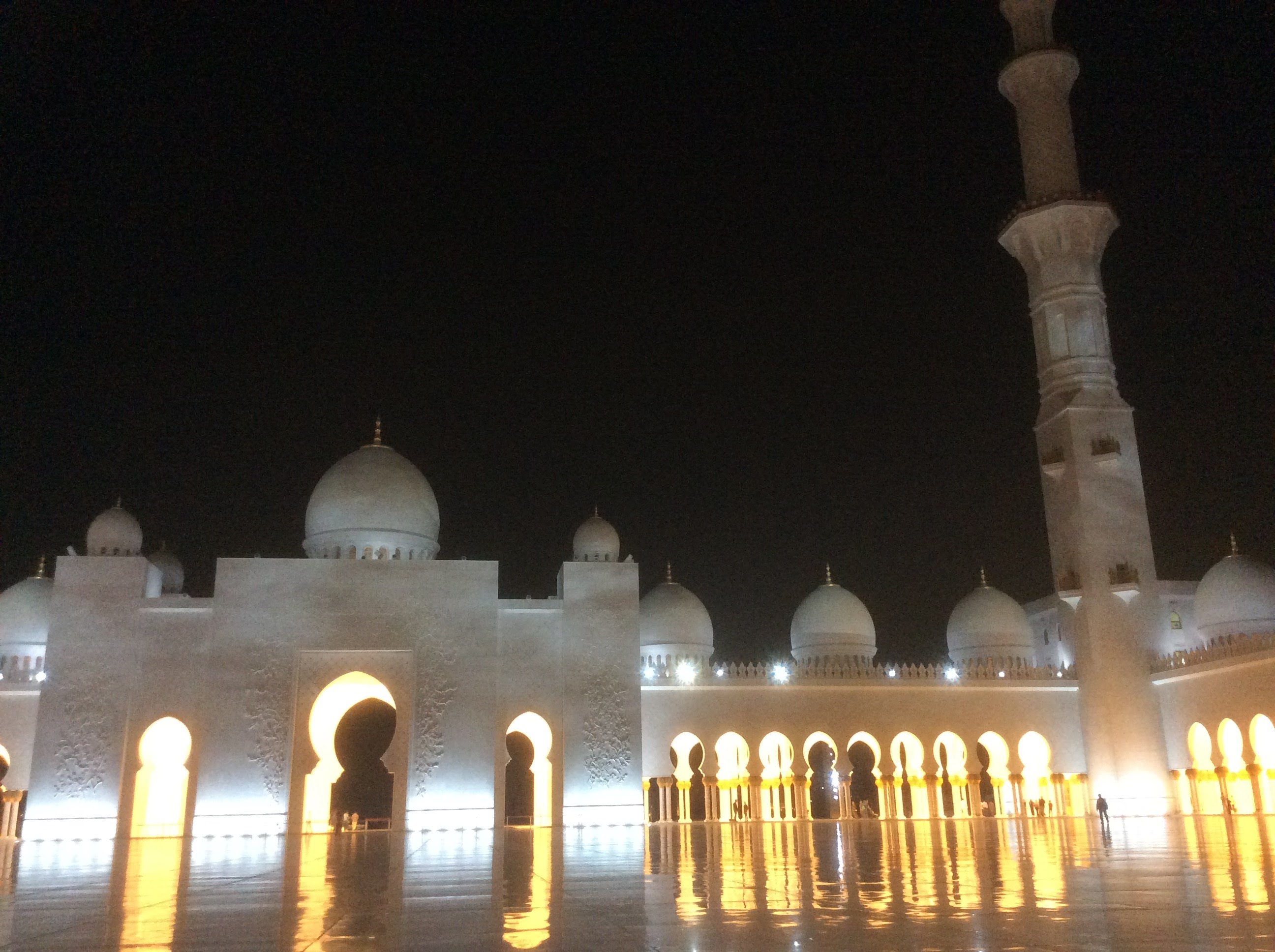
The Sheik Zayed Grand Mosque on the outskirts of Abu Dhabi was completed in 2007 after about 11 years of construction efforts, and about $545million to become the 21st largest mosque in the world by crowd capacity. On a typical Friday, it can host about 41,000 worshippers.

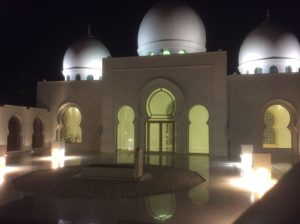
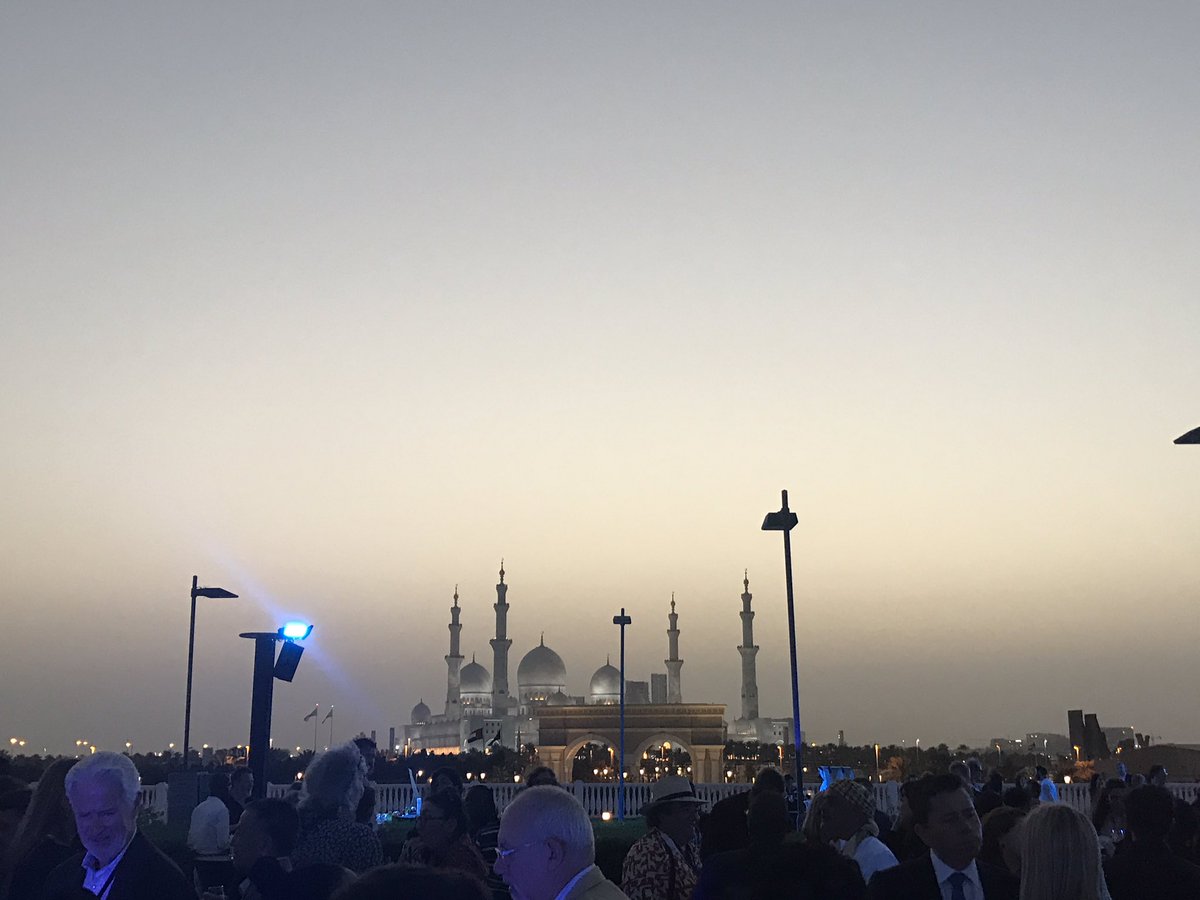
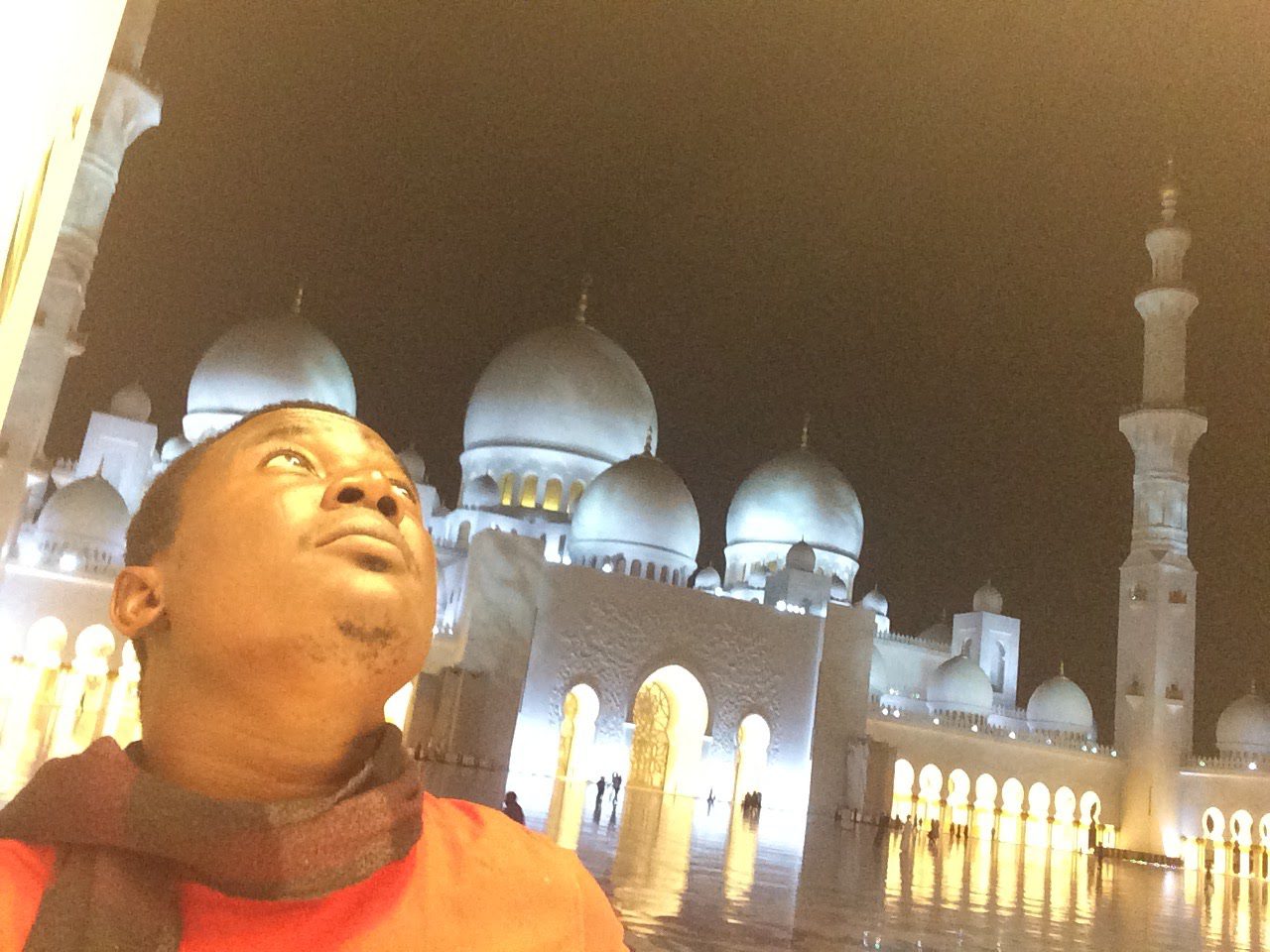
From my room at the Ritz Carlton where I was spending about a week, the view of the mosque dominated the evening, with specialized lighting constructed to reflect the phases of the moon. Luminescent from afar, inviting through the otherwise irregularly lit night, the Zayed Grand Mosque sat resplendent in the distance, refusing to be ignored.
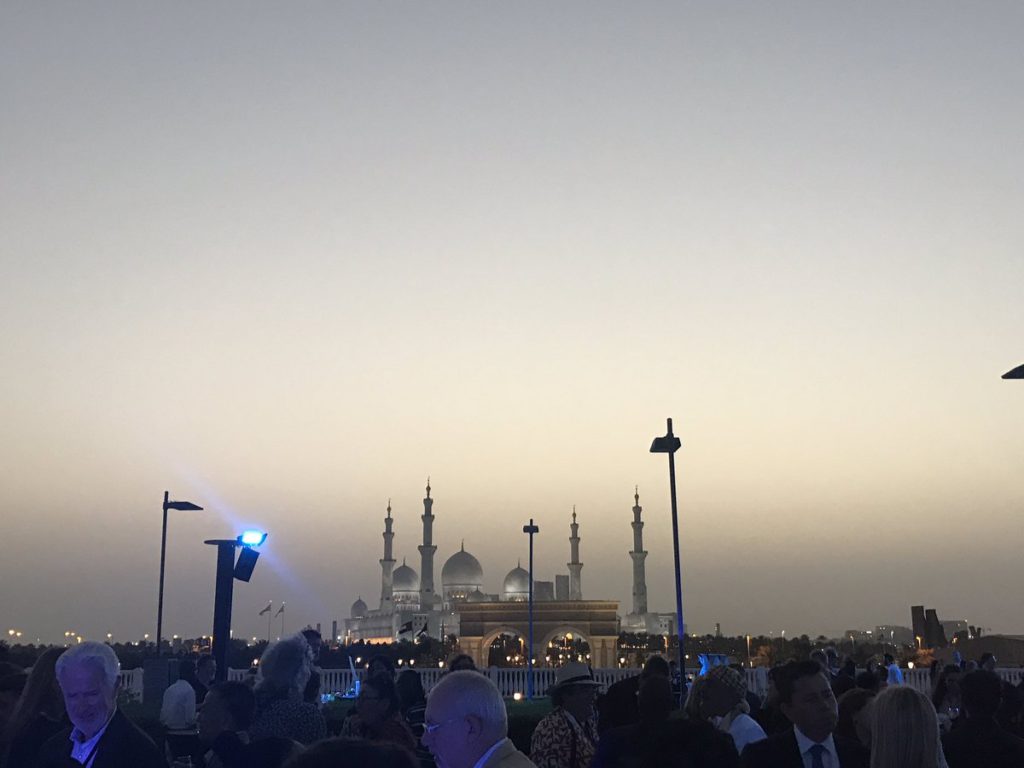
So on one evening, on the day when dignitaries like the former US Secretary of State Madeline Albright were feted in an open ceremony on the lawn of the Ritz Carlton, with the outside temperature dropping significantly to a level familiar with an African’s skin, an opportunity presents itself for an evening walk.

From that hotel, where the security official at the gate merely saluted the stranger as he headed out by himself into an unknown town, the path to the main road was barely lit, but it lacked any overwhelming feeling of fright as guests returning from town drove back into the hotel and taxis headed out into town, occasionally taking a look at the walking traveller as if to offer a better option than walking in what seemed like evening heat. Lagos weather is typically more humid, so this was a more tolerable atmosphere.

On either side of the road were sprinklers that kept the grasses fresh and green, something that must cost a fortune to maintain all through the year, not just in water supply but also in electricity. In an off-site parking lot on the left side were a few cars that I wondered contained plain-clothed policeman awaiting orders about any skirmish in town, or lovers too shy or too broke to book a space in the hotel just a few feet away. To the right of the junction where the road from the Ritz met the highway was the Memorial Park, built to commemorate the death of soldiers who died defending the country in the March 2015 war with Yemen. On the Park is an imposing steel and concrete monument by Idris Khan, a British-Pakistani artist.

At the road, cars flew by towards various destinations. A few feet away to the left is a pedestrian bridge, lit on all sides to solidify the ambiance of security. At the foot of the bridge, built into its base, was an elevator, for elders, children, and the infirm. It looked like it hadn’t seen too much action.

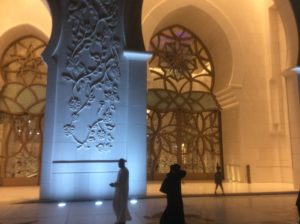
Once on the other side of the road, the mosque emerged within reach. But it was only on getting to its southern steps that one realizes that visitors are not allowed entry through there, even though there are no gates. The security officers there, Indian by their looks and accents, were firm but polite. “Walk all the way”, they said, “by the wide ornamented fence of the premises as if navigating the whole circumference of the mosque grounds. You’ll get to the visitor’s gate, also called ‘the northern parking entrance'”.

To get into the mosque itself, I had to pass through a metal detector. Not knowing better, I tried to take off my shoes as well, and the security man laughed at me. “This isn’t America, my friend.” I found it funny and asked where he was from. “Morocco”, he said.

“What about you?”

“Nigeria. Know about us?”

“Yes. Football.”

***
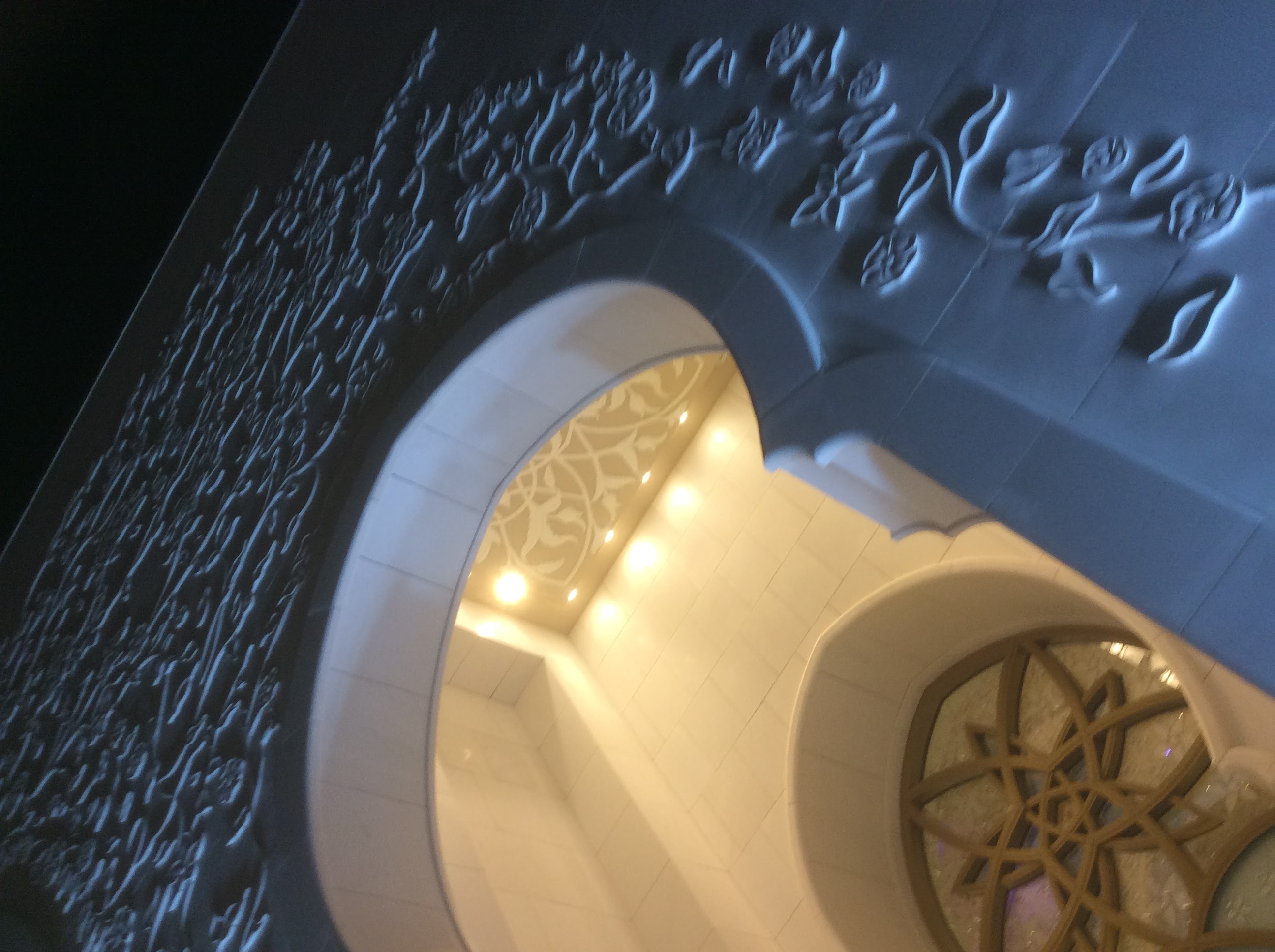
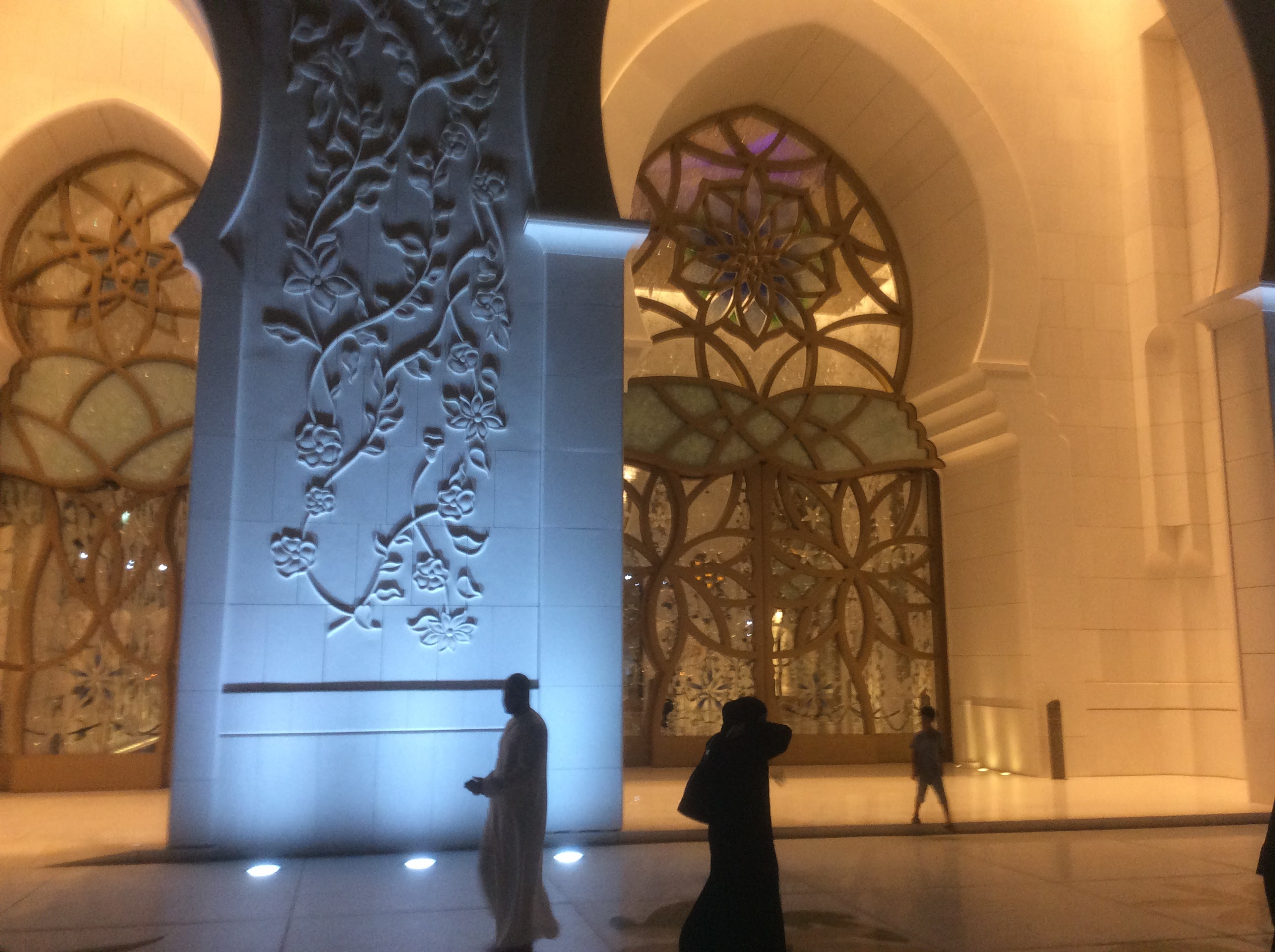
My feelings on entering the mosque itself have not found easy expression within words. But I concede now that an unfair collision of a perfect weather, full moon, and a highly anticipated contact with this building may have added too much to the most perfect first experience. resulted in so perfect an evening.

What WonderMondo described as the scope and ambition of the construction as “a structure that would unite the cultural diversity of the Islamic world with the historical and modern values of architecture and art” lived up to its expectation but much more in the way it carried the dignity of the faith it represented and the expectation of awe that its imposing nature adds to one’s contemplation of solitude while within its embrace. I still haven’t found the right words, but if the intention behind the construction included creating a serene space for contemplation of a version of paradise, then it is a successful experiment. I assume, thinking about it now, that most places of worship across cultures have aspired to that physical architectural effect

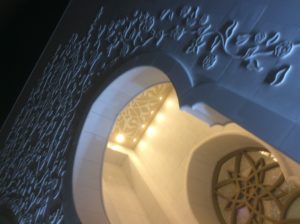
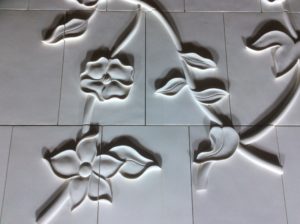
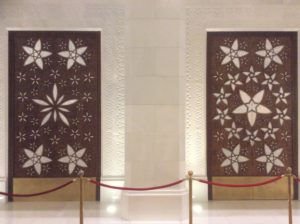
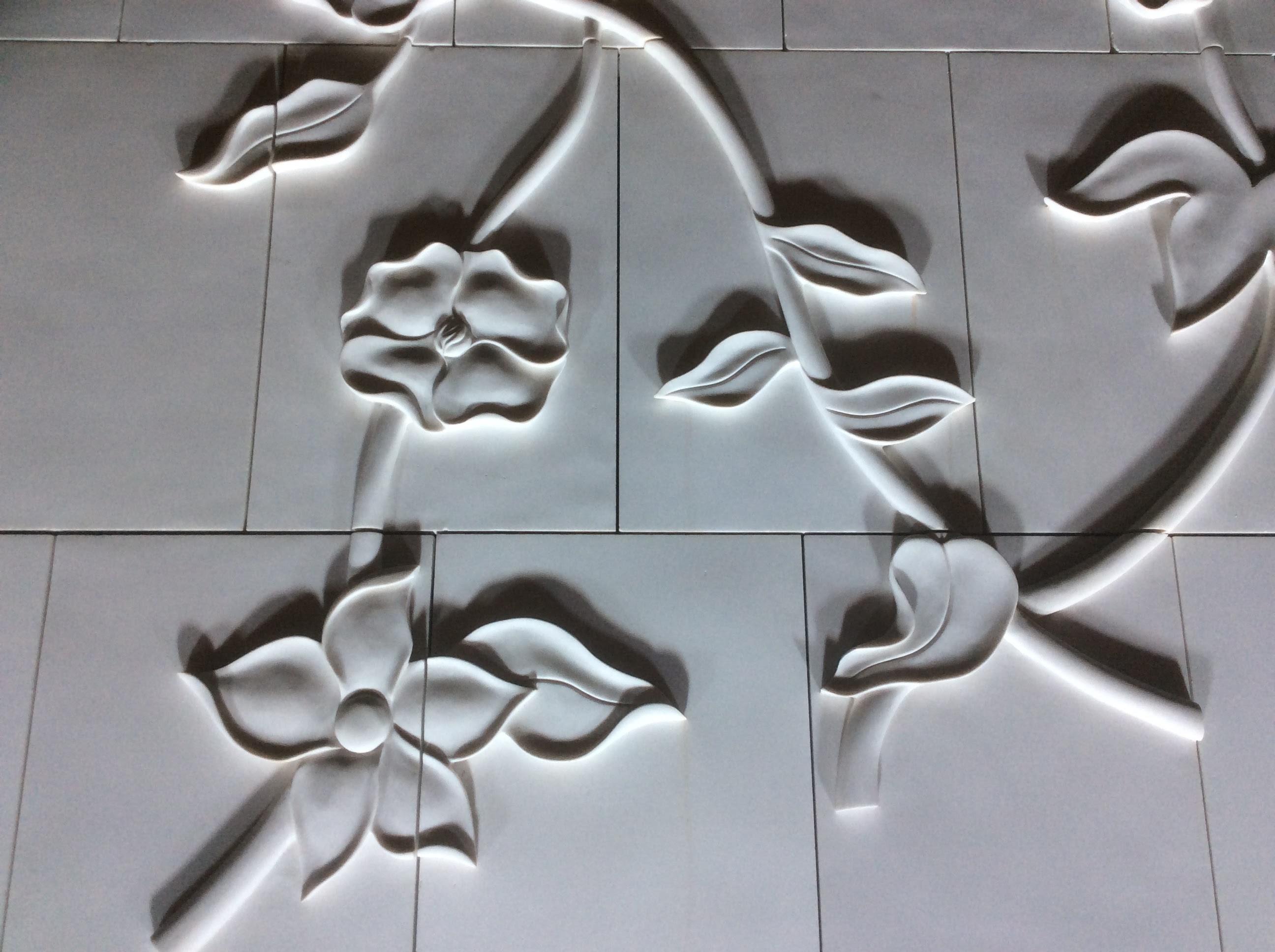
I have experienced this feeling before, at one time while observing the mosaics inside the ceilings at the Cathedral Basilica in St. Louis . The difference here is the scope of the ambition and the archetypal spread that Muslim prayer grounds have typically worn to maximize the smooth passage of breeze. Add to that, a reflecting pool, columns with Arabic calligraphy, marble carvings that go all around the face of the building, and a sense of serenity that surrounds the expectation of piety from worshippers and visitors. It was perfect.
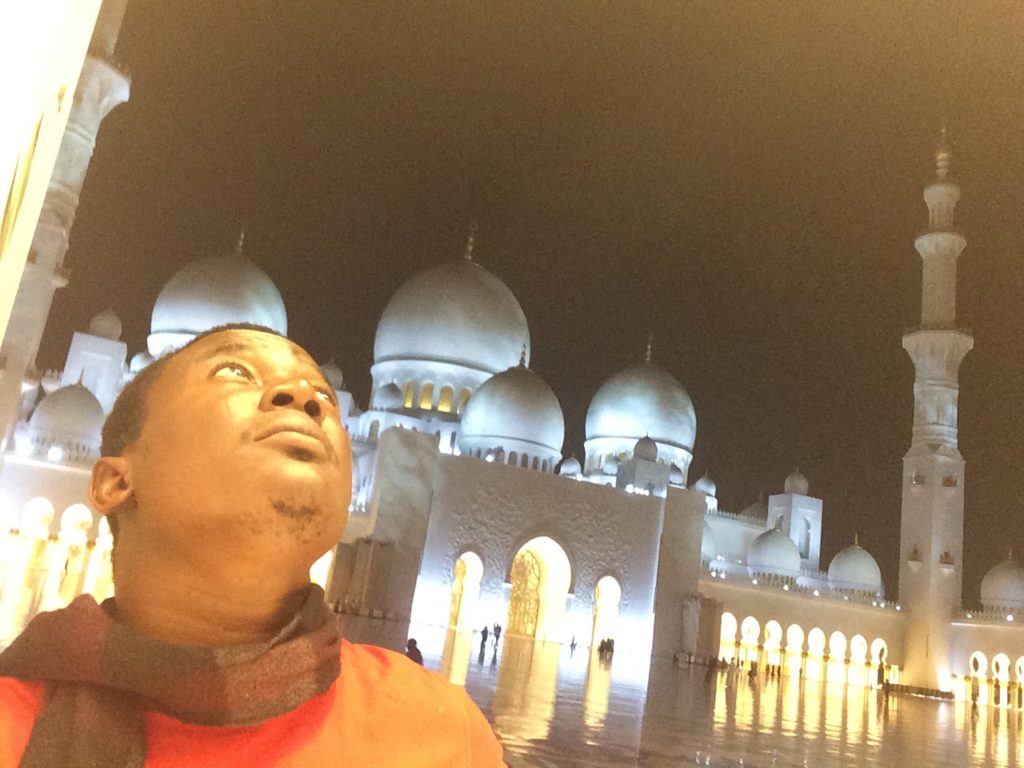
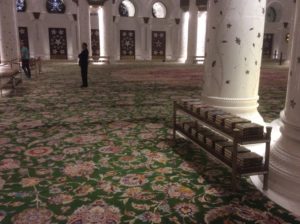
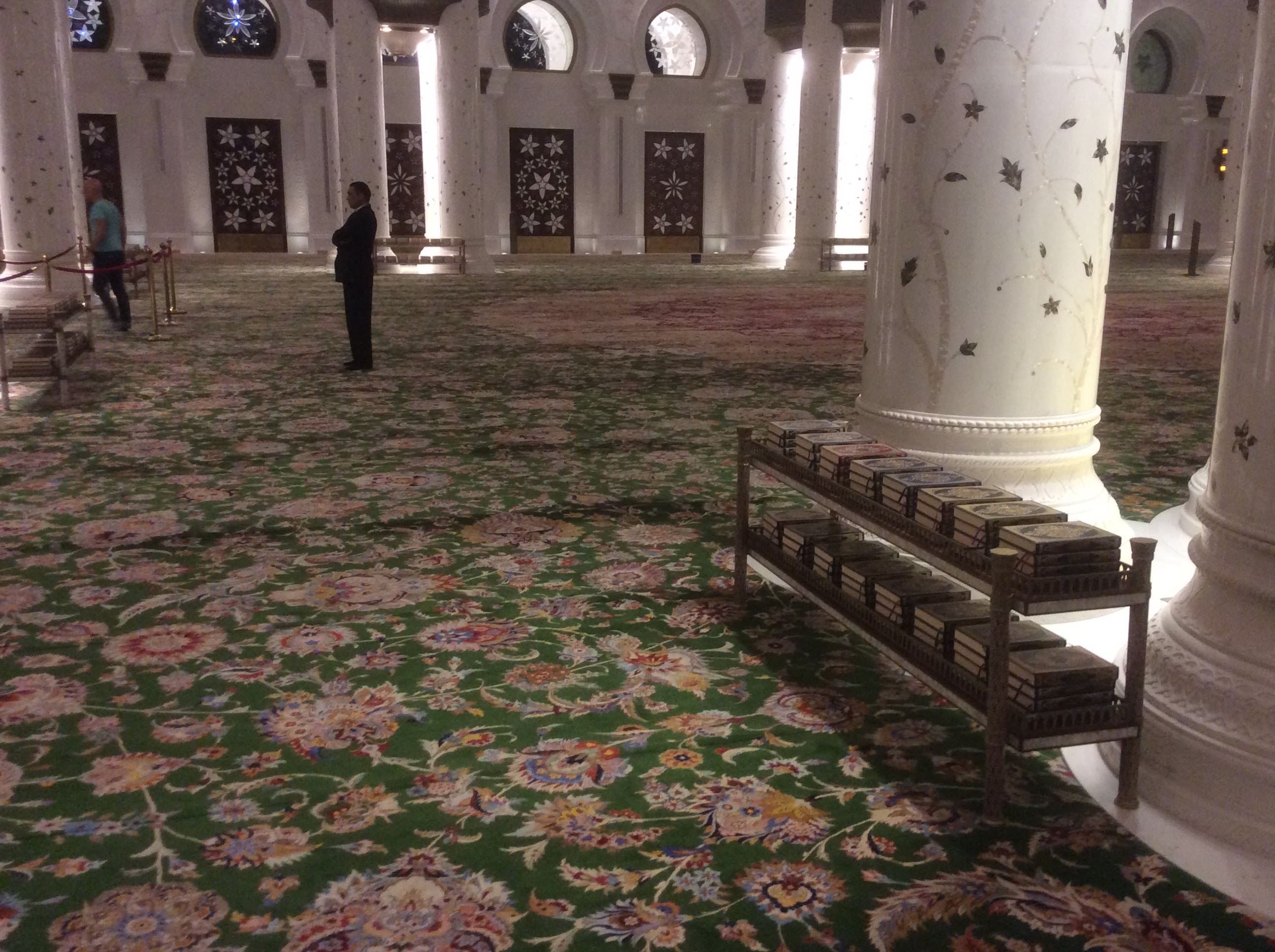
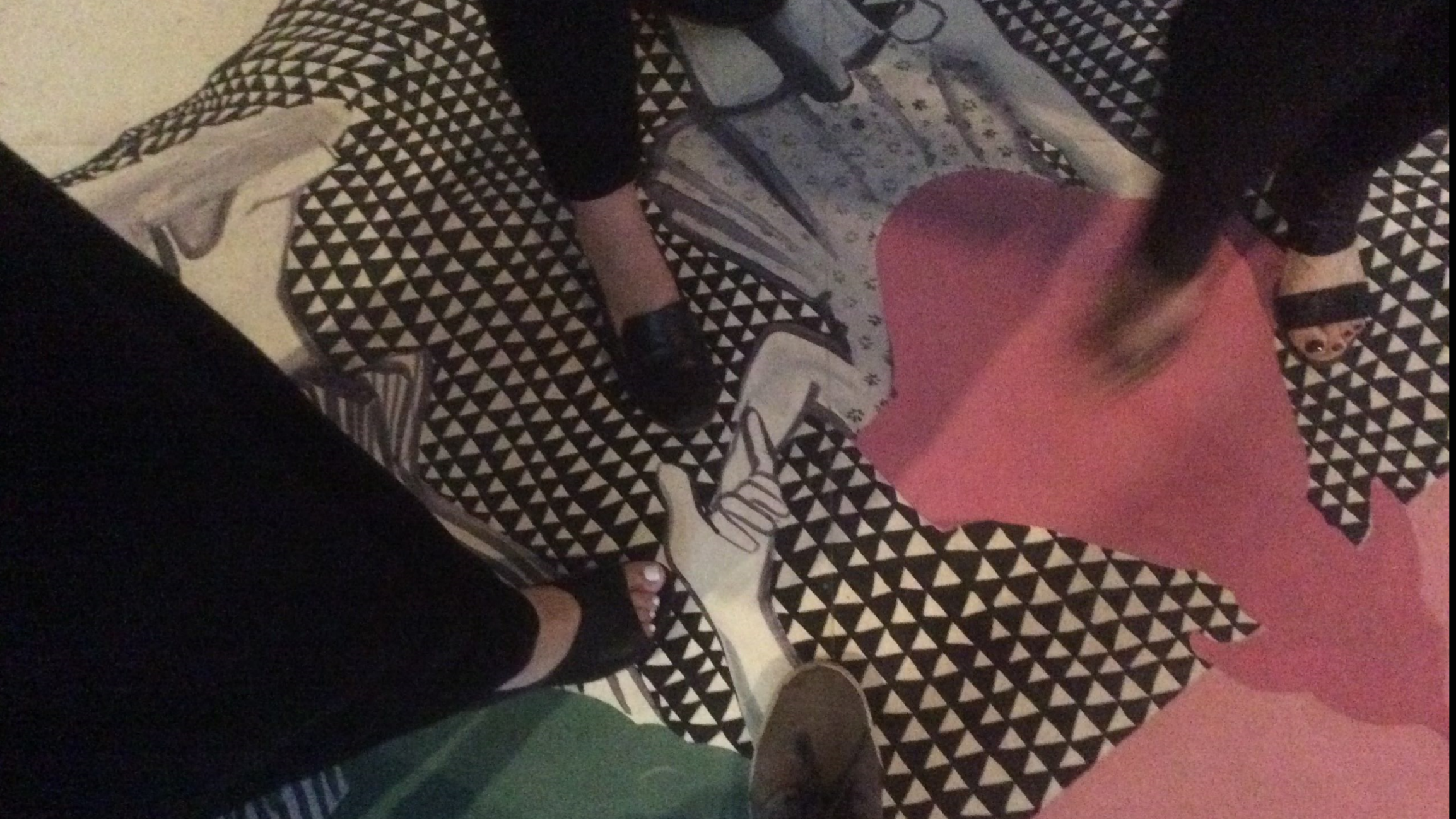
But I was a visitor, and not a worshipper. My agnosticism stood me out, at least in my mind, as an outside gaze into a least familiar space. But like others, I took off my shoes where necessary, and took a tour of the inner chamber where prayers are done every Friday, where all and sundry gathered weekly to submit as the prophet instructed. At that innermost chamber was a rug, the world’s largest carpet, believed to measure 60,570 sq ft,  created by around 1,200-1,300 carpet knotters, and weighing 35 tonne. Without shoes, its soft soothing face massaged my feet as it did others. A security man stood around a rope line preventing visitors from going too far into the centre of the room where, perhaps, the lead Imam led the prayers from every Friday. I imagined too, that this must have been where Sheikh Zayed Al Nahyan, the founding father and first president of the UAE, and in whose honour the mosque was built and named, prayed every week.

He died in 2004, leaving a progressive Islamic country with a culture of (or at least a genuine aspiration to) openness and multiculturalism. Many other structures in the country, and in the hearts of his subjects and children, bear his name. At the Culture Summit where I first encountered his name, an anecdote was told of him having to, some time ago at the founding of the country, park by the side of the road in order to correct someone who had climbed a date palm tree in a way that he, Sheikh Zayed, felt was harmful to the tree. A conservationist, then.

Outside of this mosque, in a small mausoleum constructed for the purpose, lay the rest of him, many feet under the ground. Into the air above where his body lay beneath the marble grounds, loudspeakers blared sequences of Arabic prayers in perpetuity, and a small camera stayed trained on a good view of the small enclosure.

You shouldn’t take pictures here, I was told, much too late.

The mausoleum of Sheikh Zayed Al Nahyan, the founding president of the UAE.

***

The walk back to the hotel was filled with calm recollections of whatever else the night held in store. One of the other random thoughts that entered my head asked why only religious centres benefited from this kind of architecture that invited meditation and reverence. What if, it wondered, bookstores and libraries were also built with this kind of spacious and elaborate architecture in which one could spend many hours just longingly gazing into images of marble and the sentences of Shaw or Chaucer?

I had not taken a book along to the mosque, and suddenly I wished that I had.
Art at the Guggenheim

Abu Dhabi, from distant (and ignorant) estimation, didn’t seem like the most natural place to find a Guggenheim Museum. It’s in an Arab country appearing, at least from preconception, to be necessarily hostile or at best reticent. True I’ve heard great things about Dubai and the progressive nature of that society. But like most things not encountered in the flesh, they remained in the realm of hearsay, hovering around the globally pervasive perceptions of all Arab countries as just one thing: conservative.

But all misconceptions eventually meet reality and knowledge happens. It must be what Mark Twain meant by travel being “fatal to prejudice, bigotry, and narrow-mindedness.” And so, on my week-long visit to the country to participate in the inaugural Culture Summit, I found myself in the embrace of a Guggenheim Museum. This museum project, and the other involving the Louvre Abu Dhabi, is a collaboration with the government of the United Arab Emirates and prominent culture centres around the world to make Abu Dhabi a cultural centre in the Middle East.

I am not a visual artist. Not since primary school anyway. My contact with and appreciation of the visual arts have stayed consistently close to the familiar activity of gawking, collecting, and critiquing – the latter only in my head and among like-minded friends. I have found solace, many times, in the warm presence of a well-stocked museum or well-curated art exhibition. The environment for meditation that they provide and the visual stimulation guaranteed in a well-lit studio space while observing mounted artworks are unquantifiable pleasures of middle-class life, at least for those to whom that is a worthwhile activity.

And so, when I got a chance to spend some time at the exhibition space holding the temporary collections of the Guggenheim Abu Dhabi at Manarat Al Saadiyat, I needed no convincing. This location, on the famous cultural district of Saadiyat Island which hopes to also host other venues of cultural significance like the Louvre previously mentioned, is where much of the activities for the Culture Summit was taking place. One open door away and we were face-to-face with timeless pieces of art as Jacques Villegié’s Quai des Célestins (1965) or Tanaka Atsuko’s Painting (1960).

On the first wall to the entrance was Chiinsei Botaichui (Female Tiger Incarnated from Earthly Shady Star), oil on canvas, by Shiraga Kazuo, a work created with “bold swathes of sombre colours with tactile density”. The work, we were told, was created with the artist’s feet, seeking “to liberate his work from the constraints of academic-style painting” and “in order to re-conceive the process of painting as an experimental encounter with materiality and surface.” What appears on the board at times resembles a flying bat, and at others an angel of death. But an amateur art critic – me – projecting his impressionistic sentiments on a modern experimental work offers no new value to what the work already presents. The artist was born in 1924 and died in 2008.

Through the museum space, there are other exhibits, like work by Motonaga Sadamasa, another Japanese artist (1922-2011) whose work used poured paint, depending on gravity to “replace the paintbrush and foregoing the precise and deliberate meditation of the artist’s hand.” The third and final Japanese artist exhibited was Tanaka Atsuko (1932-2005) whose work of Vinyl paint on canvas “evokes the incandescence of the dress (and) intricate network of wires and bulbs reflect (an) interest in (the) technology of wiring systems and lights.”

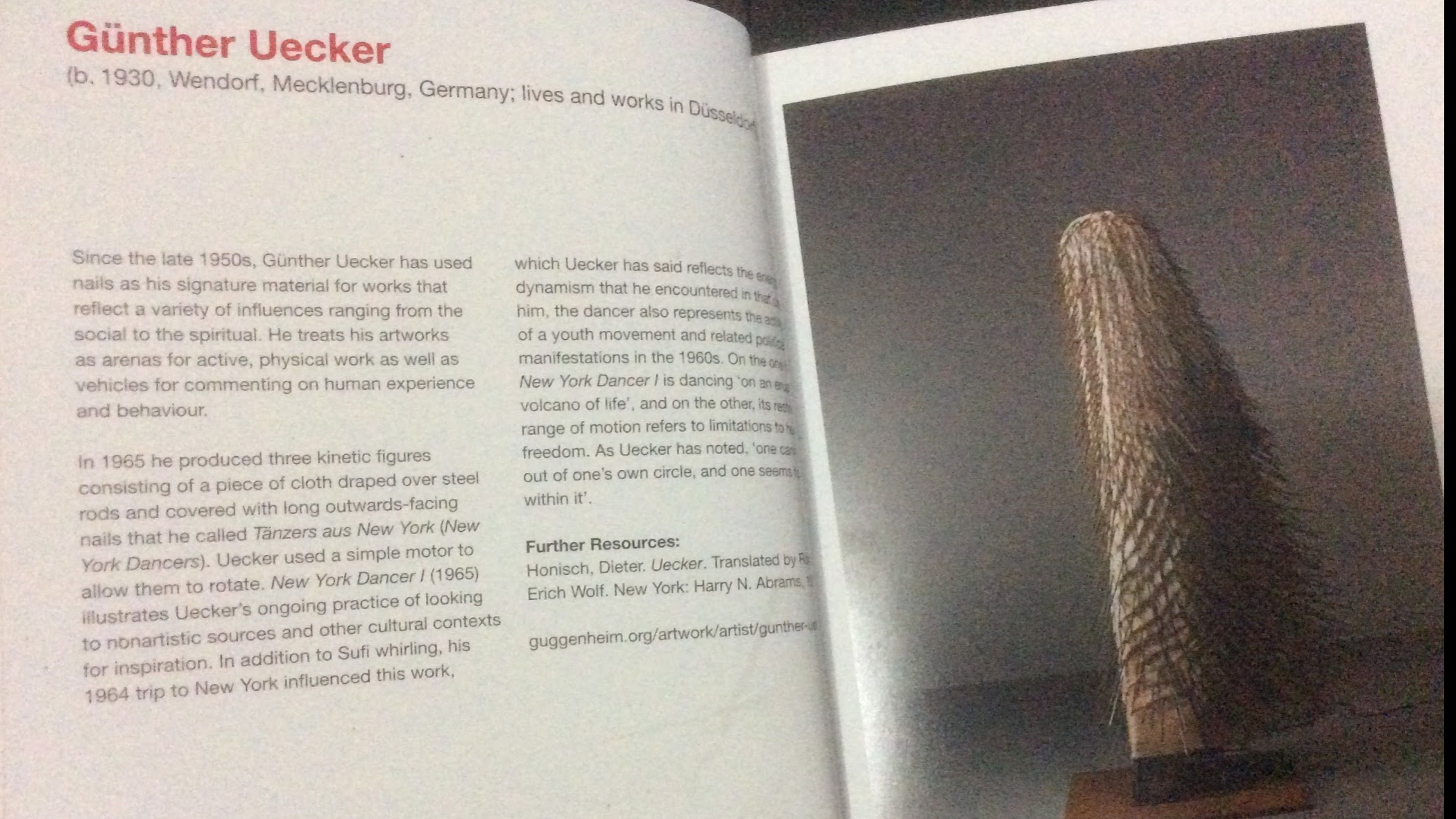
At the centre of the opening space are two kinetic works by two German artists. Gunther Uecker’s New York Dancer evokes the African egúngún without acknowledgment. It is a work “consisting of a piece of cloth draped over steel rods and covered with long outwards-facing nails.” The other, by Jean Tinguely (1925-1991) is called Baluba, a dancing piece of scrap metal “meant to portray a certain craziness and rush in this technological civilization”. Both of them, though not activated at the time but shown through a small television in their kinetic elements, felt familiar in a visceral way that most of the others didn’t. A walk through the Polytechnic Ibadan, or the Yaba College of Technology, will bring the traveller in contact with many similar kinetic and scrap metal artworks of like impression.

New York Dancer

Other artists whose work were on display included Niki de Saint Phalle, Jacques Villeglé, Julio Le Parc and Rasheed Araeen. For a temporary exhibition space, it was an impressive introduction. Outside of the museum space, at the reception area where participants in the Summit gathered, there were other artists, from Adéjọkẹ́ Túgbiyèlé (Nigeria/New York) to Jalal Luqman (Dubai) and Cristina del Middel, among others. Here at the Guggenheim, however, very little (except the age of the displayed collection, and a small reception desk) tells the visitor that s/he has crossed over into a new art space.

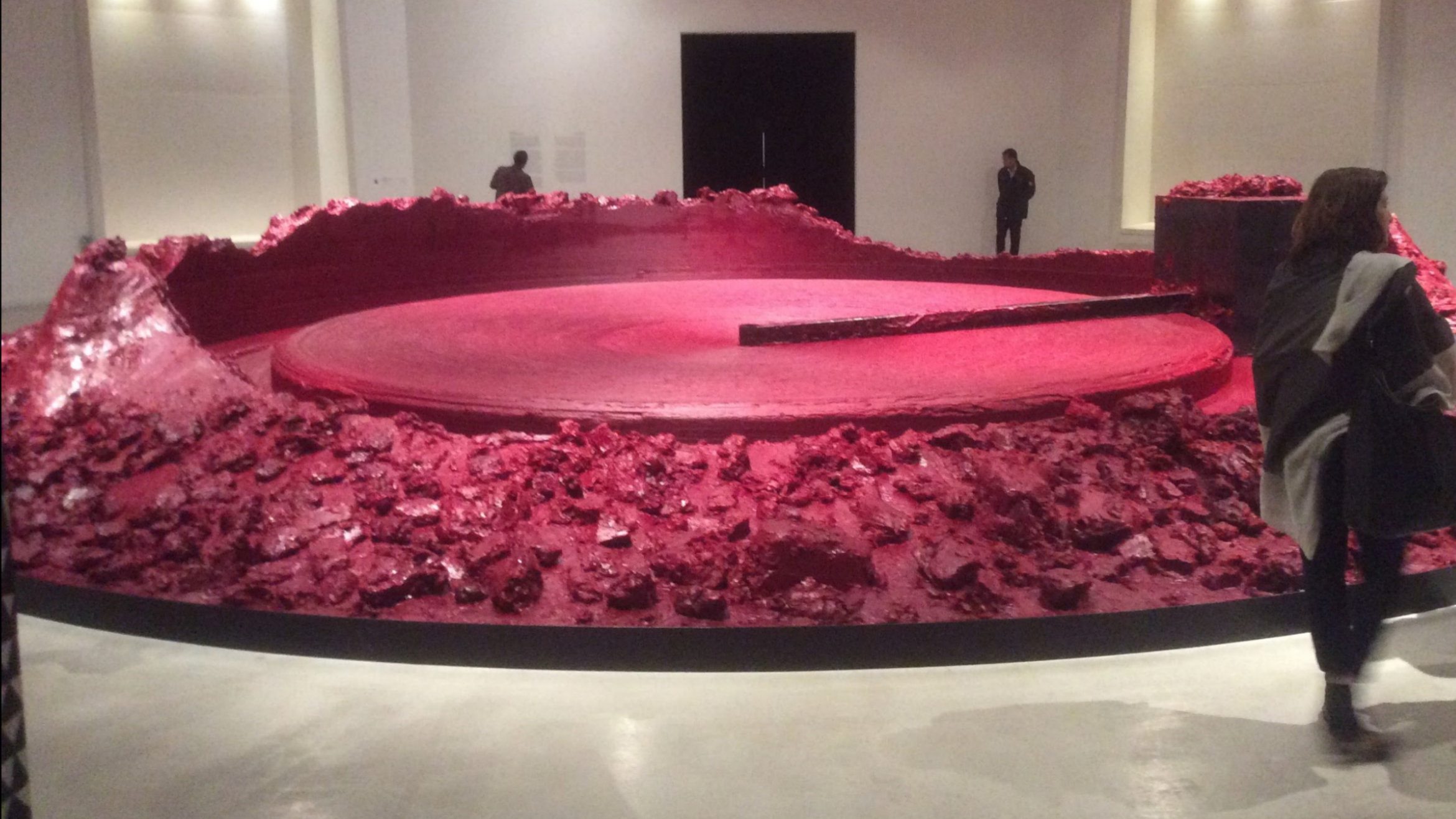
The most surprising, and most breathtaking work in that museum, however, was Anish Kapoor’s My Red Homeland, an installation that filled a whole room. It was a wax “sculpture” simulating a mound of red garbage stirred continually by a centralized mechanical arm. The description situates the concept of the piece in both the image of blood as well as the colour of saffron, an iconic symbol in India, from where the artist hails. For art enthusiasts to whom Kapoor’s most famous work is The Bean in Chicago, My Red Homeland was a welcome reprise, more impressive at close range, and equally awe-inspiring to the breadth of the artist’s vision and ambition.

My Red Homeland by Anish Kapoor

I purchased a few fridge magnets on my way out. Something to impress friends and family with. Something not necessarily representative of the scope of the ambition and inspiration of the exhibition just witnessed. Merely representative. The New York Dancer on a fridge magnet is certainly less bewildering as a work unconsciously derivative of ancient African masquerade experiences. But like others, it will mark my refrigerator as a symbol of another place I’ve been, another mind-enlarging artistic experience, not less, not more, than previous others in other parts of the world. But having experienced it in Abu Dhabi, an emerging cultural capital of the world, adds a new dimension not experienced anywhere else.

Invisible Borders at Photography Museum of Amsterdam

Over recent years, in all kinds of places around the globe, collectives have been formed that are not tied to specific institutes or to ways of organising activities that are imposed from above. There is a growing tendency among photographers and artists as well to join forces and organise themselves. Many such collectives are based on do-it-yourself principles of ‘cut out the middleman’.

Although their points of departure, artistic strategies, processes and visual end products are extremely diverse, they have in common an enthusiasm for interdisciplinary collaboration and an open view of the world. The collectives differ in organization and form: some are no more than loose associations of varying composition without an agenda, while others operate as far more business-like undertakings. One collective might present itself as an auction house, another as a shop, digital flower-power movement or tirelessly travelling caravan.

The digitalisation of photography and the rise of social media have unleashed a huge flood of images. The immense quantity and the transience of photos may make it hard to attribute more significance to photography than is intrinsic to a quick glance at yet another picture on Instagram. Working together to attach value and meaning to images is the central theme of the exhibition Collectivism. Collectives And Their Quest For Value. Some collectives investigate the mechanisms and distributions systems that cause financial values to be attributed to images. Others operate as social agents, bringing people together by means of images and creating communities, online or otherwise. The exhibition also presents collectives that concern themselves with the value of images in the media and the organisation of dissenting voices to challenge the mainstream media.

In a world obsessed with artefacts – the physical, final object – as the preferred form of artistic outcomes, Invisible Borders shifts the gaze to emphasise the never-ending, evolutive nature of Process. No distinction, hence, is made between the value of images showing the work-process and images showing the outcome; they are complementary. The artist’s presence on the road is as important as the work that commences from that presence.

Central to the Invisible Borders Installation in the exhibition Collectivism. Collectives and Their Quest For Value is the idea of the collective as a platform for the nurturing of mindsets and perceptions that offer alternative methodologies and ways of being in an increasingly narrow and enclosed notion of place, territory, and identity. As such, we shall employ as a metaphor the Road ‘s unending nature. The project will be presented as a work-of-process, an interminable voyage so to speak.

Thus, the works of the participating artists will be presented as a complimentary association between process and precipitated outcome, consisting of images, texts, sound, and videos.

Artists whose works make up the Invisible Borders exhibition are: Ala Kheir, Amaize Ojeikere, Jídé Odùkọ̀yàLilian Novo IsioroTeresa Meka, Tom SaaterVanessa PetersonJùmọ̀kẹ́ Sanwó, Charles Okereke, Uche Okpa Iroha, Emmanuel Iduma, Ray Daniels Okeugo, Uche OkonkwoLucy Azubuike , Yínká ElújọbaEmeka Okereke. 

Contributing collectives of the entire exhibition are 8Ball Community (USA), Dead Darlings (NL), # Dysturb (FR), The Eternal Internet Brother/ Sisterhood (GR), De Fotokopie (NL), InvisibleBorders (NG), and Werker Magazine (ES/NL).

###

For more information, visit: https://www.foam.org/museum/programme/collectivism

“Like Listening To An Aunt” | Sefi Atta’s Tribute to Buchi Emecheta

The first time I met Buchi Emecheta in person was in 2005, just after my debut novel Everything Good Will Come was published. I had contacted her through an old college mate, Kadija George, to ask for an endorsement, which she very kindly agreed to give. To paraphrase her endorsement, she wrote that reading my novel was like listening to an old friend talk about Lagos.

That was the same year she was awarded an OBE for her contribution to literature, and Kadija organised a celebratory dinner at a Caribbean restaurant in North London, to which I was invited. At the restaurant, she signed a copy of her book Head Above Water for me, with a message: “To Sefi, good luck with your publication, love from Auntie Buchi”. I read an excerpt from the book at today’s memorial event, not just because it’s autographed, but because it’s a testimony of what it means to be a writing mother, and because it’s good storytelling: entertaining and informative, guileless and revealing, intimate, and rendered in the meandering fashion of Igbo oral history, which, by the way, bears some resemblance to that of the American South, where I’m based most of the year.

Anyway, that evening at the restaurant, I found Buchi Emecheta pensive. I imagined she was aware of her achievements and was proud of them: all the novels, plays and children’s books she’d written, the family she had raised, and the obstacles she’d had to overcome. People often mention the burning of her first manuscript, but the daily grind of being a mother to young children, while getting a university degree and writing, was hard enough.

I know this. I have one child, a daughter, much beloved, but I didn’t think I would be capable of giving her the attention she deserved if I had more. I was thirty-three when I started writing full time and she was three. I was working on Everything Good Will Come and had more stories to tell. I wanted to go back to school to get a Master of Fine Arts in creative writing. My husband, Gbóyèga Ransome-Kútì, a doctor, got a job in Mississippi, of all places, and we had just moved there. Before the move, I had worked as a Chartered Accountant and Certified Public Accountant. Following the move, I was not legally allowed to work in the United States until I had found an employer to sponsor my work visa. I was in two minds about living in Mississippi but Gbóyèga quite liked his job. He was supportive of my writing, to the extent that he would cook while I wrote, and thankfully, on the issue of children, we were both on the same page.

Buchi Emecheta often said she saw her books as children. I don’t look at mine that way. My daughter is my child, and my books are my work, though the time I spent writing them did take away from time I could have spent with her. She is graduating from college this year, after a four-year degree. At twenty-two, she is the same age Buchi Emecheta was when she had five children and was studying sociology at London University, and writing. So, to me, Buchi Emecheta was a child bride, child mother and child divorcee, who would later become a renowned writer published in journals such as Granta and the New Statesman, with television scripts produced by the BBC and Granada. And even though one of my first interviews in Nigeria, as a published writer, was titled “Sefi Atta following in the footsteps of Buchi Emecheta”, or something to that effect, my path has been quite different from hers. However, like most Nigerian women writers, we’ve had similar preoccupations with girlhood, womanhood and motherhood, with marriage and religion. For some of us, I would add the death of relatives and the state of being African overseas.

When Buchi Emecheta writes about missing her late father, so I have missed mine. When she writes about her children walking around in wet nappies, I admit, I was sometimes too busy writing to notice my daughter’s diapers needed to be changed. When she writes about racist or xenophobic employers and colleagues in London, I remember my experiences as an accountant in London and New York. She recounts details of difficult relationships with editors and agents; I can recall one or two. She takes a swipe at Enoch Powell; I immediately think of Trump.

What I find most interesting about her works are the paradoxes – of forging ahead from one generation to the next, yet returning to old positions; of her ability to be naïve and insightful at the same time. And judging from her autobiography, what sets her apart from most Nigerian women writers of her time, and mine, is that she was incredibly resourceful, industrious and tenacious. For a self-described small woman, Buchi Emecheta had enormous strength. She could also be stubborn. In Head Above Water, she tells us how she constantly defied people who tried to patronise or diminish her, and how she was reluctant to be labelled by anyone, feminists included. In a book titled In Their Own Voices, a collection of interviews with African women writers, edited by Adeola James, she expressed her frustration about feminists she encountered in the West, who took centre stage at conferences and overlooked her views.

Twelve years ago, when I met her, feminism was a lot more unpopular than it is now, and although I proudly called myself a feminist back then, whenever I was asked, I was reluctant to be labelled a feminist writer because my stories weren’t always in line with feminist narratives. Besides, if you’ve experienced conflicts solely because you’re a girl or a woman, and you write about them, that doesn’t mean you’re a feminist. It just means you’re female.

I was forty-one when I met Buchi Emecheta. I’m fifty-three now. These days, feminism is more mainstream, and commodified, and celebrity-driven. In fact, if you’re an actress announcing your next film, or a singer releasing your latest album, it helps to declare that you’re a feminist, even if you might face some backlash.

I must confess that although I still call myself a feminist whenever I’m asked, I’ve never seriously studied feminist thought. I’ve read about notable feminists like Simone de Beauvoir and Germaine Greer. I’ve read bell hooks’ works because they appeal to me and speak to my experience in America. I’ve also read academic books on Nigerian and African women writers, but that’s about it. Now, I have met, online and in person, Nigerian academics who have written about feminism, such as Mọlará Ògúndípẹ̀-Leslie, Amina Mama and Oyèrónkẹ́ Oyèyẹmí, but I am yet to read their works, or any scholarly works that address the penkelemesis – the peculiar messes – that Nigerian women find themselves in. I think it is necessary to educate yourself on feminist ideas, and to live up to feminist ideals, if you call yourself a feminist; otherwise, it’s rather like saying you’re a born-again Christian. Every other Christian in Nigeria is born-again. They’re usually versed in the Bible, I’ll give them that – though I might quarrel with their interpretations of it and question whether they live up to Christian ideals. I mention Christianity not to be perverse. It was a foreign imposition we now readily embrace, so maybe there’s hope for feminism.

Like Buchi Emecheta, I don’t want to be labelled by any word that excludes my experiences, and, to be honest, I no longer think it’s necessary to call a woman a feminist simply because she has common sense and uses it. When you expect and demand equality and fairness, that’s all you’re doing: using your common sense.

But I digress. The point is, Buchi Emecheta’s works were my introduction to Nigerian feminist ideas. I understood her ambivalence about Western feminism and welcomed her calls for unity amongst women. In Head Above Water, she expressed her disappointment at women who resented her whenever she made progress. To piggyback off bell hooks’ term, in a tribalistic capitalist patriarchal culture like ours, women who claim to be pro-women are not always pro women they regard as competition. It’s the same between men, except they don’t profess to be pro-men. They just are.

Buchi Emecheta didn’t seem to regard other Nigerian women writers as threats to her success. Flora Nwapa, in In Their Own Voices, referred to her as a friend. On a separate note, she didn’t appear to be prejudiced against Nigerians of other ethnic groups, either. Her works suggest she honoured Igbo culture without idealising it, and opposed tribalism even after she faced it. She apparently responded to racism the same way, which I don’t understand. It takes a lot of grace to resist retaliating to prejudice. I’m still working on it.

For me, reading Buchi Emecheta is like listening to an aunt, a busy aunt who makes time to tell you her story. You almost hear her saying, “This happened and then this happened. Wait, wait. I haven’t finished. Don’t cry for me. Don’t get angry yet. Listen to what I have to say and learn from it.” You take your cue from her on how to react. There were sections in Head Above Water where I was sad for her, but she lightened them with humour. There were other sections in which I was angry on her behalf, but she didn’t allow my anger to last. It wasn’t until I reached the end of the book that my emotions overwhelmed me. But, according to her, that was how she coped with hers. She didn’t have time to dwell on them.

In fact, Buchi Emecheta is – and I use the word “is” deliberately: I often talk about deceased writers as if they’re still alive – she is the aunt in your family who stands out. The one who has done something to offend the sensibility of others, and when you find out what it is, you wonder what the fuss is about because she was just being herself, or speaking her mind. She’s really not a troublemaker. She might even be shy and insecure, as Buchi Emecheta says she was. But if you cross her path and she’s fed up with playing nice . . .

You observe her in action. You occasionally worry about her. Then, one day, she’s no longer around and you realise what she meant to you. The options she gave you. But it’s too late to tell her how much you admired her.

Last year, I emailed Kadija to ask if she could put me in contact with Buchi Emecheta again. I wanted to use a quote from her novel The Joys of Motherhood in one of my own, Made in Nigeria. My novel has a section in which a Nigerian professor teaches Joys, and Ama Ata Aidoo’s Our Sister Killjoy, to Mississippi college students, as I had done. Kadija got in touch with Buchi Emecheta’s son, Sylvester Onwordi. I had no idea whether she herself was approached, but I was given the permission I needed.

Afterwards, I have to admit that, for a moment, I hoped she would be around when the novel was published. I was afraid she might not be. I hadn’t seen her since we met at the restaurant. I reach out to writers I admire for professional reasons. I’m not one to cosy up to them. I prefer to respect their privacy and space. I’d heard she had some health challenges, but I didn’t want to pry.

Then in January this year, Kadija sent me the email saying she had died, and I was sad, partly because we no longer had an opportunity to celebrate her in person. It was our responsibility to do so and our loss that we didn’t. When we fail to honour our literary heroines, or stop honouring them, we lose as a group. As Nigerian mothers would say to children who don’t listen, “You are not doing anyone but yourself.”

Buchi Emecheta’s work is done and will continue to resonate. She has plenty of admirers in readers and writers who choose to walk their own paths. Her biography demonstrates that the most powerful thing a woman writer can do, regardless of what is going on, is to keep speaking her mind and producing work for as long as she possibly can.

She did just that, and in doing so, exposed the tribe, unashamedly, to strangers, which probably displeased some of our literary heroes, who at the time were more concerned with attacking imperialism, colonialism, military regimes and corrupt governments. She may also have offended the strangers themselves, by putting them in their place face to face and revealing what she thought about them in her books. But you don’t get the impression that her intention was to offend. Instead you get the impression she was merely trying to take control of her own story, the narrative of her life, and write her way out of her lot. However, if traditional Igbo beliefs on fate are correct, perhaps all she could do was give it her best attempt and leave it up to younger writers to carry on her legacy.

I am one of them. At the age of thirty-three, with a three-year-old child and two professional qualifications in accountancy, I found myself in Mississippi, without a job, and wrote my way out. I didn’t know Buchi Emecheta well personally. I learnt about her through her works. I appreciate the example she set by being prolific, her individuality and honesty. Perhaps I’ve got the wrong idea about her, and I still don’t know if she was aware I’d asked to use a quote from her novel, but of my final statement I have no doubt. I am glad I wrote about her novel in mine.

_____

An abridged version of this write-up was read at the Tribute to Buchi Emecheta which held at Terra Kulture on Saturday, March 25, 2017
_____

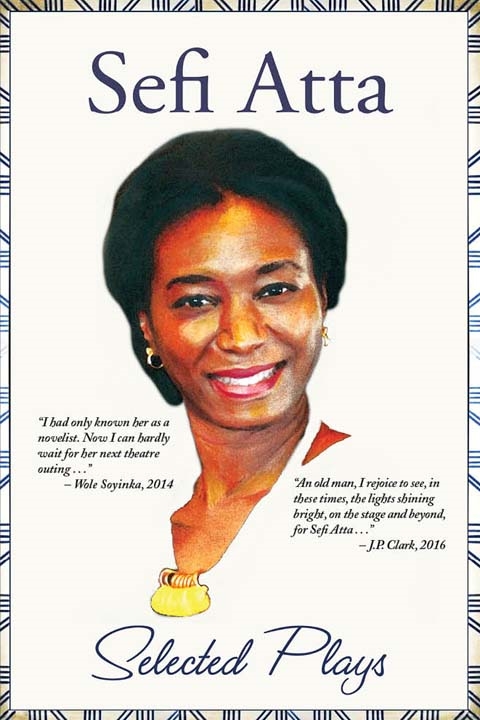
SEFI ATTA was born in Lagos, Nigeria, in 1964 and currently divides her time between the United States, England and Nigeria. She qualified as a Chartered Accountant in England, a Certified Public Accountant in the United States, and holds a Master of Fine Arts in Creative Writing. She is the author of Everything Good Will Come, Swallow, News from Home, A Bit of Difference and Sefi Atta: Selected Plays. Atta has received several literary awards, including the 2006 Wọlé Ṣóyínká Prize for Literature in Africa and the 2009 Noma Award for Publishing in Africa.  

Author’s Facebook page
Visit the author’s website
Follow her on Twitter @Sefi_Atta

A Book for the Tasting

By Kọ́lá Túbọ̀sún

Book: Longthroat Memoirs: Soups, Sex, and the Nigerian Taste Buds

Publisher: Cassava Republic Press

Publication Date: October 31, 2016

Pages: 357

The Great Nigerian Food Memoir

Nigerian food is the most endearing, enduring, topic in the world, especially since we have gone so long without talking about it.” – Yẹ́misí Aríbisálà

The allure of Yẹ́misí Aríbisálà’s debut book of nonfiction, titled Longthroat Memoirs: Soups, Sex, and the Nigerian Taste Buds, is, surprisingly, not the food, nor the promised “sex” in the title.Published by Cassava Republic Press, this book of essays comes with a more satisfying delight of well-crafted sentences, stories, and attention to detail, style, and ambition. An unapologetically Nigerian book of such brilliance, scope, and purpose has been needed for such a long time that it is hard to believe, going through its pages, that it has indeed arrived. The author it was who wrote a food column, for a few years, in the now defunct Nigerian paper 234Next as “Yẹ́misí Ogbe”. For those familiar with the understated brilliance of her style and approach, this all makes sense, and is timely.

Longthroat begins with an introduction fourteen and a half pages long, which coyly attempts to manage expectations of what is to come, through caveats about the author’s unlikely role as the bearer of the country’s food biographer, among other “confessions”. This part could, arguably, serve as a review of the book, except that it takes too much away from what follows. So, it whets the appetite of the new reader instead, and sets the table. In that introductory treatise, we are gently eased into the kitchen of the author’s mind where both the idea and the steps of implementation of this culinary journey take place first before they meet the page. I would return to the introduction again and again.

The first chapter is a review of the reputation of Nigerian food (and names) in the imagination of the foreigner. The first culprit here is Michael Barry, a half-Welsh, half Indian man whose “Nigerian River Province soup”, listed in his 1996 book Exotic Book the Crafty Way as an authentic Nigerian food, left the author scratching her head trying to identify its parts. She gave up eventually disappointed with both the writer’s imagination and the accessibility of Nigerian food to the outsider. Our ẹ̀bà, it turns out, was what was being described as “cassava bread” in Michael Barry’s book. A disappointing find! We never find out what the “River Province soup” is because it doesn’t exist. It is, also, the creation of a foreigner as an idea of what a random Nigerian food looks or behaves like. Yẹ́misí did not hold back: “I would hate for Michael Barry to get away with… suggesting that our food can be simplified and reformulated into something else, something it is not.” Her idea of the Nigerian soup as a person, more than just a passing item on a plate, takes off from here. It “may seem aloof at first,” Yẹ́misí writes, “but once given its due, it will immediately make itself friendly at the very least.”

The book proceeds smoothly along these lines, paving way to other encounters, hilarious personal stories, told through the keyhole of a writer obsessed with the dimension of food in everything, from sex to dreams. The chapters move in different ways. In one, which came early in the book, the author describes a typical Ìbàdàn boy in a marketplace arguing with his mother about eating àmàlà (or ọkà, as she put it), to illustrate the mischief of adults, and the eternal devotion of Ìbàdàn indigenes to their carbohydrate meal made from “desiccated yam ground into a dense white flour, and then made into a grey mound using boiling water”. In another narrative in the same chapter (listen to audio excerpt here), a ram goes for a ride on a motorbike and ends up on jollof rice: quite a common scenario in many Nigerian cities during festive seasons. The description lures in the oblivious reader with gentle words until the macabre nature of that ill-fated ride becomes suddenly obvious. To the Nigerian already familiar with it, the passage plays out like dark humour gently hovering above the conscience of the meat-eater. Another chapter which further elevates the book into canon of essential Nigerian literature is the story of the author’s father-in-law and his travails in the Nigerian Civil War; how the pursuit of the next meal drove the conversation of survival. It was, aptly titled, Dead Man’s Helmet.

Reading the book, deceptively called a “memoir” (it is, to be clear, but the character of the book both defies and enriches the genre) takes the reader back decades into a happy place where food and observations of food carried some reward of discovery. Here, I speak for myself. What is the difference between irú wooro and irú pẹ̀tẹ̀, for instance? What are they anyway? Why did they smell so much and why did my grandmother like them so? Why are they wrapped so tightly in those small leaves? Why are the ones my grandfather’s youngest wife bring from the farm better than the ones we bought in the neighbourhood? How come I sometimes saw them in food (as in okro) but not in some (ewédú)? How is irú different from ògìrì? How does Dadawa, the cubed variant that debuted in the 90s, improve on what was a local condiment that supposedly added character to our local meals?

Sometimes a chapter is a journey into a forgotten part of one’s culinary past left unappreciated through the passage of time. One word or a sentence here stirs it up, smell, aroma and all, into new awakening. At other times, it is the wonder of a shared experience which in one’s memory had previously amounted to nothing more than a mundane occurrence, but which in literature transmutes now into a notable cultural event, properly highlighted and intensified through the writer’s power of observation and documentation. This is where the work shines out the most: elevating the most common experiences—what defines Nigerian culture: our cooking and eating habits, among ourselves and on the world stage—through beautiful sentences that delight and titillate.  

Who remembers, for instance, breaking open ẹ̀gúsí shells with their fingers, usually while seated with mothers or grandmothers to whom that kind of chore is a perfectly productive use of afternoon time? In a world now defined by “finesse”—a type of accepted snobbery against deliberateness, patience, commonality—that image of simpler times spent sitting with grandparents and helping out with cooking over several hours, along with stories, songs, and admonition, brings the reader as close to emotional time travel as one can get. Yẹ́misí calls this particular food preparation act: “hand-shelling” ẹ̀gúsí. We who are familiar know that she meant “hand de-shelling” or “de-husking” if we’re being technical, but one could see why the former appeals more. In Yorùbá, we say “wọ́n ń ṣẹ́ ẹ̀gúsí”. That act of “ṣẹ́-ing” the ẹ̀gúsi, breaking the shell in half and removing the content, is what gets the white pointed seeds out to where it can be useful. But that attempted homage to the phonetics of ṣẹ́-ing the seed, instead of the mechanically-sounding “de-shelling”, warms my linguist heart (though that English translation wasn’t the only relevant pull to the vivid sense of nostalgia that the chapter beautifully evokes).

Of Sex,  Subtlety, and More

What I ate last night is as significant and as tangible as my dreams. My dreams are as tangible as what I’m eating. Neither of them can safely be taken for granted. Life seen through the prism of food has more colours, not fewer.” – YA

The “sex” in the subtitle of Longthroat Memoirs does not materialize in the way readers conditioned to the treatment of the subject in Nigerian writing might expect it. But it does materialize in different other ways, sometimes gentle, and sometimes hot and vivid, usually around food and cultural attitudes. I, for instance, will not be able to look at a the velvety black covering of the African snail the same way again. Through word association and the writer’s imagination of their role in our sexual myths, vividly and mischievously imagined in the chapter called The Snail Tree, a Nigerian foodie’s insistence on a snail diet will now always task the mind in the direction of more intimate parts. The treatment of sex here however, as one would realize, is deliberate. Check out, for instance, this sentence from the second paragraph from that same chapter:

There are places in a woman that a penis will never reach.”

The sentence that follows this gives too much away so I will not quote that here. But the chapter itself, one of the most directly polemic in the book, tackles the author’s discomfort with the ubiquitous fascination with sex in contemporary literature. Here, she opines directly on the Nigerian/African writing and literary culture in a way that is fresh and unflinching, using food as a contact point. Chimamanda Adichie and Binyavanga Wainaina make appearances and not in a flattering way. The chapter also explores the way in which food can be used to sublimate other human impulses. But because of the understated way in which sex appears and disappears throughout the work, I expect some mild reader rebellion. Pointing out the irony of using “sex” to sell a book in which the use of sex as a selling point in modern writing is so directly challenged will be too good to pass up.

In a yet unpublished interview with me, Yẹ́misí clarifies her purpose:

Our manifestations of sexuality seem mostly dysfunctional. In writing, in the media, it is mostly titillation and misunderstandings. Are there some things that the application of words disfigures? Obscures? We all seem to be grasping at straws in private lives bragging about our involvement on public platforms. So if we are going to be real and honest, “liberality” should be prima facie the admission of incompetence and fumblings and disastrous encounters. The chapter was me saying, look I’m not going to pretend I’m good at this, that I apprenticed with Cirque du soleil. If I’m going to be truthful and free in my writing about sex, I’ll have to talk about my confusion and incompetence. Everyone else can write titillation if they want.

I wanted to point out obvious and not so obvious parallels between appetites… I wanted to offer the perspective of seeing something better by not looking directly at it.

That chapter alone, The Snail Tree, capable of winning any prize for nonfiction anywhere, makes the whole book worth reading.

But the book does (and packs) much more. It challenges assumptions (Will a Maiguard in Lagos prefer carefully made white soup or his Agege bread and fried eggs, if given a chance?), attacks hubris (Yorùbá people, with your pride of “sophistication”, come to Calabar and experience food cooked with some imagination and creativity), and examines contradictions (How are Yorùbá the oily-food-eaters—ndi ofe mmanu—when Easterners add oil to their garri at every instance? And how are Igbos the eaters of solid-as-stone food—aj’òkuta má mun’mi—when their invention of garry-with-oil has rescued ẹ̀bà from the tyranny of turgidity?). Longthroat Memoirs successfully situates itself in a prominent space for not just the sensual narratives around food but of cultural attitudes, defining the country and its people in our own taste and words. A cookbook, a narrative of one culinary pilgrim’s journey through Nigeria’s cultural environments (from Ìbàdàn to Calabar), an exposition on prejudices and pretensions of some of our cooking myths, a personal and historical diary, all at once, Longthroat Memoirsmanages to fulfill more than gastronomic desires.

How to Cook a Sentence

Writing about food in the way I do involves noting the influence of food on life and life on food, and attempting to weave an accurate cultural landscape.”  – YA

Something that Aríbisálà has, and exhibits in abundance in this work, is patience. (That, along with the discipline to remember the names of all the food items she encountered while living in Calabar, and the diligence to verify the Englishand sometimes Botanicalnames of the local vegetables and fruits we are used to under different local names.) Reading any book is a race against time and the writers intentions. But the style in Longthroat Memoirs is deliberately contemplative of each individual reference, attentive to the moment enough to satiate an impatient reader and possessive of the right depth to reward a patient one. We know now that the book came about from a number of essays written first for a weekly newspaper column. But in setting each word to the page, the writer has deployed a rare skill that draws the reader in with an inviting aroma and keeps them satisfied after each course. In Peppered Snails, Aríbisálà introduces new Nigerian concepts (“toaster”, “yíláta”, etc) to the unfamiliar reader and spent considerable time weaving these into a tale about the cooking or endurance of hot peppered snail, all without taking the focus off the important direction of the narration. The style reminds of the best offerings of greats like Sóyínká in a work like Aké or Ìbàdàn, the Penkelemes Years, for instance. This is no idle comparison.

How does Yẹ́misí do it? How does one person deftly convey a vivid sense of smell and presence through words? We have read countless fiction and nonfiction by African writers, but not many of them have handled the treatment of food or any intimate contact with this much dexterity. I have an idea, but it is an inadequate one. Growing up in South-Western Nigeria isn’t enough motivation to care about its food, nor is having been transposed—through marriage—out of that environment into a contrasting one in the South-South a sufficient excuse either. There are many coincidences along the way, one of which is discovering, a while ago, that her health, as well as her children’s, was being affected by what they were consuming. She wrote about how she found out, in her trademark style of patient literary exploration of ordinary facts, combining personal history with a collective journey around food, in the piece for Medium in 2015 titled Mother Hunger.

Though that piece, along with many others of hers scattered around the web, are not included in this collection, they offer some clues as to the motivation for her craft, but not the germination of her skill. The writer’s obligation to memory and her diligent recollection seems to have been wrought through plodding hard work of deliberate crafting over many years.

Eventually reaching the end of such a book feels satisfying as equally as it feels deeply dissatisfying: it is not a book that should be read from cover to cover in one stretch. Each chapter, like slivers of mọinmọin under the leaves after a wrap is finished, should be returned to for extra flavours and spice. It is a shame that the book is not universally available on Kindle. Those equally likely to enjoy the literary delight of its letters juggling the taste buds of memory are Nigerians abroad or people everywhere with interest in Nigerian food culture. This book is for them. And for non-Nigerians, I suspect that its successful grounding of Nigerian recipes, ideas, misconceptions, myths, and stories through a personal lens will also be a brilliant introduction to both our cuisine and a different kind of nonfiction narrative. Listen to Yẹ́misí describe Lagos through the eyes of a drive to Yaba:

Lagos knows how to primp and sashay on bridges, new skyscrapers, tall swanky things. It has $1,200-a-night hotel rooms; overestimated real estate on anxious hairlines of land arbitrarily reclaimed from the sea; fragile, sand-filled peninsulas anchored on the Grace of God…

***

What are the knocks? A few. Olúbàdàn, the king of Ìbàdàn, was once referred to as Aláàfin of Ìbàdàn – an unintended slight that would have caused a warring of tribes in a different time. There’s also the perennial issue in Nigerian literature of having Yorùbá names/words written without appropriate diacritics. This should change in 2017, please!

In the chapter called Peppered Snails, the description of “toasting” on the campus of University of Ifẹ̀ spoke about taking a girl to “a new buka” to eat dodgy Chinese food instead of “an old buka” to eat pounded yam and soup. Those who have lived on that campus would know that the passage referred, instead, to New Buka and Old Buka respectively. These are not generic eating places, but known brands and locations.

So, What is This Book?

“(Nigerian Soup) is a multifaceted cultural treasure trove full of intriguing stories. It might not be gastronomically illustrious, but it is energetic and good-hearted. It belongs to one of the most fascinating personalities in the world: the Nigerian.” – YA

Is it a cultural resource, an encyclopedia of relevant memories, a cookbook, a dialogue with nostalgia, a thorough work in the documentation of the Nigerian food and cultural experience, a hard-wrought piece of literary exploration? All would be right and all would be insufficient. Yẹ́misí has, simply put, written a Nigerian book of stunning brilliance. Until now, when I am asked to provide a book from which to appreciate and understand Nigerian culture, I have usually had very few to mention. Peter Enahoro’s How to be a Nigerian comes quickly to mind, as does Chimamanda Adichie’s Half of a Yellow Sun. But the latter is fiction and political while the former is mostly cultural and humorous. Yẹ́misí Aríbisálà’s book is both and more. 

Memoirs are fun usually because we know that they tell us something interesting about an author, a situation they were in, or a certain time or a subject. When terribly done, they are too self-assured, too boastful and thus inauthentic, unsatisfying and unrepresentative of expected situations. Others are doomed by self-censorship to be of any real value for the genre, or by too much focus on the self to offer us more. But, depending on our initial expectation, it is usually easy to be satisfied with a personal account, which is by definition subjective. Being stimulated, engaged, or elevated by such work is another thing. That requires a different experience found in very rare instances in the hands of a skilled writer. Longthroat Memoirs falls into the latter category: a book that carries the weight of so much cultural and literary burden, and manages to discharge it with grace and style.

_____________

This essay was first published on Village Factor on January 21, 2017