What is happening here? In one or two instances today during a chat conversation, I have used the word “color”. I think I might be losing my identity. This is exactly how it begins: colour becomes color, travelling becomes traveling, aeroplane becomes airplane, lift becomes elevator, boot becomes trunk and mum becomes mom. It is subtle, it is charming, and in spite of my wall of protection built against such influences as these I am afraid that resistances are falling and I am fighting it as hard as possible. I have already given in to the problematic writing of dates with months first and days later (even though when it is not specified as MMDDYYYY, I still relapse into old habits, and feel good about it.
Now one day, maybe in the days of my descendants, English language as we know it will be dead. It will die different deaths in different parts of the world. In Nigeria, it might evolve through pidginization and more linguistic autonomy into whatever fits the political and ethnic situation of the country. In America however, I am very sure of the form that the writing will take, thanks to the internet, and media glamourizatoin that make it fashionable to invent new ways of expression. A few months ago, I started making a list of some words that have evolved already, going by the ways students use them. So far I’ve come up with these:

Than/then. e.g “I’ll make more money then you…”. This is a classic case of word spelling changing to suit the pronunciation. Too/to. e.g “I love you to.” All you need to do to see examples of this is to go to any popular website and read the comments. When did these changes happen though, and why didn’t I get the memo? The word “definitely” has also been variously spelt as “definately” while I’ve read many instances of “Your a fool…” on Facebook and everywhere else. Language tends towards simplification, linguists believe, and this makes sense. Humans will always look for more ways to reduce the efforts they put into speaking and hope to convey even more information in very little time. “You are” becomes “You’re” and now “Your”. In the nearest future, we might just have to write it as “Yor” to convey the same sense. e.g “Yor an idiot to.” So far, it is still English-sounding, if not totally English-looking.
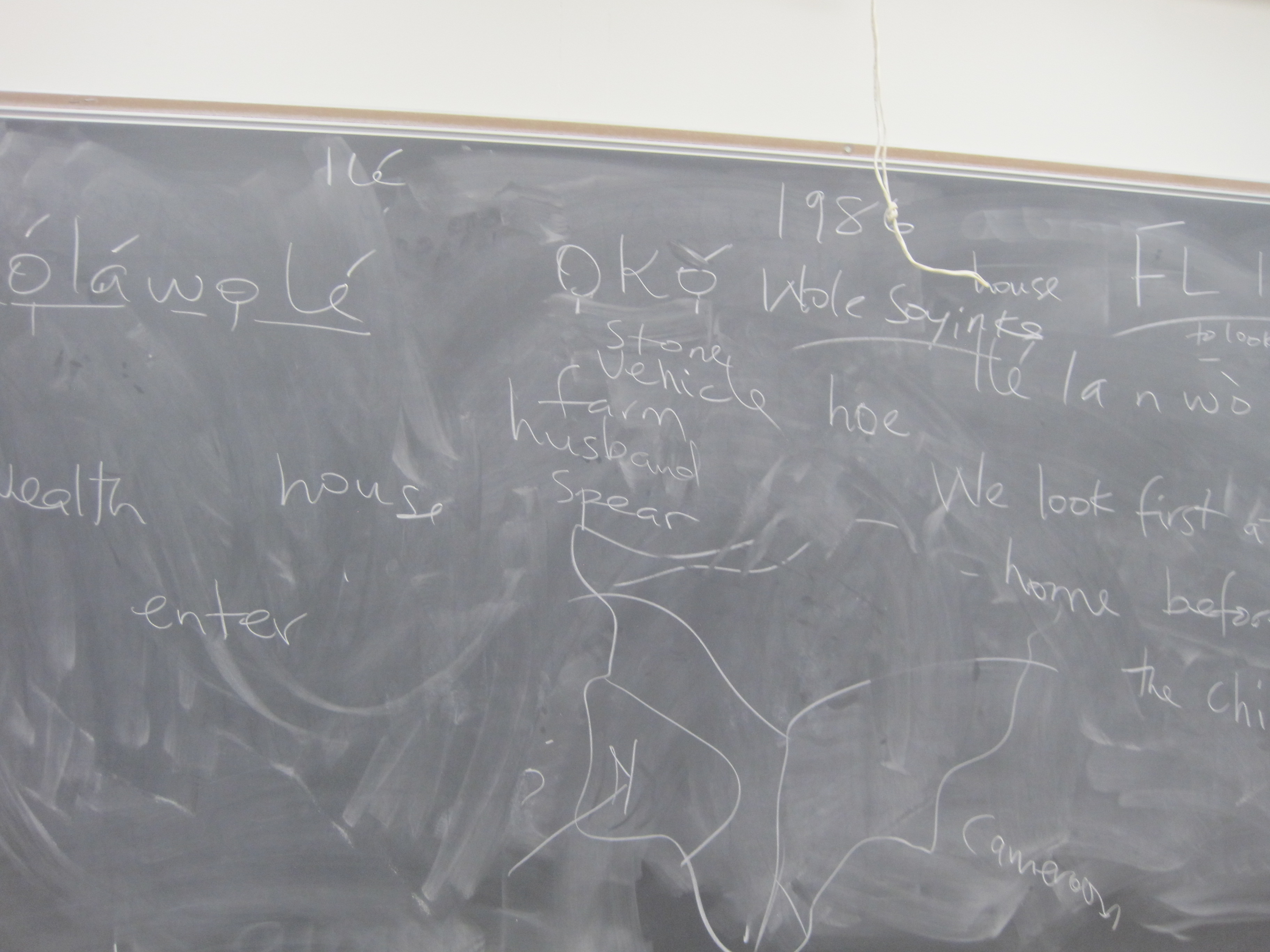
Now, search me. I do not intend to let go of the “u”s in my “colour”, “labour”, “honour” or “rigour” just yet. Neither do I intend to adopt chat-style lingo of the just emerging generation. If that leaves me as an exotic specimen of humanity just a few years from now, I will just have to live with it , but I look forward to more mutations of the language in the future. “When you are born, you get a ticket to the freak show. When you’re born in America, you get a front row seat”, says George Carlin. Now I know what exactly he means. As a bilingual person, I have an even freakier experience of the language evolution. In some other parts of the internet today, speakers of Yoruba who can’t be bothered about sticking to its rules of spelling write were (mad person) as “wayray”, maalu (cow) as “maloo” and joo (please) as “jor” in order to convey the sound as well as the sense all at once and without having to bother with tone marks. It is a system that seems to work as planned, and little by little, the two languages that I speak with some measure of proficiency evolve through a series of interesting matrices into each other. In a few decades now, it will be interesting to see how both of them have fared.
In a related but not so similar development, the text of Mark Twain’s two masterpieces The Adventures of Tom Sawyer and Adventures of Huckleberry Finn are now going to be rewritten to replace the words nigger/negro that were used to call attentions to the reality and evils of slavery in the book with the word slave, among other “corrections”. While they are at it, many commentators have also suggested that they go ahead and re-write Alex Haley’s Roots, and Martin Luther King’s many speeches because of the simple use of words that now would be deemed shocking, notwithstanding the context in which they were used in those texts, or their significance as historical materials. I mean, not even Adolf Hitler’s Mein Kampf – which could be deemed an actually evil text would warrant a revision for any reason as this. But what do I know. America always springs it surprises when one least expects. Or maybe it’s not America but humanity’s tendency to sometimes take itself too seriously to examine its own hubris.