Browsing the archives for the Soliloquy category.

More Lagos – Noise!

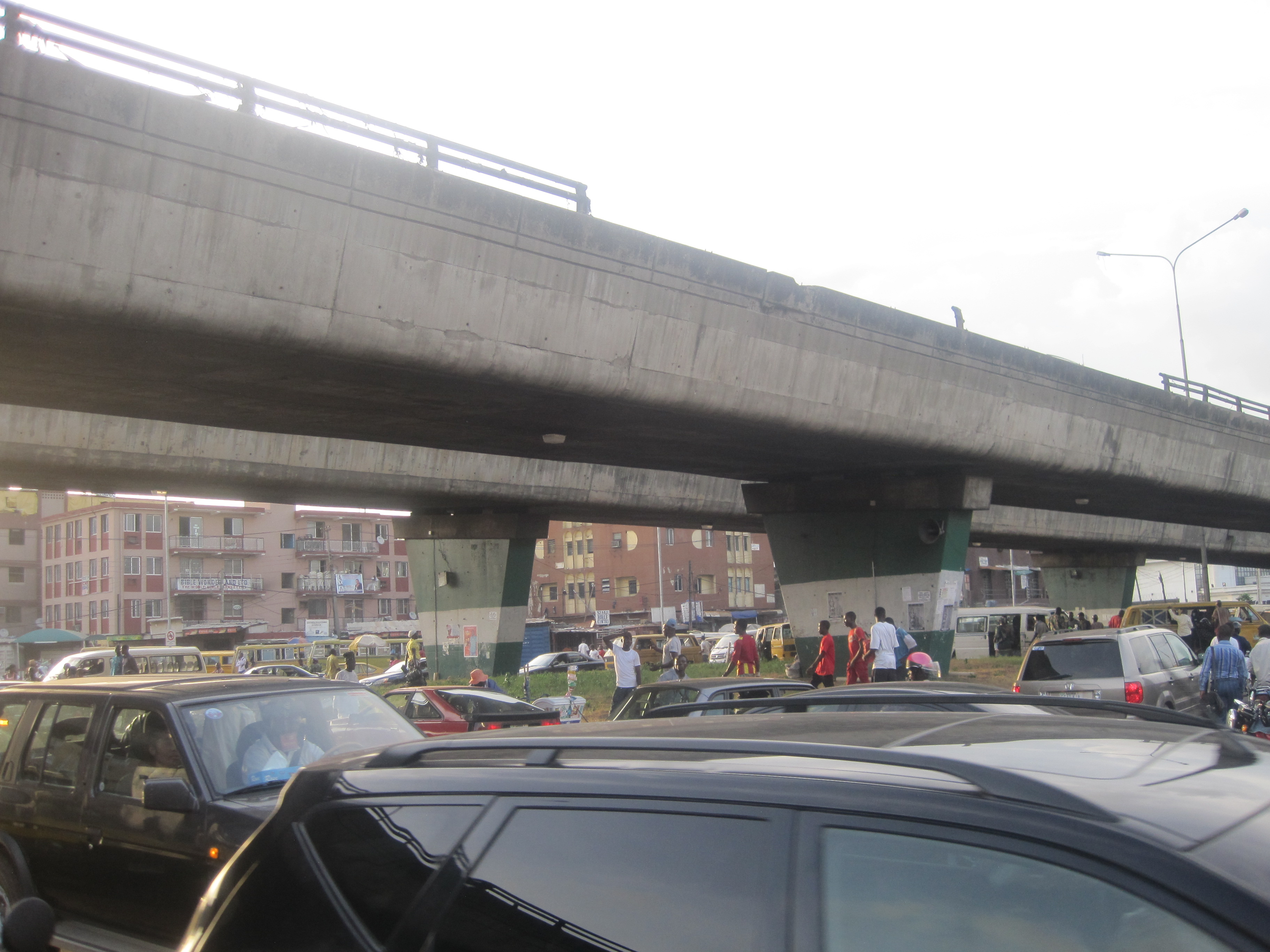
This fast city, known for its dirt as for its fast cars, runs on adrenaline. Panting for air in the back of a rickety bus of uneven metals, one wonders where exactly everyone is rushing to. I had this same feeling in Chicago, but not while in a public bus. Compared to my little village in Edwardsville, Lagos feels like hell on steroids. I’ve told you about the noise, right? When you’re not being deafened by the generators from every household that have resorted to using them to supplement electricity supply, you are being hassled on the road by incorrigibly noisy vendors on the road, bus conductors, and bus drivers with lead hands on vehicle horns. Aaaargh! Give me Cougar Village. Or, at least, give me Ibadan for now.

In my room at Cougar Village, I have never put the volume of my computer up higher than 50% of the total volume, and it was always loud enough to be heard at the front door from my room on the other end of the apartment. Right now in my sister’s house, with roaming children, a roaring fan and a rumbling generator, I can barely hear anything even at my Dell Vostro 1510’s loudest volume level.

When we talk about Climate change, we have always incorrectly assumed that the culprits are big oil corporations in the Niger Delta, or big industries in developed countries. Ask me now, and I’ll tell you that fumes from Lagos generators and commuting vans, and so much of this useless noise contribute even more to the degradation of the environment. And we say the Atlantic Ocean is now encroaching on the Lagos Island through the Bar Beach. Why won’t it? The amount of heat generated by these machines should be enough to deplete even more of the ozone layer. And what about the dirt, plastic bags on roadsides that will eventually find their ways into gutters and clog the flow of water when it rains? Well, there are some working trash cans, but are there sufficient implementation of laws regarding proper waste disposals? Are there such laws to begin with? And does anyone obey them?

My suggestions would include more road signs, stop signs, speed limit signs, traffic lights, required speedometer laws for each vehicle, and a ban on all honking throughout the day. As for the generators, there’s no solution yet although I could say let’s scrap them all totally, and force everyone to get solar panels – after all, we have the sun in abundance. The world is moving everyday towards new clean sources of energy: wind, and solar. Not only to reduce pollution, it will also reduce noise, which I believe must account for much of the disruptive behavioural patterns we see manifest in much of our public life.

Pictures coming soon. Apparently I’m not as used to whipping out my camera on the streets as I was a few months ago.
Travellers, we all.

The thought had crossed my mind at the dinner table at the house of a Palestinian professor of history Tamari’s on Wednesday evening. On one side of the table was my head of department, and on the other was Reham the Egyptian. Joyce, the oldest, was American, and I am you-already-know-what. The head of department, had just made a startling confession: her parents were German Jews who fled from Germany in 1939, first to Canada, and then to the United States. The confession, in its ordinariness, however brought a new dimension to a conversation on history, the commonness of our humanity, and migration.

Where are Jewish people originally from? I don’t know. But now they occupy the Palestinian region as a Jewish state of Israel. They used to live all over Europe and the Middle East for thousands of years. Sitting down there trying to get it all in, here was what my brain was trying to process: Jewish people in Europe (who had gone there from the middle east) were gassed in millions and some managed to flee to other parts of the world, adopting a new nationality and a new home. (Well, not quite. Belinda has confessed to have felt a certain homeliness anytime she visits Germany, in spite of the contradictions of the occasional meeting with descendants of people who just a couple of decades ago could have murdered her parents or sent them to the gas chamber.) As a result of their new nationalities, these travellers have become a new people: Americans. Not even a Jewish Americans or an American Jew, she is every inch American albeit with a certain longing for the beauty of Germany. Had Hitler not begun killing, she probably would not have been born, or she might not have been born in the United States. And there won’t have been the State of Israel, perhaps, and the displacement of the Palestinian people. But now, she’s no longer German. She wasn’t born in Germany; nor is she really Jewish. She doesn’t practice Judaism. Alright.

Now, our host professor is Palestinian. His people are regularly killed and/or victimized in Gaza and parts of today’s Israel by settlers (or state soldiers meant to protect settlers) many of whom are likely descendants of survivors from the pogrom of 1940 Europe. A sign at the entrance to his house says “No more war” or something to that effect. He is one of the softly-spoken people I’ve ever met. Brilliant and level-headed. He is a professor of history and he is as knowledgeable in the Palestinian cause as he is in the subject of the Jewish holocaust. Had he lived in Palestine or Israel today, he could have been killed by suicide bombers, or the Jewish state soldiers either for looking like a terrorist or throwing a rock at a soldier, or arrested for being outspoken against the state. Had Hiltler not started killing Jews in Europe, he could also have been born and raised in Palestine, where his ancestors lived and had land before they were evicted, living there till old age, and not ever having to have migrated to the United States, or meeting someone like Belinda, or myself.

Of course, if instead of coming to the West, Belinda’s parents had instead gone with the folks who founded the State of Israel, she could be a citizen of Israel by now, or a settler on occupied areas, or a supporter/descendant of those who evicted Palestinians from their lands, some of who might be related to Tamari. Just sitting there in their midst brought to me a new sense of amazement, at how something as little as migration could have changed the course of history.

Full Circle – Short Faction

Written at Cougar Village.

Looking up into the predictable night sky, he saunters home. In other climes, he might have been a little high on the freedom of the night to surprise, and to appease his seething exhilaration and bubbling fears. Here, he just paces home in little steps that completely ignore the need for caution, yet a buoyancy remains. Even the geese have gone to bed, and the road is free of any surprises. Only the warm wind blows from all directions, and his open shirt blows with it opening spaces around his armpit and exiting through his similarly open cuffs. From afar and against the background of light – except for the colour of his shirt or the size of his frame – he could have been mistaken for a waving flag, or a moving scarecrow.

Once upon a time this was home to more shuffling feet and heaps of snow. But that was then. Once upon a time, trees and their leaves that now whistle with the night shedding grains of white pollinated flowers were only high and dry, and winter shook the alien city to the barest limit of its own survival. Then there was nothing but death and dryness, and a certain music to the melancholy of heavy and seemingly wounded trees. It was seasonal. Hope had sprung up later like the flowers that now scatter on his head from on top of the tall pine trees. All in one night the change came, suddenly and without warning. Even to him a traveller, it was an unexpected miracle of a seasonal revival.

Like a visitor in a now growing market place, he looks around again with a certain brightness. The fears that returned were about how in a different place and a different time this might have been unwise, coming home at this time of the night. In his mind was something similar to a mother’s scoff of a rage: “Bloody fool, you toss your life around like a game of cards.” The delight in mischief of such confrontations has gone now, and only a nostalgic smile remains drawn on the face of the dark night sky that breathes on his upward gaze. Like looking at a mirror of one own smeared reflection, he muses, head up towards a direction that could only be east, judging by the position of the crescent moon. Home lies there, he whispers.

Good Friends We Lost

I never met him in person, but his spirit reached out to me from as far back as 2000 at such a distant place as a negligible classroom in the University of Ibadan when I first read Nwokedi. The play featured blood, gore and very very angry philosophical retorts to life. I do not remember any of the lines in the play now, but I still carry its name in my head everywhere I go – was one of my first books to challenge my self-inflicted limits of playwriting imagination. My eyes hang heavy now. Esiaba Irobi, the roaring poet and playwright, has gone to be with the elders. He was greatness personified. I feel as pained to think of him in the past tense as I write a tribute to someone that I got to know only for a fleeting moment, but not nearly enough.

Rarely have books moved me the way Nwokedi did. Perhaps it was my innocence, or my search at that time for meaning and answers, or perhaps the mixed feeling that overwhelmed and sustained me from page to page as I pored over a work nuanced in poetry with satire and anger. I had always wanted to know who he was. Thinking about it now, it must also have been from the amazement that someone with that firebrand imagination and craft could have eluded popular discourse for so long. All we heard then was Wole Soyinka and Femi Osofisan in the field of playwriting. Where was Irobi when these great names were compiled? And why was I discovering this gem only in a first year course in my first week in the University? I forgot about the first year drama class, but I did not forget the name.

And then in 2006 or 2007, I joined the Wole Soyinka Society Yahoo group and was happy to find the man in the same creative space as I. We did not become friends, but we did exchange ideas about so many things. That group owes the robustness of its archives to that man. He was frank and unpretentious, and he was as fiery in his thinking as he was gentle in his appreciation of the little things of life. He wrote love poetry. (Who could tell?). He missed Nigeria and he reminisced about the frustrations he had while living there. At a point in 2008, he volunteered to donate his books free to people in Nigeria who were ready to start a reading club. On his own expenses, he was ready to ship as many as fifty books to whoever had asked for them. I asked for some on behalf of the Union of Campus Journalist in the University of Ibadan whose president I was for 18 months before I left the University, but I didn’t follow up on the request. He promised many other people as well.

A few months later, I learnt that he was fighting cancer. His participation in discussions on the forum dwindled until it was finally nil. And yesterday, I heard of his passing – a very very terrible loss. Those who know him will say how cerebral, and how genuinely personable he was. I can’t say as much, but from the snippets from his brain and person that I met through his novel Nwokedi and another one I read shortly afterwards, and from testimonies of his teaching style, fervour and humour, I wish I had met him. This Facebook Group made for him had celebrated his life for a couple of years now. Now, only tributes mark the wall.

Rest in Peace, oh great intellectual of repute; a joyful fellow, playwright, poet, educator, lover of all things good, storyteller, and in the words of tribute by one of his students in Ohio University where he finally got tenure after years of working, “the most brilliant teacher I’ve ever known.” Sleep well.

Now I have to go find Nwokedi to read again.

May I?

Please listen to this important announcement

The management and staff of KTravula.com wishes to warn our numerous guests, readers, friends, foes, admirers and commenters that as from sometimes in the next few weeks, posts to this blog might become erratic due to a change of (physical, and not web) address, due to no fault of the blogger and administrators. From then as well, the blog description might undergo a slight change from “the Nigerian Ghoul in the American Forest” to something different that they still haven’t figured out yet.

So when you come here and you see a change either in colour or in form of the blog, or wait for two days without seeing a new post, please DO NOT BE ALARMED :). We are in a process of undergoing a certain transformation, the ramification of which we can not yet fathom. Please bear with us.

Mgt.