Browsing the archives for the Soliloquy category.

Blues: Of Love and Losses

For Granny (d. January 14), and Aunt Banke Akintunde, PhD (d. March 15)

How does goodbye begin? With love? With a kiss on the lips or a warm hug in public places?
How does goodbye begin? Sour drops of tears in the beer of a familiar place or worse?
Or streams running down the ugly face of a twice-recurring moment without a sound?
How do goodbyes begin? Do they run like a silent brook on a gloomy day, or bubble
like the fresh waterfalls of a once-forgotten hill? Do they fall like raindrops on a desert?
Do they hum like bees after the smell of fragrance, or like light glowing out of a burning wood
Do they burn? Do they pinch like flakes of snow? Do they, like birds, just pick up and fly?

How does goodbye begin? With a whimper? With a wave of hand or a cry in the night?
How does goodbye begin? Babbles and laughters that rise about the dark lonely room
When days and night merge into one, and strangers write the lines of tomorrow’s song?
How do goodbyes begin? Do they wander in the air, elusive to touch and description
like the wounded butterfly across the sight of an elder? Do they soothe or do they excite?
Do they waft across the oceans like a forgotten dream, or like the tired membrane of a drum
Do they tear? Do they itch like the rash? Do they, like birds, just pick up and fly?

There is a painful swelling in the dead of the night on my heart, ripe like a freshly open weal.
It is the goodbye mark of gems, with smears of the now bitter tears, too hard to heal.

(c) Kola Tubosun 2011

Saturday Night, and Time

Sometimes before dawn between tonight and tomorrow, we’re going to lose one hour of sleep. Don’t ask me. It’s America’s way of reminding us of the vanity in predestination. Give me determinism. Heaven helps those who help themselves. Time waits for no man, except s/he that changes it at least twice a year. It’s common sense. It’s business. It’s the economy, stupid. Who cares for one more hour of sleep when we can add it to the productive part of the day and get more out of it. If you don’t like it, move to Canada, or Nigeria.

The spunk of America amazes, and delights. Nothing is, until human intervention makes it so. Spring break, for instance is what is it because of the attitude, general acceptance of its relevance, and the stories passed down from generations of the need to travel. In a few more weeks, it will be the break after school semester and another season will be gone. Culture. Acceptance. Season. Relaxation. My Italian colleague in the department has a different perception of time and enjoyment, of course, but having lived in the United States for many decades, I’m sure he has by now settled into the rote of American living.

Movies. Conversations. Fun, the usual. Monday will come and life will be back on the track of its brutish, interminable self. I will oil the wheels of my bicycle and plan for more days on the bike path to school rather than burn the gas whose price has skyrocketed since Gadaffi started slaughtering his citizens in Libya. But then there is Japan, now suffering from a horrible earthquake. It is easy to relax in the pattern of life that never seems to shake in turbulence. In other parts of the world are some of the most frightening indices of instability. Where is the safety, the peace of mind. The crises in Japan resulting in the explosion of one of their nuclear reactors yesterday night is a reminder of how precarious all existence as we know it is. This is to the little moments. Praying love and healing to Japan and the world. Libya too.

On Teju Cole’s “Open City”

Here’s a few words on Nigerian writer’s American debut novel published by Random House books:

In Teju Cole’s novel “Open City” (Random House, 259 pages, $25), the narrator, a Nigerian émigré named Julius, says that he has developed the habit of “aimless wandering” through New York City. He is not being coy. “Open City” obediently follows him as he ambles through Central Park, browses in bookstores, strolls through museum galleries and tours the sights around Wall Street. He is in America on a fellowship to study psychiatry; when he takes a vacation, he goes to Brussels and wanders aimlessly there.

Julius finds that the more he roams the “solitary but social territory” of the streets, the more invisible he becomes. In part because he’s an expatriate and in part because he’s attracted to an existential philosophy that exalts “being magnificently isolated from all loyalties,” Julius feels alienated from the busy neighborhoods he passes through and the garrulous people he meets. Yet there remains a vague purpose to his purposelessness, a low-simmering desire to recognize himself in his surroundings: “I wanted to find the line that connected me to my own part in these stories.”

Not having read the book yet, what fascinates me the most about what I’ve read is the premise on which the book is based – the very nuanced nature of cities (and towns) and what they can offer us either at the level of imagination, or merely at face value. A new short story set in Edwardsville? Why not?

More on the book here and here in the New Yorker.

On the Snorm That Wasn’t

‎”BREAKING: Midwest braces for boring conversations about the weather.” – Andy Borowitz

Alright, in the last couple of days, there has been plenty new words in the midwestern weather vocabulary: Snowtorious (by Baratunde), Snowpocalypse, thundersnow, snowmageddon, and my favourite: snOMG. All of them have pointed at the horrible snow storm the likes of which our area hasn’t seen since 1981/2. Sounds like the government of Hosni Mubarak, right?
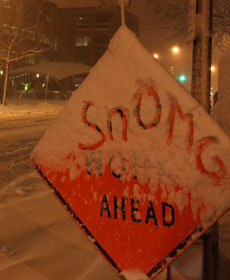
The news of the snow apocalypse that had school closed for two days straight (for the first time in years) had students, staff and residents rushing to buy house supplies: helmets, battery-powered flashlights, food, drinks, lighters, radio etc. When I got to the store to buy groceries yesterday, I found out that all the milk had gone out of circulation. There was none at all to buy. When it comes to panic buying, it seems that my current countrymen are the champs.

Now, at 2.45am on the day billed to be the scariest of the three days the terribly disnowbedient weather, there is no storm, no falling trees and sparkling electric wires, no raging alarms making us head for the basements and bath tubs covered with large matresses. No need for flashlights either. Just bloody snow and icy rain on the ground, and a thoroughly rested populace very glad to get two good days off. It is not all good. My classes take place on Mondays and Tuesdays, so I effectively have the whole week free of classwork, and that sucks. I’m beginning to think that this ruse was sponsored by Walmart and other shoppers so that we can all rush and buy things we don’t need for a weather we can’t handle.

I had made preparations for a different scenario anyway. In the event that power goes completely off and our phones run off that we can’t communicate with one another, and the heaters run out of steam such that we can’t even sleep without having to lay down  together like pickles in a jar, and all hell break lose such that trees fall, and all we have are ourselves against the elements. I figured that it might become a perfectly opportune time to start returning to the basic natures of our humanity: hunting. I had already started making a long list of recipes that can do with some deer and geese meat. When roasted on an open fire made out of fallen trees, and set in public in front of the lake and surrounded by scores of homeless students and residents – add a few bottles of beer or wine bought from the panic rush of the previous days – the fact of hunger and depression will disappear from the world even for a few hours, and all that would remain would be glee, and a certain kind of happiness hard to describe and impossible to forget.

Back to the reality of the present, there is no snowstorm around here. The closest storm we have is in Cairo where protesters have decided that Hosni Mubarak’s televised announcement of intention to leave government in September comes too late and gives too little. That storm is purposeful, unpredictable, and has defied all predictions. Here, citzens that have not been used to more than a few hours of interrupted electricity think that the world has come to an end if something like that should ever happen without notice. Life is good. No snowstorms. All we have are new words, and that one in the title of this post is one of them: mine.
Something Short But Crucial

Immigration is a fact of life and humans have been doing it for centuries. We made it complex by building embassies and consulates around the world so that before we move to any other place we get a chance to feel at home through an annexe of our government in that new place where we’ve moved to. We going through several processes of documenting ourselves so as to confirm our good behaviours. We also pay money so that those consulates and foreign missions keep running and providing the services we need. Usually, we do this in expectation of a kind of courtesy in return from the consulates. After all, they are set up to help citizens far away from home.

Some things had been bothering me for a long time. I work in a language lab affiliated with a foreign language department. Occasionally, I get to handle the employment papers of foreign students from France, Germany, Spain and Mexico who are in the department to help with conversation hours and language tutoring of our students. Something that has amazed me over time is the amount of time given for their passports to expire. German and French passports give ten years. This means that if you obtain the passport in 2002, you would not need to renew it again until 2012. I first thought that this was a fluke until I looked at several students’ passport and confirmed that indeed, it is the trend. It’s the same for American passports, and very many others.

You know where I’m going with this: Nigerian passports don’t enjoy the same privilege. Before getting the passport, I remember a couple of gruelling days spent at the immigration office in Ibadan first to hear that due to some strange reason, I will not be issued a passport in the particular branch because they were all sold out; I should go to Abeokuta instead. I didn’t buy it, went back to my university, got an official letter stating that I didn’t have that much time to travel around and it was important that I got it as soon as possible, and returned there to speak with someone who looked like a higher officer. Many days later, and after paying money a little more money than necessary, I got it, only to find that after five years, I would need to renew it again going with a chance of going through an even harder process when the time comes. And one could see their point, right? Make the process of obtaining something as simple as a passport so hard that people will think twice before leaving the country – even if it is to progress in their careers or escape a hard condition of living.

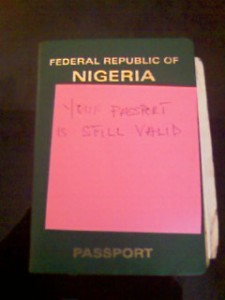
And so last week, I discovered that not only has that certain inefficiency in my country’s immigration department followed them from local Immigration Offices into foreign consular offices, the same attitude to citizens which resembles nothing else but contempt seems to determine the way they conduct their businesses. I don’t know about Nigerian embassies in other countries but what I have seen of their behaviour in Washington leaves much to be desired. A Nigerian – not me – and a Fulbright scholar studying here in this state had sent her passport for renewal. Along with the required fees and forms completed, she also sent a self-addressed envelope. A few weeks later, the passport returned along with the forms and the fees. There were no letters addressed to this citizen who had done all that is necessary in formal situations to apply for a passport renewal. There were no letter heads. All that came with this travel document was a post-it note written by hand and stuck to the back of the passport, which simply read: “Your passport hasn’t expired yet.”

Welcome to Nigerian diplomacy.