Memorial Day comes up on Monday, which means that we have a four day weekend, and time for Pirate of the Caribbean 4, Hangover II and some good old home theatre with leg stretched on the leather sofa. In an alternate world, there will also be some tone project transcribing, short writings, bibliography gathering for forthcoming MA project, and some hours of being serious reading abandoned books and babysitting cats. Four days is not so long when one thinks about it. Have a good one, readers.
Browsing the archives for the Soliloquy category.
What do you think of when you hear the words “British”? Well, it depends on who you are, doesn’t it? I bet the French, the Irish, the Scots, and the Americans think of them differently than the Germans, South Africans, Indians and Nigerians do. Stiff upper lipped, stoic and unyielding. My first impression of Britain started and ended at the UK Border Agency counter at Heathrow Airport in London en route to Boston, and it wasn’t very heartwarming. Portrayals in Mel Gibson’s The Patriot and Braveheart didn’t help either, and if those were all I had, I’d have re-routed my plane flight to go through France. But then, there was Colin Firth in The King’s Speech that brought much humanity back to the name. And there is the delightful Queen. In any case, this post – which is merely supposed to explore my contact and thoughts with stereotypes has just merely started. I chose “British” as the first example in my head. Imagine if I’d chosen to start with “Jewish.”
Now, I have just listened to a nine minute video by Andy Borowitz, one of my best living comedians. His tweet feed was named the funniest of 2011 and he has provided the best commentary on every contemporary news since I’ve started reading him. He makes twitter a fun place to spend one’s day. So, back to the story. One day, I discovered that he was also a stand-up comedian. I’d always thought that it was hard to combine being funny in 140 characters to being funny in real life. He does both very well that now I can’t tell which one I like better. (Well, that was a lie. His tweets take the cake.) What was notable about him today that I discovered was that he is Jewish. Now it all makes perfect sense. See – and I’m not an aspie like my friend Clarissa – I sometimes tend to look for patterns, for no good reason. I discovered sometime ago that Jon Stewart was Jewish, and then I knew of Lewis Black, and then Larry King, then Jimmy Kimmel, and Jerry Seinfeld. The only other thing that connected them all was that they were funny, brilliant people. Then Woody Allen.
Now, a few steps back again. My favourite authors weren’t Jewish. They were Irish. George Bernard Shaw, James Joyce, Seamus Heaney, Jonathan Swift, Oscar Wilde, Samuel Becket, W.B. Yeats, (and Barack Obama 🙂 ). I had grown myself into the idea that the most brilliant authors/people had some Irish in them. Oh, and let me now forget George Carlin. So it was such a shock to find out that when it came to intelligently interrogating ideas through literature and the arts, the Irish were not just the ones out there, and were definitely not the funniest. Thinking about it now, I should have taken a hint from the fact that Albert Einstein and Richard Feynman also had Jewish ancestry. So where does that leave me? Nowhere, actually. Like I said in a much earlier post, the link between the Yoruba people of West Africa to the Middle East – as plausible as it sounds on the surface – leaves many questions than answers. And that’s fine. I’ll just watch the Daily Show, Jimmy Kimmel Live, read Borowitz Report and go watch Larry King (whose last name is actually Zieger) on his comedy tour. There is an interesting, notable pattern in the talent of those who carry the ethnic (if not the religious) identity into the public sphere.
And there ends my post on stereotypes. I’m sure this wasn’t what you were expecting, but I have a feeling that a sequel will come sometimes soon when I come up with the other recollections of contact with people based on expectations, observable patterns of behaviour, hearsay, and yes, stereotypes. And yes, my friend Clarissa, and my head of department are Jewish as well. Regarding that expectation of brilliance – if only through contact – now I have nowhere to hide, and no excuse.
There was a huge tornado in this area four weeks ago, and I was in it. It was a most frightening experience. I was returning home from campus, and it ended with my car being spun 360 degrees and tossed off the road along with the meal of fries I had just bought at McDonald’s. (It gives a new meaning to “taking the car for a spin”, doesn’t it?) Luckily I wasn’t hurt, and neither was the car. But by the time I read the news and saw what it had done to the airport in St. Louis that same night, I knew how much luckier I had been. It moved planes and cars, broke glasses and knocked down electric systems. Since then I’d sworn never to ignore tornado alerts.
The biggest storms I’ve ever experienced in Nigeria usually happened at night. There have been tornadoes but they are rare and spaced out so I’d never actually been in one. They’re deadly nevertheless. Imagine walking in the rain at night and have the wind throw an aluminum roof straight at your jugular or at your car while you drove. Just a few years ago, father went to bed in a large house of two storeys and woke up with an open roof. The whole roofing frame had been moved a few miles down the street. My grandfather’s house once suffered the same fate many years later.
The houses in America are built differently, it seems, and thus suffer a seemingly greater damage. Then there is the powerful wind running at such speed that can wreck anything in its way. Two days ago, another big stormed roamed this parts and killed about 117 people from Missouri to Minnesota. Pictures from Joplin MO looked like a war zone. When people say “be thankful for little blessings”, I guess they mean that one should be grateful for not being in a place like this when the storm comes. It is a frightening, and often devastating experience.
UPDATE: President Obama has promised to visit the town on Sunday.

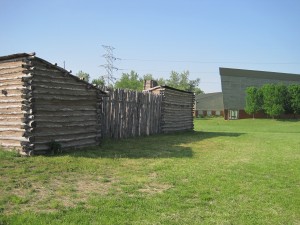
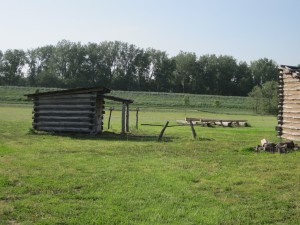


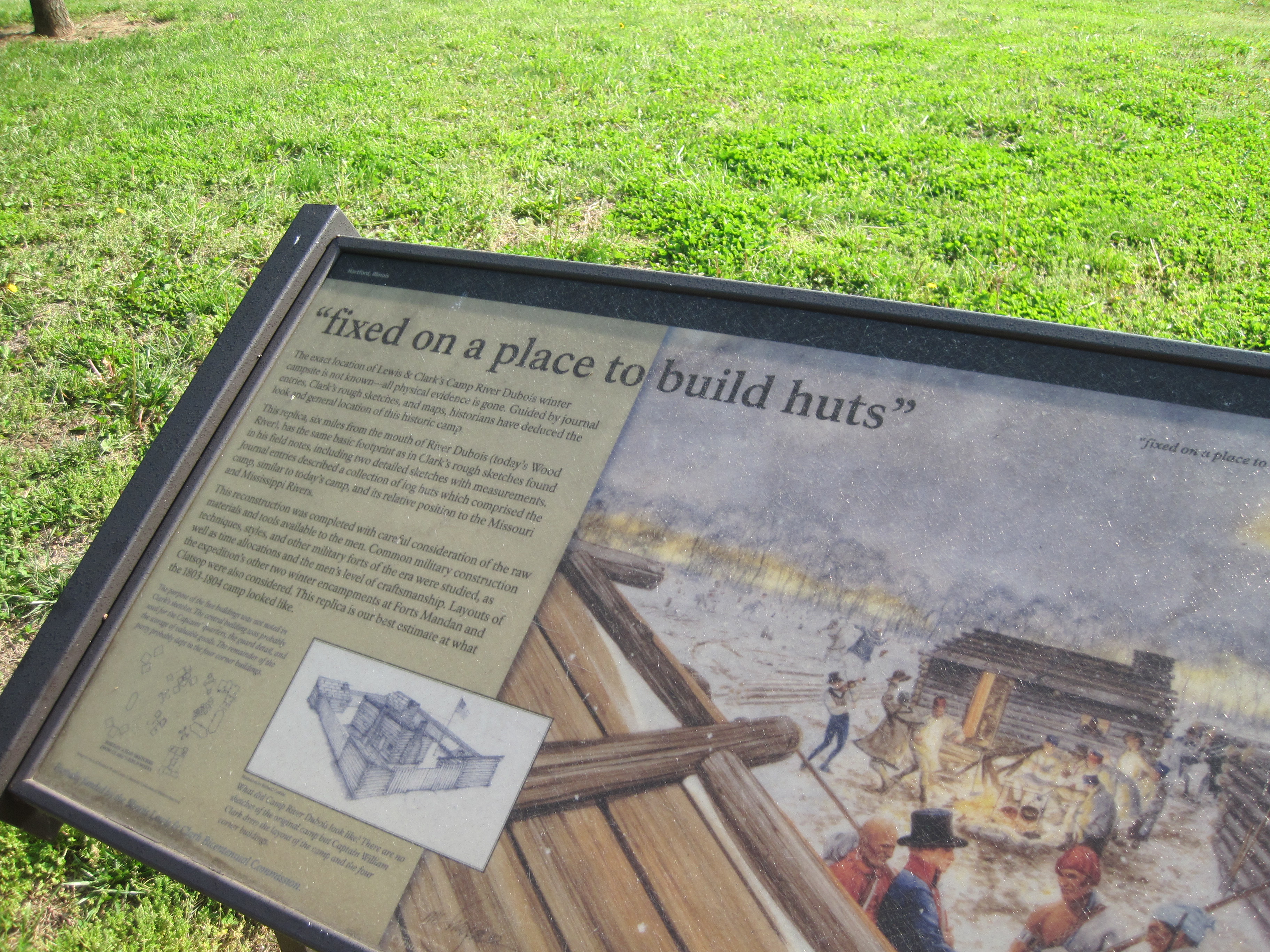 The Lewis and Clark interpretive centre is built to commemorate the spot where the expedition of Meriwether Lewis and William Clark departed on the orders of President Jefferson to discover what lay in the piece of land by then just recently purchased from France. It was called the Louisiana Purchase and it contained what is now must of the Midwest United States reaching to Arkansas, Minnesota and North Dakota. (A most fascinating look-back to those times would wonder what kind of country we would be living in now if the land hadn’t been sold and the land – as it was then – consisted of English speaking people on the east, Native Americans and some French speaking people in the middle and Spanish speaking people on the West.)


Here are some of the pictures I took on a visit to the state historic site a few miles away from here. The old houses there are replicas of the camps that must have been built by the expedition party before they set off on the Mississippi river trying to discover the flora and fauna of the wild west. The models, according to information, were rebuilt from the notes and diaries of Lewis and Clark.
When I took my TOEFL (Test of English as a Foreign Language) exam sometime in 2008, I knew it was a futile exercise and I approached the test venue with all the contempt I could muster (I got 110/120, by the way). The reason was because English to Nigeria was not a foreign language but a national one. Everyone who has gone to school, especially through a university like I had – has acquired a competence that is as native as anyone else in England, America, or Australia. And although there are isolated cases of poorly formed university graduates in Nigeria (as well as in some other post-colonial societies) whose grasp of the language would not improve even no matter the amount of input, it was safe to say that graduating from the university was enough proof that one was competent enough in the national language which had been one’s medium of instruction in school from around age two or much earlier (and six, for some).
My linguistics classes in the university opened my eyes to a few of the reasons for this standardized test. The linguist Braj Kachru’s famous work on English’s “concentric circles” divides the English speaking world into three places. The inner circle is where the language is spoken as the sole language (England, US, Australia, etc), the outer circle is where it is spoken as a colonial language (India, Nigeria, Philippines etc), and the expanding circle where it is spoken only to be able to interact with the rest of the world (Japan, China, Saudi Arabia etc). That definition successfully relegates the post-colonial British world into a second place where competence is measured not just by situation of birth as what can be proven through standardized test – a very problematic situation. According to Wikipedia entry on the matter, a person’s native language “is the language(s) a person has learned from birth or within the critical period, or that a person speaks the best and so is often the basis for sociolinguistic identity.”
In Nigeria, as in India, Philippines, Jamaica, Trinidad and many other former colonies of Britain (and the United States), contact and exposure to English for many occurs during the “critical period” and develops over time with more exposure to education and progress up the social ladder. Thus by the time one is old enough to graduate from the University (and for many far earlier than that), they are already sufficiently socialized not just in the language use but also in the cultural nuances that come with it to be able to pass for a truly native speaker. We have the media to thank for that as well. The presence of abundant corpus of brilliant literature from these places should be enough to put any doubt about this to rest. VS Naipaul, described as the master of “modern English prose” published his first novel The Mystic Masseur in 1957 when he was just 25. Wole Soyinka, Africa’s first Nobel Laureate in Literature already published his play The Lion and the Jewel in 1967 when he was 33. Chinua Achebe’s Things Fall Apart which is widely regarded as the archetypal African novel in English was published in 1957 when the author was just 28.
Now, our wikipedia definition continues: “In some countries, the terms native language or mother tongue refer to the language of one’s ethnic group rather than one’s first language.” This is precisely where my issue lies, especially if any of such countries include the United States of America where many “native speaker” citizen graduates of universities will perform very poorly on the TOEFL test. Most job openings for linguists today require that the applicants be “native speakers of English.” What one would wish is that this stipulation is not based on this second but the first definition of “native language.” It will be disastrous if this were not the case. The closest I got to finding out is a discussion I started a few weeks ago on Facebook about whether I – born and raised in Nigeria (with Nigerian English and sufficient access to both British and American linguistic and cultural conditioning) – would be considered a native speaker. All responders said that I would not. The reason was not that I don’t speak the language with native-like proficiency, it is that I acquired the language along with another one during my critical period. It is likely that if any of my Facebook friends were on the board of my job application, I may have to go apply elsewhere.
Luckily however, as I found out a few minutes ago, the list of countries exempt from taking the TOEFL now includes Nigeria. (When I took the exam, the only African countries exempted from taking it were Liberia and South Africa. Go figure.) I am therefore glad to hear this finally though it takes the sting out of the indignation that I had brought to writing this post. I had once suggested that American students begin to take the TOEFL before getting into universities as well in order to vet their English language proficiency. It’s not going to happen, of course, but the idea tickles me.