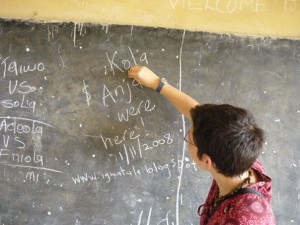
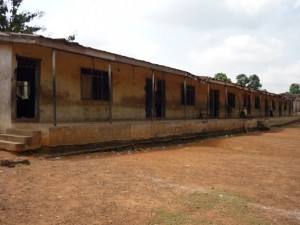
 Exactly one year ago today, I had taken a much-needed trip to my old secondary school in Ibadan with a friend from Germany, and received, along with a certain exhilaration of returning to the compound after eleven years, a baptism of heartbreak at the level of the school’s undeserved decrepitude. The desks were bad and disfigured. The structures were falling apart and the school looked like it could use if just a little management. Going back down memory lane, I realized that it seemed to have always been that bad, but schooling there, we cared more about dealing with our academics and making good grades, than caring about how nice the structures looked, or how less than perfect they were compared to the other schools we knew. Thinking about it now, I also realize that we were not that much different from many of the state-run high schools all around the state and the country both in management, educational standard and aesthetics. There is something inherently slack about the way public schools are run in Nigeria. Education is free but not qualitative. It is definitely not worth the long term traumatic and demeaning effect of a poorly gained education. We will never be able to successfully measure how much of the bad management of structures and academic system from such schools have contributed to the continued slide of Nigeria on the list of civilized places in the world – if it was ever on the list in the first place.
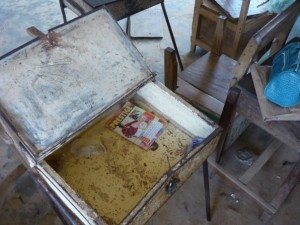 Now, this is usually the first question that comes to my mind when I look at the structures of public schools in Nigeria today. I mean physical structures now, and not because it’s more important than curriculum or the total academic system, but because aesthetics is the first condition of sane, healthy learning. The question is: with the enormity of Nigeria’s billion dollar incomes from oil every year, why does education have to be underfunded? I can never get my head around this. As at today, the educational system is in a shambles. And from what I know, it has not always been like this. The people at the leadership positions went through a very organised system that catered for their educational, emotional, physical and even spiritual needs. They got scholarships. They travelled wide, and many of them studied abroad on the bill of the government which at the time was not even this rich. The case seems now like that of the selfish man who destroys a bridge as soon as he gets across it, so as to prevent others. In the universities today, research is almost non-existent, due to underfunding. Most of the students in the department of computer science either don’t have personal computers, or can’t use it within the campus because the University authorities believe that they overload the electricity supply. I couldn’t use a computer in my university for a long time because of this ridiculous argument. The country of Kenya is not half as rich as Nigeria, yet it seems to have a better attitude to education than Nigeria does. I can’t explain it. I don’t understand it. The more I think about it, the angrier I get, so I think I’ll stop here.
 During my secondary school days, we always had to bring our own desks from home – made by whichever carpenters our parents chose. The school would not provide the desks. And for security, we also had to bring chains and locks to keep the desks and chairs fastened together so that they don’t get stolen, as they always inevitably did, sometimes even with the chains on them. I had a particularly peculiar misfortune of having always to go around the school looking for my chair or desk at the begining of every week. Someone was bound to have taken them for a ride out of our classrooms because they didn’t have doors. Some times, the search takes me all around the school, and I can’t count how many classes I missed because I was busy so early in the morning trying to locate my desk. I started writing my name on them, but one day, I discovered that writing my name with paint didn’t help at all. In fact, it made matters worse because the recurrent thief also happened to share my name and surname, as I discovered.
Now, when I think about it, let me warn you that if you ever get an email from anyone of my name and surname tomorrow asking for favours from you, please beware. It might be him, again up to his old antics 😉
Two days ago, there was a news story here on Nigeria’s newspaper NEXT about the problems of school children in Lagos who now have to write on the floor because of underfunding. Apparently, the problem hasn’t gone away even with the civil rule. We could at least have said that we had that much problem because we schooled under a military dictatorship, and yet we didn’t have to write on the floor during our time (if I remember correctly). However, if it makes them feel better, those children may take consolation in the hope that one of them may one day make it to America on a Fulbright programme, in spite of the gruesome obstacles forced on them by an insensitive, uncaring set of leaders. Who knows how far away hope is? Apparently, it’s not in the hands of these set of democratic rulers.
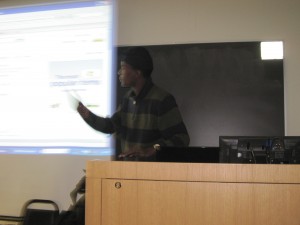 I did not grow up with computers around me. I am definitely not a first generation internet user. Much of the first creative things I wrote in my life were in long hand on rough sheets of paper, and later on an abandoned typewriter in my father’s lounge. Today there are kids growing up who probably never spent a day without getting on the computer. Whether they are smarter or more efficient than us is beyond me, but I do know that there is some kind of thrill in my current adaptation to a 24hour electronic cycle. The book is dead, I’ve heard, incredulously, and yesterday when I tried to read the current edition of Time magazine in print, I found a certain kind of lazy resistance, and some unexplainable wonder that they still make paper editions of those in this age of the internet. It must be why I spend so much time trying to to finish reading a book of just 300 pages. There’s definitely a sort of taking over by the internet, and I’m surprised to be on the train, considering that my first email address was just ten years ago.
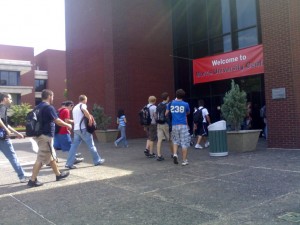 Whenever I tell my American friends that I’ve been here for only two months, they immediately ask for my opinion on everything I’ve seen and experienced. And, instead of going with a previously standard response of “Oh it’s nothing. Except for the cold, it’s not much different here from where I’m from,” I now have to go into a long discussion on my very many notable observations, wonder, amazement, dread, lonesomeness and all, just to avoid a long stare or an awkward moment of uncomfortable silence that have now begun to attend any seemingly self-confident response. “It’s okay to feel lonely at times, and miss home, you know.” My classmate had said to me once, and he’s right. I should desist from this present stoic, often impersonal response to this distance, and really break down into my true status as a lost stranger in a distant land. Maybe only then can I find another part of myself necessary for the true experience of travelling. The problem is, it’s not working out for me. I wonder if there’s anything wrong with that.
 I was once presented by a doting love with a list of several endearment terms from which to choose a specific one for future continuous use. After about a few days of serious thinking I came back with a preferred choice, and she looked at me long and hard, hissed aloud, then wondered aloud why of all the thousand and one “nice and lovely” possible names to choose from – like ‘darling,’ ‘dear,’ ‘love,’ ‘honey’ etc – I had chosen “pumpkin”. To her very bewildered self, this terrible mis-choice only meant one thing: a confirmation of what she had probably long suspected: that I had finally lost all my romantic sensibilities. To me however, it was a very unique expression of my kind of doting which was not meant to conform to popular expectation. Needless to say, the arguments that ensued afterwards ensured that it was not one of the best nights of my romantic life!
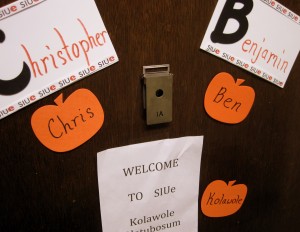 It was therefore a mild surprise, on getting back to my apartment this evening, to find that our names on the door have been re-written on pumpkin-themed pink cards by some strange fairies within the University Students Housing system. How very sweet! I can now be sure that whenever the Halloween fairy finally comes by, he’d be sure to knock on our door sometime in the night, even though our own pumpkins plants are just a few inches large.