Browsing the archives for the Opinion category.

A World In Intolerance

Saturday evening found me in a bar downtown Edwardsville for a quick drink. One particular conversation with a mere acquaintance present there with a few other friends eventually turned to discussion about careers, mine, and about what I would like to be doing as soon as I’m done with a Master’s degree. It then returned to him and what he was doing at the moment. He’s studying to be a health scientist and he would one day love to work on the African continent. “I would have gone to Ghana in the summer,” he said, “but I didn’t have the money”. “Great,” I replied. “I know a program called the Global Health Corps which sponsors interested health workers/scholars from the United States to parts of Africa in order to make a difference doing what they love. It’s fully funded, and it’s perhaps precisely what you need. As a matter of fact, my fiance lives in Uganda at the moment because of this program.” He was immediately enthusiastic for one second, and then stopped. “I can’t go to Uganda, Kola. They’d hang me there.”

It took me about two seconds, and then I got it. He is gay. This was my first time of hearing this admission directly from him. He was apparently already familiar with the laws in many states on the continent today demonizing that kind of difference. I recovered from my double-take and tried to assure him. “You’re a foreigner. Foreigners are usually more protected especially when they’re volunteering… Maybe your presence in local communities saving lives will be enough to help change minds… Or maybe you don’t have to wear the tag on your forehead…” No, he said. He doesn’t have anything to hide and would never live where he is forced to deny who he is. The conversation went on for a little while more with me asking a few more questions I’d always wanted to know from a self-declared homosexual: How long has he known? Has he ever kissed a girl and loved it? Has he ever had sex with a girl? etc It was surprisingly an open conversation without any awkward moments where the young man opened up with his fears, hope, dreams and pain at the kind of society that demonizes difference. I expressed my empathy to him, just a few seconds before I informed him that he wouldn’t be able to live in Nigeria either.

A few days ago, last week, a  new law was passed by Nigeria’s Senators penalizing “homosexual activity” for up to 14 years in jail, and up to 10 years for those who support, conduct or witness homosexual marriages and association. Many things make this law stupid, but this makes it curiously draconian: there has never been a clamour for homosexual union/marriage in Nigeria. If anything, the derisive societal attitude has been previously enough to keep those with same-sex attraction in the closet. Societal acceptance – if it ever happened – would have been a very big leap forward. Many pundits have already written about this, and the conversation about the scourge of this state-sanctioned intolerance has already taken centre stage in the media, which is good. Looking through the various arguments put forward by citizen for the support of this legislative measure has however convinced me of the long way that society still need to go to overcome intolerance.

Back to America, at around the same day, Congresswoman Michelle Bachman of the United States House of Representatives was telling a group of voters that she has no problems with homosexuals or lesbians getting married, as long as they get married to people of the opposite sex. Read it here. Here is the summary then: If you live in Nigeria or in the US as a gay person, you risk being criminalized except you get married – to the people you are not attracted to. If you live in Uganda, there’s one step further, you may be brutally murdered by a mob of intolerant activists (as was the case of the human right activist David Kato). There is much more to say about the hypocrisy of these expressions of sadistic intolerance, but I will end this post here – a minor contribution to the dialogue. There are a lot more we can do to bring peace to the world than spending time demonizing other people because they are different from us. A lot more things we can do with our conscientious energy.

Exceptionalism is Overplayed

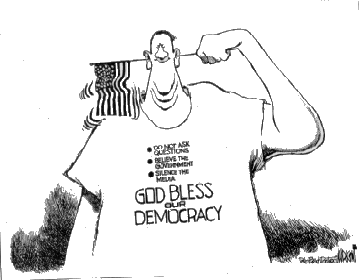
There is this weird notion that Americans are exceptional among peoples. It is one of the oft-repeated catch-phrases one would most likely find among politicians these days. Something like “unlike our president who believes that we’re just like every other country, I believe that as Americans, we are exceptional.” I have paraphrased Republican presidential candidate Mitt Romney, but he’s not alone. Heard repeated again and again, it often begins to sound something like this, between two children on a playground: “My daddy will beat the hell out of your daddy!”

Here is a problem though: the vapid mantra has been taken so seriously by many citizens that a leading politician now thinks that it is something with which to impugn the credibility of an opponent. “Hear that America, he thinks that you’re human like everyone else. I, however, believe that you’re supermen. You’ve always been.” Before this post is accused of being anti-American, let me give a few more examples of these delusions of exceptionalism as I’ve found them all around the world:

  • Nigeria is the giant of Africa (said to a tone/attitude of superiority derived from nothing else than the fact that one in five persons on the continent today is a Nigerian or that the country has produced some of the continent’s most accomplished citizens.)
  • We are the chosen people (an oft-repeated phase associated with Judaism and Jewish identity. According to the bible, this conviction could be traced to hundred of wars and pogroms in the bible led by the leaders of the nation-states acting on direction of God. It is also a source of immense national pride).
  • A ji sebi oyo laa ri… (a saying from the Oyo people in Nigeria, translated fully as “Oyo is known only to be emulated. Oyo never emulates anyone.”)
  • We’re the superior race (from Adolf Hitler and the Third Reich)
  • Arab Exceptionalism (“a phase that prescribes that Arab nations are immune to economic modernization and democratization, or that these concepts form part of the ‘clash'”)
  • Polygamy is an integral part of our culture/Homosexuality is not a part of our culture. (One of the many vacuous polemics that surface around the African continent whenever any of those issues are raised in public discourse).
  • “Rang de Basanthi” (Hindi: “Colour it saffron” – a badge of nationalism, pride and racial exceptionalism among Indians to the exclusion of everyone else).
  • Once you go black, you never go back (A disgusting racial aphorism. Use google.)
  • I’m a man: that’s what we do/Don’t tell me what to do/What do you expect? (Gender exceptionalism?)

There are many more across different world cultures that I have come across but now forgotten. A thing common to all of them is the belief in a particular world outlook accepted as superior and as defining of the people who hold onto them. American exceptionalism, of course, falls into the same category as all of those above, and it is the reason for this post. The concept is usually defined this way: “Here is a country exceptional in its creation and survival, as well as its role in world affairs.” It is usually bonded with a demand for indemnity from all accountability. “Can’t you see? I’m American!” American television personality Chris Matthews, in debunking the Republican “slight” of anti-American exceptionalism on President Obama, often uses this defence: “Can’t you see? Didn’t you listen to the man’s election speech? He said that only in America was his story possible. President Obama himself is a product of American exceptionalism. Look at where he came from and where he is now…”

Where Chris Matthews got it wrong however is the better end of the same spectrum of Mitt Romney underhanded sneakiness. While America is really no more exceptional among other countries of the world with less colourful starting histories or world presence nor its people any more important than people in more obscure parts of the world, it is also not exceptionally unique just because a bi-racial young man from a poor home and a single mother could become its president after a long history of slavery. I agree however that these make for a very spectacular (albeit empty) polemics. There are a few more examples of such exceptionalism: Mother Theresa moving from Albania to live in India in service of the world’s poor, or Susane Wenger – an Austrian woman, who spent all of her creative life in the groves of Oshogbo learning and teaching art and spirituality (and in dying there become one of the forest’s eternal goddesses).

The undeniable fact is that humans will always thrive wherever they find themselves. The story of Steve Jobs making it out of an almost hopeless beginning to become an accomplished entrepreneur could equally have happened elsewhere (perhaps with much less flair). The son of a carpenter from a victimized culture becoming the most famous, venerated, victim of capital punishment (by crucifixion) is as much a story of Jewish exceptionalism as is the story of a black African from post-colonial Kenya making it through the ropes to become a PhD holder in the United States a case of Kenyan/African exceptionalism, as is the story of a previously obscure princess from a repressive patriarchal culture growing up in the world’s ugliest war finding herself, due to a series of coincidences, as the queen of a large empire on which the sun never set – a case of British exceptionalism. Here’s Brazilian exceptionalism: defy all odds of a third world/developing country and win gold in (almost) every World Cup in which your country participates.

My conclusion here – as might by now be clear – is that there either is something of a human exceptionalism – defined by great success in spite of all odds – common to every culture and people on the face of the earth, or there is no such thing as exceptionalism, and we’re all just as unique as we are different. Nationalism and patriotic/religious credos are usually more disingenuous than the words in which they are couched tell us, and they have not always led to an improvement on the condition of human well-being. Politicians should therefore find something more stimulating to spend their time talking about, as should all blindly-following fanatics.

Book, Blook, Bloog, Blog…

Ikhide Ikheloa has joined the blogging community. This next sentence, otherwise supposed to describe him in a few words and put him in the context of Nigerian and African literature, will however be used to tell you something else: that blogging is the future, or at least the way to it. With electronic data content and text being gradually becoming the most viable medium of communication, it takes no prophet to see that what literature is will also eventually take on a more pro-electronic bias. I have said this before, and let me repeat it here (as if it needs repeating, duh) that the future of literature depends in some form (if not entirely) on the internet. A future Nobelist from blogging, anyone?

You should also follow @SalmanRushdie and @TejuCole on twitter while we’re still talking about the internet as a literary resource.

Top Twenty Questions FLTAs Would Be Dying To Ask

Every time I start believing that I am sufficiently removed from my Fulbright experience to return to my anonymous student life, I get requests like this from readers like Darsh who want to know more about the FLTA experience in the United States. I’ve once written about what to expect in a one-year trip away from home, but here are a few more. As soon as you have passed the initial stages of being selected at your local country consulate, you are almost on your way to the United States.

1. How much is the monthly stipend? A: In 2009/2010, it was a little over $1000 per month. I hear that it also depends on where in the US you’re posted to. I was posted to Southern Illinois. f you are on the coast, you get a lot more (but then spend a lot more as well for food, and rent).

2. Is the stipend ever sufficient? A: Yes. With very prudent use, you would usually spend about half of the whole stipend monthly on food, housing and books. At the very worst case scenario, you would still be able to save about $300 every month.

3. Can relatives visit me from home? A: Technically, they can, but that is not what the program is about, so it is not encouraged. Believe me, the last thing you want is carrying the home baggage with you. But then, it’s up to you.

4. Can I date my students? A: No. Bad idea.

5. Can I date other students on campus? A: Yes.

6. If any of the people I date at #5 ever become my student in another semester, what should I do? A: I have no idea. But the fact that you know that such scenario is possible should make you re-think #5. You’ll find very many opportunities to meet other new people.

7. Will I need a mobile phone? A: Yes, but you don’t have to bring it along from your country.

8. Will I need a car? A: Not usually. You’d be able to get by without one on most campuses. Many FLTAs however often apply for, and obtain, a driver’s licence before they leave the US. It could be a worthwhile endeavour, so pursue it if you can.

9. How cold is a cold weather? A: Very cold. If you have never seen snow/experience winter before, chances are you will start needing to buy winter clothes and boots as soon as late October. Right now, it is 6 degrees Celsius.

10. Can I stay in the US after the program? A: No. There is a mandatory “return policy” which you’d sign on your way in. As soon as you’re done, you are required to head home first, before you do anything else. Many people return to the States for advanced degrees afterwards.

11. Tell me more about this “return policy”. A: Every grantee is obligated to spend two straight (consecutive) years in their home country after completing the Fulbright program. The aim of this clause is to make sure that the grantee returns home to contribute to the development of their country. If you do return to the US immediately after you return home after the FLTA, and spend a couple of years pursuing a degree, you will still need to eventually complete this mandatory 2 year home stay period before you’re ever allowed  to process any long-term immigration to the US later in life.

12. Do I have to live in campus housing during my Fulbright year? A: You don’t have to, but in my experience, campus housing gives you a chance to know a bit more about American campus experience. And if you’re lucky to have stayed in a highbrow student housing like we had in Edwardsville, you will have a fantastic experience. However, many FLTAs have found other housing arrangements downtown (or somewhere close to school) that are more affordable than the campus housing (sometimes through r00m sharing with other international students). This can work too, but you may lose out on much of the “executive” campus scholar experience.

13. Can I send money home? A: Why not? But in most cases (refer to #2 above), the money is barely anything. By the time you buy an iPod, a camera, and a few gifts to take home with you, you barely have anything left. And if you hope to return for advanced degrees, you might want to save as aggressively as you can.

14. What do I need to take along to be a successful teacher of my language? A: In my case, a few books, some movies, plenty traditional clothing, and an adventurous spirit. American students are curious and they’d appreciate your efforts. Dressing to class at least once a week in your native wears will send a message of cultural appreciation more visibly than one month of teaching. I also showed a couple of movies in class. Use YouTube. There are plenty there that you can use to illustrate any point that comes up during teaching.

15. Can I travel out of my state? A: You will travel, at least once during the program. The first travel takes place before your teaching starts: you will be taken to another state for the FLTA Orientation. And then, in December, you will have to attend the annual conference in Washington DC. This is a five-day event which will allow you to meet up with your fellow scholars, and visit parts of the nation’s capital. Aside from these mandated trips, you will also have the time during your year to visit any other place you want, as long as you do it during times where your presence is not physically needed in your place of primary assignment. If you’re in Illinois, you should try to visit Chicago or Springfield.


to be continued…


Defining Racism Wrong

I have come across this pernicious argument more than a few times now, and lately from Donald Trump and the “Hercules” actor Kevin Sorbo who appeared on Fox News yesterday to make the same point. The argument goes this way, that those who complain about Tea Party racism should direct their anger at what is the real racism: the fact that over 95% of black people voted for President Obama in 2008.

Sigh.

And there I was thinking that I live in a country that speaks English as its first language.

Sigh.

So here it goes, the real problem with that really pernicious argument: racism is defined as “the belief that inherent different traits in human racial groups justify discrimination.” I’ll break it down: racism is deciding that someone should NOT get something that everyone has access to, just because of the colour of their skin.

So, here again is a reason why it is less likely that it is racist that Obama was voted overwhelmingly into the White House by an overwhelming black vote: by the time he was voted as president, he was the first person of his race ever to get that close to a position that had been dominated for hundreds of years by people of a certain race.

I’ll make another analogy. Imagine these scenarios.

A: There is a school somewhere in the world which for four hundred years had admitted only people of a certain height/hair colour/dentition etc, and then one day, people who have for that period of time had been excluded from that process found a candidate that qualified as an outsider and was overwhelmingly supported – along with other support from the people who hitherto had that privilege. The student shorter than the average height requirement/hair colour/dentition is finally admitted, and everyone is happy.

B: There is a school somewhere in the world in which only one shorter/different-hair-coloured/wrongly-dentitioned student was recently admitted after about four hundred years. He is about to be removed by an overwhelming majority of the “establishment” regular people for no other reason that made sense, or had been applied for other “regular” people up until then.

Now, here is my conclusion. There is absolutely no evidence from the above to show that there is racism in any of the two scenarios A and B. Perhaps.

But…

It is MUCH LESS LIKELY racist that an underdog is collectively SUPPORTED to get equal opportunity, than that an underdog is collectively DENIED access to equal opportunity. And this is where Sean Hannity, Hercules, Donald Trump, and all the others got it wrong.

And here is one more thing. There is a clear difference between racial and racist politics. It is racial politics to vote for someone on the basis of their skin colour, but not necessarily racist. It is however clearly racist (as well as racial) to try to remove someone from a position because of their skin colour. The difference is the harm inherent in only one of them.

And here is one more thing I found on a Youtube comment: “black (and other minority) people, until 2008, have voted 100% for white candidates.” How racist is that?