Browsing the archives for the News category.

American Corner to Screen Femi Amogunla’s “The Bargain”

As part of the United Nation’s The 16 Days of Activism Against Gender-Based Violence, American Corner, the Nigerian Society for International Arts and Culture, Firm Media Production and Liveinibadan.com join the world to stand against gender-based violence.
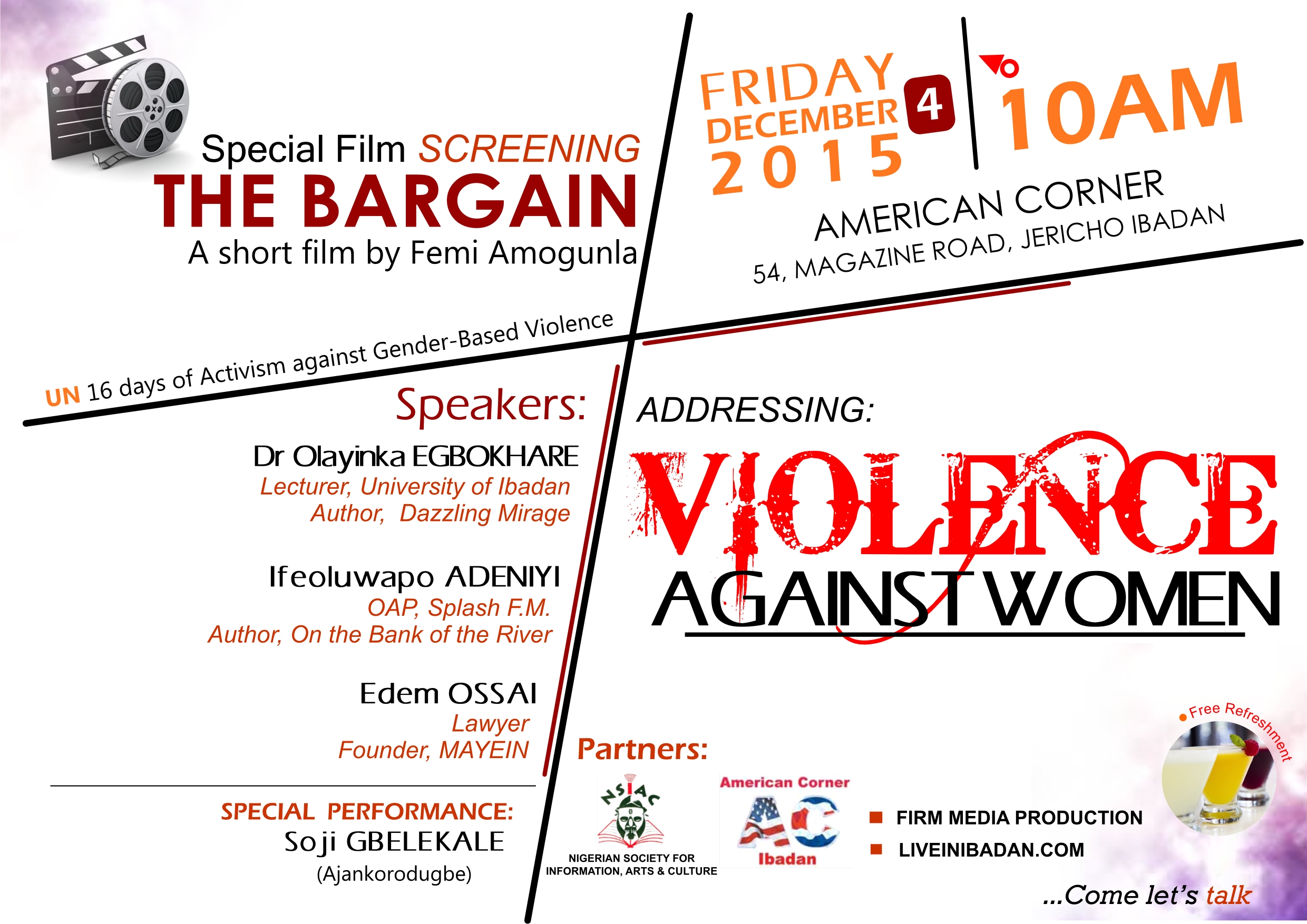
The Bargain. AThe 16 Days of Activism is a yearly international campaign that runs from 25 November (International Day for the Elimination of Violence against Women), to 10 December (Human Rights Day). The Bargain is apt to raise awareness about these issues because it chronicles a woman’s life, from childhood to adulthood.

“I think that film has power not only to inform but to transform. Many will see themselves in film characters and I think much more than whine about the abuse that happens in marriages, it is important to do something. This is my own little something,” says Amogunla Femi, the producer of the short film.

The film screening will be followed by a conversation on the many manifestations of violence against women in the society.

Venue: American Corner, Jericho, Ibadan

Time: 10am

Date:  December 4, 2015

About The Bargain

The Bargain is a short film that chronicles the life of a Nigerian woman from childhood to adulthood. It shows the many manifestations of gender-based violence against her; this violence resonates with many Nigerian women. The film is about how the Nigerian woman negotiates her existence daily, the way she bargains with reality, with stereotypes. It is a call from one woman to another on the price they place on their lives, on their value. It also raises questions: what are the lessons women learn while paying this price? How much or with what will you trade your worth?

The Speakers

Dr. Olayinka Egbokhare teaches Communication and Language Arts at the Faculty of Arts, University of Ibadan. She is the author of the widely acclaimed novel Dazzling Mirage which was adapted for screen by Mainframe Productions.

Ifeoluwapo Adeniyi is an On-Air-Personality at SplashFm; she is also the author of On the Bank of the River which is on the longlist of the Etisalat Prize for Fiction, 2015. She loves literature and has a penchant for socio-economic and political issues.

Edem Ossai is a Lawyer, development practitioner and founder, MAYEIN (Mentors Assistance for Youths & Entrepreneurs Initiative). Edem received a Commonwealth prize in 2013 for her Essay on the role of women in leadership and entrepreneurship.

Abiade Abiola is a lawyer with an interest in women’s human rights, children’s rights, sexual and gender-based violence and alternative dispute resolution. She is also the founder of Human of Substance Empowerment Initiative.

Femi Amogunla is an award-winning multimedia artist who works with stories, photography and film. His poem My name, My Identity was curated, produced and performed as part of the 30 Nigeria House Project during the 2012 Olympics. In 2014, he was commissioned as one of the official photographers for the #VoteNotFight# campaign in Oyo State. His photography has also been featured in Kuramo Report.

When Femi is not writing or producing, he takes a shot at the world with photography. The Bargain is his first short film.
EVENT: Writing a New Nigeria

Representations of Nigeria in contemporary fiction and poetry

  • Time: Saturday 14 November 2015, 4pm – 5.30pm
  • Venue: Freedom Park, Museum Building
  • Admission: Free

Panelists

  • Elnathan John, author of Born on a Tuesday
  • Abubakar Adam Ibrahim, author of Season of Crimson Blossoms and The Whispering Trees
  • Jumoke Verissimo, poet and author of I Am Memory and The Birth of Illusion
  • Dami Ajayi, poet and author of Clinical Blues
  • Toni Kan, author of Nights of the Creaking Bed and the forthcoming Carnivorous City
  • Kólá Túbòsún, linguist and writer, author of Attempted Speech & Other Fatherhood Poems 

Moderator

  • Wana Udobang, journalist, writer and poet

wanaA selection of celebrated contemporary writers and poets discuss representations of Nigeria in fiction and poetry. The panelists will consider how writers are reflecting the issues and concerns of Nigeria today and their role in holding politicians and society to account. They will debate how Nigerians navigate by language, slipping in and out of character, dialect and language according to the circumstances, and the importance of writing and publishing in languages other than English.

The significance of identity and place will be discussed, with two authors bringing a perspective from Northern Nigeria and another who says he couldn’t live – or write –anywhere but Lagos. There will be an opportunity to hear authors read from their works – and for audience discussion.

‘Writing a New Nigeria’ is a 2-part BBC Radio 4 documentary giving a portrait of Nigeria, seen through the eyes of a new generation of writers and poets, presented by Wana Udobang and including contributions from our panelists. Produced in partnership with the British Council as part of UK/Nigeria 2015–16, it will be available on www.bbc.co.uk/radio4 from 28th November 2015.

___

Photo from Lovenwords.com

Habari, Kenya!

IMG_9787I’m currently in Kenya again, after an absence of ten whole years! And how time flies! Last night, the city of Nairobi welcomed me back into its breezy arms like a long-lost friend. I am here for the CNN/Multichoice African Journalist of the Year 2015 Awards, along with journalists from around the continent some of who, like me, have been nominated for this year’s awards, and some who have just been invited to participate in this year’s edition, which is the 20th anniversary.

Whenever I can, I will post updates on my trip here. By some luck, there will also be a couple of significant blog-worthy experiences around Nairobi for which I will be able to write a few long-form travel reports for you, the reader, and possibly for a few other publications. For now, in the comfort of my reunion hug with East Africa, let me go explore.

Blogging in Klieg Lights

A while ago, while pondering the changing landscapes of contemporary media, I suggested that many things have irrevocably changed enough to warrant a different attitude, especially by prize-giving bodies, towards alternative media and publishing outlets. I must have said it in many other different ways afterwards. It was true then as it is now, that the democratisation of the media which has given rise to many new voices and expressions that would otherwise remain silent has not received much of its due respect from the traditional gatekeepers.

A number of times on this blog and elsewhere, I’ve made a case for blogging as “the future, or at least the way to it.” I believe this to be true, although the Booker, The Nobel, among other literary prizes have however not yet taken any relevant cues from this reality enough to change the traditional nature of their annual winner selection. Rational people expect the changes to be slow. However, great, brilliant and beautiful work is still being done everyday on web platforms by writers who either can’t find publishers, or don’t think that the traditional route of print publishing is effective in reaching their audiences. The earlier we begin to recognise them in spite of their refusal or inability to comply with traditional methods, the better. The world is now a different place.

cnn_aja_logo_2015_rgbI want to say though – some of you probably know where I’m going with this – that I’ve received recently some encouraging validation for that aspiration. This blog has been nominated for the CNN/Multichoice African Journalist of the Year 2015 for a travel report I did for this blog a while ago.  (I’ll tell you which one it is, shortly). And for that, I’ve been invited for an all-expense paid to Nairobi, Kenya – this October – to writing workshops, networking, and the gala night to hear the name of the winners. (I also found it incredibly gratifying to be returning to Kenya exactly ten years since my first visit in March 2005. Yay for travel, nyama choma, and meeting old friends. Habari yenu, Kenya!).

More enchanting for me, however, is a possibility for the future. We’ve seen it with Uber successfully subverting the idea of organised traditional taxi service, and of AirB&B helping people turn their home and apartments into “hotels” without having to get a licence or own properties like the Hilton or Trump. It has happened with radio vs podcasts, and with music companies vs Pandora, Spotify, etc, and with e-Books helping writers reach their audiences faster and more affordably. Everywhere we turn, new ways are challenging the old and forcing us to negotiate the world in a lot of different, less cumbersome ways. I see blogging in the same way: a platform that is accessible to all, can be set up at no cost, and yet can be incredibly powerful in transmitting and interpreting the human experience across boundaries like never before. This has certainly been my experience here and it’s hard not to be excited for the attention of traditional media giants, CNN and Multichoice, to this new reality.

As for you, dear readers, whose constant presence in my analytics make sure that I keep coming back here, it’s all your fault! So, thank you! Now, let’s go have some East African fun.

_____

References

Blog, Writing, and Real Life (October, 2009)

A Case for Blogging (June, 2010)

Book, Blook, Bloog, Blog… (October, 2011)

A Little More than Fun (December 2012)

Blogging and Other Botherations In Saraba Issue 7b. Page 10 (December, 2012)

An e-Book is a Book (September 2013)

NEWS: New Book-ish

I am currently rounding off work on a new book. It’s a collection of essays exploring my thoughts on language.

Those who have read this blog from the start may already be familiar with the direction of my thoughts on a number of linguistic and language issues. In actual fact, many of the thoughts in the book first debuted on this blog in form of small blog-sized arguments and opinions. Many more were written but never published, and a few were published as guest-posts on websites focusing on language survival, language endangerment, or mother tongue use.

This, along with a full-time job as a teacher of English language in Lagos, Nigeria, and a father of a young son under two, has kept me busier than I thought I’d be. It has also kept me quite engaged, and quite surprised at the number of things I’d said about language over the last five years. My current word-count is 50,000 words. I think I should stop now, before it becomes an epistle.

I hope to be in the United States again, for the first time in three years, this July, just for one month. One of the things I hope to do while I’m there (besides travel, spending time with family and friends) is to find a publisher – perhaps a university press – to publish the book. What I’ve heard from friends and other authors doesn’t give me much to be encouraged by, but when is that ever enough? There’s usually some good news out there. If you, my dear blog reader, have any tips that can be of help, please drop me a hint.

It’s been a while. I hope you’re all doing well in your chosen endeavours.