Browsing the archives for the News category.

CFP: LAGOS: From the Pepperfarm to the Megacity (and Beyond) An Interdisciplinary Conference on Space, Society, and the Imagination of an African Crossroads

Faculty of Arts
University of Lagos, Lagos, Nigeria
June 15-17, 2017

Between May 6 and 7, 2016, a conference titled “Lagos: From the Pepperfarm to the Megacity (and Beyond): An Interdisciplinary Conference on Space, Society, and the Imagination of an African Crossroads,” took place at Barnard College, New York City. Participants came from several universities in the United States, Africa, Europe, and Asia. For the conference schedule and other information, see here.  The organizers are planning a second edition of this interdisciplinary conference to be held at the Faculty of Arts, University of Lagos between June 15 and 17, 2017.

Talk of cities is everywhere in African Studies and talk of African cities is everywhere beyond the field. Thinking through African cities has produced critical reappraisals of how concepts such as urbanism, globalization, citizenship, migration, epistemology, infrastructure, flexibility, history and futurity, can be more productively thought to capture current, imminent, and historical realities. The city increasingly appears to compete with the nation-state as the key spatial category of analysis for Africanist social theorists. From Casablanca to Capetown, from Kinshasa to Mogadishu, and from Lagos to Luanda, Africa is dotted with cities that constitute political, economic, social, and intellectual alternatives to the nation, while being situated within it. Perennial challenges to nation-states in Africa and beyond combined with the spectacular growth of cities on the continent and the global south more broadly, have prompted some to suggest that we may be witnessing the rise/return of the city-state as the key structuring formation of the new global order, and thus the key structure of concern for theorists of the social world.

The conference will pull scholars and practitioners working from a range of disciplinary standpoints into conversation with each other around shared questions. Through cross-disciplinary engagement, we will flesh out linkages between the pasts, presents, and speculative futures of Lagos. The organizers welcome papers and multimedia presentations from the perspective of literature, politics, dance, culture, diaspora, geography and environment, art, architecture, religion, knowledge and epistemology, economy and labor, identity formation, film, public science, popular culture, history, etc. We plan workshops on publishing and academic mentoring for postgraduate students and junior scholars.
Selected papers from this conference will be published shortly after in a special issue of urban studies journals. Interested parties are asked to send a 250 – 300 word proposal and a short bio to the organizers at lagosconference2017@gmail.com by October 30, 2016. Notifications of successful proposals will be sent out on November 30, 2016.

Conference registration fee: N10,000 for local participants, $100 for international. (Registration fee covers meals)

Conference Organizers:
• Saheed Aderinto–Western Carolina University (USA)
• Abosede George–Barnard College-Columbia University (USA)
• Ademide Adelusi-Adeluyi–University of California-Riverside (USA)
• O.B Simire (Chair of LOC)–University of Lagos
• Charles Okafor (Secretary of LOC)–University of Lagos
• Paul Osifodunrin (LOC member)–University of Lagos

Collaborators:
• Western Carolina University
• Barnard College-Columbia University
• University of California-Riverside
• University of Lagos

173 Authors vie for the 2016 Nigerian Prize for Literature

According to the press release from NLNG today, there are 173 entries for the 2016 NLNG Nigerian Prize for Literature. This year’s edition is focused on the Prose Fiction genre. More from the press release:

NLNG-Prize-for-Literature--330x218“The entries were handed over to the panel of judges by the Emeritus Professor Ayo Banjo Advisory Board for Literature. Other members of the Advisory Board are Emeritus Professor Ben Elugbe and Professor Jerry Agada. The panel of judges is led by Professor Dan Izevbaye, a professor of English Language, at Bowen University, Iwo. Other members of the panel of judges include Professor Asabe Usman Kabir, Professor of Oral and African Literatures at Usmanu Danfodiyo University Sokoto and Professor Isidore Diala, a professor of African Literature at Imo State University, Owerri and first winner of the award for Literary Criticism. The International Consultant is Professor Kojo Senanu, Professor of English at the University of Legon.

The last winner of the literature prize in the Prose Fiction category was Chika Unigwe in 2012 who beat 213 authors to the prize with her book On Black Sisters’ Street.

This year’s award for prose fiction will run concurrently with NLNG’s prize for literary criticism for which only two entries were received. Introduced in 2013, the literary criticism prize is a yearly award and carries a monetary value of N1 million.”

A Chapter in Literary Wonderlands

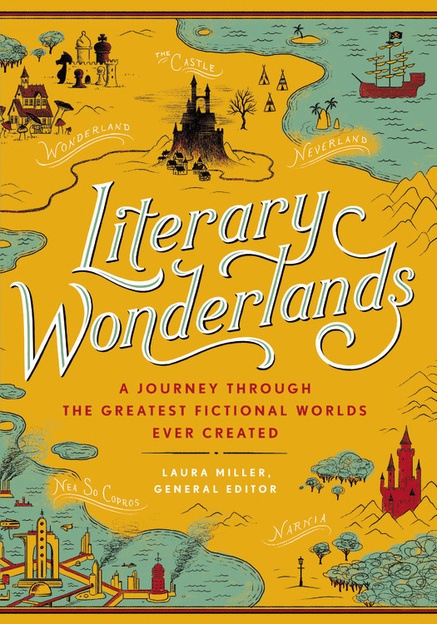
literary wonderlandsI’m thrilled to announce that I am contributing a chapter to the book “Literary Wonderlands”, a book that “seeks to bring together the greatest ‘created’ worlds of literature in one beautifully designed and illustrated single volume.” More about the project here

The book is being edited by Laura Miller (co-founder of Salon.com), and contributors include Adam Roberts, Julia Eccleshare, Lev Grossman and Lisa Tuttle. It will be published by Elwin Street Productions by November 1. You can pre-order it here.

My chapter is on Nnedi Okorafor’s “Lagoon“, the only African novel in the list of 100. The novel examines a post-apocalyptic Lagos during and after an alien invasion. Here’s a summary from Amazon:

“After word gets out on the Internet that aliens have landed in the waters outside of the world’s fifth most populous city, chaos ensues. Soon the military, religious leaders, thieves, and crackpots are trying to control the message on YouTube and on the streets. Meanwhile, the earth’s political superpowers are considering a preemptive nuclear launch to eradicate the intruders. All that stands between seventeen million anarchic residents and death is an alien ambassador, a biologist, a rapper, a soldier, and a myth that may be the size of a giant spider, or a god revealed.”

 I interviewed the author about it a while ago for The Guardian here.

Bloody Morning: The Ukpabi-Nimbo Massacre

Guest post by Chijioke Ngobili

On Monday, 25th April, 2016, just before it was 7am, the unarmed indigenes of Ukpabi-Nimbo, Uzo-Uwani LG of Enugu State, South-eastern Nigeria were attacked with machetes, guns and other dangerous weapons. It was a bloodbath. The news filtered in and pictures of mangled bodies were shared on social media. My Facebook newsfeed began giving me snippets of the carnage around 1pm on 25th April, 2016. I read and searched out more information on it and I was embittered by what I read—some false, some exaggerated and some compellingly true. But then I had begun considering a travel to Nsukka.

On 26th April, 2016, by 6.20pm, I was at the Bishop Shanahan Hospital, Nsukka situated along Enugu Road. I asked the security men that I be directed to the ward where the victims of the Fulani massacre were, and they did. On entering this very ward, anguish and sorrow greeted me with their smell and wisps. One must have to double his guts to endure the sight of blood, deep cuts and wounds. I did before I entered a particular partition of the two wards.

The doctors, nurses were very busy and proactive in managing an overwhelming situation. The victims and their caregivers looked at me with suspicion. They were very careful and looked traumatized. I spoke in Igbo immediately and introduced myself mentioning my place of work so as to douse the growing tension and discomfort. I realised that it would be wise if I limited my speaking to one or two persons as not to attract the attentions of the doctors, nurses and other people in there, else I may be unable to extract any information at all since I’m no journalist by profession.
Nimbo 1 (1)

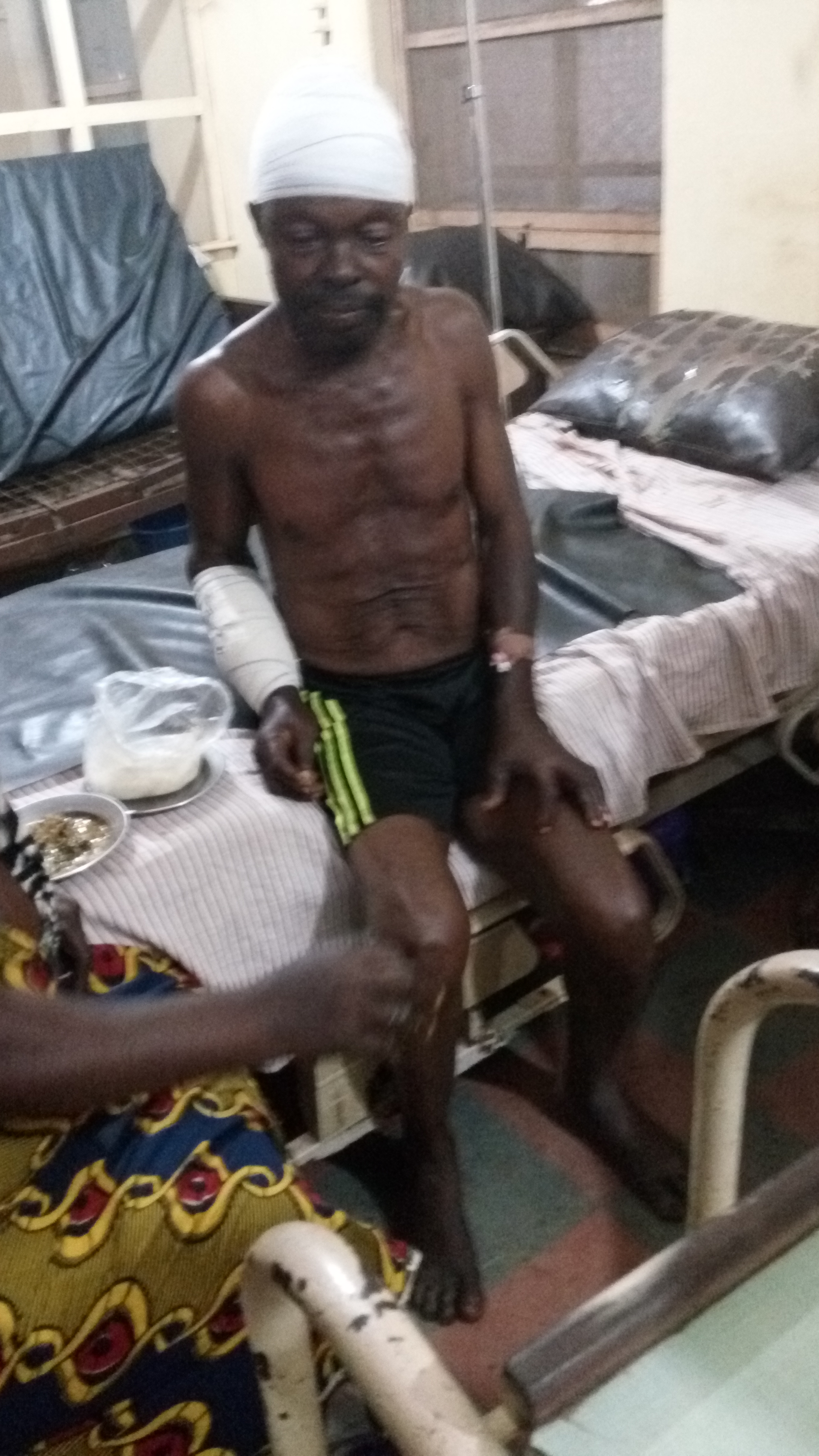
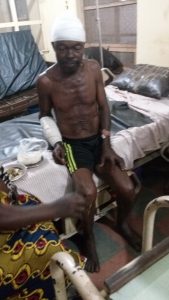
Samuel Uzoh – one of the victims.

Samuel Uzoh (pictured above) was the first victim I tried speaking to. He had a fiery temper. He understandably barked at me when I tried asking him questions directly: “So, when you get the answer, what will you do with it?” When I tried to explain, he ignored me and continued eating the food his sister was feeding him. It was this sister of his—who declined giving her own name—that told me her brother’s name and gave me a sketchy report of the horrendous incident before withdrawing from saying more when she saw me getting out my phone to record some of the things she said. Despite his massive wounds, Samuel’s mouth remained sharp and mind alert. You need not know that he engaged the herdsmen who wielded machetes and guns, and paid for it. This was his brief story: He is a farmer. He was going to early morning farming around 6am when the marauders attacked him. He refused to submit to death. Instead, he fought and lived to sustain the wounds on his head and right arm.

When I looked to my left, on the other row of the hospital beds, I saw a much younger man laid on the bed with a young woman of his age looking over him. I approached them. The young lady was more friendly and welcoming. She struck as more exposed and educated judging from her response in good English and the unexpected courtesy she showed me after I had introduced myself. 

Celestine Ajogwu (pictured below) was the name of her brother. I had asked if she was Celestine’s wife. “No. We are siblings from same father but not same mother. He is Celestine Ajogwu while I am Chioma Ezugwu”, she said. His brother’s left palm was cut with a machete by the Fulani herdsmen as can be seen in the picture. His head and jaw were equally hit with a machete as he lost three teeth in the process. Celestine managed to say a few things to me despite the badly hurt mouth that affected his speaking. His sister, Chioma, helped him to narrate to me how it all happened in their town of Nimbo in the wee hours of April 25th, 2016: “I was in Onicha, Anambra State where I live when they called me to come home; that our community was raided”, she said. “I didn’t even know that my brother was among the victims until I saw people being carried out of the vehicle. I was shocked to speechlessness on seeing him in his very bad condition”.
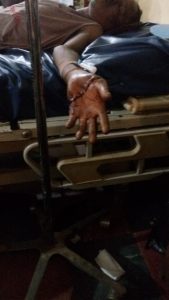
Nimbo 1 (2)

Celestine Ajogwu – one of the victims.

Chioma then took me down memory lane as far back as 2006 when their traditional leader of Nimbo community naïvely thought that Fulani herdsmen could be pacified with money as to leave his people in peace, only for them to tell him how they desired to acquire more lands. “The man who is our Igwe (name withheld) was away from us for a long time. He returned from Abroad (maybe US/UK) and became the Igwe following some traditional succession”, Chioma revealed. “In 2006 or thereabout, after he had been deluged with complaints from our people on the destruction of farmlands by the Fulani herds of cattle, he invited the Fulani herdsmen and asked them how much he can give them as to vacate from our community entirely and in peace. The Fulani Cattle breeders asked for 10 million naira and our Igwe raised it and gave them, only for them to return to their excessive grazing with the claims that we have a wide expanse of lands”, Chioma told me. Since that year 2006 when the Igwe made that offer and before then, “…it has been endless conflicts between our people and the Fulani cattle breeders”, she emphasised.

Recently, the Fulani herdsmen wrote a letter to the Igwe, informing him with untold bravado, of their intention to revenge the clash they have been having with the men of the community on the issue of excessive grazing. On learning that, the Igwe alerted the State and Local authorities. Policemen were mobilised to the town and stationed to protect the people. But something suspicious and conspiratorial mixed up to birth the eventual misfortune.

Celestine Ajogwu told me himself: “I had slept the night before seeing the policemen around our community and so felt relaxed. Early in the morning, around 6am, I had woken to move out. I saw unusually numerous men dressed in black thinking they were the security men I saw the other night. But when I noticed they were blindfolded, I grew afraid and ran back to my house not knowing they had seen me. Some of them came to my house and struggled with me before dragging me out to butcher. In the process, I fell down to the ground pretending to be dead. That was when they left me alone thinking I had died”.  Chioma took over to straighten the wavy mix of how the indigenes managed to save many lives by escaping an army of numerous marauders. “These Fulani had planned not to raise dust in the killing which is why you can see that many of the victims were mainly butchered and were barely shot with a gun. They planned a smooth ethnic cleansing such that no one around would know what is happening until they are done with the cleansing. But it took one of our men who had woken much earlier to shout out when they struggled with him. The man was coming out with his bike when he saw something unusual about the people they thought were protecting them. With his shouting, people scampered for safety and the killers managed to kill the much they could. My brother, though badly hurt, managed to alert other people he could alert using his phone”.
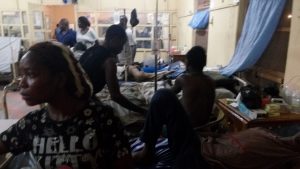
Nimbo 1 (3)

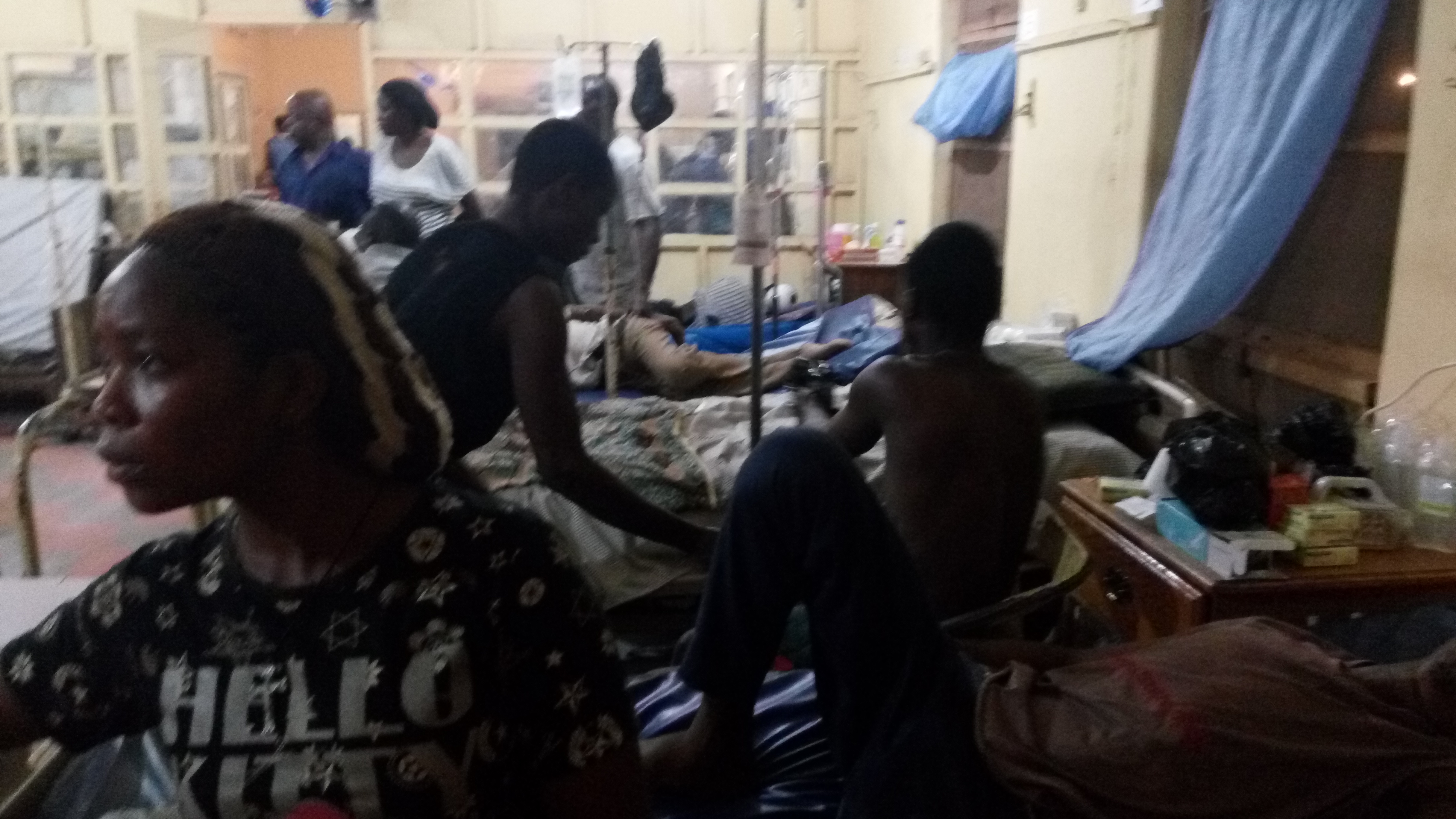
Chioma Ezugwu—my main source of information and resource person—with people milling around in the hospital ward.

I also gathered that the Catholic parish priest in the town earlier escaped the carnage even when the killers approached his house and found no one. In all these, something is significant but rarely noticed: The women were barely part of the victims. I checked the five patients in that ward and noticed that they were all men. Chioma had brought this to my attention saying: “Even if women are gathered in hundreds, they would just pass by and leave them. They said it’s the men they are looking for; that it’s our men that have offended them most and refused them on our lands”. On asking the actual number of deaths so far, Chioma said she had been able to count nine dead bodies brought to the morgue with her own eyes despite the conflicting figures thrown about the media. She pointed at a bed adjacent to theirs: “This evening, the man here died and was taken to the morgue. He was old and couldn’t endure the pains of the deep wounds he sustained”. Chioma didn’t clarify to me if the recently dead man added up the dead bodies to 10 or completed them 9. She also reminded me that there were other victims taken to the General Hospital in the same Nsukka; and definitely, other dead bodies will be there too, plus those who may have equally died in the process. She told me how Governor Ifeanyi Ugwuanyi, the governor of their State, visited them and gave them each a hundred thousand naira each, just as the Senator representing Nsukka Senatorial Zone, Chukwuka Utazi gave them fifty thousand naira each; making it a hundred and fifty thousand naira each. (They were 5 patients in that very ward as at 26th evening of April, 2016). Also according to Chioma, the governor paid their bills and informed them that they’d be transferred to University of Nigeria, Teaching Hospital, Ituku-Ozalla between that evening and the next morning.

Celestine and Chioma, in a nutshell, believed that there is a conspiracy somewhere which resulted to the bloodbath. They believed there was an insider who facilitated it even though they refrained from mentioning the people/group they might have suspected. They are right! The constant pulse in that suspicion is this: An enemy served you a threat. You provided a security to avert it, yet the threat became real. So, what actually did the security agents do after all? Why did they leave their station only for the enemies to surface in a space of few hours? Were where those enemies all along? In the bush? Or did they use the same roads you guard to assess the community of Nimbo? Too many questions begged for answers in my mind.

“We can’t even wait for morning to come, so that we can be transferred to Enugu”, Chioma said resolutely. “This place doesn’t seem safe judging from two of the victims in the other ward who couldn’t speak Igbo when the doctors and nurses asked for their names. I am afraid of their body languages and facial expressions so far. They can possibly be informants who consciously got wounded as to keep penetrating our people further”. I left them at 8pm after showing them some little financial gestures. I assured them that I would keep checking on them and that if anyone who gets to learn of their story from me offers anything for them, I’d surely make it reach them. 

_____________

Chijioke is a musician, writer and freelance journalist. He wrote from Nsukka.

_____________

Photo credit: Chijioke Ngobili
A Three-Book Review

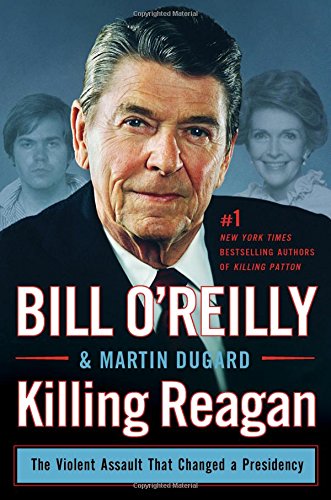
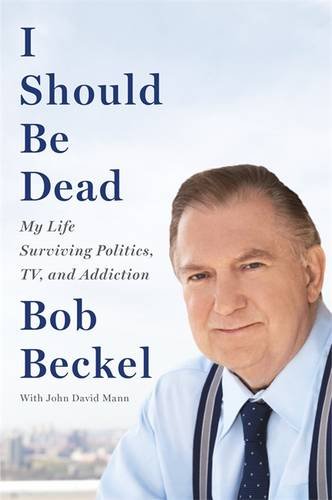
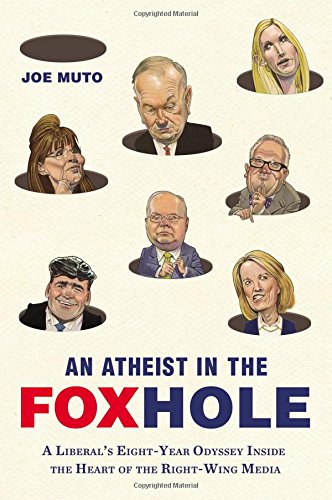
ReaganBeckel MutoI’ve just finished reading Joe Muto’s An Atheist in the Foxhole: A Liberal’s Eight-Year Odyssey Inside the Heart of the Right-Wing Media. It is the third of non-fiction books that I read over the last two weeks. And for some reason, they all happen to revolve around a certain preoccupation: politics, especially in the right-wing quarters of the United States. The other two are Bob Beckel’s I Should Be Dead: My Life Servicing Politics, TV, and Addiction and Bill O’Reilly’s Killing Reagan: The Violent Assault That Changed a Presidency. They also happen to have notable dissimilarities.

What they all have in common, though, other than aforementioned similarities and that they are all non-fiction – which always gets my attention every time, is that they were all written by people who either are current (O’Reilly) or past (Muto, Beckel) employees of the Fox News Channel, America’s enigmatic but highly successful conservative television channel; a business enterprise of Rupert Murdoch, an Australian billionaire.

Muto’s book details his train-wreck adventure as a liberal-minded employee through an eight-year career in America’s most right-wing media company, a career that ended in ruins when he turned into a mole for the website Gawker in April 2012. More than giving a rare insight, with notable anecdotes, into the working of the media house, its politics and successes, it also portrays a sympathetic image of the employee himself. Like many others in the company, and in perhaps many other such organisations around the country, the writer didn’t start out being conservative or in any way supportive of the employer’s political and business viewpoints. He only wanted a job in a tough economy, and a chance to build a life with his girlfriend whom he had brought into New York from a small town. And through a series of justifiable (and sometimes hilariously contrived) compromises meant to keep him in the good graces of his employers, he worked his way from a Production Assistant to an Associate Producer for the channel’s most highly-rated programme. Then blew it. Publicly. What was to be learnt from reading the book other than how to throw away an eight-year career in the most ignoble manner? Not much, but it was nonetheless a good account that read like a fast-paced thriller. The writer may not be glad about the way his career ended, but he was sure glad to have left as we are of his decision to write the book. He had a keen eye for details, and his observations, especially of his former colleagues, seemed fair and measured.

In Bob Beckel’s book, one lives through the civil rights era of 60s America through the unlikely journey of a child from an abusive alcoholic home who, in a few short years, became the Deputy Assistant Secretary of State in the Jimmy Carter White House and later the campaign manager of a presidential candidate (who lost 49 out of 50 states, no less). The book details not just the notable events of these times and the author’s personal successes, but also his failings and struggles with drugs and alcoholism, and his eventual redemption. I first knew Bob through The Five, a roundtable political news conversation show at 5pm on Fox where he was the resident liberal against four conservative hosts. His geniality, unconventionality, and resilience as he held his own successfully against the usual misinformation and sometimes just merely surly temperament of his co-hosts was stuff of legends. It was easy to root for him: a lone sane voice in the wilderness. He, of course, notably got just as surly himself, ending up as a butt of brutal jokes when he advocated for the ban on muslims coming into the US, a suggestion apparently not risible enough for Donald Trump, the Republican frontrunner to eventually picked it up many years later. Bob’s attempt with this book however is one of honesty and courage in telling a story that is at once self-reflective as it is self-incriminating. The subject is both its conquering hero as its remorseful villain. The reader leaves its pages understanding the causes, cost, and cure for alcoholism and addiction. And, more importantly, gaining sufficient empathy for its victims around us. It is certainly a book to recommend, and I do so, strongly.

The third, a biography of sorts, was Bill O’Reilly’s Killing Reagan which revisits the assassination attempt on the president’s life in March 1981, just two months after he was sworn in. The book details not just the former Hollywood actor’s rise to fame and mythology from a humble mid-western (and liberal) background, but also the effect of the assassination attempt (and his Alzheimer’s disease which was said to have started a little bit afterwards) on his presidency and legacy. Fascinating, also, was his relationship with his wife Nancy (whom he married after the failure of his first marriage to a fellow Hollywood star, Jane Wyman) and who turned out to be his rock-solid companion and shield (and, as some insinuated, manipulator). Not only did she endure the loneliness of his last years when he lost the ability to recognise her or anyone, she also had to live twelve more years alone without the man she had loved for most of her life. It was a well-written story, which introduced the former president to anyone curious about his life and legacy. The book wasn’t without its critics, however: some Reagan loyalists and other reviewers thought that O’Reilly exaggerated the effect of the disease on the president’s performance in office, among other untruths. Bill, for some reason, continues to dominate not just cable news with his O’Reilly Factor but also the Bestseller lists with his Killing series. Like Killing KennedyKilling LincolnKilling Patton, and Killing Jesus, before it, Killing Reagan continues the trend of entertaining (and informing, I must admit) readers through the non-fiction medium, sometimes through dubious or exaggerated reportage, but always with a single-mindedness of purpose.

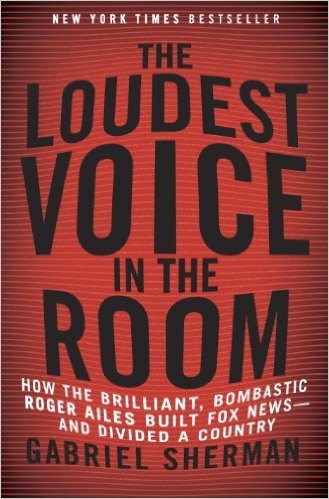
loudestA figure that stood out of these three books, like a brooding shadow, was that of Roger Ailes, Fox News’ boss. It was he who is reputed to have built the cable channel out of nothing, discovered and made its on-air talents into national figures, and continues to drive liberals crazy around the country with his enigmatic and unapologetic successful conservative persona. But in the three books, Dr. Ailes is a number of different people. Joe Muto’s Mole dedicated a notable space to describing how his micromanaging style, and politics, ensured that all those who worked at Fox took care to either tow the party line as true believers, or fake their way into promotion and prominence by appearing to be as conservative as desired: an image of a paranoid invisible puppeteer. In O’Reilly’s Killing, he was a genius who kept Richard Nixon’s administration television-friendly, thus minimising the damage it would otherwise have got earlier on. He, it was, during the re-election campaign of Ronald Reagan, who (as a hired political consultant) came up with the killer response that damaged the Mondale Campaign (and, by extension, Bob Beckel’s campaign career) in 1984. More than that episode, for Beckel, Roger Ailes was also the man who – after decades of failure and impending ruin – offered a lifeline by giving him a job on Fox News as a contributor, and eventually as a co-host on The Five: a smart but benevolent operator who holds no grudges against former opponents. The portrayal of his genius (or deviousness as the case may be) has now driven me to buy this promising biography of his, written without his support or approval.

These three books were a delightful, and surprisingly easy, read, as most non-fiction works tend to be in my experience. They were worth each cent, and gave me a deeper peek into the workings of the US media, politics, and journalism in general. It certainly delighted the part of my brain that has always wanted to write a memoir or someone else’s biography in the future, though not necessarily the part in search of a clever turn of phrase or some delightful serving of English prose in its literary glory. Still, not a wasted time in the company of lived history.