Browsing the archives for the News category.

Fueling Poverty – The Video!

This short documentary on Nigeria, said to “address the serious issue of corruption in governance” just made news by being banned by the Nigerian Film and Censors Board. I’d never heard of it until today, but since it concerned the government so much as to attempt to put a muzzle on it, then it must have some value for the enlightenment of the citizenry. According to news reports, the documentary was “released late in 2012, was produced by young filmmaker, Ishaya Bako, in partnership with the Open Society for West Africa [OSIWA].

Watch with me!


What do you think after watching it?

Check Yourself! Introducing a Homophone Checker

My friend, Jason Braun, has launched the world’s first free Homophone Checker app at  Homophonecheck.com!

According to the press release, it is a free web app that allows writers to quickly proofread for errors that word-processing software typically skips over.

homophone-2

“Writers copy text and paste it into the homophone checker. Then 40 of the most commonly confused homophones–words that sound the same but are spelled differently– are highlighted automatically. When writers move their cursor over the highlighted homophones, a box pops up showing each possible word, its part of speech, and a grammatically correct example sentence.”

Blogger’s comment: So far, the software only checks 40 commonly misspelt English homophones, which makes the app targeted mostly at a specific level of writing. It is a wonderful start. Also, rather than bemoan the problems of English language usage nowadays that makes this software inevitable and invaluable, I’ll celebrate its presence and its ability to makes essay writing easier (especially for high school or undergraduate students too distracted by other things to proofread their work right). Of course it will eventually take a smart writer to properly use a software that merely points one to where one might want to take a second look in an essay. Like every spell-checker, the work will still come back to the writer to be sure of exactly what they intend to write. As a piece of utility however, it is a brilliant invention and a good start. I love it. 

378172_4306321257743_1262440586_nJason Braun currently teaches English and is the Associate Editor of Sou’wester at Southern Illinois University Edwardsville. He hosts “Literature for the Halibut” a weekly hour-long literary program on KDHX 88.1. He has published fiction, poetry, reported or been featured in The Riverfont Times, Prime Number, ESPN.com, Big Bridge, Sou’wester, The Evergreen Review, SOFTBLOW, The Nashville City Paper, Jane Freidman’s blog, and many more. His Paradise Lost Office App contextualizes John Milton’s epic poem for the cubicle crowd and is available at iTunes. He releases music under the moniker Jason and the Beast. He is a member of the National Council of Teachers of English (NCTE) and the Learning Disability Association of America (LDA).

Chinua Achebe (1930-2013)

If what has been reported in various places online, and comments from close family members and colleagues are anything to go by, Africa’s foremost novelist and author of the famous Things Fall Apart, Chinua Achebe, has passed on, at 82.
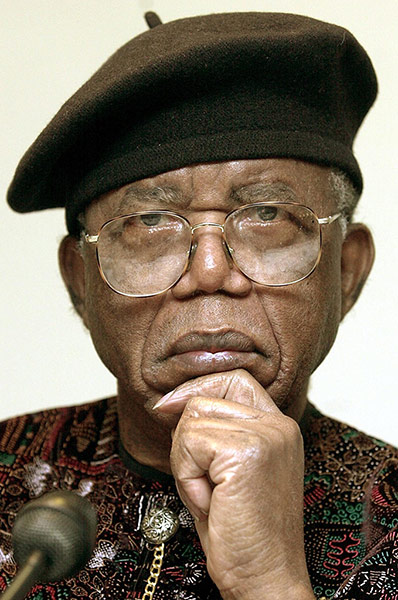
Chinua Achebe 2002

The author whose magnum opus, a novel detailing a class of the Igbo traditional culture with an invading European one, has been translated into 50 languages, selling about 8 million copies to become “the most widely read book in modern African literature” (Wikipedia), was a distinguished professor at Brown University. His famous intervention in the debate on Joseph Conrad’s Heart of Darkness is a stuff of legends and has spawned essays after essay about the portrayal of Africa, the rise of African literature and outlook, and the need of more than just a single story. He was often called “The Father of African Literature.”

Achebe’s latest book, There Was a Country, describes in his characteristic lucid prose a flattering ideal country in Nigeria and Biafra before and during the Nigerian Civil War of the 60s. Its characteristically blunt references to political players in Nigeria from the different sides of the warring divide made the book an instant classic and one that generated conversations and re-opened old wounds about the civil war and the pogroms that came with it.

I read his children’s book Chike and the River as a young boy in Ibadan, and a number of scenes in it have remained with me since. His famous work is, of course, Things Fall Apart, which is beyond the scope of my words to describe. Reading the killing of Ikemefuna was one of the most traumatizing experiences of my childhood. The image remained for very many years, raising questions in my young man’s mind about the real cost of becoming an adult.

I never met him. The closest I got was the about four weeks interval that separated my leaving Brown University for Southern Illinois University in September 2009 when it was announced that the legendary author had in fact taken up a position there. I blogged about my disappointment here. His words however, and stature, work, and engagement in public life has been a shining example. If he truly is gone as being reported, it is a terrible loss, but a glorious exit for a man who held our attention and admiration for so long, kept it focused on what is important and noble, and whose example of dignity and grace is one that will be remembered for a long time to come.

Read more in my tribute to/obituary of the father of African literature on NigeriansTalk

WALC2013 – Call for Papers

logo-redDespite years of scholarly research a large percentage of the indigenous languages of West Africa have not been documented. Several of the languages are at the risk of being lost. Greater attention to diversity, environment and sustainability in the global discourse has not reflected much in terms of support for and development of indigenous languages. Although there is a heightened sense of activities and activism for language documentation, there has been no commensurate attention to the very important aspects of description, development, modernization and integration of local (West African) languages with global information infrastructure. This appears to be leading us once more to the ideological issue of resource exploitation. The critical question remains, how do we make West African Languages relevant and work for those who speak them? We are once more forced to rethink the role of the linguist and interrogate West African Languages Curricula in the face of emerging realities. The task of language documentation is particularly necessary so as to plan the future with the past, since information/ facts derived from such efforts can have positive impact on current and future linguistic endeavours.

The aim of the conference is to explore the different perspectives from which language studies reflects or impacts on the different aspects of human endeavour. In addition it seeks to foreground the various areas in which language and linguistics interface with diverse capacities and disciplines. Given the current realities of modern human life it seems increasingly compelling for Linguists to find common grounds with other disciplines while emphasizing language as a core human capacity. The conference brings together researchers and students in the various fields of language studies as well as aspects of professional life in which indigenous languages play a part. This is expected to motivate an exchange of ideas and promote discussions of, progress in and development of these areas in West African languages. We hope that through the conference participants will be able to consider the issue of sustainability in research and practice.
The sub themes of the conference include (but are not limited to):

  • Language Typologies
  • Morphology and Syntax
  • Phonetics and Phonology
  • Semantics, Pragmatics and Discourse
  • Language shift, maintenance and documentation
  • Language and education
  • Language policy and language management
  • Language, the media and ICT
  • Language and the community
  • Language and industry
  • Language and medicine
  • Language and governance
  • Language and Business
  • Language and Law
  • Language and poverty
  • Language and migration
  • Cross-border languages and regional cooperation
  • Cognitive corpus linguistics and Corpus-based computational linguistics
  • Language competition: Ex-colonial languages vs. indigenous West African languages
  • Literature, film and popular culture
  • Language, gender and power
  • Language, identity, culture and translation
  • Language, Peace and Conflict

Participants are invited to submit abstracts dealing with any of the sub themes and other related areas. They can be up to a maximum of 300 words long. It must be typed in a 12– point font and in both word and pdf file formats. Deadline for the submission of abstracts has been extended from 31 March, 2013 to 30 May, 2013.

Individuals and organizations who would like to present demos and organize workshops/special events should contact the LOC Secretary, Dr Oye Taiwo, Department of Linguistics and African Languages, University of Ibadan, Ibadan, Nigeria through the e- mail address: oyepaultaiwo@gmail.com.

Abstracts can be submitted through the following e-mail addresses: tayolamidi@yahoo.com.  (Chairman, Abstract sub-committee: Dr Tayo Lamidi);oyepaultaiwo@gmail.com (Secretary, LOC: Dr Oye Taiwo)

More information can be obtained on the conference homepage at www.walc2013.com, the twitter page @WALC2013 and the Conference’s Facebook Page.

Chika Unigwe in Lagos

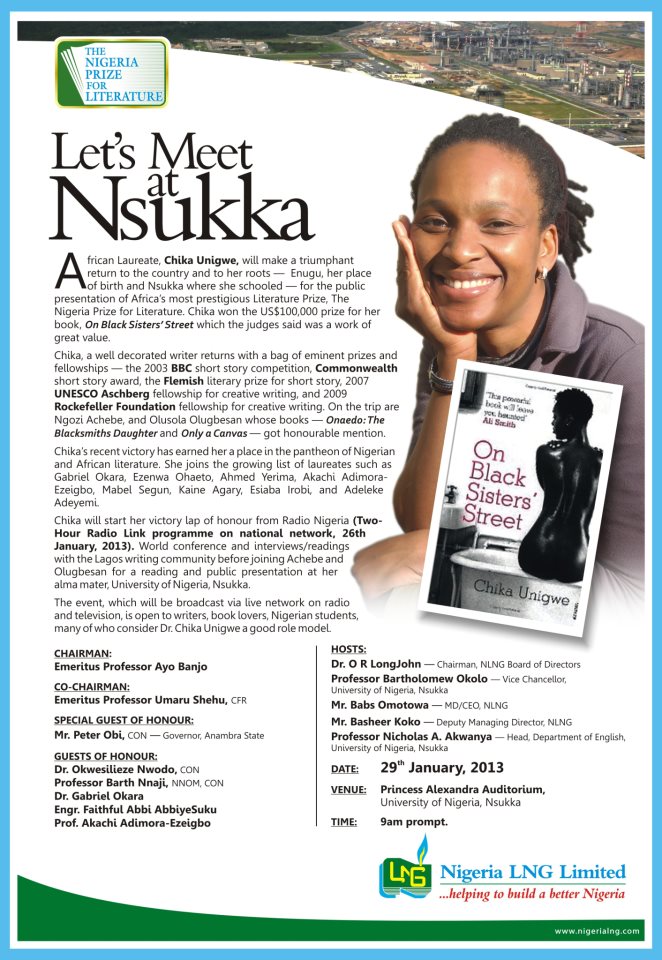
154155_525183577503551_1026276156_n…on January 31st, 2013. 

But before then at the University of Nsukka on January 29th to read from her works.

Chika is the winner of the NLNG Nigerian Prize for Literature 2013 and the author of On Black Sister’s Street.