Browsing the archives for the News category.

How to Kill the Nigerian Publishing Industry

This comes from new article by Jeremy Weate (founder, Cassava Republic Press) published on Africa is a Country in which the hypocrisy (or counterproductive measures) of the Nigerian administration is laid bare in the new series of tariffs placed on book importation, in contravention of a treaty signed with UNESCO.

Here’s an excerpt:

The reality is, Nigerian publishers who wish to sell good quality books at an affordable price are forced to print overseas. There’s nothing particularly innovative or unusual in this: many Western publishers now print in Asia too. Cheap electricity and labour, access to international paper markets as well as technical know-how limit globally competitive print facilities to a small group of countries. Nigeria has no hope of competing with these countries any time soon. A wiser alternative policy decision would be to not even try. Nigerian paper mill and printing companies catering to local (non-book) printing needs can be supported through tax breaks and subsidies to nurture market development, without the need for protectionism. The lesson learnt from other sectors in Nigeria (such as textiles), is surely that tariffs and import bans stimulate piracy, rather than local market development. It is therefore also likely that book pirates may benefit from the punitive tariff. In other words, authors as well as Nigerian publishers will suffer.

More here.

PRESS RELEASE: ARTMOSPHERE MARCH 15, 2014

ARTMOSPHERE is the leading monthly platform for the revival of a vibrant reading culture and the promotion of creative expressions in literature, music and the arts amongst Nigeria’s teeming youth population. 

Curated by WriteHouse Collective since July 2011, ARTMOSPHERE has consistently incorporated the classic ideals of artistic erudition with the innovations of performance practice and contemporary culture. The event offers an eclectic mix of creative dexterity from leading and emerging culture practitioners in Nigeria. Book readings, poetry performances, panel discussions, music and art exhibitions are creatively fused together to make each edition a memory to be relished.

The March edition of ARTMOSPHERE will play host to renowned writer and publisher, africanwriting.com, Chuma Nwokolo. Chuma Nwokolo will read from his new collection of short stories, How to Spell Naija and also discuss the creative process, governance, political as well as social issues alongside five emerging writers. There will also be book signings and music performances by D’Jazz Band at the event.

The event will take place from 3PM to 6PM on Saturday, March 15, 2014. Additional information about the event, together with details about how to get to the venue at the NuStreams Conference & Culture Centre, KM 110, Iyaganku Road, off Alalubosa GRA, Ibadan are available on our fan page: www.facebook.com/writehouseng.

1394061812789GUEST OF THE MONTH: CHUMA NWOKOLO 

Chuma Nwokolo is one of Nigeria’s most prolific writers working in the short story subgenre. A lawyer and satirist, Chuma was writer-in-residence at the Ashmoleon Museum, Oxford, United Kingdom between 2005 and 2007 and is currently the publisher of African Writing Magazine. His published collections include, One More Tale for the Road (2003), Diaries of a Dead African (2003), Ghost of Sani Abacha (2012) and How to Spell Naija in 100 Stories (2013). In 2006, he released a poetry collection titled Memories of Stone. He is the inaugural editor for the Nigerian Writers Series, a publishing project promoted by the Association of Nigerian Authors and endowed by the Niger State Government.

Two Writers on Sexuality and Morality

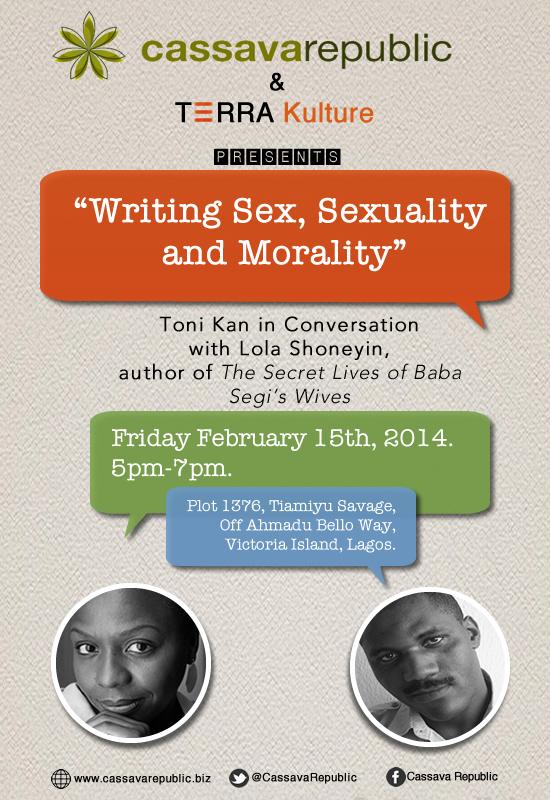
Lola Shoneyin (Secret Lives of Baba Segi’s Wives) and Toni Kan (Nights of the Creaking Bed) will, on February 15, head a public discussion on writing sex, sexuality, and morality. Find the details below:

12701_10151963897808131_184968217_n

We Must Free Our Imagination

For those who haven’t been following the matter (or who didn’t know there was any matter to begin with), the coming out of Kenyan-born writer Binyavanga Wainaina as gay added a personal and human dimension to the culture wars brewing currently on the continent on the wings of religious fervour, bigotry, and intolerance on the one side, and that of freedom, compassion, and inclusiveness on the other.

In this six-part YouTube video series, recorded and released after the coming out declaration was made, the author makes a case for the expansion of the imagination – beyond the limits of the boxes imposed by colonialism, religion, and our own cultural myopia.

Must watch.

Also: Here, a recommended read, from Think Africa Press


Nigeria Takes 100 Steps Backwards

A very curious thing happened in Nigeria today: a controversial bill that criminalizes not only gay activities but association with gay rights groups was signed into law by President Goodluck Jonathan. The bill recommends up to 14 years for convicted gay citizens, and up to 10 years for people convicted of supporting activities of (or belonging to) gay rights groups.

_____________

So, here’s an addendum that is probably now more necessary than ever: In spite of the law, this blog (and I) supports (and will continue to support) the right of gay people everywhere, and especially in Nigeria, to pursue happiness; to love and to marry whoever they want, without interference from a prurient and puerile person, society, or government; and to continue to seek every avenue to express their love and affection for each other in public and in private. It is up to us, the conservative (or intolerant) society, to deal with the insecurities about our sexuality that expresses itself in fear, loathing, and suspicion of our fellow beings. The word of our national anthem that says “One nation bound in freedom, peace and unity” should yet apply to all, in spite of their gender, religion, race, ethnicity, and yes, sexual orientation. And until that time that it does, Nigeria shall continue to be an imperfect experiment needing the moral force of its active citizens to bring it to reckoning with its purpose: providing security and justice for all.

(Update: There’s a long but good read here about why the law is terrible, beyond criminalizing orientation)