Browsing the archives for the Drama category.

Drama at the NLNG

I realized, just last week, that the call for entries for the Drama Category of the annual Nigeria Prize for Literature is out. The Prize, as will be familiar to those following Nigerian literary conversations, carries $100,000 and is awarded annually in four rotating genres. Last year’s winner, Ikeogu Oke, won for poetry (and you can watch my interview with him here, or read a review of his willing entry).

At a lunch invitation in Lagos with interested stakeholders, literary journalists, and selected members of the public, Mr. Tony Okonedo, Manager, Corporate Communications and Public Affairs at the Nigeria LNG spoke about the progress of the prize, fielded questions about its shortcomings and public expectations, and announced a number of initiatives being planned for this year’s edition.

One of the attendee inputs that got a favourable response by the organizers is the suggestion that NLNG consider sponsoring a command performance of whichever play that won the prize last. In this case, that will be Iredi War written by Sam Ukala, and which won in 2014 when the Drama Prize was last awarded. I can already imagine such a performance (open to the public, perhaps) helping to draw more attention to the prize, the winning writer, and the genre in particular.

Another suggestion which I particularly like will involve having the NLNG sponsor a type of writing workshop every year either with all the longlisted authors in its prize categories or for selected and/interested writers who are then taken to the Island of Bonny where NLNG makes most of its money through the liquified natural gas. Either that or a type of residency. What I’ve heard of the tranquil nature of that island makes this something of a perfect fit.

According to a press release, the NLNG-sponsored Science Prize will also be accepting entries on Innovations in Electric Power Solutions. The literature prize opened on February 13, 2018 and will close on March 29, 2018. The window for the science prize, on the other hand, opened on February 15, 2018, and will close on May 25, 2018.

Professor Matthew Umukoro will chair the panel of judges for this year’s Literature prize competition. He is a professor of Theatre Arts at University of Ìbàdàn. Other members include Professor Mohammed Inuwa Buratai, a Professor of Theatre and Performing Arts and the Dean of the Faculty of Arts at Ahmadu Bello University, (ABU), Zaria; and Dr. Mrs Ngozi Udengwu, a Senior Lecturer in the Department of Theatre and Film Studies at University of Nigeria, Nsukka.

Do people still write plays? Silly question, I know. But are there still many being published every year, a vibrant industry like we have for prose and, sometimes, poetry? I don’t know. Are unpublished plays eligible for this prize even? If not, why not? I know, though, that Sefi Atta published a collection last year, so I look forward to seeing the writers on this year’s long and shortlist. Who knows, maybe I’ll get to interview the shortlisted playwrights as well. Still, about 10 days for you to enter if you qualify. More information here.

More than Ashẹ́wó: Kalakuta Queens Remembered

by Ọpẹ́ Adédèjì


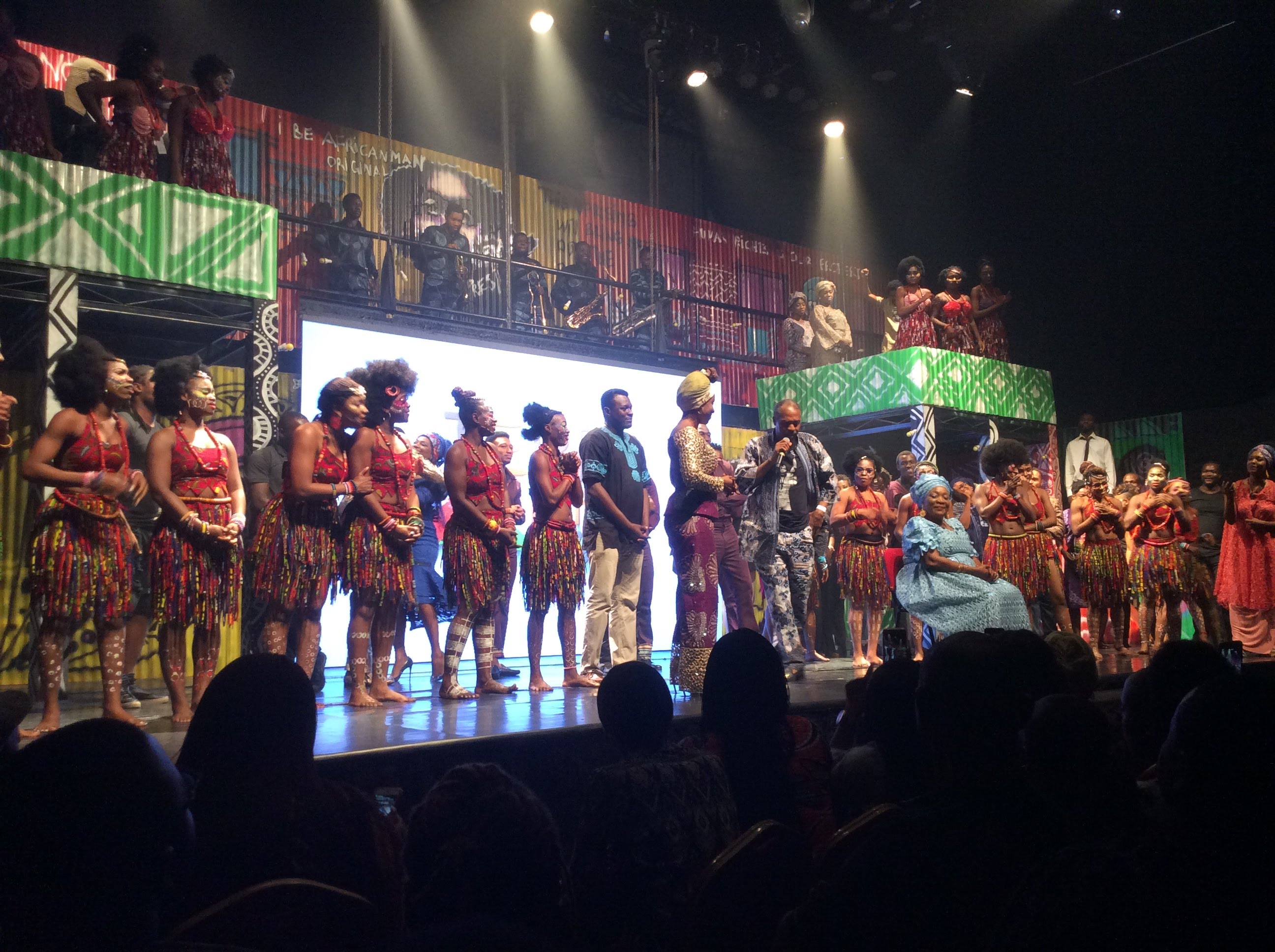
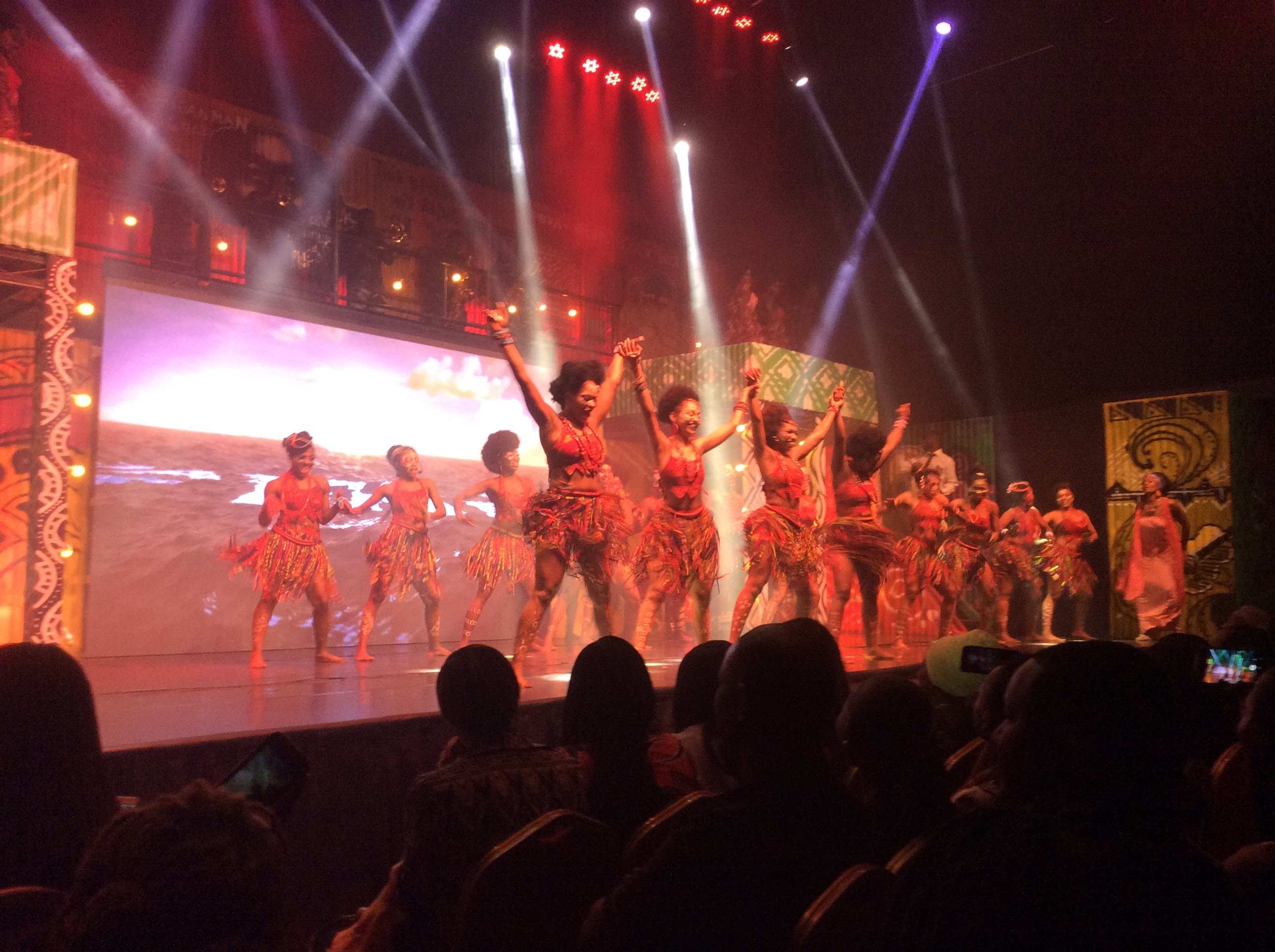
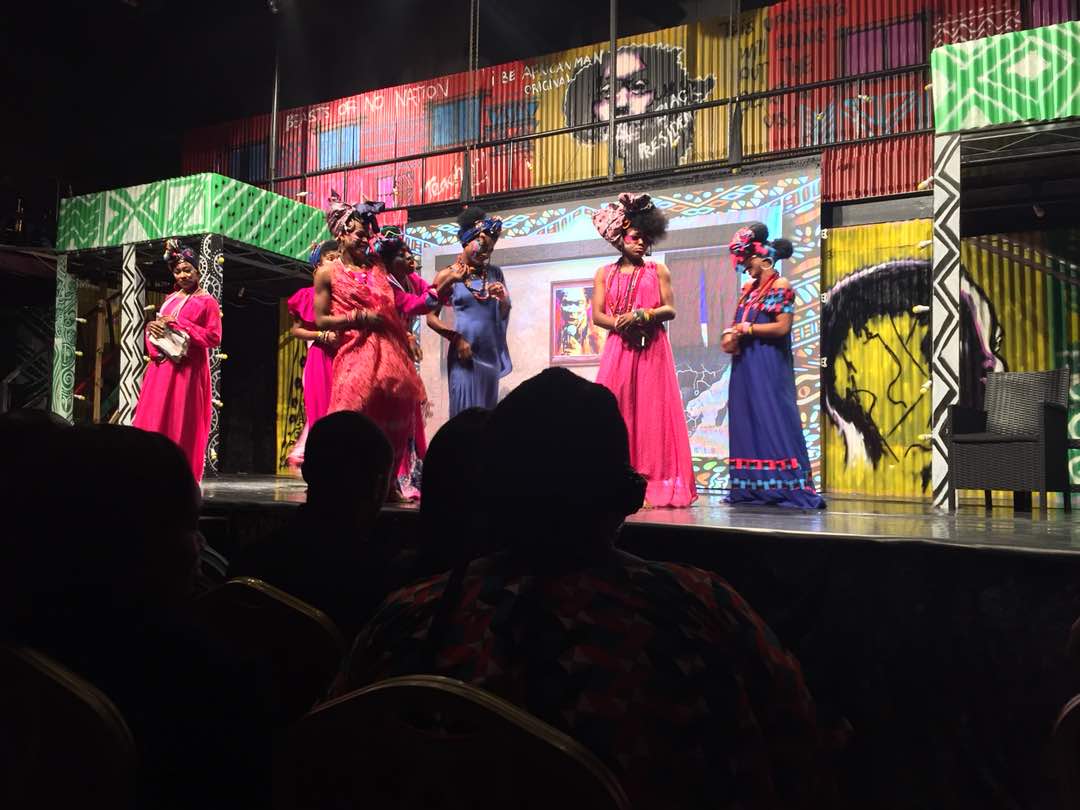
One of the living Kalakuta queens, Ọláídé is on stage with Fẹ́mi Kútì and Yẹni Kútì, two of Fẹlá’s children. They are passing the microphone around reminiscing about a time when Fẹlá was alive. They speak fondly of him, as if he stepped out of the room and would be back any minute. They are smiling. It feels like we know Fẹlá personally, beyond the music and stories we have read of him. Bọ́lánlé Austen-Peters looks tired. She stands by the trio who keep praising her genius and creativity. She has just explained to the audience that intense rehearsals had been on since October and that the show started airing in December. They have one last show before they come back in April during the Easter break. Behind them, the complete cast and crew of Fẹlá and the Kalakuta Queens stand, still in their beautiful costumes, smiling at the audience. In a bit, we are allowed to climb up the stage to take pictures with the cast.

Ọláídé, one of the surviving Queens from Kalakuta Republic, seated to the far right in blue, while Fẹ́mi Kútì speaks and Yẹni with Bọ́lánlé Austen-Peters look on.

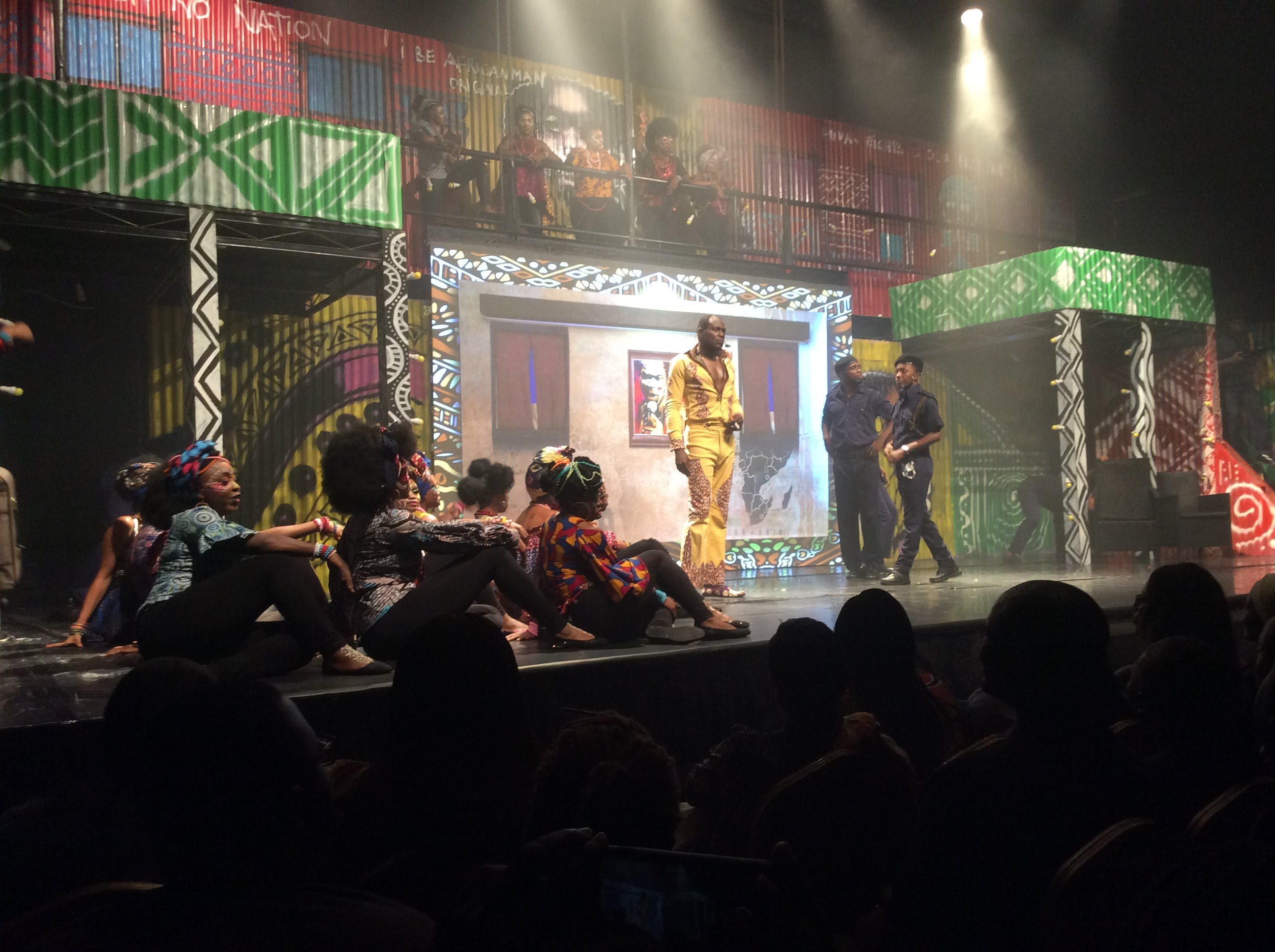
I particularly find the man who played Fẹlá – Ọláìtán Adéníji – intriguing. Apart from the fact that he did a great job with producing a close imitation of Fẹlá’s voice, mannerism, and movements, it is commendable that he has had no history or career in acting. He is an afro-jazz vocalist and saxophonist and prior to this time, definitely not an actor. The audience is awed when Bọ́lánlé says that his role as Fẹlá is his first acting role. Fẹlá, or rather Ọláìtán, smiles a modest smile. I take a picture of him. He is darker than the real Fẹlá but the resemblance is there.

On Terra Kulture’s website, they describe the event as a thrill of a lifetime. While I agree with this, I wish they had used a more adequate description. Fẹlá and the Kalakuta Queens was a thrill of a lifetime and more. It was a spiritual experience. I feel that this is the only way to capture its essence in a few words and evoke a true emotion.

In the wake of the #MeToo movement, the unveiling of several sexual harassment conducts against well-known members of the public and celebrities, especially in Hollywood, and the conversations around consent and feminism on social media, Fẹlá and the Kalakuta Queens is a timely production. It seems almost like Bọ́lánlé saw what 2017 had in store for women when she started preparing and doing research for the show a year ago. I can only imagine what extensive research and investigation she must have put into it because of Láídé and Fẹ́mi’s remark that the play is exactly what happened in real life. There is an emphasis on the ‘real life’. This leaves me short of words.

Bọ́lánlé explains that, while Fẹlá is continuously being praised for his incredibly unique music that has outlived him and promises to outlive us, no one ever talks about the women who stood by him. After his death, they sort of became relegated to the background, and their roles ignored. It was almost as if they had never existed in the first place. Every year in October, Felabration is celebrated widely in Lagos, and perhaps other parts of Nigeria, with musical performances, art exhibitions, stage plays, film shows and several other acts. But none of these acts recognize the 27 women who became his wives, who were an entourage of his band and more than anything, the inspiration behind some of his music. Bọ́lánlé’s introduction of this narrative to Fẹlá’s living story is brilliant.

The play details the scorn these women faced from being with Fẹlá. Láídé says this. She tells us some of the adventures she had with Fẹlá and the other queens. She narrates the story the way a grandmother would tell stories to her grandchildren. This is not to say Láídé is in any way an aged lady. She is merely in her 60s but looks at least a decade younger. It is almost impossible to imagine her as the troublemaker Fẹ́mi calls her. (In return, she calls him “Ọmọ-ọmọ Ìyá Àjẹ́” – a nickname that continues the moniker that used to be attached to Fẹlá himself: Ọmọ Ìyá Àjẹ, meaning “the son of the witch-godmother”. The witch-godmother was Fúnmiláyọ̀ Ransome-Kútì. Ọmọ-ọmọ means “grandson”). She tells us of the numerous times the police arrested her and the queens, of how the queens beat the Ghanaian police officers who had arrested them, and how they were eventually deported to Nigeria. She says this amidst our laughter. Many times during the play, the women were referred to as prostitutes – ‘ashẹ́wó’ the policemen often screamed into their faces. Láídé who has probably heard this one too many times in her life, reminds us blatantly and continuously that the queens were not prostitutes. ‘We were not prostitutes,’ she says. But the relevant question here is not ‘who were these women?’ The question is, ‘why were they so keen on supporting Fẹlá? They supported him to the extent that they were raped and beaten by police officers. Why were they so ready to give it all up, in order to stand with this rebellious musician? And why did Fẹlá marry all 27 of them?

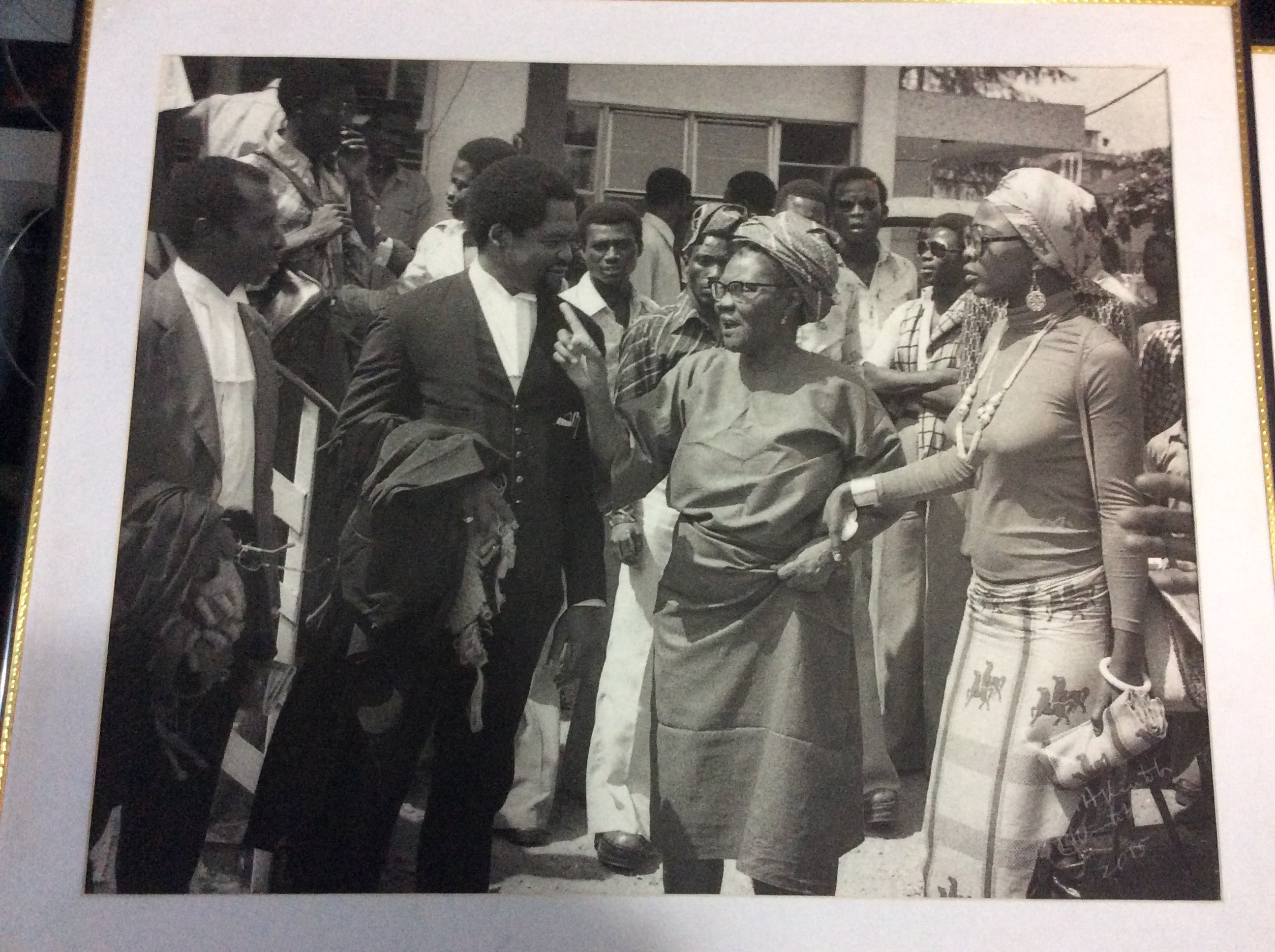
“Sister Ọláídé”(right), as many people in Kalakuta Republic knew her, was a close confidant of Fẹlá’s mother, Mrs. Fúnmiláyọ̀ Ransome-Kútì (middle). Both of them are pictured here with Fẹlá’s lawyer (left) during one of Fẹlá’s court appearances. <b>Photo credit:</b> Kalakuta Museum, Lagos.

Fẹlá Kútì was absolutely nothing without his queens. Ọládọ̀tun Babátọ́pẹ́ Ayọ̀bádé writes in the dissertation the ‘Women that danced the fire dance: Fẹlá Kuti’s Afrobeat Queens, Performance and the Dialectics of Postcolonial identity’ that the women were indispensable actors in the making of Afrobeat music as well Fela’s rise to prominence as a musician and activist. The author adds however that their collaboration with Fẹlá’s anti-government ideologies as well as their often-eroticized stage performances made them special targets of state-organized violence and earned them contempt from the Nigerian society. In this play we see state actors vis-à-vis Nigerian police officers continuously demeaning and harassing them. On why they have been ignored by history despite their critical role in elevating Afrobeat music to a global level, the author writes: ‘they have been imagined as indecent underclass women undeserving of Afrobeat’s collective memorializing or as collateral damage of Fẹlá’s political and personal excesses.’

The play ran for nearly three hours. Starting around past three, music from a live band serenaded us while the lights were still on and people networked, or caught up with old friends. The music gave off Yorùbá party vibes that I felt were just right. This set the stage for the play. But the Fẹlá vibes did not start here. At the entrance, there is graffiti and the words “Afrika Shrine” inscribed. In the ticketing area and beyond, you are welcomed by photographs of the Kalakuta Queens, of Fẹlá and some of his more famous quotes like “water e no get enemy.” This gives you goosebumps even before Fẹlá’s incarnate walks on stage. When it is time for the play to begin, the lights dim. A eulogy of Fẹlá opens up the show, intensifying the mystery and its spirituality.

There is a tendency to criticize Nigerian stage plays – at least the popular ones, as being too musical in nature. Critics ascribe the stunted growth of Nigerian theatre to this, poor plots and terrible acting.  Theatre critics also attribute the lack of growth to lack of theatres and other like spaces. While these concerns are valid, Bọ́lánlé Austen-Peters has carved out a niche in musical stage plays that continues to thrive. The construction of the new Terra Arena where Fẹlá and the Kalakuta Queens holds, further reduces the dilemma. Previous BAP productions: Saro and Wakaa the Musical held at the Muson Centre. Muson is a great space, but it is not necessarily homely. I find that what the less than spacious Terra Arena theatre does is to make things somewhat informal and yet attractive. Brymo’s concert in December attests to this. And this, I feel, is one of the reasons Kalakuta Queens was such a hit. Characters from the play sometimes walk from amidst the audience unto the stage. The audience itself is more often than not a part of the play in the way we raise our hands up in salutation to Fẹlá, sing along, and cheer with every performance.

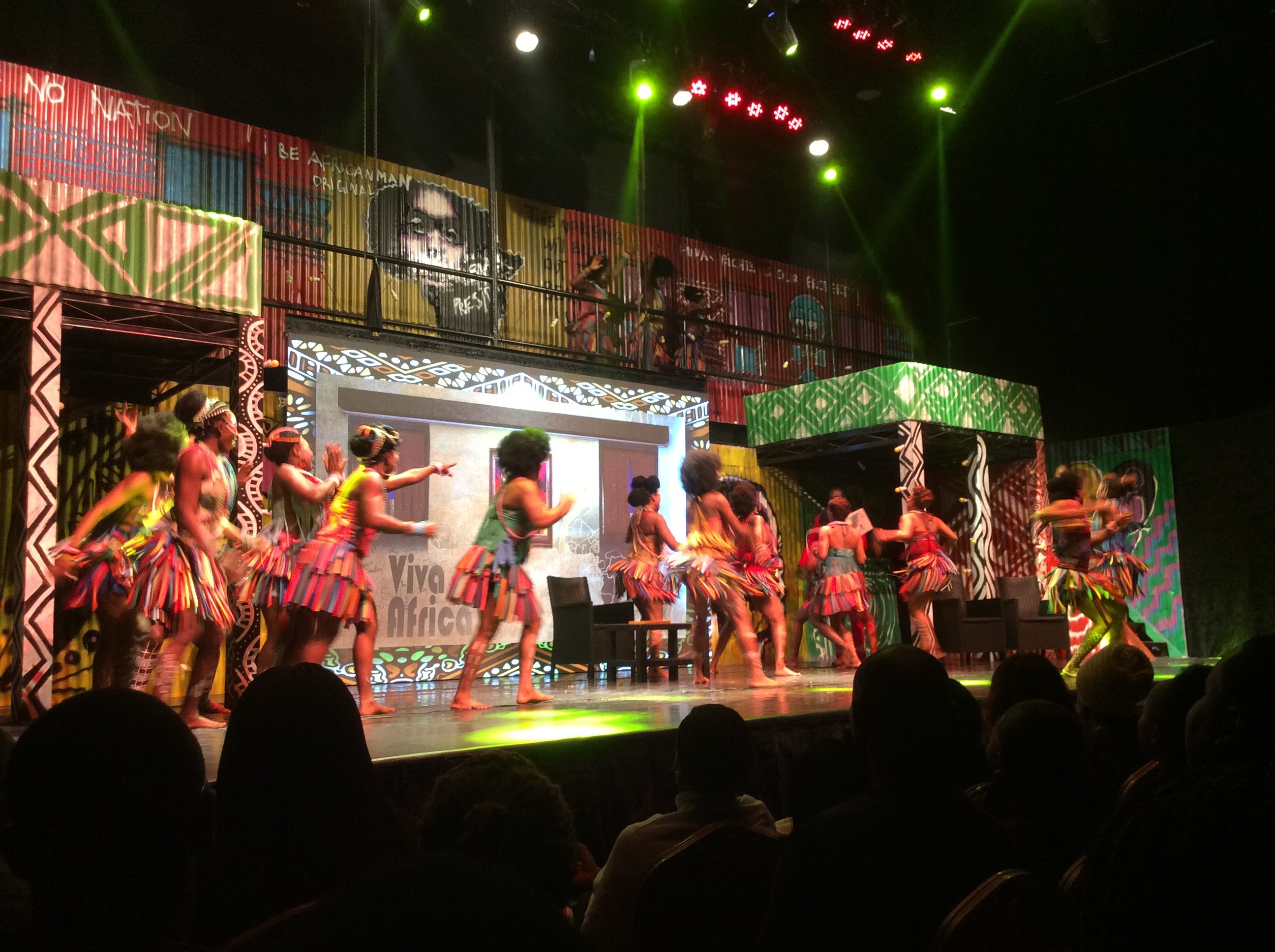
When they perform for the first time, they are dressed in white costumes their faces painted in different colors, shapes and lines. They dance in red light and other times in blue, green and yellow lights. Their entire look, from their natural hair wigs to colourful costumes and bead ornaments made the play authentic. It was increasingly important for me that the originality of the entire play went beyond Ọláìtán’s close resemblance to Fẹlá. I wanted to feel this same sense of originality with the other characters. BAP did not disappoint. In 1983, Bernard Matussière took some beautiful shots of the Fẹlá queens. In the main, their portrayal by the actors in this show hews as close enough as possible to a true approximation of their appearance, skills, and dance dexterity. Around the world today, several stylists and fashion icons have drawn inspiration from the bold makeup and hairstyles of Fẹlá’s wives.

The beauty in their choreographies and dancing cannot be overemphasized. Their moves certainly mesmerized the audience. Through the show, I imagined their motions being trapped into an art frame and exhibited like photographs. Though Fẹlá’s 10 to 20 minutes songs have a life of their own, the dance these women brought to accompany them gave a deeper meaning to what it means for a song to be alive. It is without a doubt that the dancing of the Kalakuta queens made Fẹlá’s songs a complete package back then, as they did on stage during the play. It was a whole new level of energetic, sensual and majestic.

The play is hilarious. Think of the way in which Lọlá Shónẹ́yìn’s Secret Lives of Baba Segi’s Wives is hilarious, the way in which it showcases a Nigerian polygamous home and is still poignant but not crude in the messages it passes. It is in this same way that Fẹlá and the Kalakuta Queens is hilarious and serious at once. The women struggle and compete for Fẹlá’s attention. They plot against and fight with one another, often using music and dance to pass on their messages. They find a common rival in the beautiful Malaika, the woman from London who says she has come to study Fẹlá and the queens, particularly the queens. They become agitated when they notice that Fẹlá has fallen for her, and that she has gained monopoly over the Kalakondo. As with when they stand with Fẹlá, they unite as one in order to throw her out of the Kalakuta Republic. It is interesting though, that while the women stand with Fẹlá when he is arrested, Malaika does not, further establishing her traitor-hood.

A particularly interesting scene is the court scene. After Fẹlá is arrested the first time, he is taken to court and charged with the abduction of the girls and possession of marijuana. He pleads not guilty and the judge asks the lawyers to present their case. The court clerk is a side-splitting character who seemed to overdo his role but still got the audience laughing. The claimant’s counsel presented witnesses who were emotionally inept at giving a clear and concise testimony. The first witness, Láídé’s mother, cries all through her testimony at the witness stand. The second witness is an aunt to one of the queens, Lará. Though she does not cry, she still presents a poor testimony in poor English. The two women stare at Fẹlá accusingly. While they can prove no clear case against the musician, there is another perspective when Lará’s aunt reveals that her niece is underage. On this count and on the count of being in possession of marijuana Fẹlá is convicted and sentenced.

The women call Fẹlá ‘king’, ‘Black President’ and ‘Abàmì Ẹ̀dá.’ He calls them his queens. He says, “I love all my queens. They are unpretentious and are ready to battle with me. Without them, I am nobody”.  When Fẹlá decides to marry the women, he does not do it for selfish reasons. He learns that his queens are unhappy because despite standing by him, despite being dancers, singers and activists in their own right because they are women, they would never do right by society. People would continue to mock them and refer to them as ‘ashẹ́wó’. So he felt the right thing to do would be to marry them. At first, people – his lawyer, Tunji Braithwaite inclusive – try to dissuade him from marrying the twenty-seven at once. He is told that he would be prosecuted for bigamy. But this does not move him. The women are delighted to hear he is going to marry them. In an article on She Leads Africa, Halima Bakenne writes, “Marriage offers some form of validation for women in Nigeria and maybe even other parts of Africa. It is believed that irrespective of what a woman achieves, she is nothing without a man.” This succinctly describes the motive behind Fẹlá’s marriage to the queens. A priest conducts the marriage ceremony. This is followed by a brief performance after which the show ends.

One of my favorite scenes in the play is Ihase’s performance. After the police destroyed their house and abused them, they were taken to the hospital. At the hospital, Ihase broke into soul-wrenching music. Her powerful voice reverberated across the quiet, still hall. In this same scene, Fẹlá is being treated on a gurney and behind him, in the projector, his spirit is depicted as coming out of his body – death and later on, as the music intensified, returning. Fẹlá Kútì later confirms that his father had mentioned that he once died and returned. This scene is also painful to watch. It reminds me of war-torn countries and daily domestic and street violations of women in Nigeria. It reminds me that sexual assault and domestic abuse are still endemic in our society, just as they were in the 80s. It reminds me that while most of the world has joined in on the #MeToo movement, Nigeria is still lagging behind.

There are so many take-homes from this stage play, like most stage plays and generally from Fẹlá’s life. Despite his many flaws and the seeming patriarchal nature of his relationship with the queens, he never disrespected them. He treated them equally. Their place in history has been reintroduced and there’ll hopefully be more public recognition and appreciation for their role in his life story as time goes on. When I climb the stage to take a picture with Láídé after curtain call, I smile at her and kneel beside her. I say to her: ‘thank you for sharing your story with us.’

___

The play/musical Fẹlá and the Kalakuta Queens ran from mid-December 2017 to January 14, 2018 at Terra Kulture Arena. It is billed to return in April 2018. Photo credit: KTravula.com, Tobe, and Kalakuta Museum.

___

Ọpẹ́ Adédèjì dreams about a lot of things but most especially about bridging the gender equality gap and working with the United Nations. If you do not find her writing, you would find her reading a novel. She is the co-founder of Arts & Africa.

Finding Home in Writers’ Words

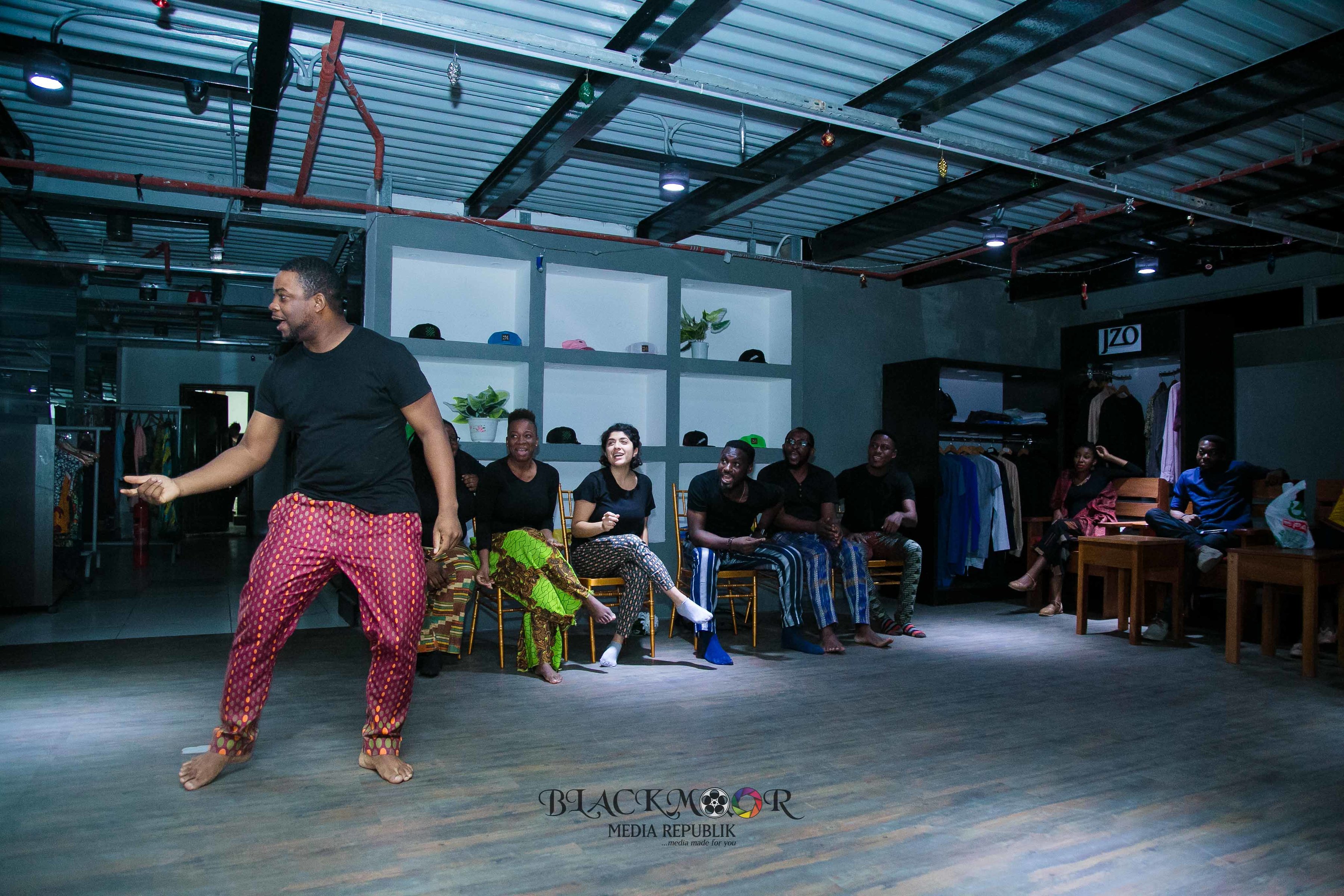
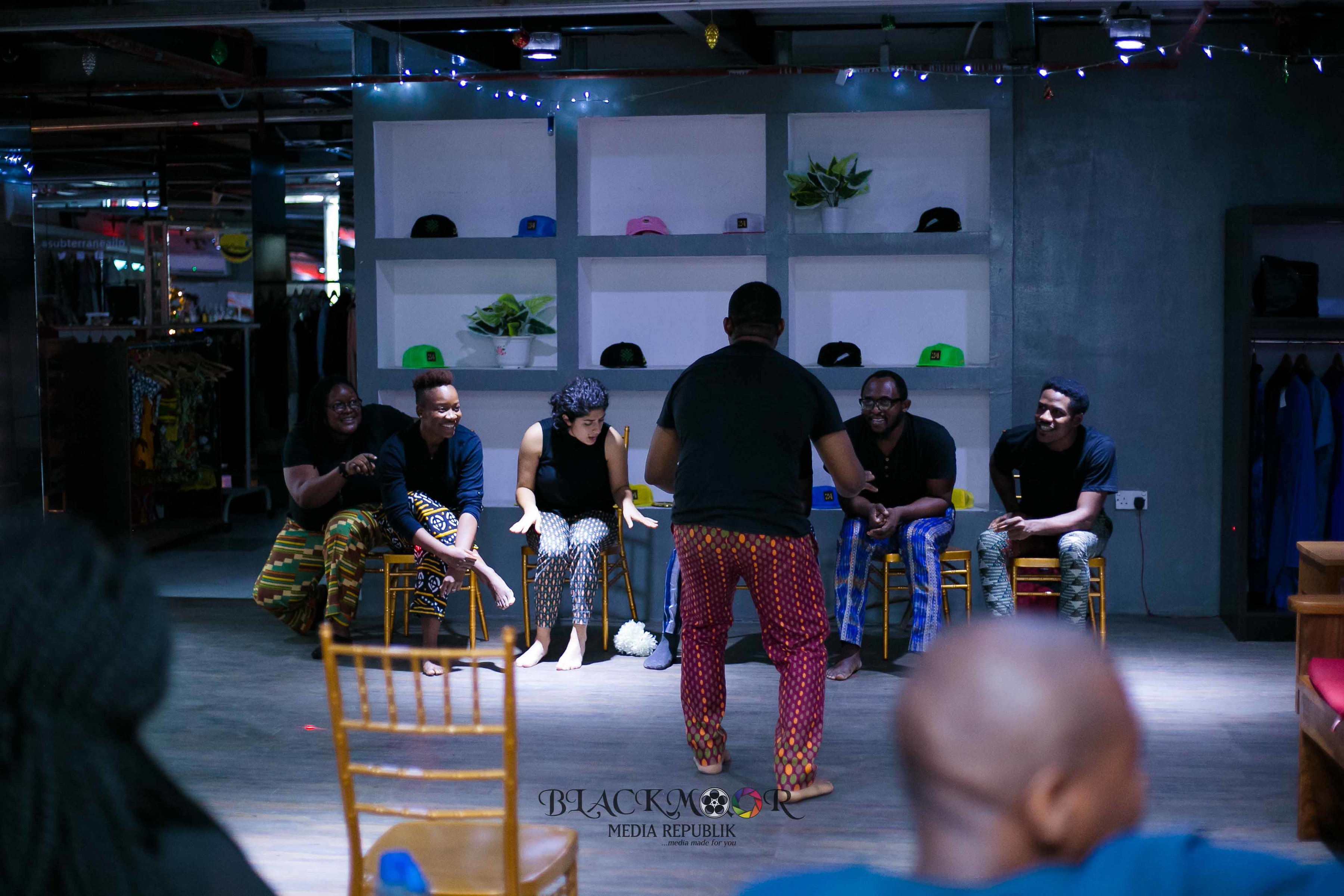
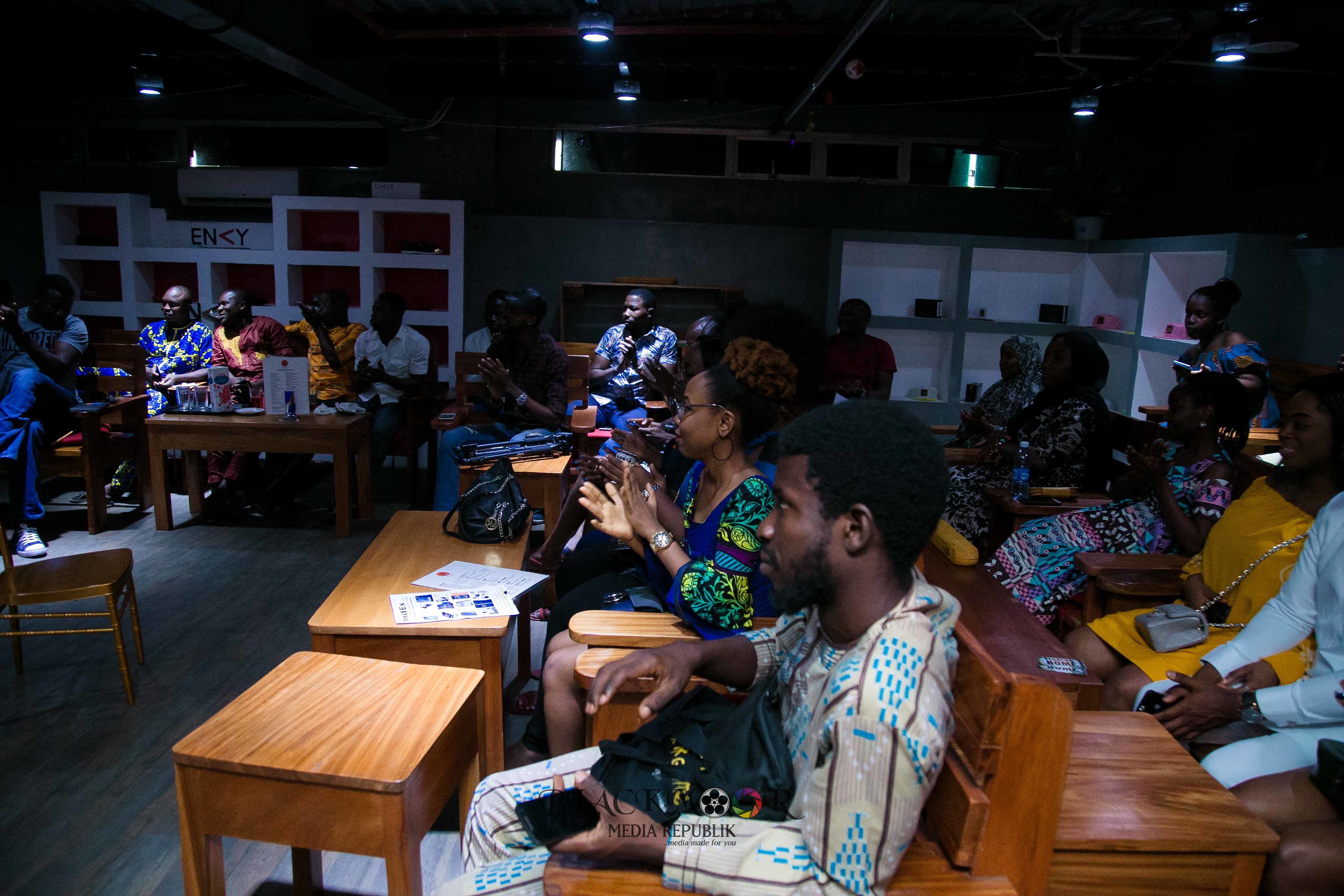
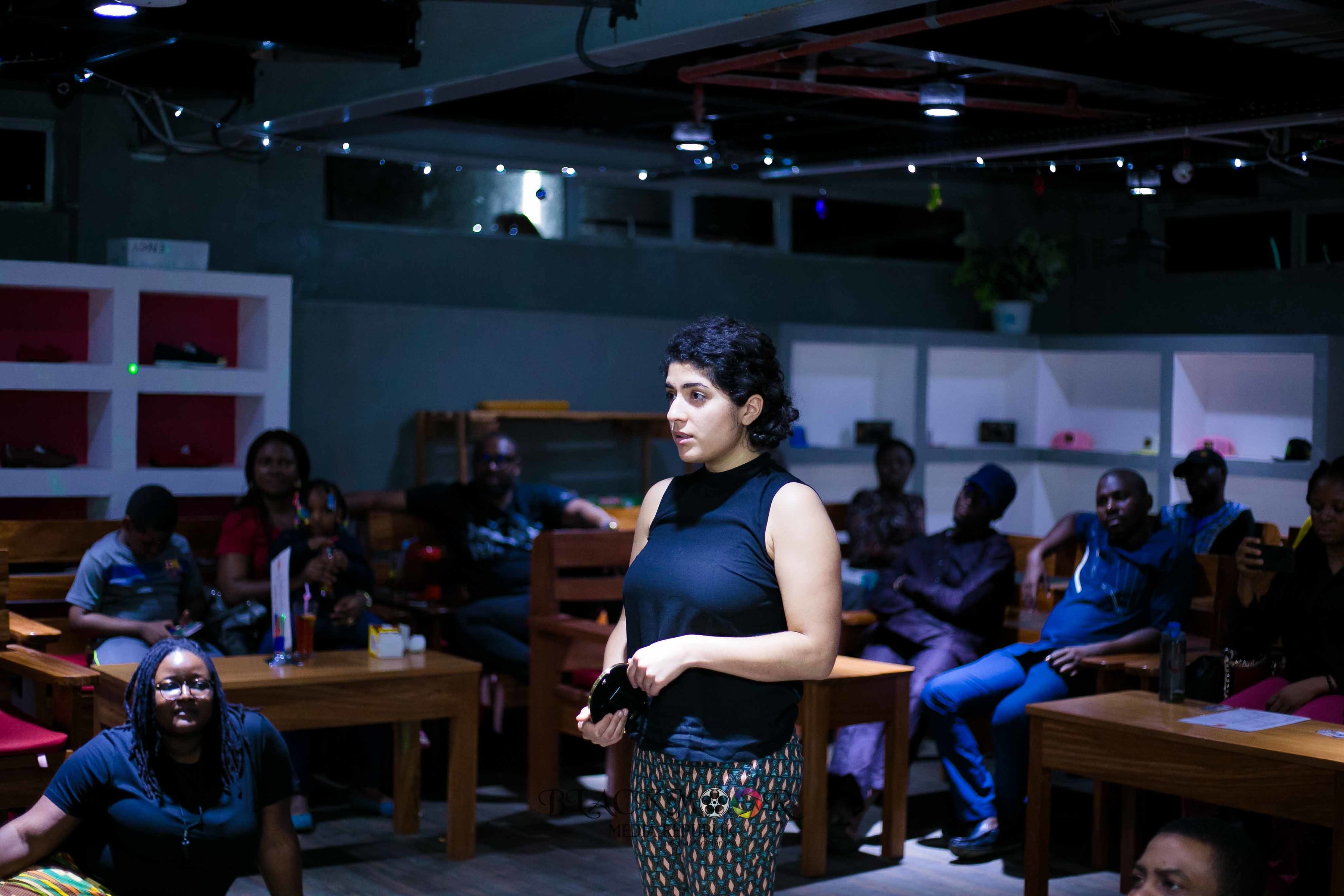
I watched the Lagos performance of Efe Paul’s Finding Home earlier in December. It held at an underground bunker in Ìlúpéjú and featured an array of bold and exciting voices, including some of Nigeria’s best spoken word acts.

The concept of the show always fascinated me since I first came across it in November 2014. Then it featured a different cast, including Sheila Ojei, and Bassey Ikpi (who has now relocated to the United States), among others. But the format was the same: a show designed around migration and movement, and built from the ground up with the words and stories of the individual poets and performers who make up the cast, and who are at liberty to create characters to advance the theme.

I found that not only fascinating but innovative. But I wasn’t able to see it.

Spoken word performance is a relatively young genre in Nigeria, but you won’t know by watching its biggest headliners perform, be it at art events in Abẹ́òkuta or opening events at Freedom Park, be it reciting inaugural poetry for the Nigerian president or harnessing the power of metaphors to sell the services of a commercial bank. The words move, and excite, and provoke, and instruct. From Wana Udobang’s emotive and playful dexterity to Chika Jones’ soft cadences that packed a punch; from Efe Paul’s baritone and theatrical evocations of truths to Títílọpẹ́ Ṣónúgà’s vulnerable but assertive tenderness; from Sage Hassan’s intense rebelliousness to Dike Chukwumerije’s eclectic experimentations, those who have braved the wilderness of this new and fascinating stage have brought with them a range of creative expressions before only seen in drama. So, when a play was constructed from these kinds of creative manifestations and fashioned around a contemporary theme, the result is always interesting to see.

Finding Home is, thus, not about one thing. It’s about many: a young man who takes all his savings in order to move to a new world in search of the golden fleece, a young woman who marries for visa, an immigrant who was ratted out for deportation by someone of their skin colour, or refugees who found themselves in the bottom of the ocean rather than the promised land. These kinds of stories are what the show is about, told mostly in the first person, with sound effects, mimesis, and playacting, in ways that carried the audience along with the ups and downs of each tragedy or triumph.

We leave because we have learned that staying still will kill you faster than moving.
So when home becomes a mad song from a broken guitar,
And it feels like the entire universe is playing you,
Let your fading footsteps become drum beats of victory and let them say: He was a good man, but when home becomes the stench from a rotting carcass, even the best men, leave.

– Chika Jones

There were other innovations. The show was performed in a semi-circle, for instance, with the actors facing different parts of the “stage” at different times. This gave it a sense of familiarity and intimacy, but also a kind of limitation. It will be interesting to see how it is realized on a flat conventional stage.

There was also an innovative but sometimes frustrating foreign language element.

One of the actors, Tanasgol Sabbagh, performed only in German – a brilliant invention that both illustrated the international dimension of the theme and the fact that the play had recently been shown in Germany, courtesy of the Goethe Institut. But in Lagos on this cool Sunday night, surrounded by bilingual speakers of only English and another Nigerian language, her part felt almost alien. And yet in that alienation is another realization of an important dimension of home or homelessness. How many immigrants, like those portrayed in many tragic instances in the play and in real life, get the chance to be fully understood before being sold off to slavery, or strapped to airplane seats and deported (in the best case scenario), or killed in cold blood in the back alleys of drug and gang-controlled slums of Europe and America?

The play, then, was both a communal contemplation of loss and survival as it was an examination of conditions that continue, all around the world today (accentuated, of course, by the prevailing news at the time, of the sale of Nigerians in Libya as modern-day slaves) to dehumanize immigrants, their stories, their bodies, and their condition. It was also an important twist on the character of spoken word as being just a one-man craft. Under the creative director of Fẹ́mi Elúfowójù, the cast showed what can be done when creativity and cooperation are harnessed to economy. There wasn’t much costume change, and much of the show played out in the plain site of the audience without any negative impact on the plot movement or overall message.

Is Finding Home a drama or a poetry production? Don’t ask. I’ll certainly see it again. I just hope there’s more music next time, by the characters, even if they are sad ones.

___

Cast members: Efe Paul Azino, Chika Jones, Títílọpẹ́ Ṣónúgà, Ndukwe Onuoha. Obi Ifejika. Adeṣọlá Fakile. Tanasgol Sabbagh and Fẹ́mi Lẹ́yẹ.


Wetin Dey? Nigerian Pidgin and Its Many Pikin

‘Better soup na money kill am’ | Good things don’t come easy

‘E don tey wey nyash dey for back’ | There is nothing new under the sun

‘Cunny man die, cunny man bury am’ | It takes a thief to catch a thief

‘Na condition make crayfish bend’ | Hard times encourage adaptation

Over 500 languages are spoken in Nigeria today, according to most accounts, although many of them are dying, endangered, or extinct. Three major languages spoken more widely than others are Hausa in the north (with about 70 million speakers), Igbo in the east (with about 24 million), and Yorùbá in the west (with about 40 million speakers). Other languages include Edo, Fulfude, Berom, Efik, Ibibio, Isoko, etc. Because of the multiplicity of languages in the country and the need to communicate among different ethnic groups, English, or Nigerian English, has served as a connecting tissue, but only in formal circles: schools, government, courts, etc. In the informal sector, however, where most Nigerians function every day, in the markets, on the streets, at restaurants, Nigerian Pidgin (NP) has emerged as a crucial and important feature.

Nigerian Pidgin doesn’t have its roots in English, but in Portuguese. In about 1456, when the first Portuguese ship reached Senegal via the Gambia river, to Sierra Leone about four years later, and other parts of the region in due time, they made contacts with famous kingdoms like Benin, Ghana, Mali, Songhai, etc. Benin at the time, now in present day Nigeria, was said to be one of the oldest and most highly developed states in the coastal hinterland.

To trade with these kingdoms and establish a cordial relationship beneficial to both parties, a mutually intelligible language had to be employed. It is unclear what kind of Portuguese these sailors spoke, but it is possible (and even likely) that they spoke a crooked and unrefined one, also befitting of that societal class of illiterate seamen. The contact of that pirate-type ship-lingo Portuguese with the language of the coastal Africans resulted in what eventually became Pidgin, and later Nigerian Pidgin.

At the time, however, it was a mere contact language, retaining elements of both cultures, enough to facilitate communication along with hand gestures and other universal signs. But it got the job done and helped cement the relationship between the seafaring Portuguese and the West African kingdoms. So that when the British showed up hundreds of years later, they found it easier to communicate with the indigenes, through a later variation of this language which, likely, had undergone sufficient evolution. This later contact with the British, via the slave trade, missionary invasion and colonialism further improved the intelligibility of the language, with English words added to supplement the earlier Portuguese ones.

The use of the word ‘pidgin’ in identifying the language as it exists in Nigeria today has added some confusion to understanding its current state. To linguists, a language is a pidgin only in the initial state of its creation, when it serves as the lubricating vessel of communication between two strange peoples (in this case, between the early Europeans and Africans). After a generation of contact, the language begins to evolve, with words and phrases from either language and others, introduced to flesh out the skeletons and give the language a unique character. At this stage it stops being just a ‘contact language’ and becomes a living one. We call this stage ‘creolisation’.

The creolisation of Nigerian Pidgin happened gradually, with the adoption of the language not just as a contact lingo with Europeans but as a native language of contact and of trade with other ethnic groups in Nigeria. This is the characteristics of the language that helped it become the most used language in the country by the time it got independence from the British in 1960. By then, coastal communities, though with other native languages of their own, had adopted NP as a full native language and spoken it among themselves and to their children.

The syntax of Nigerian Pidgin is similar to the local West African languages than the European ones. That probably explains why it used to be called ‘Broken English’, or ‘Broken’ for short, when it was perceived to be a language of the unschooled, unsophisticated people, a language spoken by those unable to grasp the complexity of English. To say ‘I am leaving’ in NP, one would say ‘I dey go’, which is a lean and simple rendering of that basic action. ‘I will be right back’ is rendered as ‘I dey come’. This simple syntax, covered with the fleshing of English, makes it easy to use by Nigerians who eventually adopted it as a local language.

However, Portguese still has some influence. Words like sabi and pikin, which came from Portuguese ‘saber/sabir’ and ‘pequeno/pequenino’, words for ‘know’ and ‘little child’ respectively, have remained in NP, to mark the true origin of the language. So, for example, ‘You sabi dat pikin?’ means ‘Do you know that child?’ As you’ll notice, the pronunciation has also evolved as well, so that a ‘th’ is pronounced instead as a ‘d’.

There are also many different dialects of Nigerian Pidgin today, depending on where it is spoken. Because words are borrowed from each of the languages that have influenced NP – words like àbí (a question marker) and ṣé are more common in the west, while words like nna and unu come from Igbo in the east. The Niger Delta has the highest concentration of NP speakers and here the version spoken is widely regarded as the most authentic form, sometimes as a first language. Places like Sapele and Benin are regarded as norm-producing communities, where the language has the most root and influence.

And of course, because of the diasporic migration of Nigerians to other parts of the world, there are more refined NPs spoken today across the world, from Peckham to Chicago, Houston to Baltimore. They are not markedly different from the Nigerian versions, except in accent, influenced by their new environments and company.

It is estimated that NP is the most spoken language across the Nigeria today, spoken as a first language by over 30 million people, and as a second language by the rest of the country (about 140 million). However, the language has never enjoyed the respect of the country’s elites. It currently has no official status and is neither used in education, or governance. But in the early 60s, through the efforts of early Nigerian writers in English like Wọlé Ṣóyínká, Chinua Achebe, JP Clark, Ken Saro Wiwa, and Cyprian Ekwensi, fully formed Pidgin-speaking characters were introduced to Nigerian literature. This helped elevate the language a bit more into the mainstream.

In Nigeria today, NP functions in informal capacity, lubricating contact and communication between people of all classes, gender, ethnic groups, and educational status. It is the language of the streets, and of uneducated market women in cosmopolitan cities. The flavour infused in each expression from the speaker’s original ethnic background continues to enrich the character of each individual output.

Where NP has dominated, however, is in the informal sphere of television and radio entertainment, in Nollywood and the Nigerian music industry, which reaches not just all Nigerians, but also most Africans. Fẹlá Kútì, the inventor of Afrobeat, played no small role in mainstreaming Nigerian Pidgin through many of his hits like Follow Follow, Trouble Sleep Yanga Go Wake Am, Teacher Don’t Teach Me Nonsense, etc. On the streets of Nairobi, Johannesburg or Accra today, one is likely to hear ‘Wetin dey?’, ‘Wetin dey happen?’ or ‘How far?’, or any one of NP’s common greetings (meaning: ‘What’s up?’, ‘What’s going on?’, ‘How’re you doing?’) even in the mouths of non-Nigerians. This has happened through the influence of Nigeria’s entertainment industry.
In 2009, a ‘Conference on Nigerian Pidgin’ at the University of Ìbàdàn proposed to drop the name ‘pidgin’ altogether, and call the language ‘Naija’, a nickname once reserved for referring to the country in an endearing way. This has not caught on beyond those academic circles, and it likely never will because of the tension between what the academic intervention represents (stiffness) and what NP truly is (dynamism). It is the jolly playfulness, accessibility and musicality of NP that continues to help convey the convivial spirit of Africa’s most populous country, along with colours and sound, to the rest of the continent.

________

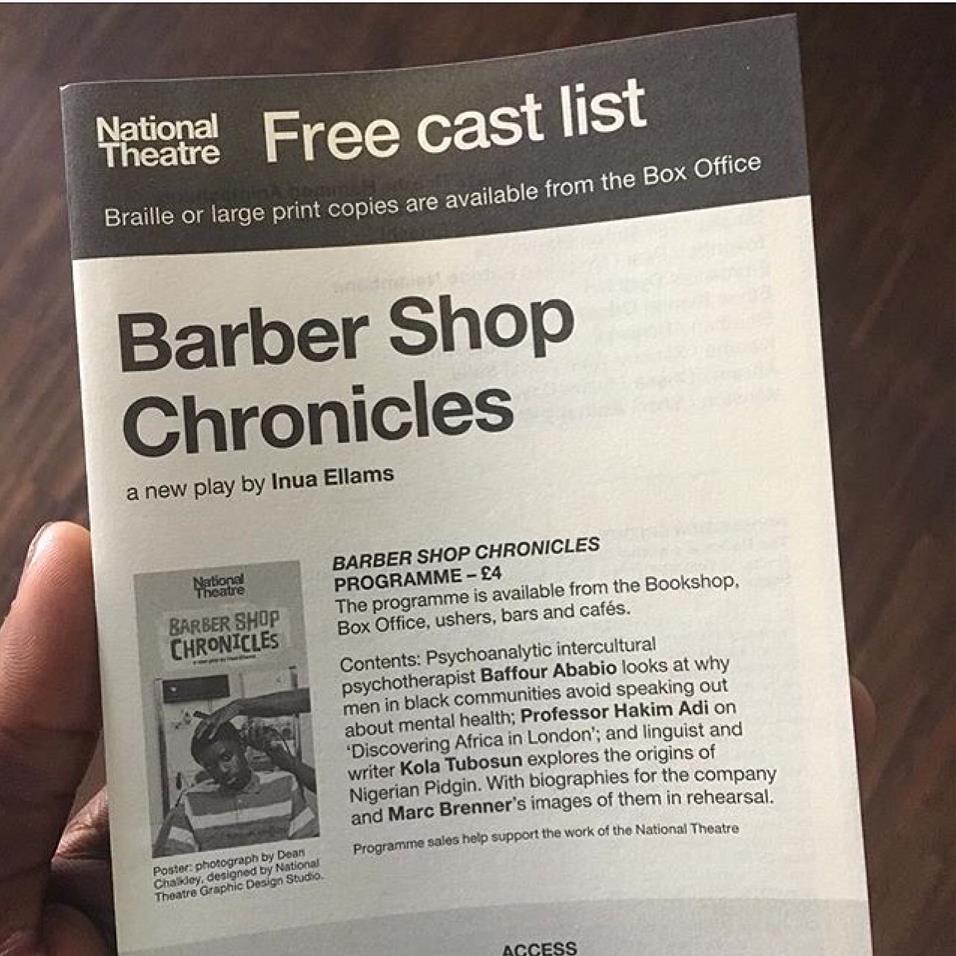
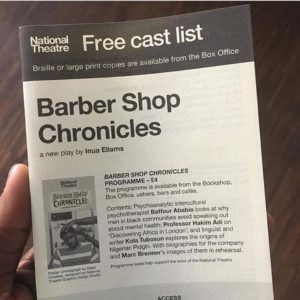
First published by the National Theatre, London, as companion to the play Barber Shop Chronicles by Innua Ellams, showing from May 30, 2017. The reference to Ken Saro-Wiwa and Fẹlá Kútì, added later, regretfully did not make it into the original text.

________

References
Three Days of Madness at the University of Lagos

By Péjú Láyíwọlá

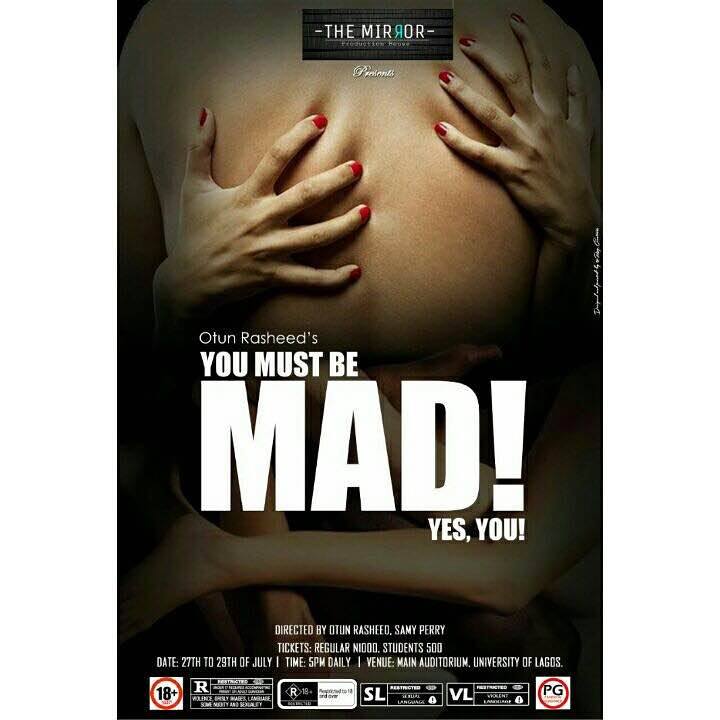
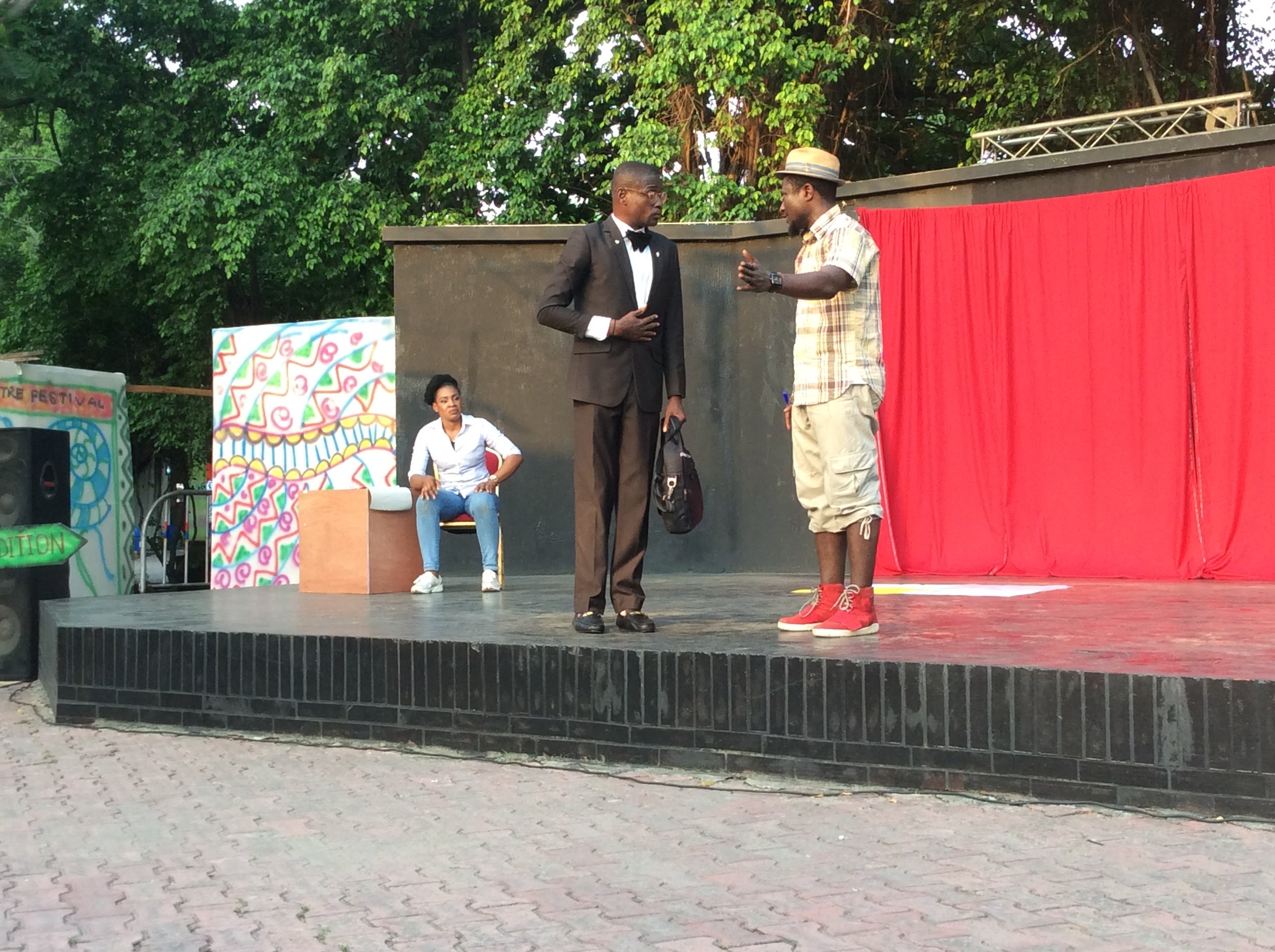
madI was first captivated by the posters and then I was warned not to watch the play because of the high level of vulgarity shown on stage. I braved it and opted to watch it on the second day of the three days that it was shown at the Main Auditorium, University of Lagos. Truly, if you survive the first few minutes of the play, you are likely to sit through this very captivating and bold attempt by a talented young playwright, Otun Rasheed, to shock, provoke, challenge, incite, and stir all manner of emotions through this breathtaking 70 minitues play. Given the very diverse critique of this play, one thing remains clear: sex is a tabooed topic in Nigeria. People prefer to talk about it in private spaces and not see themselves on stage.

You must be mad, Yes You! is the title of the play. While some might quarrel with the title, I think it is apt because really we live in a very mad world! It is a world full of paradoxes. The play was laden with foul language. The stark show of sexual pleasure and the rigorous scenes of obscenity and eroticism would make you cringe! But the message is loud and clear at the end: the level of promiscuity in the Nigerian society is high but largely ignored. Parents delude themselves by thinking their children are ‘holy’ and would not indulge in sex in this highly virtual and visual world of the internet. Infidelity, fornication, incest, pornography have become the order of the day. The level of incest within families is so high that you would be shocked. A few years ago, I attended a popular monthly camp meeting. When the altar call was raised, I was shocked at the number of people involved in incestuous relationship come out for prayers.

The cast comprised students of the Department of Creative Arts. Otun Rasheed is a lecturer in the department. What great mentorship! But does he represent the views of the Department or does he make any reference to it in any way? No! It is unlikely that such a play would see the light of day were it presented as an academic project. It is also not likely to receive a research grant. Yet, the academy should be a crucible for such phenomenal thinking.

Many thoughts crossed my mind while watching. Some of these discussed below reflect, in part, views of some of my colleagues when we discussed.

Why are people more likely to accept visual images of eroticism rather than a play with a similar theme? What role does sound and movement play in accentuating a message?

A bit of diversion: About eleven years ago there was a half nude life-sized female figure in the courtyard of the Visual Arts unit of the department. She was bare chested and wore a very well sculpted g–string that had a butterfly as motif on what I would consider the most significant part. A former Head of Department (also a visual artist) could not understand why that work should have been made. We all lived comfortably with the work for a long time. Over time there were signs of wear and tear on the nipples and lips of the figure. Several months later, the work collapsed. When I asked the students what happened they jocularly said. ‘She was raped and murdered last night and the case had been reported to the state CID’. Investigations are still ongoing till now.

Ọ̀tún Rasheed. Photo taken from Encomium Magazine

Ọ̀tún Rasheed. Photo taken from Encomium Magazine

Religiosity and fanaticism becloud our judgment. I was told that some of the staff in solidarity rushed to watch the play only to run out after five minutes. They couldn’t handle it. Jesus! Armageddon! This is Satan at work! The devil is a liar! This playwright must be mad! Yes, Otun Rasheed is mad! We were told in our elementary theatre class that theatre is make-belief. Yet, there is a meeting point between reality and fiction. Outside the performance, can I look at the most vulnerable of the cast without casting my mind back to the acts of violation on stage? Perhaps the change of cast for each production helped mitigate this.

Tunji Sótimírìn is concerned about the very graphic scenes and the perception of parents who are only just accepting theatre arts as a field of study. Are parents likely to allow their daughters study theatre arts after seeing such a play? As a former Head of Department, I have come to realize that the passion for some of these students far outweighs the choices of parents. I have seen students cry when offered courses other than theatre arts. Every new entrant into the Theatre Arts Department believes, and rightfully so, that he/she would succeed and surpass the achievements of former alumni and alumnae of the department. Several of them abound – Moceda, Stella Damassus, Fẹ́mi Brainard, Mercy Aigbe, Dáre Art Àlàdé, Fẹ́mi Oke, Wọlé Òjó, Helen Paul, Ọmọ́wùmí Dàda, Sambassa, Sẹ́gun Adéfilá and others too numerous to list. The successful careers of their forbears in the entertainment industry looms larger than the sentiments expressed by some parents. We are thankful for such great mentorship since the days of cultural studies. Both students and lecturers have enjoyed such great tutelage from Prof Ẹ̀bùn Clark, Prof Dúró Òní, Prof Àbáyọ̀mí Barber, Prof Délé Jẹ́gẹ́dẹ́ , Prof Alagoa, Prof Anthony Mereni, Prof Bọ̀dé Osanyin, Alaja Brown and Túnjí Ṣótimírìn. It is from this tradition that Otun Rasheed has emerged.

Many questions arise, a number of which I cannot answer: What role does theatre play in the society? What was the message of this play. Was it meant to be a corrective measure? Must theatre always have a message? To whom was this play directed? What binaries does this play throw up.

There are many points at which this play succeeds:

a. The use of space was amazing. Like an owl, the audience found themselves turning three sixty degrees. Many of the cast were seated amongst the audience and the audience were literally brought onto the stage. The stage could not contain the depth of actions Otun Rasheed offered. I also like the use of light and the special effects on the stage particularly in the opening scene.

b. Great publicity. Every day was a new message urging you to watch the play. The t-shirts and posters added pep to the show. The visuals were simply amazing! Social media aided publicity for this pay. Gone are the days when crude publicity was done by hiring a rickety university based cab with speakers mounted on it, while announcement are made round the campus through unfiltered microphones.

c. There was great synergy between members of the theatre unit and the students in bringing this idea to fruition. For this, I congratulate both students and staff of the theatre unit. Otun entertains much as he shocks his audience. His main aim is to call for the censorship of plays just like it is done with films. His personal experiences of taking his under aged children to watch adult plays without knowing it inspired this work. You must be Mad, Yes you! was rated 18+. Tickets were not offered to underage undergraduates, but a few still managed the gain entrance. That is the very point this play tries to address. How careful can parents be in bringing up their kids? What should be told them and what should be left for them to discover on their own?

The play lasted for three days. In my mind, it lasts forever. The final day had the main auditorium full to capacity. My only regret was that the madness was not sustained for a full week. Much as I like this work of art, I would like the directors to temper some of the violent scenes, particularly those couched within the audience area.

Peju-LayiwolaI salute your courage Otun Rasheed for bringing this play to the university environment. I look forward to watching it over and over again. I hope it would be viewed in a more pubic theatre and receive the sort of commendation it deserves. Did I hear you say condemnation? It is left for you to decide because you must be the only sane person in this very crazy world.

_________

Péjú Olówu Láyíwọlá is an artist, painter, and sculptor. She lives in Ibadan. Full text culled and edited from her Facebook page, with permission.