My way to work every morning takes me through a myriad of winding lanes through the veins of Nigeria’s former capital city, Lagos.
I wake up at 5am.
The alarm clock on my phone as well as that of my wife* ring both at once, separated by just a microsecond, and I get up. The games we play is to plan to be the first to get up before the other places the ringing phone next to the other’s ear.
Like clockwork, I must head to the bathroom in the next two minutes, sometimes spent on my phone checking for missed calls from the US, or unreplied emails on my phone. She nudges me again, and I head to the bathroom.
In twenty minutes, I am back in the room, this time dropping fresh warm bath water on my hair and on my feet. She has placed my clothes where I can easily reach them, a very romantic gesture. A white shirt, a black tie, and a grey pant. Another day is a different combination of colours that leave me entering every class looking as distinguished as I could ever look. I smile, talk about a few interesting things I forgot to tell her yesterday, while I dry myself, put on clothes, and get ready. Must be out of the house latest by 5.30am. And that’s getting late. At the door, I give her a kiss and promise to get home early, and get out of the house.
My path through Lagos is a winding one through all its throbbing lanes. But at a quarter to six, in usually the first or second BRT (Bus Rapid Transport) bus out of the gate at the park, the roads are just waking up. In less than fifteen minutes from then, the city begins to fully wake to the promise of day.
We go through Ikeja, close to the famous airport, then get to Oshodi, a once notorious spot filled with all manner of commuters and market men and women. Dawn wakes in a distance, and the bus plows through. In a few minutes, we are on Ikorodu road, saved for a couple of minutes by the presence of a designated lane for the BRT buses marked with Yellow. We sometimes get to Iganmu, site of the National Theatre (built in 1977 to mark the Festival of Arts and Culture: FESTAC), driving on the bridge that puts the military-cap style of the theatre against the backdrop of a distant skyline of the Lagos Islands. On another day, we find ourselves on the Third Mainland Bridge (Africa’s longest bridge that ends up at CMS near the first church building in Lagos, belonging to the Church Mission Society.)
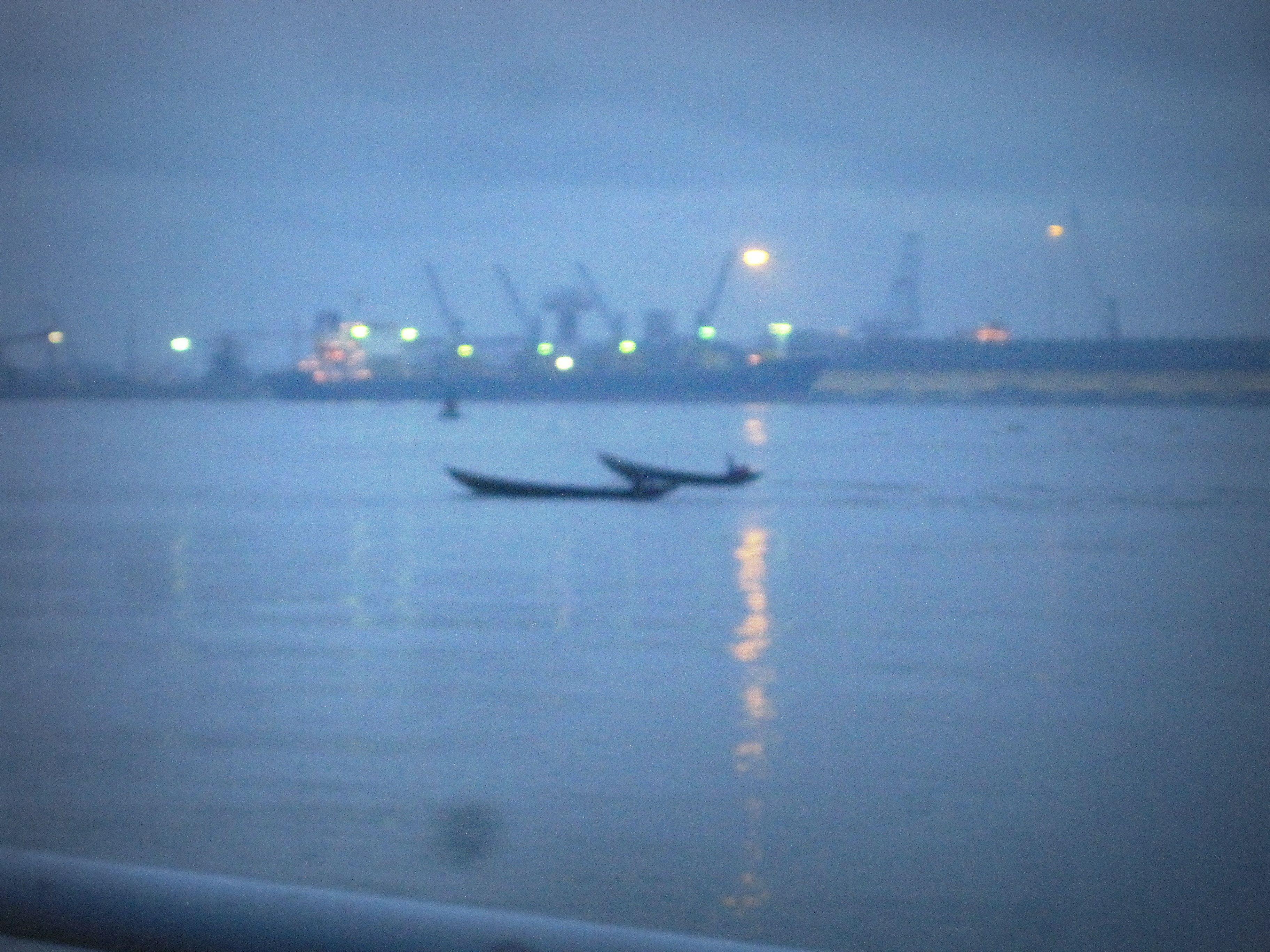
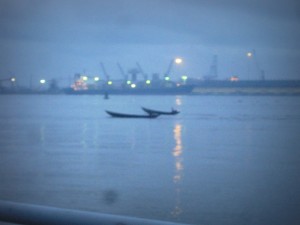 It is on this bridge that I encounter one of the most enduring images of my last couple of days: sillhouette images of fishermen on canoes going to work, sometimes riding in a formation, sometimes not. But usually, without fail, moving with the dawning day into the far reaches of the dark Lagos Lagoon. At 6.30am, all I see is the shapes of men and young boys paddling slowly into the morning. Here I am, an “educated” middle class “elite” in the Nation’s commercial capital heading to work. And there they are, the fishermen whose livelihoods depend on the benevolence of the waters. It is morning. We are all going to work: me, in a fast-moving vessel of the Lagos State Government heading onto the Islands, and them – from wherever far away in the darkness – into the depths of the waters to find sustenance.
I make a mental note as we go along. I wonder whether the small handheld Canon I just pulled out to take a picture of the dawn along with the canoes was able to see anything. In many cases, it only made me the centre of attention in a bus full of work-faring passengers like me, not yet buoyed by breakfast or a morning coffee. That happens at work.
“How is madam?” used to be the first greeting I receive at work. Now it’s like the second. “How was traffic today?” has replaced it. Sometimes it is, “I hope you didn’t get wet from the rain.” We fraternize like long lost brothers. Make jokes about each other’s appearance. Sometimes we share anecdotes about difficult students, then we disperse to individual offices to prepare for the lessons of the day. I have the first two periods – usually the best time to teach young boys anything, before their irrepressible energies sublimate into the most cantankerous behaviour. An hour and half later, I am downstairs at the school cafeteria for breakfast. Today it is coffee with sugar. No milk. And bread with corned beef and mayonnaise. Tomorrow, it might be ogi and akara. A few members of the academic staff are here, and we laugh and share some more small-talk.
 I go back to class to teach, this morning, the subject of argumentative essays. I tell them the importance of having control of the subject, and being able to anticipate the points of the opposition. I ask them about the debates between President Obama and his competition. A few saw it. Some thought that the president won, and some rooted for his opponent. A few students – having seen some doomsday poster/calendar sold under the bridge at Oshodi tell me that Obama was the antichrist. “He has signed 666 into law, and now there are chips being placed into people’s foreheads.”
I shake my head in incredulity and laugh at the folly of the student. He asks me if I am a supporter of the president, and I decline to immediately answer. I tell him that I could oppose the president and still believe that what the doomsday calendar said was just the feverish imagination of smart/desperate Nigerian preying on the gullibility of the average Nigerian. A couple of students laugh at the student, implying that he had been getting information from a grossly unreliable source.
We discuss how to write an essay. I give corrections of past exercises, and tell the students that all of them had made mistakes of beginning their essay with “Dear Panel of Judges, dutiful time keeper, co-debaters, and fellow students…” An essay, as opposed to a debate – takes place on paper, and there are no time keepers or panel of judges. We deal with the necessary points, I give them another exercise, and the class ends. There are three or four more classes during the day, lunch, and a staff meeting where we intend to discuss an upcoming performance of Ola Rotimi’s The Gods Are Not To Blame by students. By 4pm, I’m on the way back home. The traffic of the Lagos roads, beginning at this time of the day towards this direction, promises about two and a half, to four hours on the road.
By this time, it seems the whole of the state are on the road, each private car containing one or two passengers. The distance to the next BRT bus park is about half an hour, and it goes through Obalende. At the end of the bridge that comes from Bonny Camp, tapering towards the Tafawa Balewa Square at Onikan, is an extension of the Lagoon. By the side of the bridge, on the floor of the pedestrial sidewalk, with a lesser look of stress on their faces than the one I now carry along with the passengers of this small bus, are fishermen and some women. In front of them are big pieces of fish of different species. I have spotted large tilapias most of the time. Before the night is over, they will most likely have sold enough to be happy with on the way back to their families.
Tomorrow at dawn, they will be back on the canoes, heading into the deep under the Third Mainland Bridge. Tomorrow at dawn, I shall be on that bridge on the way to work taking pictures of their silhouettes in the dark. Tomorrow, they shall observe us well dressed Lagosians and project the hopes of their children making it to the big stage as middle class “elites” in tie and suits. And tomorrow, I shall look at them from afar with an understandable wonder and affection, of those who work – in rote no less, and in no less dedication as I – to feed their family and secure their future.
The only similarity we would have is the stress on our back muscles when we slouch back at dusk into the arms of our loving wives.
______
* On September 22, 2012, I married my fiance in Ibadan.
 The Yoruba language lives today in Candomblé, a religion in Brazil, and in Cuba as Santería. Some of the cultures of the old Gold Coast have remained in Jamaica and some other parts of the Caribbean in sometimes recognizable bits, or sometimes in totally evolved forms. This is the inevitable fall-out of language and cultural transposition. As dead as Latin is, it still lives on in science and in the Catholic Church. The point is that even in the worst case scenario, there will still be a recognizable part of the language left.
 I have long wondered about this process of organic nomenclative (if the word exists) behaviour. In my many walks around the world of visiting places of significance, the process of naming – and the etymology of words over time – has always held a tremendous fascination. A place in Southern Illinois, a few miles from where I lived for a few years, was called “