Browsing the archives for the Interview category.

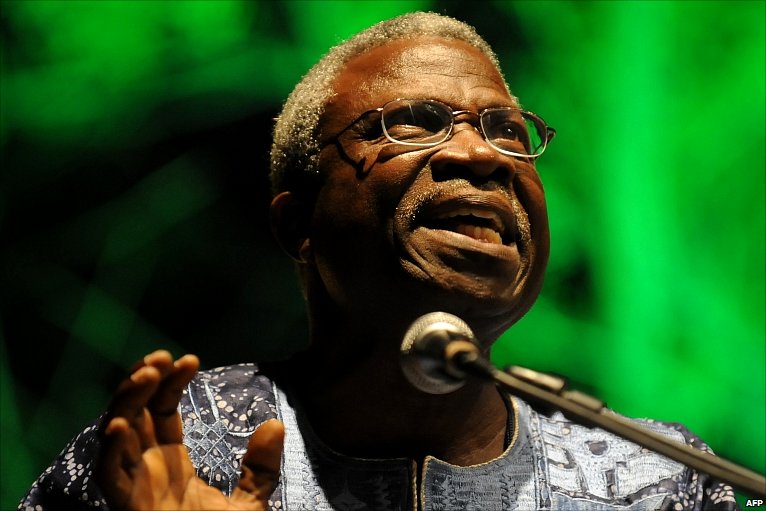
Interview With Professor Ben Elugbe (video)

Professor Ben Elugbe is on the Advisory Board of the NLNG-sponsored Nigeria Prize for Literature and has been for many years.

He is a Professor of Linguistics and a former Head of Department of the Department of Linguistics and African Languages, University of Ìbàdàn where I was once a student. He taught me phonology. He is one of the most important authorities in African linguistics. (I co-edited a book of language essays on his honour in 2011). He is also a former President of the Nigerian Academy of Letters, and President of the West-African Linguistic Society (2004-2013).

In this interview, I interrogate him about the Nigeria Prize, his role as a member of the advisory board, his opinion on the prize itself and the entries this year. I also ask him about the controversy surrounding this year’s longlist and shortlist, particularly of the accusation that one of the judges ran a publishing house in which one of the longlisted books was published. He had some interesting responses.

Watch his response and the full interview below.


___

This is the continuation of a series of interviews about the 2017 Nigeria Prize for Literature. Read more about it here, and read a review of each of the books on the shortlist (as well as the schedule of the release of future interviews) here. The prizewinner will be announced on October 9, 2017.

NLNG 2017 Literature Prize Interviews and Reviews

As promised, over the last week, this blog has featured reviews of the shortlisted work on the 2017 NLNG Nigeria Prize for Literature (Poetry), as well as interviews with the shortlisted writers, and the prize coordinators. You can now read and watch them here, below:

Monday, September 25, 2017: A Review of A Good Mourning” by Ogaga Ifowodo

Thursday, September 28, 2017: A Review of Songs of Myself by Tanure Ojaide

Sunday, October 1, 2017: A Review of The Heresiad by Ikeogu Oke

Monday, October 2, 2017: Conversation with Professor Ben Elugbe, member of the advisory board of the Nigeria Prize (video)

Tuesday, October 3, 2017: Conversation with Ogaga Ifowodo, author of A Good Mourning (video)

Wednesday, October 4, 2017: Conversation with Tanure Ojaide, author of Songs of Myself (video)

Thursday, October 5, 2017: Conversation with Ikeogu Oke, author of The Heresiad (video)

Friday, October 6, 2017: Excerpts from each of the collections (video)

Sunday, October 8, 2017: Conversation with Kudo Eresia-Eke, General Manager, External Relations for NLNG (video)

Monday, October 9, 2017: Prize Announcement/World Press Conference.

Update: October 9, 2017: Ikeogu Oke’s The Heresiad is the winner of the 2017 Nigeria Prize for Literature. 

The intention behind this effort was to help engage the community of writers and give visibility to each year’s shortlist as a way to better improve the prize through conversations and constructive criticism. The end game, of course, is the hope to stimulate an improved culture of reading and appreciation of literature around the country.

____

Follow us on twitter at @ktravula.

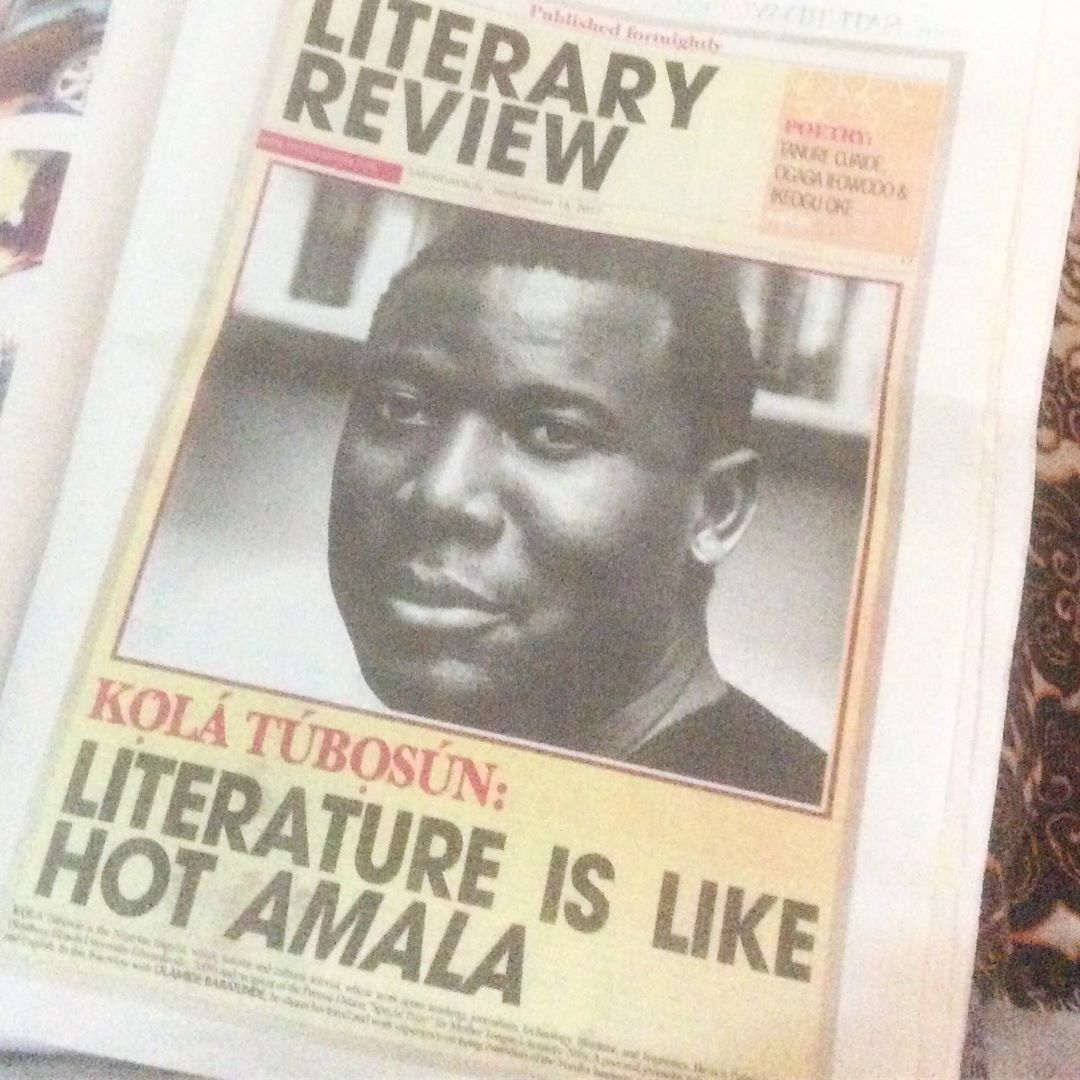
“Literature is Like Hot Amala” | Interview with the Saturday Sun

I spoke with Ọlámìdé Babátúndé of The Sun over the weekend about my work. Here is the interview, first published here.

___

It seems you have done more prose than poetry, is that deliberate or it’s just your forte?

I have actually written a lot of poems, mostly in English and some in Yorùbá. I just haven’t put them together in a book collection. I had a chapbook out in 2005 as soon as I left the university. I called it Headfirst into the Meddle. The second one, published in 2015 by Saraba Magazine, was called Attempted Speech & Other Fatherhood Poems. I’m currently completing work on a full collection for print, focused on the memory of my time in Edwardsville, Illinois.

But yes, these days, I’ve spent a lot of my time writing reviews of books I like (and hate), and writing essays on issues (especially about language) that I feel strongly about.

What are you working on next?

When I’m not racking my brain on the TTS-Yorùbá research, I am compiling a book of interviews with writers I’ve spoken to over the years. I think interviews are a forgotten art and it will be nice to have the voice of our artists showcased in other formats than just in their creative work. I am also working on a memoir of my time as a Fulbright scholar, which was an enchanting time with lots of interesting and important memories. I’ve put that off for so long. And then there a few other book and essay projects that I can’t talk about until they’re ready.

How imperative are reviews to a text for you as a reviewer because an author once said he did not care about whatever anyone had to say about his book and what should a good review be about?

I can’t prescribe what a “good” review should be about, but I can say what kinds of reviews I’ve enjoyed reading. And they include ones that give me appropriate context about the work and about the author. I’ve heard people say that they don’t care much about the author, that they just want to read about the work he/she has created. I don’t always feel that way. I am a social animal and I want to know as much about a creative endeavour as about the mind that created it. That’s also probably why I like the interview as an equally important means of engaging the writer’s mind.

What is the way forward to making literature and other forms of art more appealing to people particularly Nigerians?

Literature, like any other form of art, is like fine wine, or hot amala at a rare roadside buka. Those who want it will seek it out no matter the obstacles.

I bet one way is to ensure there are translations of works into local languages, how is that future looking in Nigeria?

I think one paragraph will not be enough to do justice to my thoughts on the gaping hole we have today in the production and consumption of literature in the mother tongue, particularly in Southern Nigeria. Translation is just one way. Actually writing, publishing, and distributing literature in Nigerian languages will be most ideal. And we can help that by no longer having our educational syllabi insist on “Literature-in-English” as a high school subject when we can simply have “Literature(s)”, which includes texts in as many relevant languages as the students can understand or tutors can teach. It’s to our shame that we have 500 languages and most of the texts that students read in our schools are in a foreign language, and by foreign authors.

In the nearest future where do you see Nigerian literature, what opportunities lie ahead regarding using cultural tools to effect positive changes in all facets of the Nigerian Economy?

As I said above, I’d like to see a more robust approach to literature in our schools. D.O Fágúnwà’s books are not only meant for the Yorùbá children’s minds. They should be taught both in the original text and in translation. Same for selected Hausa and Igbo literatures, etc. It is interesting to see a resurgence in the interest to read more indigenous Nigerian literature by foreigners and tourists than Nigerian citizens themselves. This shows that there is some economic potential in giving them attention. Some bold publisher has to start first. Or some rich philanthropist has to put money out in support of such an endeavour, at least at the early stages.

I’ve also, in the past, suggested that Nigerian Customs insist that products coming into the country that don’t have their instruction manuals written in at least one or two Nigerian languages should not be let in. Imagine what would happen if you export a Nigerian product to the US or China and write the literature in Yorùbá. They won’t let you in. So why do we allow that for us? A policy like that will create new job opportunities for Nigerian translators in the local language and signal that we take ourselves seriously.

Name some young and new generation of writers whose work you enjoy

I recently discovered Chika Jones’s spoken word poetry and I’m sold. He has a bright future ahead of him.

What does it feel like to be a poet Father and husband?

For what it’s like to be a father, I’ll refer you back to that chapbook of my poems I spoke of earlier. It’s called Attempted Speech & Other Fatherhood Poems and you can find it on the Saraba Magazine website. I wrote a lot of my first thoughts about the experience there. As a husband, my role is to support and protect my family, which usually has nothing to do with poetry.

I read how irked you got for the misspelling of your name when you first created an email account. Could this have led to your mission to intervene in the saving of Yoruba Language globally?

I’ve since realized that the peculiarity of my name will always get me into these types mess. The email incident was the least benign. But when I returned to the University of Ibadan after my Youth Service in 2006 to pick up my certificate, I found out that they had written “Olatunbosun” on it, instead of “Olatubosun” which is how it is written in full. This is a running problem I get into most often with Yorùbá people. Non-Yorùbá people tend to stick with what they see on the page and don’t feel the need to add the extra “n”.

To your question, no. My work in language and linguistics wasn’t motivated by that one incident. There are many, some of which happened when I was very young. I blame my parents for all of it, for their insistent that we speak Yorùbá at home, which in hindsight was a very important gift. My most pressing motivation, I think, is the reality that the advances in technology will contribute as much to the endangerment of our languages if we don’t make those languages compliant with them as whether our children are made to speak them comfortably at home and outside of the home.

Your Initiative Tweet Yoruba, to what extent has it saved the third most popular Yoruba language from becoming extinct as predicted by the Linguistic Association of Nigeria? And how did you kick off the YorubaName.com?

The #TweetYoruba and the YorubaName project are two sides of one coin. The former was started as a way to call Twitter out in 2012 for not putting any African language on the list of languages for which the platform was being translated. It was an advocacy to make a case for Yorùbá which largely succeeded. I say largely because even though the promise has been made to launch Twitter Yorùbá, it hasn’t yet seen the light of day.

YorubaName.com was started as a way to expand on my university undergraduate project through which I compiled about a thousand names into a compact disc along with audio and other metalinguistic elements. By making it globally accessible online, with a crowdsourced element through which people can submit their own names and improve the meaning of the ones in there, I figured that we could gather even more names and better provide a sort of an online platform for education and cultural reinforcement. It ties back to that intention to make sure that anything that we value in the culture, any intangible cultural heritage, can also be accessible on the internet, and is compliant with information technology.

Not just for Yorùbá but for Igbo, Hausa, Edo, etc. If we want a language to survive into the next century, not only must we speak them to our children and use them in various public domains, we must also make sure that modern technologies can read, write, and function in them.

This brought on the Yoruba text-to-speech initiative, TTS Yoruba. Please enlighten us on how this is to benefit the 30 million who speak the language?

The TTS-Yoruba project is a result of my own personal research curiosity. For a while, I’ve been bothered by the fact that Siri – that automated voice on the iPad – was available in languages with as small as 5 million people. Yorùbá is spoken by over 30 million people, yet the combination of people speaking Swedish, Norwegian and Danish is just 15 million in total. Yet Siri exists in each of these three languages. The question I’ve always asked is whether it just isn’t possible to create a computer-generated Yorùbá voice or people just haven’t tried. I know that people have been trying, so I wanted to see what I could bring, as skill, into the research question. And if we succeed, there are very many significant benefits and possibilities. Imagine, for instance, being able to use an ATM in your local language. Many old women in the villages would no longer have a reason to distrust banks. We could also be able to use to create automated talking systems that can, for instance, be used by disabled people to use their voices to activate their phones in their own language. You can get your texts read to you, etc. There are also economic opportunities. I imagine that mobile phone creators will want to pay for a technology that allows more people to use their devices because of the new language elements.

Winning the prestigious  Premio Ostana International Award for Scriptures in the Mother Tongue in 2016 is a big one, what other doors did this open for your career?

The Premio Ostana was a welcome recognition of the work we are doing to shine attention on the issues in mother tongue use in education, literature, and technology, etc. The Italian organisation which awarded the prize (Chambra D’Oc) has spent its time and effort seeking out and recognizing people and organisations across the world who work to promote a small, endangered, or minority language. They have done this as an extension of their own intention to celebrate their own minority language in Italy and France called “Occitan”. So, of course, I am proud to be affiliated with them and their goals.

As per open doors, I’ll say that I have kept my focus on doing the work at hand, and that’s more important as a tool for open doors.

In April , you took part in the Culture Summit in Abu Dhabi with other participants from 80 countries around the world to discuss how cultural tools can fit into global challenges and capture existing opportunities, tell us of your experience.

The programme was organised by Foreign Policy magazine as a way to engage cultural arbiters and practitioners across the world, to figure out what opportunities exist for the celebration and advancement of (sometimes marginalized) cultures through art and creativity. I was glad to be there.

One of the things I took away from the event is that there are people doing great things, sometimes with little financial incentive, all across the world. One of the things I hope I left the participants and organisers with is that the language question is an important one in opening doors to development. As long as we keep thinking that the universality of English has freed us from the responsibility to support and encourage the survival of minority tongues from all over the world, we are still doing a lot wrong.

Your favourite world destination so far is where?

It is mostly Ibadan, where I was born and raised, and where both my parents still live. I have also made a sort of home among friends and adopted families in Edwardsville and Minnesota in the United States. I visited Verona in Italy last year and I had a whale of a time as well. Being able to find particular things relatable and enjoyable everywhere I go is a gift I greatly cherish.

What’s your worst travel experience?

Any one in which I get a small legroom seat on the plane. My legs are very long and don’t do well in cramped spaces.

Thank you for your time and for doing Nigeria proud, staying the course to preserve our languages.

Ẹ ṣé. My pleasure.

____

First published in the Saturday Sun of September 16th, 2017

“Ours is Not Yet a Humane Society” | Conversation with Niyi Osundare

Professor Níyì sundáre is Professor of English at University of New Orleans, USA, and one of the best-known poets from Africa. His works of published poetry include Songs of the Marketplace (1983), Village Voices (1984), A Nib in the Pond(1986), The Eye of the Earth (1986), which won both the Association of Nigerian Authors Poetry Prize and The Commonwealth Poetry Prize in its year of publication. He was also a recipient of the prestigious Folon/Nichols Award for ‘excellence in literary creativity combined with significant contributions to Human Rights in Africa’. Other published volumes of poetry include Songs of the Season (1987), Moonsongs (1988), Waiting Laughters (1990), Selected Poems (1992), Midlife (1993), The Word is an Egg (2000) and Tender Moments(2006). Niyi Osundare has also published four plays and essays on literature, politics and culture. Orality and performance are important features of his works, which have been translated into the Italian, French, Dutch, Czech, Slovenian, and Korean languages.

________

Thank you for talking to me. And congrats on your 2014 National Merit Award.

I should be the one thanking you for providing the forum, for making it possible for this exchange to take place.

Let’s start with your poetry for which you’ve been widely acclaimed. The last recorded work from you was in 2006, titled “Tender Moments”. Is there a reason you haven’t released another published collection since then, almost a decade ago?

Tender Moments is, actually, not my last publication. The book has got two aburos: City Without People: the Katrina Poems, published here in the US, and Random Blues, the first volume of the collection of my weekly poetry column in the Sunday Tribune. Both were published in 2011. And right now, the publisher is looking at a new book of poems, some kind of travelogue-in-verse, which I completed last year after many years of preparation. I’m also working on a sequel to The Eye of the Earth, a 1986 book whose resonance and thrust I consider so achingly relevant in this age of the deniers of the scourge of climate change and global warming, even when the effects are so palpably, so tragically evident. Many of the poems from this manuscript have featured in three influential international journals on either side of the Atlantic:  Interdisciplinary Studies in Literature and the Environment (ISLE), University of Oklahoma’s  World Literature Today,  and Moving Worlds of the University of Leeds, UK . Mine were invited contributions, and I am both glad and inspired by these journals’ single-minded concern with some of the burning issues (all pun intended) of our time: nature, climate change, wild winds and tsunamis, etc.  So, you can see I’ve not been sleeping on duty!

I first met you on the campus of the University of Ibadan where you taught in the department of English, and then left for New Orleans. What was your most significant memory of teaching in Nigeria compared to teaching in the United States?

Now, you’re asking me to cast in the past tense  a narrative that is  still very much in the present tense. My pedagogical and academic relationship with the University of Ibadan (and other Nigerian universities) continues, though at a less formal, less regimented level than before.  You will remember that I said in my 2004 valedictory lecture that my relationship with the University of Ibadan is a laelae  (lifelong, everlasting ) affair. This is why I do not come on the summer vacation without having one kind of interactive session or another  with students in the Department of English – a mutually beneficial activity which I thank the present Head of Department for facilitating. I also actively participate in academic events in other departments. But I do know that both the tenure and the tenor of my service have changed, and things are not exactly where they were when I left in 1997.

Now, teaching at Ibadan versus teaching at the University of New Orleans. Many similarities and a few differences. To begin with, in both institutions, I have to deal with students, the centre of my professional concern. I have discovered that students are virtually the same everywhere: young, vulnerable, unsure, even fearful, but inquisitive, ambitious, demanding, generally idealistic. And on both sides students who are sharp as razor, engaging, and quick on the uptake, and those who are a little slow and need some gentle prodding. But what makes the real difference is the environment. It is common knowledge that the Nigerian student as well as her/his teacher are still engaged in a life-or-death struggle for the provision of amenities which their American counterparts have come to take for granted: steady power supply, potable water, relative freedom from hunger and suchlike harassment by social needs, a predictable academic programming and scheduling,  and above all, a relatively stable political system. A book comes out on Monday; by Thursday it is already within your grasp; access to internet facilities that are fast and inexpensive. These are facilities still far from the grasp of the Nigerian student.  But in a way there is some ‘sweet uses’ to the Nigerian’s student’s ‘adversity’ – to echo Shakespeare. Driven by need and necessity, the Nigerian student tends to be more aggressive, less complacent, and less dependent (Who are you going to depend on: parents who are barely striving to survive, or a government that has no interest in your welfare?). I have observed that drop-out rate is much, much lower among Nigerian undergraduates; for to drop out is to drop under and, in many cases, to drop dead; for the kind of socio-economic safety nets available to American students are nowhere there for their Nigerian counterparts.


At the faculty level, surely, the American academic has much more to work with: the laboratories are well equipped and functional, research funds are made available (depending on the buoyancy of the university’s budget; for, yes, even in America, colleges and universities do go broke!). As a result of a situation of general relative contentment, labour union activity is almost non-existent in American Academe. Many times I miss the rousing militancy of ASUU!

You were notably affected by Hurricane Katrina in New Orleans in 2005, and you’ve given a number of interviews about that sad event. Do you hope to write a memoir about it at some point? Many of us would like to read what it was like to get through those harrowing times.


Thank you for your concern.  The book mentioned earlier on in this interview, City Without People: The Katrina Poems, has tried to explore and articulate some of the harrowing experiences. The poems themselves are sandwiched between two prose pieces: a prose preface and an interview both of which put the Katrina narrative in proper perspective. But there was a prose parallel I was writing while composing the poems. Somehow, I managed to complete the book of poems, but the prose narrative stopped a few pages after 40. The memory of our losses weighed me down. The prose narrative literally collapsed under the debris. Why and how I found poetry a readier bearer of the tragic experiences, I still do not know. I think this would be an interesting study for psychanalysts.  Even the poems, I couldn’t complete until six years after the hurricane… I may go back to that prose narrative someday – maybe when I’ve retired from this penny-a-day teaching job and I have more free time to myself. And when the trauma engendered by memory of the event would have thinned out sufficiently to allow for relatively painless recollection. But then, who knows: some memories never let go of our faculty of remembrance.

Being influenced by your Yorùbá background, you must have strong opinions about poetry as performance (spoken-word) as opposed to poetry as text. How best do you think poetry should be enjoyed or employed?

Both ways, both modes. And more. In the house of poetry and its practice, there are many rooms. Some poems are written for the eye, some for the ear, and others for both. I see my Yorùbá background as abundant blessing to my poetry. I have always wondered what kind of poet I would have been without this fabulously rich culture and its language. Or, indeed, whether I would have been a poet at all. Come to look at it: everything in Yorùbá is poetry-in-motion, poetry-in-action. Yoruba language is music: from its intricate tone-system to its inimitable ideophones. Sounding is meaning, and meaning is sounding. A language whose syllables sound like drumbeats. A generously metaphoric language which can render the most abstract concept in the most arrestingly imagistic way. Compare ‘I am hungry’ with ‘Ebi npa mi’ (Hunger is beating/killing me); ‘I am shy’ with ‘Oju nti mi’ (Eye is pushing me) . This phonological and imagistic paradigms are central to my poetics. For me, the line is not complete until I make it sing and make it sing meaningfully.  My Muse is never far from her/his music. Those who cavil at the abundance of repetition in my poetry need to know the music behind my Muse. Fortunately, this is not an exclusively Yoruba attribute. The music of Welsh language drives the prosody of Gerard Manley Hopkins and, to a lesser extent, Dylan Thomas; Irish inflections in the drama of John Millington Synge. How can one come to a full experience of Igbo masquerade chants in the poetry of Obiora Udechukwu and Ezenwa Ohaeto; of udje songs in Tanure Ojaide,  without remembering the haunting  musicality of Soyinka’s Death and the King’s Horseman and Osofisan’s The Chatterinng and the Song, the threnodic minstrelsy of JP Clark in Casualties and Song of a Goat? It is this blend of sounding and meaning, music and movement that lies at the heart of the performative strategies and enactive potentialities of the poetry of Akeem Lasisi and Segun Akinlolu (Beautiful Nubia)… At the personal level, I hear my words before I set them down on paper. I allow them to indulge me in the sheer musicality of their essence, their dramatic possibilities. Most times, I see with my ears.  For every word I care about, all the world’s a stage.

It’s been said that your decision to resettle in the United States was based on the educational opportunities afforded your daughter who is hearing-impaired. What has been your experience from the time of your resettlement about what’s lacking in Nigeria and what can be done about it?

Thank you for not forgetting this personal dimension. Yes, indeed, my family and I left Nigeria hurriedly in 1997, (leaving behind  our son who was then an undergraduate at the University of Ibadan).  My wife had to leave her job while I took an unexpected leave of absence from mine. The English Department of the University of New Orleans facilitated our relocation by providing me a job. Upon our arrival in the US our daughter was enrolled in the Louisiana School for the Deaf in Baton Rouge, about one- hour drive from New Orleans where we live. That school provided the necessary educational needs and a conducive environment, and our daughter took full advantage of these and began to thrive. Her talent in Fine Arts was spotted straightaway and fully encouraged. Two years later she was recommended for admission to Gallaudet University, America’s famous university for the deaf, in Washington, DC. where she graduated with a degree in Fine Arts. She is out of school now, still figuring out what to do to earn a living. It’s been a challenging period for all the family, but we are happy this girl has not ended as a roadside beggar in Nigeria. Our experience has shown us all the more how little Nigeria is doing for her citizens, especially those impaired and those with special needs. Ours is not yet a humane society. There is plenty of work to do to get us to achieve that ideal. But we must not relent. Every child deserves the best.

What role do you think that poetry should play in the political and cultural environment in Nigeria and around the continent?

Seven cheers to you for asking this question which many would have considered  intolerably old-school,  even passé, in our triumphally ‘post-colonial’,  post-functionalist, post-humanist condition… Poetry is the soul of a people, their heartbeat, the rhythm of/in their movement, the rhyme in their reason. It is that magic which distills cosmos out of their chaos, the song which salves their sorrow and exults their gladness. It is that oríkì which causes the head to swell; that èébú which makes the victim feel like jumping into a bottomless river. Poetry has never been far from politics, for the real poet is one who holds up the mirror to  the naked emperor; one who calls evil by its original name;  one who perceives hope where others only see despair. Have I idealized the poet and the role of poetry? Yes, and deliberately so. The poet is no insulated saint nor is s/he an angel. I am inclined to judging life by its possibilities, not its failures; to accept life’s cup as half-full while I join others in finding a way to fill the remaining half.. It is legendary now, the staunch, life-affirming role that poetry has played in African politics, from the anti-colonial, pro-Independence versifying of the Osadebays to the towncrier griotism of the post-Independence era, and the ‘decentred’, ‘indeterminate’ collage of the ‘post-colonial’ present.  Has poetry ever caused the toppling of bad governments in Africa? I wouldn’t know for sure; but I do know that excoriative words and guillotine verses have chipped away at the ramparts of despots, military or civilian, opening up fissures and cracks for the entry of revolutionary barbs. As for culture, African poetry keeps reminding the African tree of the neglected importance of its roots, the African society of the pollution of its values.

Literary output in the local languages of Nigeria has been abysmal in the last couple of decades. Why is this so? What can be done to revitalise the industry? Is it even worth it?

Our indigenous languages are in that state because they have been neglected by our government and ignored by our school system – just like other aspects of our culture.   The enthusiasm brought to bear on their cultivation and promotion in the  1970’s and 1980’s has fizzled out just as aggressive, and philistine foreign religions have desecrated and taken over the temples and shrines of indigenous deities. Ọmọlará Wood put the matter so succinctly well in her book chat at the  First (2013) Ake Book and Arts Festival when she said ‘I think a lot of our ways are demonized, especially in the Nigeria of today where it is perceived to be uncouth to speak your language’. She then sums it all up in this painfully crisp, undeniable statement:  ‘Others rubbish our culture because we don’t value it’ (Both quotes from Sunday Tribune, January 13, 2014).  We Africans are a people in danger of a looming culturecide. In the southwest, people like Adébáyọ̀ Fálétí and Akínwùmí Iṣọ̀lá have built on the solid foundation of the likes of Fágúnwà and Ọdúnjọ, and produced literary works that are deep and enduring. I shudder to think of what will become of creative writing in Yorùbá when these intrepid cultural and linguistic nationalists are gone. Well, maybe it will be Nollywood to the rescue, though the kind of trivialization and literalization the indigenous languages are going through in the video world are a cause for worry. Needed urgently an educational policy that will make the teaching and study of Nigerian languages compulsory in all Nigerian schools, and a mindset that does not privilege the foreign over the indigenous. Without an iota of doubt, we can only get to that juncture when/if we get our politics right.

How do you see the future of literature in Nigeria? What gives you hope? What gives you despair?

On the positive side: Thronged.  Complex.  Diverse.  Largely relevant

On the not-so-positive, my concern about the increasing diasporization of Nigerian/African literature in conjunction with the phoney globalization which deceives  people into the acceptance of  a world  on whose map their own home is missing. Consider this:  Our ‘best sellers’ are determined abroad, in places where the values which propel our imagination are either unknown or disdainfully discounted. Virtually every young Nigerian now dreams of getting published abroad (read USA and Europe). The cultural, socio-economic, and aesthetic repercussions of this exogeneist mentality are grave and far-reaching. Our writers’ charity no longer begins at home. This is culturally and psychologically suicidal.  But who can blame these young folks, considering Nigeria’s illiterate, philistine political leadership, our inefficient and dishonest publishing culture and abysmal reading habit, and the consequent slump in the sale of books. We must create an enabling environment that does not alienate Nigerian writers and their vast and diverse talents.  For this to happen, again, I say: we need to get our politics right.

____

This interview first appeared in Aké Review 2015
I Started Speaking English When I Was 15 | Interview with Peter Akinlabí

Peter Akinlabi was the winner of the Sentinel Literary Quarterly Poetry Competition in October 2009 with his poem, Moving. He holds a B.A degree in English from University of Ibadan and an M.A in Literary Studies from University of Ilorin. Peter currently lives and works in Ilorin. I had this conversation with him via email.

________

Tell me about your involvement with poetry. How long have you been writing and how did it all start?

I record no precocity here, as it were. My involvement in poetry began as a love for creative use of language. I started writing after high school, however. The space of time in-between high school and higher education, when you generally cast about for something to do while waiting for WAEC and JAMB results. I read a lot of stuffs then, Fagunwa mostly, books in Heinemann African Writer Series. Obi Egbuna’s The Rape of Lysistrata was a long-lasting influence in this phase- have you ever heard of the author or the book? So was my threadbare copy of K.E Senanu and Theo Vincent. Ulli Beier’s edited collection of African poetry was like an appendage to my body.

I wrote short love poems for a girlfriend, lifting words and expressions from impossible sources as diverse as Helen Ovbiaghena, Shakespeare, Kwesi Brew, Lenrie Peters, Dennis Brutus and other poets in recommended high school anthologies. Later I encountered Alagba Opadotun’s Arofo, Soyinka’s Idanre and Okigbo’s Labyrinths. Things changed from there. I started thinking of poetry beyond juvenile, amorous verse. Then I went to study Literature in English in the university.

Have you always had a preference for poetry or that just happened to be your first love?

Poetry is my first love. I love fiction. But I knew if I decided to do fiction I probably would write only one novel in my lifetime. This is because I would love to write the kind of stories I like to read – stories that can elevate consciousness, that can torpedo the base of creative expectation; stories that can eternalize reality. I love profundity in fiction… Fiction that blurs boundaries of consciousness. I would write the first draft at say 25 and would perfect it for another 30 years. But I could write a poem in 5 minutes and perfect for a month, a year, but I surely would have written more poems in between. I wonder how long it took Yvone Adhiambo Owuor to complete ‘The Weight of Whisper’.

How much did Yoruba language influence your writing?

A great deal. Thing is I started speaking English when I was about fifteen years old and in third year of secondary school- you know how township public school could be like. But by then I had read through all Odunjo’s Alawiye texts, Oju Osupa series and all Fagunwa’s novels.

Then I grew up in a context of Yoruba artistic practices. I grew up amidst daily rehearsals of Ijala Poetry by my uncle Ogundare Foyanmu and his group. The way they bantered words gamely in their discourse of abuse was especially a delight. Then the annual Egungun festivals and the attendant cultural spectacle- especially the Iwi. I picked a formidable bit of Ifa poetry from another uncle who was a diviner chieftain. I was also introduced to the beautiful poetry of Lanrewaju Adepoju, Odolaye Aremu and Olatubosun Oladapo at this time.

Yet what Yoruba language gave me, and still gives me, is a gift of imaginativeness, of transgressive conception of worldview through language. The material of my poetry is not essentially Yoruba, but the ontology is.

Who are your Literary Influences and just how much have you taken from them?

Early influences in poetry are Soyinka and Okigbo and they still remain constant creative founts for me – I mean how can you possibly get over Idanre or ‘Distances’? But I would soon discover a dizzying poetic experience in the university: Russian poetry- especially Mayakovsky; American- Walt Waltman, Brodsky, Allen Ginsberg; English- ah, Auden, Plath; Irish-Yeats, Seamus; African American- Sonia Sanchez, Langston Hughes Caribbean- Walcott, Braitwaite and the spaniard Garcia Lorca. Then a very important poetic influence is this book of creative non fiction by Harbison called The Eccentric Spaces.- that book makes you see the godhead in a most prosaic object. Then time froze, when I discovered Jay Wright- I unearthed a poetic joy on the strength of only one collection- Boleros- a book of exceptional beauty and elegance. Recently, I go back often to Mani Rao, the Hong Kong poet of Indian descent, I call her poetry deep and rumbling stillness of waters. Niran Okewole and Benson Eluma rupture the box; I read them as some read the stars – to see.

How many poems have you written so far, and where have they been published or pending publication?

I am lazy. I am slow. I am careful. I only push a poem out when I have convinced myself and some of my friends that it is fit for the public. I once wrote a ‘yab’ poem titled ‘To a Poet Manqué’, you see, deriding some poetaster who thought he was Okigbo of some sort. I have poems scattered in all sorts of places. But I am slow and careful in working my poetry, my process is kind of sculptural. And I believe some of my poems will appear in major literary e-zines in coming months.

What influenced your Sentinel Poetry winning poem ‘Moving’?

That poem mediates the experience of loss, memory and creative replication of place that attend all migration, especially when relocation is threatening and sudden as the expulsion of Nigerians from Ghana in the late 60s was. My family was a victim of such forcible uprooting, though they called no where else home but Kumasi, Ghana, since 1940s. There is a bit of fetish pain in trying to reconstruct places only others remember. ‘Moving’ reconstructs the Kumasi experience.

How did you feel when you found out you won the competition?

No grandiose feeling, really. That was not my first literary prize. There was the Okigbo Poetry Prize of the University of Ibadan, a later edition of which I believe you too won. It was initiatory, you know, you felt confirmed. But then Sentinel comes with a cash prize- that delighted. The elation really was later when I found out I was the first Nigeria to win it. The absolute pleasure is the opportunity to step on such large stage as the Sentinel team provides. We thank them.

Describe the nurturing of your creative development at the University of Ibadan. What stood out in your memory?

The library. The books. That was the first time I was seeing so many books and I must have thought some fire could consume the library if I didn’t finish reading the book early enough. The library offered me the first, initiatory companionship on encountering UI. I, however, was jolted out of the ritual when I almost got expelled for dismembering a book. Then, the faculty. There were some of the academic staff whose sheer presence can revolutionize creative or artistic genes in you. But what actually blessed my days were contacts with some colleagues, fellow students, whose creativity and conviction, in different ways, gave me a sense of direction and commitment.

How would you rate the quality of literary offering in Nigeria today and the climate of literary production?

Terrific. Absolutely.

What brings you inspiration?

Every thing that lifts reality out of the mundane. To misquote Tom Robbins, Everything that amplifies the whisper of the infinite until it’s audible.

What is the state of the literary scene in Ilorin where you now reside?

Non-existent. I live in Ibadan as far as literary creation goes. And Ibadan is really a mouse click away, you know.

Do you see any hope for the renaissance of literary development in Ilorin anytime soon?

Well, Ilorin has never been known as a literary city. There are three important literary figures I know of in Ilorin currently, however- Olu Obafemi, the playwright, Charles Bodunde the poet and Abdurasheed Na’allah. Incidentally all of them are also very busy academics. I am not aware of younger or aspiring writers in the town who can push the word rolling. And I have not heard of any writerly group either.

What are your creative writing plans for the future?

I hope to publish a collection of poems as soon as I could arrange my time and pen for the purpose. While I work on that, I surely would continue to engage the various literary avenues the internet can offer creatively.

Thank you for taking time to talk to me.

Thank you for the opportunity.