Browsing the archives for the Guest Post category.

How To Look Crazy in Kigali

by Laila Le Guen

There’s nothing wrong with looking a little crazy on a trip. In fact, it can be a fun way to make friends. I know, I know, crazy is probably not what you’re going for. You’ve researched the weather and fashion trends, packed adequately and learnt three words of Kinyarwanda. You’ll totally blend in. Except…

Take it from me, looking crazy doesn’t happen on purpose and preparedness has little to do with it. There’s just a sort of disinhibition that happens when you smell the air of a new place that makes you giddy and you may sometimes act in ways locals consider eccentric, whether they let it on or not.

There’s plenty of places online where you can find tips on where to stay, what to do, what to eat in Kigali. This is a different – though equally thorough –  type of guide on quirky things to do and say in Kigali.
<center>Photographer: Gwendolyn Stansbury/ IFPRI</center>

Photographer: Gwendolyn Stansbury/ IFPRI

Enquire about safety

It only takes a year or two of living in Nairobi (or Lagos, I’m sure) for safety concerns to become second nature. I’ve learnt to never ride in a car without first checking if the doors are locked and I would not dream of walking around by myself after nightfall in an unknown neighbourhood, nor would I board a random taxi if I could help it. These habits die hard, even when you know that Kigali is generally very safe.

So here I am, on a weekday night at Sundowner in Kimihurura, enjoying a lasagna dish and pretending to read while in fact I’m distracted by the lights, the music and the hum of conversations coming from every corner of the pub. I had strolled to Sundowner before nightfall and found myself in a bind: should I walk back in the dark or take a cab to cover just 500m?

After requesting the bill, I debated whether to ask the waiter. I didn’t want to cede to fear but I also wasn’t going to take unnecessary risks in a city where I knew nobody. I figured there was no harm in asking, only the threat of awkwardness.

Awkwardness did occur when the waiter gently laughed at my incongruous question and assured me it was safe. So I walked back feeling tense the whole way, even though the most threatening presence was a bunch of barking dogs behind a closed gate.

When in Kigali, you can afford to chill. And that’s great, if you actually manage to put aside old habits and actually chill. I’m not saying muggings don’t happen, but your guard doesn’t need to be up all the time. Feel free to take a holiday from your high alert default mode, was the message Kigali residents kept reiterating.

Get on the bus

2-kigali-moto-dylanwaltersThanks to consistent signage and well-organised bus terminals, public transport routes are really easy to navigate in Kigali and I tried to use them as much as possible. I find the slow rhythm of the ride an occasion to breathe, to wander, to observe the movement of the city.

A visitor to Kigali, much like Kampala, won’t really need to use buses, as motorcycle taxis (moto) are inexpensive and so numerous that you’ll never wait long before catching one. So when I asked for information about bus routes to strangers at the bus stop and to my host, they inevitably looked bewildered. Why would I choose to take the bus and “waste” half an hour, when I could just hail a moto and have virtually no chance of getting lost?

I could see how it sounded weird and irrational. For me, the joy of riding the bus is in the figuring out of the paths through the city, in the conversations you strike up with strangers, in the languages you overhear. And how else would I have experienced the prepaid “Tap&Go” card system used on many routes in the Rwandan capital?

Pavement passion

For three days, I explored parts of the hilly capital on foot and I did so with my eyes to my feet. Not to avoid potholes or puddles but because I couldn’t stop staring at the beautiful Kigali pavements. Just the fact of their existence in every part of the city filled me with joy.

I might have raved about them to every person who would humour me…

Pedestrians in Nairobi get the short end of the stick since pavements – where they even exist – are seen as a space open for dumping stones and rubble when they are not used as a parking lot extension. Most of the time, you’re walking on the roadside.

Kigali residents, I’ll say it again: your pavements are wonderful.

How much hadi la gare?

3-kigali-tapngo-laila-cc0-licenseSince I could never guess which language someone would prefer speaking and Kinyarwanda was not an option for me, I tried English, Kiswahili and French successively (not necessarily in this order). While this linguistic trio makes for strange multilingual introductions, it proved to be a winning strategy in everyday communication.

For moto rides, knowing basic round numbers in French is very helpful (you’ll be counting in hundreds, potentially up to a thousand). Even when we initially spoke English, the driver would often quote a price in French.

Kiswahili is also a good language to have in your toolkit. Many Kigali residents speak it and you’re likely to come across swahiliphone Congolese people as well, so do try it: reactions were always very warm and I found it quite easy to engage with strangers in Kiswahili.

Most of the time, the situation called for a mix of English, French and Swahili because things like ‘sauce provençale’ don’t really translate. Not to worry though: even if your only available option in this context is English, you’ll still be able to get by just fine.

Roju…what?

It took me all of two days to be able to pronounce the name of the nearest landmark to my guesthouse.

I had one of those retrospectively hilarious moments where it’s late at night and you’re trying to explain to the moto driver where you stay but, this time of all times, you have no language in common and the words that come out of your mouth don’t seem to find any resonance.

I kept repeating different versions of the name ‘Rojugire’ but the look of recognition never came. On top of that, we were both getting soaked under the pouring rain!

I ended up walking back with a kind stranger from the pub who happened to know the neighbourhood like the back of his hand because he had grown up there. While we huddled under his umbrella, he told me about the time he got mugged in Nairobi. It sounded like a variation on the universal East African travel story: I went to Nairobi and I got my phone stolen. We made nervous jokes about how unwise it would be to have a stranger walk you home at 11pm in Nairobi.

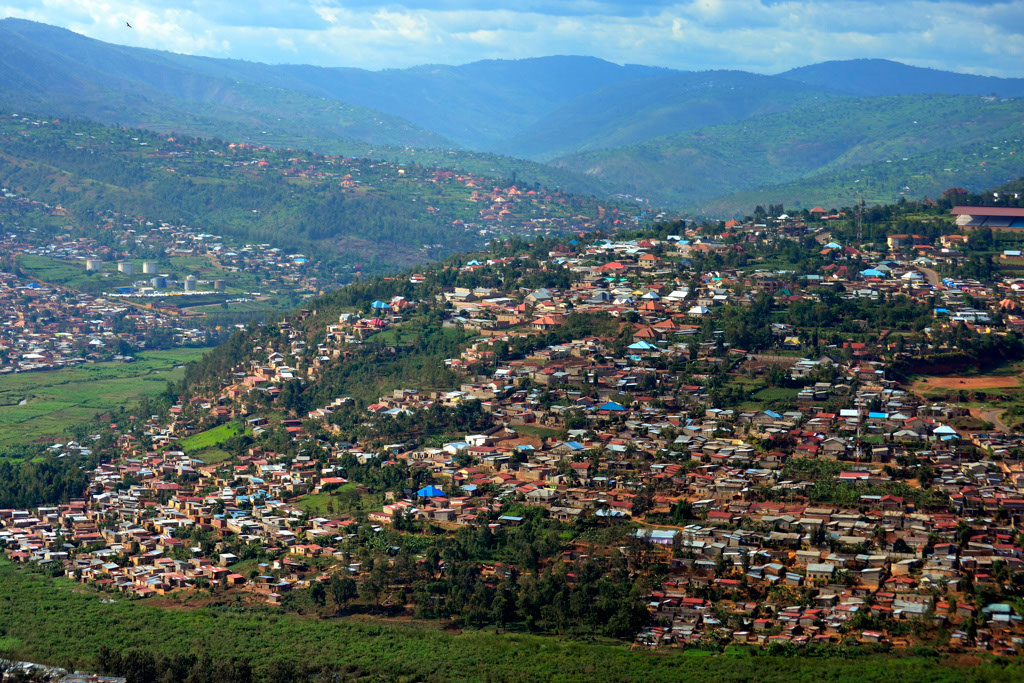
This trip was about contrast and wonder. Three days in Kigali is enough time to be charmed by perfect pavements and enjoy views over hill after hill, but not enough to to start noticing the flaws that would likely drive one mad after a year.

Do you feel like unleashing your own brand of crazy on Kigali yet? I sure hope so.

__________

Laila Le Guen is a 2016 aKoma Amplify fellow based in Nairobi. Growing up in France, her dreams of getting to know the world outside her small town were nourished by books from the public library. Her work has appeared or is forthcoming in Brainstorm, Aerodrome, Afrolivresque and Saraba.

Nigeria’s New Feminism – Say-You-Are-One-Of-Us-Or-Else

by Yẹ́misí Aríbisálà

___

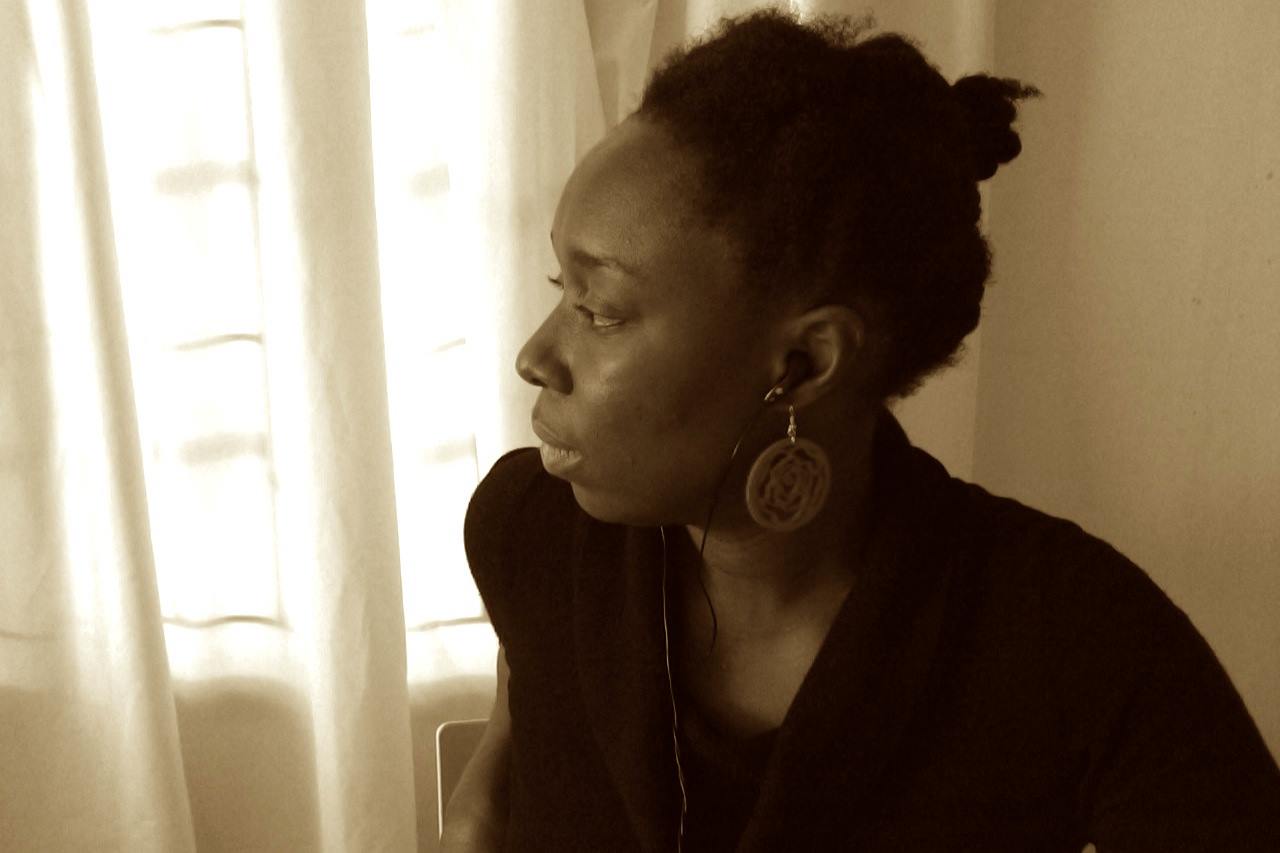
yemisi2My name is Yẹ́misí Aríbisálà. Because of context I must state that I am not a feminist nor will I ever be one. As made clear from the paragraphs below, the “or else” will come to my door and meet it open.

Over the last few months and especially after an interview in recent days, Chimamanda Ngozi Adichie has become the woman that we all love to hate. What irony. I only have one indictment for her regarding the attacks on social media for words spoken to the press in that interview: It is that she wittingly contributed to the creation of the “We”, the same mob that turned against her. It is what happens when people are not allowed to go away and really think and decide what they believe as individuals, and they are coaxed and persuaded and ushered into making decisions in groups. What happens when we all become a “body of feminists” without a a coalition of working, dissenting brains is that we are and become a mob.

The most recent social media uproar against Adichie is over her differentiation between feminisms – hers and Beyoncé Knowles-Carter’s. It is allegedly also about Adichie’s arrogance and the way she expresses herself that seems to condescend to the person being addressed. It is about causing a rift between feminists and seeming thereby to designate some as intellectuals and others as liberal and possibly nonintellectual. That feminists should not be distinguished thusly is the crux of the protest. Lastly it is about a supposed change of position indicated by Adichie’s permission to Beyoncé three years ago to use her words in the song Flawless suddenly retrospectively retracted in the interview. Or if not retracted, sidestepped in a clarification that said that giving permission for the use of her words in no way indicated that she and Beyoncé’s feminisms were moving along the same track.

So people are angered by the backtracking and the condescension and the lack of acknowledgement by Adichie that she got plenty of mileage in allowing Beyonce to insert her words in her song. But really the whole thing is about being fed up with Adichie’s condescension.

Here are my thoughts:

Adichie’s responsibility to her audience is completely different from Beyoncé Knowles-Carter.  Both may be in the public eye but Adichie is an intellectual and a woman of words. Someone whose philosophy cannot and should not be ignored. It is not a philosophy of entertainment that belongs to Beyoncé.  The philosophy of entertainment allows all kinds of things that real life will not accommodate. For example, a woman in entertaining people may take her clothes off and bend over to show her crotch in front of a room full of people and they will clap and encore her. In real life, she cannot do this, she may be dragged off to an asylum.

If certain people do not like the fact that the artist has exposed herself, they don’t have to go to her show the next time, and if she really offends, she can pass it off as intrinsic in the licence of artistic expression. Not so Adichie. Even though she doesn’t have a very effective PR body advising her on how to manage the balance between the transience of celebrity and the more crucial creation of art and a strong body of ideas that will surely outlive her, she is still operating in real time, in real life where people do not react liberally or placidly to the showing of crotches and cleavages and erotic dancing. Even when people try to pretend that they have blurred the differences between entertainment and reality, we should not believe them. They are being false. Real life is real life and entertainment is entertainment. And we all understand that no matter what happens in the rooms of Big Brother Africa, the contestants have to go home.

chimamanda

Chimamanda Adichie. Photo source: MyCelebrityAndI

I do not like Beyoncé’s art nor her expression of it, but that is irrelevant because I don’t have to go and watch her or buy her records.  More importantly, because she is an entertainer even if one who likes to include political material in her art, I don’t have to take anything she says to the bank. I don’t have to accept her philosophy of life and relationships. I don’t have to ascribe to my daughter sitting in a car and performing oral sex on a man and agree that this is liberal and open-minded. I don’t have to take her seriously at all. I don’t have to take a bat to a car. The agreement is that she is an entertainer and even if I am carried away by her beauty and power, and feel all hot and wonderful after her show, I don’t have to believe any of it. This is the contract of entertainment that exists but which people are attempting to falsely blur. Beyonce’s art is often about channelling pain and joys of relationships with men with very questionable language. The nudity, sexual language, and violence are in my opinion not powerful at all – not in any way about real power – and should be considered with great caution even in the realms of entertainment. But I am unwilling to tell people what to consider as entertainment. I love Billie Holiday’s music but on no account can I consider her doormat hood to husbands and lovers as expressed in her art as a sensible philosophy to life.

The contrast is that we cannot ignore Adichie. Not only because she carries enormous intellectual potential whether we like her or not, and possesses a great influence over generations of Nigerian women, but also because her views are daily being written down and concretised. She is a philosopher of real life in real time. More importantly, Adichie belongs to Nigeria and she is a beacon of that which is possible for the Nigerian woman. We cannot underestimate her worth nor her work. The attempts to disregard her are also a falsehood. Having said that, I must add that I dislike Adichie’s Americanah’s treatment of relationships between men and women. Her portrayals of traditional, non-“liberated” women in that work are uncharitable and tapered. Without a good balance of her art, her work, and her personal brand, she willingly inserts a fragility in her writing. Again I cannot take liberties in telling people how to live their lives. She can do what she wants. Adichie in the end is a powerful Nigerian intellectual with serious responsibilities.

In my opinion if Adichie informally retracted the permission she gave to Beyoncé to use her words in her song Flawless, then it was the right thing to do. Retrospectively, it is the right thing to do. If she never really gave it, then even better for Adichie’s ideas are in fact too good for Beyoncé’s entertainment. Too bad if Adichie did not know that, or if she saw it as an opportunity three years ago to get her words attention. If a person makes a decision one year then three years later changes that decision. That is what is called growth. And rather the person should be commended for growing and for changing their minds than castigated for speaking.

I will never pretend that I don’t change my mind.

The Yorùbá hold as sacred the head. That head has a mouth in it and each person has a head and a mouth. We can take this as a pointer towards individual thought and speech. We all have our irritating quirks, our mannerisms that rub people the wrong way, our crazy headless ideologies. We are all work in progress.

I am appalled that I can count on the fingers of one hand the people who stood up for Chimamanda Ngozi Adichie in a week of strong personal attacks against her from women like her, from women to feminists on social media. Not surprising, as a few weeks before that on Ikhide Ikheloa’s facebook page it was the annihilation of another woman, Abiodun Kuforiji Nkwocha, using language that made one’s mouth fall open in shock and disgust.

Chimamanda Ngozi Adichie is not a friend, a relative, nor even an acquaintance that I bump into once a year. I did sit next to her for two weeks in 2012 during the Farafina’s Writers Workshop. I disagree with many of her ideas, as I am sure that she disagrees with mine. Yet I have a responsibility to look at her and say – this is a woman like myself, with her own traumas and challenges and insecurities. More flesh and blood than a feminist philosophy or tract. More present than BBOG or some vague profile of a woman who is a victim of domestic violence, or some powerless hungry hawker of a girl. She is a woman, a mother and a wife. One day her daughter might google in her name and find the hate and vitriol and ugliness spouted against her. It is self-preservation on my part. I don’t want my daughter to be the google-r and see that I am a grasshopper in a swarm of locust attacking one person by consensus – telling her she cannot speak her mind. My role as a woman is not to gag other women and take away their voice – whatever it sounds like. Debate(s) should, happen but not on vicious personal terms.

yemisi3Why be the fighter for the rights of some faceless woman who I don’t know when I am going to be part of a mob rolling out the old tires and lighting a fire for burning another woman That I Do Know. If you do not like the woman, nor agree with her, is it possible to agree to disagree with decorum then let her be? I can determine that I find her tone arrogant but I don’t have to retaliate arrogance with arrogance. I can stay out of her way completely if it helps. I don’t even have to accept her philosophy for real life either. I don’t. Whatever my decision, it must be clear that like all tides things have a way of turning around.

I hope that if a mob does stand opposite me one day, someone will say “I know her, that lady that cooks moin moin on the internet. Let her be.”

____________

Yẹ́misí Aríbisálà is the author of a new memoir titled Longthroat Memoirs: Soups,  Sex and Nigerian tastebuds. (Cassava Republic, 2016)

Across the West African Coast: Ghana

By Yẹmí Adésànyà

It was work that dragged me across the coast of West Africa in delightful week-long bouts of adventure, each country exhuming different parts of me long hidden beneath the lacquer of a time-guzzling occupation. Some ports were more enchanting than others, workload and available time was not equally indulging, and thus my impressions are naturally skewed in favour of cities where my schedule permitted extra-metier experiences.

ghana1My journey started with Ghana, a colonial sibling of beloved Nigeria. Accra felt just like home: a buzzing commercial centre, invoking the unfortunately familiar and tiring spirit of boisterous vehicular traffic congestion, co-witnessed by hardworking street hawkers. My hotel was only a stone throw from the office, in Ring Road; there was not much time to play, I therefore did not see much of Accra. Ring Road is largely a business district, but my daily commute offered a view of the residence of one of the top opposition politicians, with campaign banners and billboards clearly marking his territory. So one might say the area is partly residential too.

20160429_144618Any city that reminds me of Lagos meets with a kind of languid resignation and apathy, the kind in which I steeped for the duration of my visit.  I got a lousy shot of the state house (although my driver was not sure it was safe to take these photographs) and a stationary armored tank, but no other sense of adventure or curiosity was piqued in me. I made a mental note to opt for a hotel in a different part of town when next I visit, as I prefer relatively less densely populated spaces, with minimal noise.  I was later rewarded on one of these trips with two West African cities that felt like heaven to my Lagos-suffused soul.

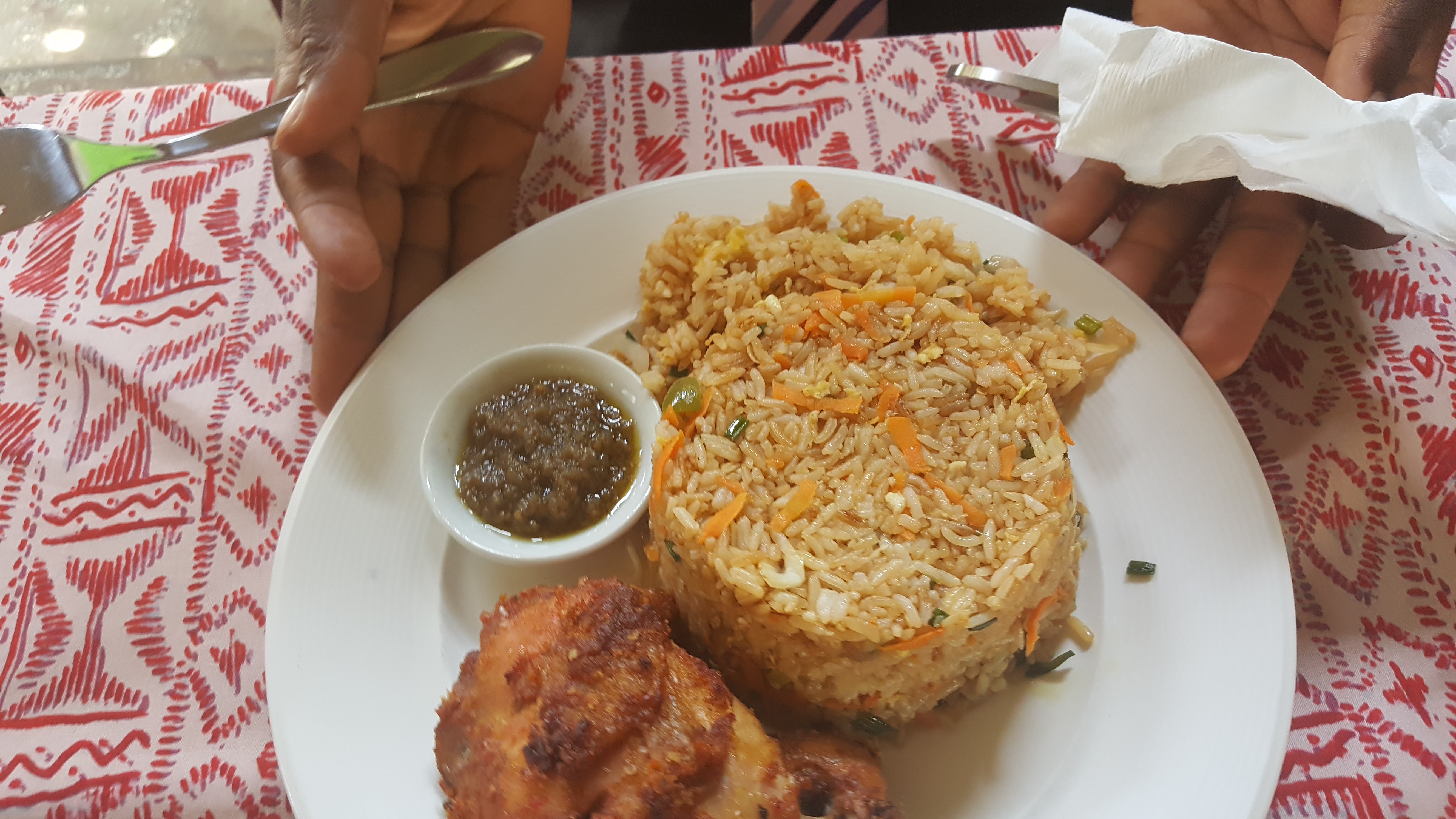
20160429_164403An interest that seemed of inexplicable significance, to my lunch buddy anyway, was a matter of immense national pride which I had made a mental note of witnessing, and documenting my observation and verdict. Many Nigerians have taken part in at least one light-hearted debate on the staple continental dish – Jollof Rice – and I had too, before my trip to Accra. I thought the Nigerian Jollof was better, just because, of course, but I had no objective evidence in favour of my bias. I had ample experience with the Nigerian flavor, and wanted to taste the Ghanaian, to have some closure. Well, I achieved that.

20160425_080640During my week-long desk-bound sojourn in the city, I was condemned to a food-evader’s utopia of monotonous lunch at the Swiss School, chiefly because it was close to the office, plus time did not permit any exploration anyway. I ate Jollof Rice in Ghana, and it was flat, and unlike the pill Posner took in Ibiza, no high followed. It was the second most unjollofesque rice I have ever eaten. Almost completely tasteless, inadequately seasoned, and what it lacked in tomatoes and salt, it made up for in excess pepper. As if that was not enough disappointment, the Zobo drink I enjoyed with my first lunch had taken on a more pungent taste by day two. Zobo the popular drink made by boiling dried calyxes of the hibiscus plant floweris big in Ghana, I was told by my colleague. What he forgot to mention was that it is not always harmless. The variant I was served on the second day shocked my palate to astringent displeasure and reminded me of the need to pay a closer attention to food labels in the future. Spicy ginger does not belong in Zobo drink!

20160425_130806I left Accra with a memento from the Ghana Art Centre market; a Djembe drum, delightful to my little music maker, and a regular reminder that one can sometimes find pleasure in interruption.

Encounter With a Brexiter

by Dèjì Tóyè

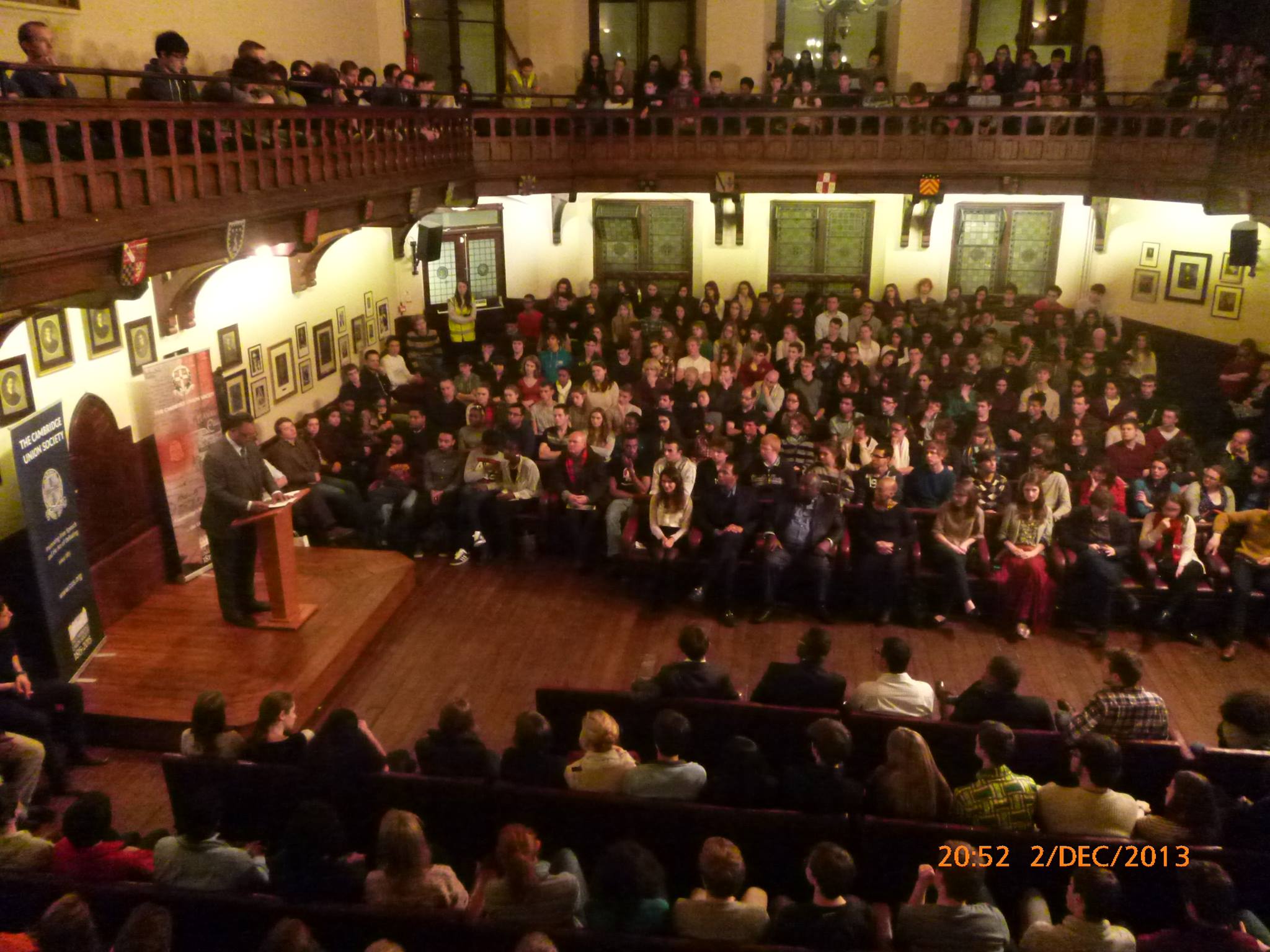
cambridge

A Cambridge Union Speech. Photo by Dèjì Tóyè.

The first Brexit ideologue I met in flesh and blood was not as dramatic as the foul-mouthed Nigel Farage or mop-headed Boris Johnson. The novelist Fredrick Forsyth was at the Cambridge Union Society to talk about ‘the 7 Pillars of Freedom’ a pretty dainty title for a talk about the future of the UK in Europe. It was in the late autumn of 2013 and Forsyth, himself now in the autumn of his life, was a character from a different era. The Union hall which filled up to the brim and spilled into the lawns when crowd pullers like Jesse Jackson or, as I understand, Julian Assange visited, was sparse on that occasion. I even got a front-row seat in the motley crowd that occupied half an aisle of the hall. As I made my way to that event, Forsyth was for me still an image—that young reporter whose career took off with his coverage of the Nigerian Civil War in the 1960s, whose reportage of that event challenged official British policy much earlier than most analysts’ and whose two books on the war would become as important as any other in the much controversial historiography of that war. In short, I was going to hear this internationalist with an expansive view of the world. But oh, what autumn does!

‘The 7 Pillars of Freedom’ was really a nativist treatise on how only the Anglo-Saxon world now holds the hope for true democracy, and freedom, in the world. And, oh, how Europe is gradually dragging Britain down the path that leads away from all that. Although, in my view, many countries across the world would check the boxes of the so-called 7-pillars, Forsyth did not believe what passes for democracy in the rest of Europe and much of the world (he has interesting things to say about Africa, by the way) meets the mark. The speaker also papers over the fact that Britain does not balance two of the pillars well—that is, the Pillar of ‘Elective supreme power’ (elective executive government) and ‘Election by constituencies’, at least not as well as in her ‘Anglo-Saxon’ peer, the US, where both popular and electoral votes are better balanced in the direct choice of the executive authority. This should have been warning signal that democracies are not all the same. After all, Aristotle may not even recognise as representative of democracy a gathering where all eligible men of the town are not congregated in the agora, caviling all day.

Forsyth’s performance in Cambridge has something to say about the way the Brexit campaign had been carefully curated over the years. Farage may fume and curse in the European parliament, and Boris Johnson may scare the hoi polloi with the immigrant bogeyman, our speaker knew well enough to strike a more dignifying pose before this debating society, appealing rather to the finer, if somewhat exaggerated, elements of the British heritage. Subliminal in Forsyth’s speech – made to the more politically aware of the students in this university that, together with Oxford, has produced all of UK Prime Ministers with university degrees, bar four – was a reminder of ‘the good old days’ when all of Europe was fascism or socialism and Britain ‘alone’ spread the light of freedom and democracy from the Atlantic to the Pacific (never mind that that itself rode on the tailcoat of imperialism).

forsyth

Fredrick Forsyth. Photo from thetimes.co.uk

That last point is important because Forsyth’s ostensibly more elevated argument also papers over the possible economic consequences of an ‘exit’ decision. It has been suggested that Britain got a better deal in the world when it was not constrained by the collective bargaining of the common market. What is forgotten is that the status quo ante has changed. The old empire has since disappeared and even that feel-good replacement for it – the Commonwealth – has now weakened. India, Britain’s most important colonial legacy is itself now a world power in both economic and technological terms (it launched 20 satellites into space in the last few days). China, that other Asian power, has since repossessed Hong Kong, the British Pacific holdout. Against the colonial dependency paradigm, the biggest European trading partner to Nigeria, Britain’s most important colonial haul in Africa, is, wait for it, The Netherlands.

But the UK has made its decision anyway. And as an avowed political determinist, I support it, just as I supported the Scottish referendum and even mildly wished the separation campaign won, if only to reinforce my belief that, as I stated then, a nation is an argument and not an axiom. It is a lesson for Nigeria and other struggling political inventions of, well, say Britain.

__________

Dèjì is a lawyer and creative writer, based in Lagos. 

For Ọlákìítán (April 30, 1984 – May 31, 2016)

Laitanxxby Yemi Adésànyà

“I will see you when I return”, I said

But the reply came as an empty sound

Followed by a reverberating crash

And simultaneous burst of love-laden eyes

Caked over a closed retina of time and reminiscences,

Congealed bonds that neither bleed nor budge

Baked over thirty-two fleeting years in a familial furnace.

Six green bottles on the village wall

One fell to the horror of a purblind audience

Sending shreds of tears through transatlantic waves

Mouths ripped by ripples of shock

As phones ululated in mournful ring back tunes

Disbelief became the punctuation for grieving souls

But the rainbow was already sealed in an obdurate cask.

Raw hearts flickered and shivered

In muted sopranos and suppressed throes

Rising to a crescendo of idiomatic anguish

As the creator chose to wield his pleasure wand

On the eve of an otherwise joyful birth.

Life began before we saw it emerge

A fair maiden in head-turning pageant strides

when we met her with a full possessive embrace.

Laitanx

Nobody warned us that our hold was too snug

We wouldn’t have heeded anyway

And together, we journeyed through laughter and storms

There is no earthly cure for this riling wound

Tears are too slippery for any tangible grip.

No support holds true for our flailing souls

Words fall flat, too dry and blunt,

Drained to ashes of their ephemeral meanings.

Prayers have become snails, crawling to heaven.

Will they return to us in time with a consoling riposte?

This loss is fine sand on the clean Gambian beach

UbiquitousLaitan1

No matter how boxy your shoes are

It permeates

Deep inside the craters between your soul’s toes.

Far away on a smothering homeland bed

A bright star had dropped from an impossible height

Piercing the earth with its sharp, stringent, edges

Sending particles flying into the eyes of all

Who watched its illumination.

We could only look on in helplessness

The ship already sailed with our prized possession.

Larceny! We cried on top of our frail lungs

Then we were told she wasn’t ours to keep

We can only hold on to memories now;

Those are safely stashed away

Where no bandit can snatch them.

Poetry will not heal us of this loss

Tomorrow will surely be celebrated in a wan frock

Till we meet again on the blue skies of dreams

One-sixth of me died with Mayowa in May.

________

Ọláìtán Máyọ̀wá Adéníran (nee Ọlátúbọ̀sún) is my only younger sister.