Browsing the archives for the Fun category.

3bute.com & Caine Prize: Press Release

The 2012 winner of the of the £10,000 Caine Prize, Africa’s leading literary prize, will be announced at a celebratory dinner at the Bodleian Library, Oxford, on Monday 2 July. To promote the new crop of young writers, 3bute.com in collaboration with the Caine Prize will be adapting (so readers can mashup) all the stories shortlisted for this year’s prize before the winner is announced.
Drop dates for the Caine Prize 2012 ‘3butes’:
–          Stanley Kenani (Malawi) ‘Love on Trial’ – May 27
–          Melissa Tandiwe Myambo (Zimbabwe) – June 3
–          Constance Myburgh (South Africa) ‘Hunter Emmanuel’ – June 11
–          Rotimi Babatunde (Nigeria) ‘Bombay’s Republic’ – June 20
–          Billy Kahora (Kenya) ‘Urban Zoning’ – June 30
 
3bute [pronounced: tribute] is an online anthology devoted to the contexts often missing when African stories are reported. Our mash-up platform lets artists collaborate with writers on 3-page visualizations of their stories and journalism. By being able to add context to these narrative and “mashable” surfaces, our goal is to render, with your help, the developing world in a more engaging and immersive way.
3bute’s mashable surface lets everyone add their voice to the story by submitting relevant links to any context/ media content they can find on the web. 3bute pages can also be embedded all over the web, and the context everyone has added to the page goes along with it. In other words, 3bute is a social, accessible and sustainable way of distributing African stories, along with much needed context, around the web.
This year, like never before, overwhelming attention is being drawn to the shortlisted stories, thanks to the efforts of portals like ZunguZungu. 3bute hopes to offer a hotspot for the discussions around the stories.
For more information visit www.3bute.com or email us at mail@3bute.com.

Kitengela Nights

(Kenya, 2005)


Kitengela nights, a freedom flight.

Dry wisps of grass fly by, breaking

with the cold wind of a pregnant night

as harmattan singes the flesh and mind,

lungs dotted with dust and rust.


Nairobi evening. Lights, cold,

And love – ugali and roasted meat,

Nyama choma, in the walled hub

Of a distant home from home:

Then, warmth in the eastern country.


April winds break across my face

in the bust of a fast-moving beast.

We were four – and a few more,

Strangers in a foreign land, alone.

Only love moved, hosted, filled us.


Now, the mind journeys back

In soft bytes of soothing moods:

dark, homely evening, Kenyan tropics.

Rain and home in a distant place.

Kitengela, you live across from me.

Shit ________ People Say

These series of youtube videos highlighting cultural/linguistic eccentricities have been all around the internet. These three made my day.

Jamaica


and New York


And No one

There are a lot more online, some funnier than others. It’s fun wondering what expressions would be in “What Linguists Say?” video.

The Whole Picture

The last couple of days has brought a record number of new visitors to this blog. That brings with it a certain kind of delight. (Welcome people!) I may yet resume a regular dump of my thoughts on you once again as I have been doing for the past two years. Sitting here for the past few hours has brought me into a few ideas none of which have furthered the work into my thesis beyond a few sentences. On one screen is my twitter feed that shows me diverse opinions of trending topics, from the Golden Globes to the Fuel Subsidy fights in Nigeria (in which my heart absolutely resides), and the Republican Primary fight in which another video has shown up with frontrunner Mitt Romney offering an unbelievably cold response to a sick man who had asked for his opinion on medical marijuana.

As I have discovered many times over, coming back to the empty page of a new blogpost always brought words back to my fingertips, bringing me back to a required level head to continue my work. In any case, here is what I thought: a solution to an old puzzle. All the (about three thousand) pictures that I have taken since this travelogue began need to go somewhere. As from today, I will be putting one (or two) of them per week out on the blog’s Facebook page with a little back story. If I never eventually make it to writing/completing that travel book of all those experiences, pictures and short back stories would have to do. Of course, you would be missing out on this if you are not already following the page.

Alright, that is out. Back to wondering how to successfully measure the progress of second language tonal acquisition, and communicate same to a thesis committee.

Conversations with Neil deGrasse Tyson

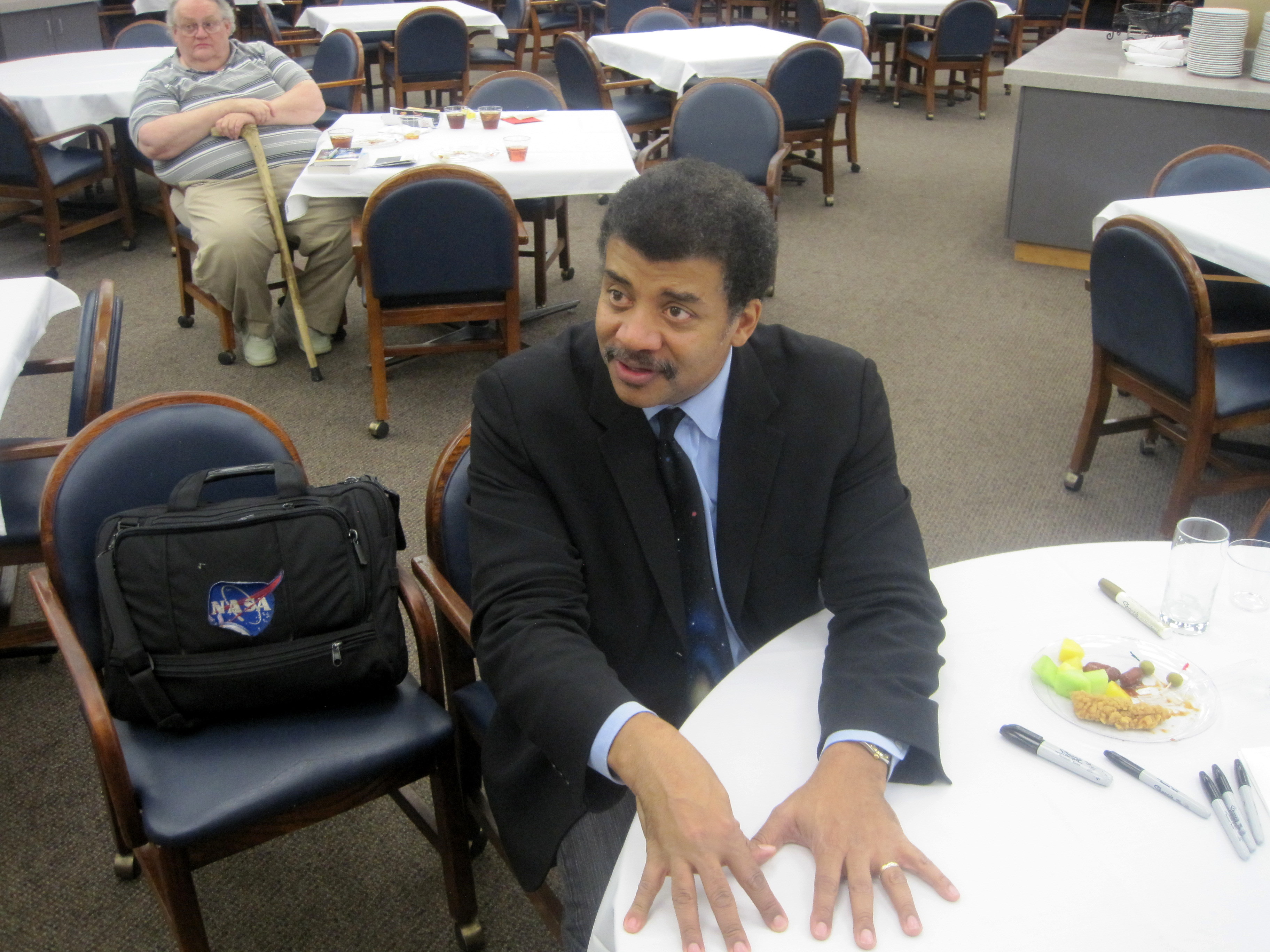
America’s most famous astrophysicist dropped by campus today for an event of the SIUE Graduate School. Dr. Neil deGrasse Tyson is the director of the Hayden Planetarium in New York City and the recipient of the NASA Distinguished Public Service Medal, the highest award given by NASA to a non-government citizen. He is also the author of The Pluto Files and Death by Black Hole (and other Cosmic Quandaries).

His talk, titled “Our Past, Present, and Future in Space” focused on the regression and eventual end of the US space program, and the contribution of public and political apathy to this end. Those who have heard him talk will already be familiar with his worldview: a passionate defense of imagination and a unified, inspiring public policy for science. The end of the space program, according to Mr. Tyson, is one of the worst things to have happened to America in a long time not only because of the now total absence of motivation among young people, but also because of how the general apathy has now negatively affected the status of the country in the world. In a preview to the visitor’s speech, Dean Aldemaro Romero of the Faculty of Arts & Sciences had this to say: “While I was growing up in Venezuela and told my parents that I wanted to be an astronaut, they told me ‘You have to be either an American or a Russian.’ Now, many decades later, as an American citizen, I have found out that to go to space, I’d either have to be Chinese or Russian.”

There was a lot more. The maps of the world, when plotted on a chart on the basis of resources spent on science (and, on another chart, on the basis of scientific progress/development in the last decade) shows the African continent virtually invisible. What concerned Dr. Tyson however – as well as the members of the audience – was the shrunken shape of the American map as well. Even Brazil, and Japan, on this map showed far more encouraging progress, to the dismay of all who have previously believed this country as being on the farthest frontier of future advancements. Many things are wrong, among which is the absence of a political will and imagination.

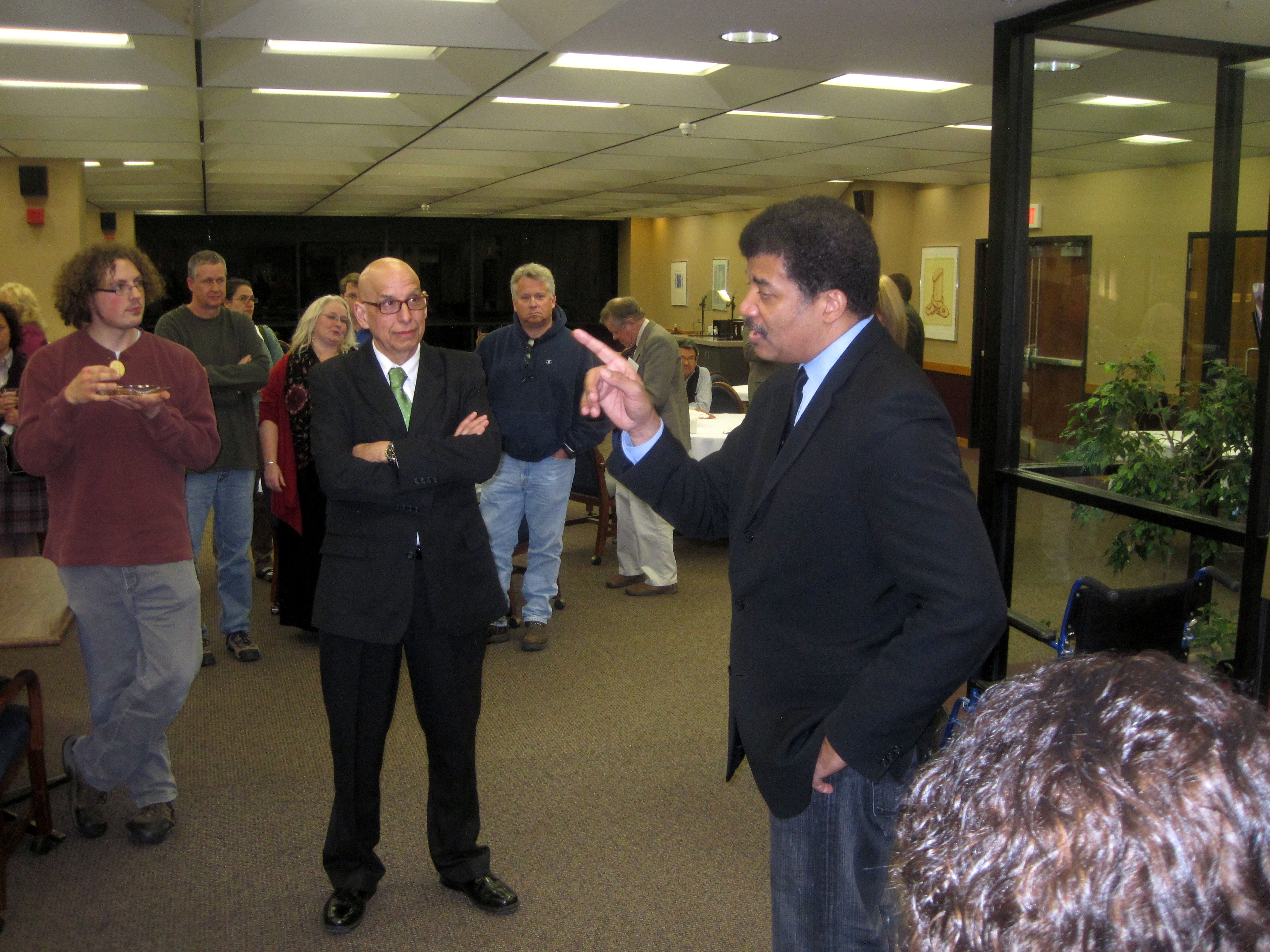
At the reception party arranged for him, I asked for his opinion on the absence of scientific advancement in Africa, and whether the frontier had irrevocably moved westwards. He disagreed, opining instead that like every great civilization had come and gone, the continent would have its turn again at some point in time. There is a particular initiative at the moment in South Africa, he said, where scientists have begun training young high school students in order to be able to produce the next big scientist (of the stature of Albert Einstein) and a Nobel Prize in Physics from the African continent. What did he think of Physicist Richard Feynman? “He’s as brilliant as he has been described,” he replied.

Known among young people in America today as the man who relegated Pluto from the status of a planet to that of a mere floating astral rock, Neil has contributed to the progress of modern science and astrophysics in popular culture than most people in the world today, and continues to do so. It was quite an enlightening event. His autograph on my copy of his book simply read: “To Kola, welcome to the universe.”

His book, The Pluto Files details in a fun manner the arguments and debates surrounding the relegation of the former planet Pluto, including also letters from angry young children and cartoons from the media weighing in on the many sides of the relegation debate.

Previous guest speakers at the Arts & Issues events here include Maya Angelou, Ken Burns, and the Basie Count Orchestra. I recommend this video, by the way, Dr. Tyson in conversation with Stephen Colbert. (H/T @loomnie)