“One of the magical things about theater is that it gathers a crowd of people in a quiet space, and each member of the audience gets to see how people respond differently to the different things being said on stage. The person next to you will laugh at something that you’d never think of laughing at, and you’ll get a glimpse into all the different ways of viewing the world. Unfortunately, so much theater today is less nuanced. It gives you a large dose of one way of thinking, in hopes of getting as many of the same type of people into the theater as possible.” – a thespian recently features on the Humans of New York page.
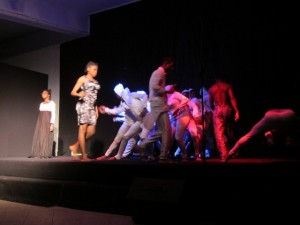 I begin my review of a stage production of Wole Soyinka’s A Dance of the Forest (1963) by Segun Adefila’s and the Crown Troupe of Nigeria from this, a succinct appraisal of theatre as a vehicle to entertain and inform a populace without catering to mass appeal alone, but rather individual tastes through a large but severally tailored offerings.
Perhaps no other play could be used as a poster example for the complexity of theatre and its ability to regenerate itself in a myriad of colours to diverse people than this production which, produced to mark the 80th birthday festivities of its playwright, was only one of the few other performances of the author’s play around the same time. In actual fact, another production of the same play, at a far larger and ambitious scale, was performed on the night of the celebrant’s birthday itself, right across from his front yard in Abeokuta, with trees, shrubs, and real life rock formations as a live set. Photos from that ambitious performance posted on social media depicts a throbbing energy of an audacious imagination, with an air of theatrical verisimilitude for which the author should be extremely proud: an ensemble of real life masquerades, for starters. But I digress…
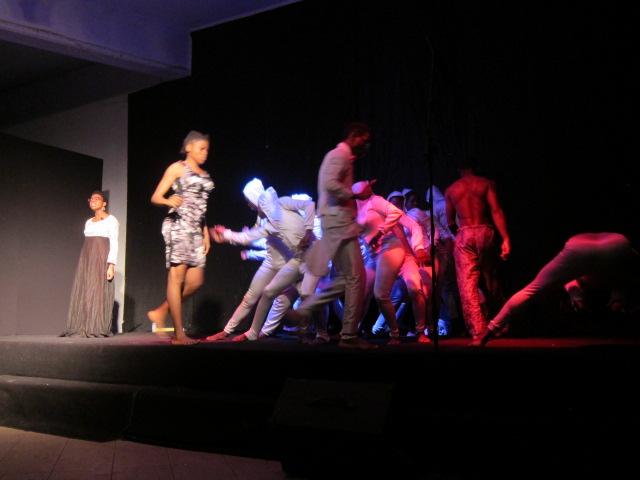
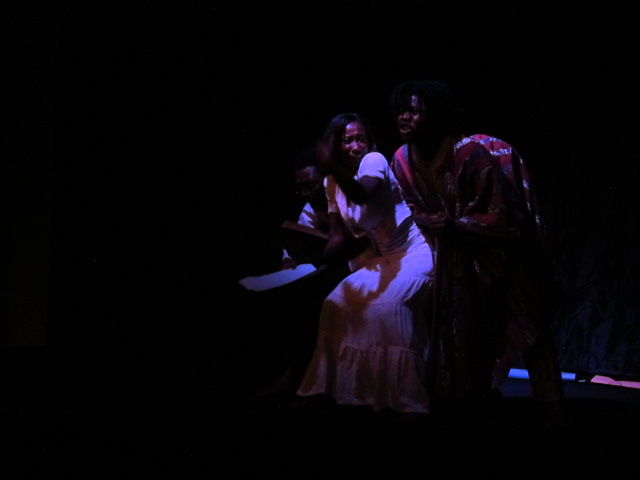
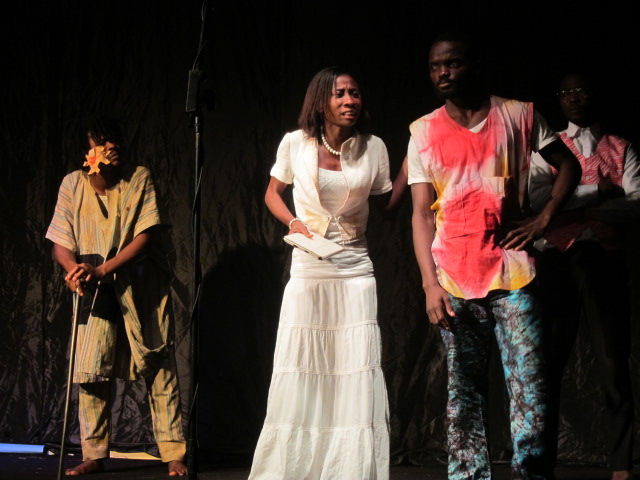
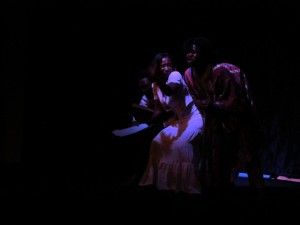 Segun Adefila’s production was a far less ambitious enterprise, which shouldn’t be surprising giving the grand and colourful exertions the play itself embodies. A Dance of the Forest, first performed in 1960 as an iconoclastic satirization of Nigeria’s independence celebrations, has been described as one of the author’s most complex and most difficult to understand works. However, effort was made, not just in the utilisation of the small stage that Terra Kulture (the venue) provides, but also in improvisation on the script of the play itself. Most of the improvisations were with songs, jokes, costumes, and slangs. At one point in the play, a character sings from Omawumi, a contemporary Nigerian musician who was definitely not born in 1960: If you ask me, na who I go ask…? An obvious oversight that could have worked for great dramatic effect happened when the corrupt civil servant was presented a bribe in broad daylight. The token was… a loaf of bread. Audible gasps in the audience suggested that it could have worked way better with a bag of rice. I agree.
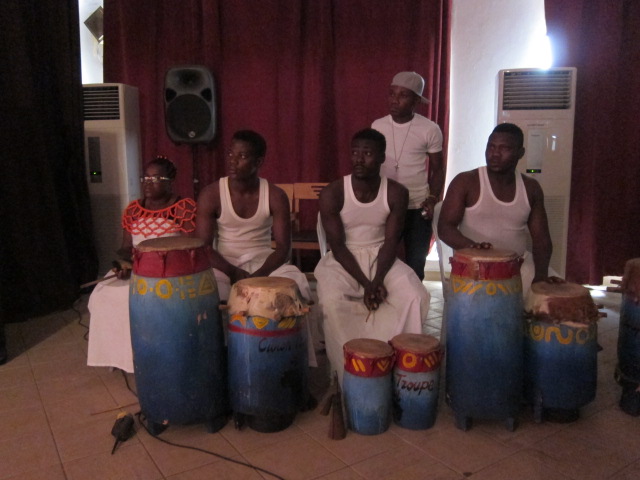
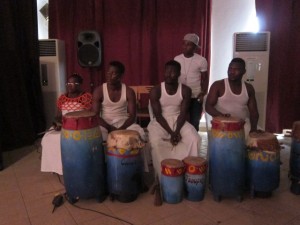
For a low budget production which, one assumes will not, except with some sponsorship, recoup its cost of production (even with the 3,000 naira, $20, gate fee), the play was well rendered. The hall was full, and the audience engaged, with songs, dance, drumbeats, and a dialogue that flowed in the right cadence, at least for most of the night (except for a few understandable omissions or stammers here and there). For a member of the audience with no knowledge of works by Wole Soyinka, this might be a rough introduction, helped only by the dynamic acting of some of the cast. A green-white-green motif featured prominently throughout (a reminder to the audience that Nigeria is the real subject of this play), while the masquerades dressed in white fitting overalls.
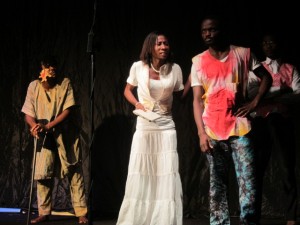 For someone watching the production of this play for the very first time, not much is lost. In fact, a few things are illuminated; how, for instance, the two undead characters loitering around the forest in search of someone to take their case were actually metaphors for the evils of slavery from an earlier time. Why the author chose to depict the man as a castrated being is his to explain, but the depiction leaves no one in doubt. That explanation is just one of the many layered metaphors that earned the play its reputation as a difficult but ambitious experiment. Patient readers, and audience members of future performances will benefit even more unveiling of the work’s many nuances.
There are others head scratchers. Names of Fela! Awolowo! Balewa! were repeated at a number of times as chants to what came before. But there was no Azikiwe. Why? What defines this group which takes only three names: Fela, Awolowo and Balewa? In any case, by 1960, none of these men had achieved much of what gave them the great stature that eventually stamped them into immortality. Definitely not Fela. It is also highly improbable that the author had written the names of any one of these into a script written as early in the life of the country as 1960 when much of what toppled that first democratic experiment had not even unfolded yet.
 And while we’re on oversights, why was there never a consensus before, during, or after rehearsals as to what the right pronunciation would be of Demoke the murderous carver, a major character in the play? Is it “Démoké”: [A + dé + ọmọ + kẹ] “We crowned a child to pet”, or “Démókè”: [Adé + mú + òkè] “Ade held onto the heights”. It seemed a bit distracting after a while, I would assume even for those who don’t speak the language of source, that the pronunciation of the character’s name changed at will without any logical, textual, or dramatic justification.
And there end the knocks.
“Movies will make you famous; Television will make you rich; But theatre will make you good.” Terrence Mann was said to have quipped. For me, as theatre typically guarantees, it was two and a half hours of mental and aesthetic stimulation. Definitely a well-spent time.
______
Read a review of the work itself here, and – even better – here.
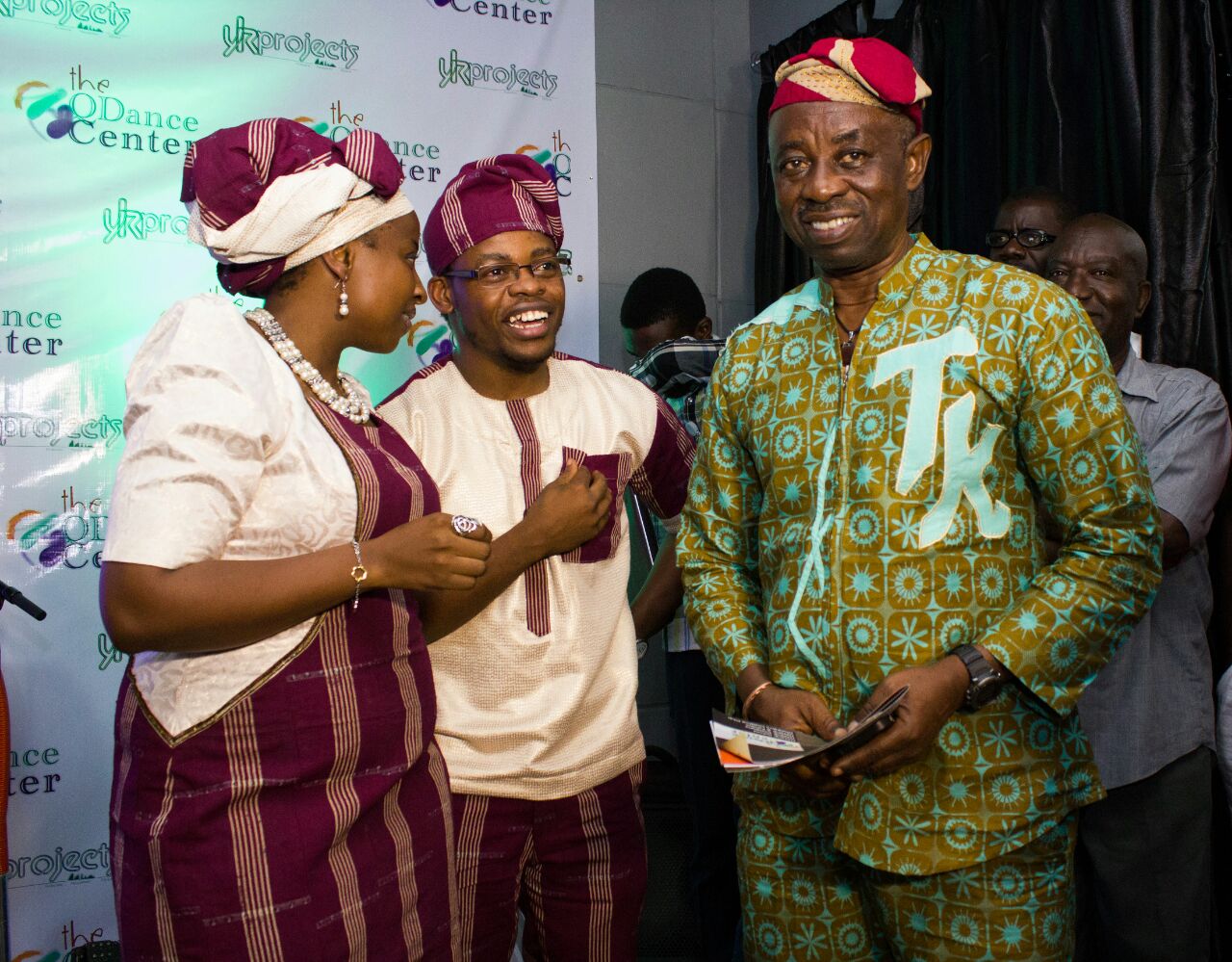 On the third of August, Mr & Mrs Qudus Onikeku commissioned their latest project, a dance academy. It was an informal cocktail party dotted with short monologues, artistic performances and finger food. In attendance were bigwigs of the creative industry—filmmakers, writers, actors, comedians, editors, poets and, of course, dancers.
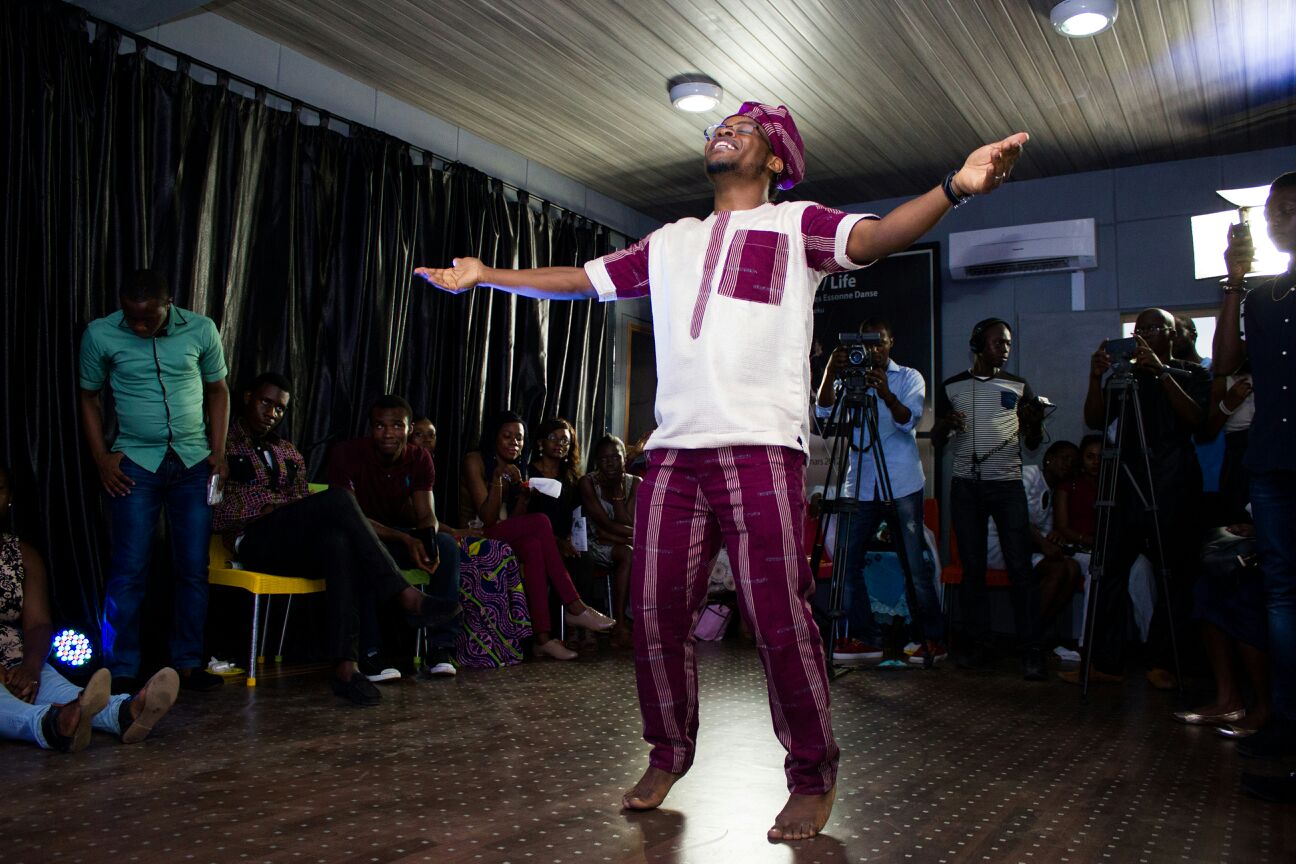 Qudus targets young individuals passionate about dance and he encourages them to enroll at his QDance Center. Young adults are better of pursuing something instead of being idle and becoming tools for ungainly use. The dance space will also be made available for creative seminars, poetry readings, close-knit film premieres and whatnot. And of course, dance drop-outs are eligible to enroll to reignite their long lost interest in dance.