Browsing the archives for the Art category.

Guest Post: My Clicker

by Adaeze Ezenwa


I’d like to get a camera, not one of those high-tech contraptions with dials and buttons intended to confuse and confound. I’d want one that is just a simple shutter and lens operation but will make me some stunning pictures. I would not take pictures of people, they do not interest me. I might take pictures of babies though, just because they haven’t learned to be self-conscious before the camera. Their essence would shine through because they aren’t concerned with making a fine picture or in my capturing their most flattering side.

Animals are more appealing to me, goats especially. I’d take pictures of goats, cows and monkeys, no cats or dogs because I do not like either. Then I’d take pictures of houses, interesting houses. I’d find the most fascinating houses, no house built within the last twenty-five years would qualify. In Sapele I found the most beautiful colonial houses, I’m glad that they haven’t been torn down for space to make the monstrosities that are the stamp of the nouvelle rich. I’d travel from town to town and find houses worthy of my clicker, I’d print them in the widest photo paper and hang them everywhere.

 Nigeria is an art treasure trove and my camera would bring a huge portion to life. From the wood carvers of Epe who make the most exquisite carvings of canoes and Ẹ̀yọ̀ masquerades to the Bronze castings of Benin and Ifẹ̀ and the beautiful, beautiful patterns that our weavers produce on clothes that are almost too beautiful to wear. I’d show you the street painters of Lagos who put the Picassos and Monets of this world to shame and the extravagant poetry and glass works of Bida craftsmen. Have you seen the wall art that decorates most Northern palaces? Fret not, my camera will show you all that and more.

I’d go round the country looking for rocks and hills and jaw dropping landscapes. Finding the most beautiful plants and flowers would be my delight, my pleasure and perhaps my salvation. From the tiny sunflowers that line the road to my grandfather’s house but strangely do not grow around the house, to the pale pink hibiscus that makes me wonder if it’s a mutation or a deficiency that bleached the flowers from the variety that produced the bright red blooms that I used to wear in my hair and that has drawn my eyes in every part of Nigeria that I have visited. Not forgetting the Ixora from which my brothers and I sucked the nectar even though we didn’t really like it. We did it because we didn’t want to seem like we were snobbish Lagos children in our hometown, we didn’t know that we would never belong even if we sucked all the Ixora in the world. Ixora might have nectar but they do not hold a candle to the fresh flowers of the Hibiscus that deliver a burst of tangy and sweet when you chew them. The dried flowers make the drink you know as zobo, that red liquid that will stain your tongue and clothes, the same one that southerners are prone to make with ginger. Please stop that nasty habit.

  And the rocks? I’d travel from Ọ̀rẹ̀ to Okpella to Jos and Kaduna in search of hills clothed with the most diverse vegetation you could think of. I’d bring images of majestic rock sides polished by thousands of years of rainfall and of depressions in the earth that makes the houses look like match boxes and the people like ants. Wouldn’t you like to see the green that decorates the rain forest? All the shades of green and a dusting of light brown will give you a peace that words cannot describe and the plenty snails and other bush creatures that make Bendel the home of bushmeat.

Then I’d take pictures of the soil, the light brown sand of the Savannah that drinks up any liquid with a speed that will startle, the rich loamy soil of my hometown that pulses with life and brings only one word to mind- fertile. Then I’d go to Enugu and show the world the baby rocks and monstrous pebbles that the people there call soil. From Benin we’ll see images of that rich red clay that coats everything with a reddish patina before coming to Lagos the city I was born where I’d show the aptly named potopoto. That clingy blackish mass that SUVs like to spray on hapless pedestrians, it’s not surprising that the first thing a Lagosian wants is wheels and metal roof with four windows and a windscreen.

I’d love to take pictures of the sky, of the blue sky dotted with pretty white clouds that remind of Mary’s little lamb. Or the days when the clouds are a duller shade of white and seem heavy without promise of fruit. People of the earth would describe such weather as cloudy, I wouldn’t use such a mundane term. If I could, I’d capture the play of colour that makes the evening sky its canvas. Most of all, I’d like to take a picture of the sky just before a storm- the kind of storm that you’d instinctively know that your umbrella is hopeless against. I’d show you the papers and nylon bags whipped by the frenzy of the wind, show you the sky black with surging rage and the bands of lightning that provide the most amazing contrast you’ve ever seen. Then when the first drops of rain come down, I’d take pictures of the thick fat drops as they hit the earth. Thick and fat like the ones dotting the windscreen of the bus I’m currently sitting in. I am in Benin-city and it always rains here, if I had a camera I’d show you the patterns formed by the raindrops.

I want a camera, will you buy me one?


___________

Adaeze is a writer who recently started referring to herself as one. In another life, she studied pharmacy at the University of Benin and had high hopes of becoming the next Dora. Now she sits in front of her laptop and writes about the everyday trials and joys of a single sistah in Lagos. She still lives with her parents and brothers and she’s married to Jesus.
American Corner to Screen Femi Amogunla’s “The Bargain”

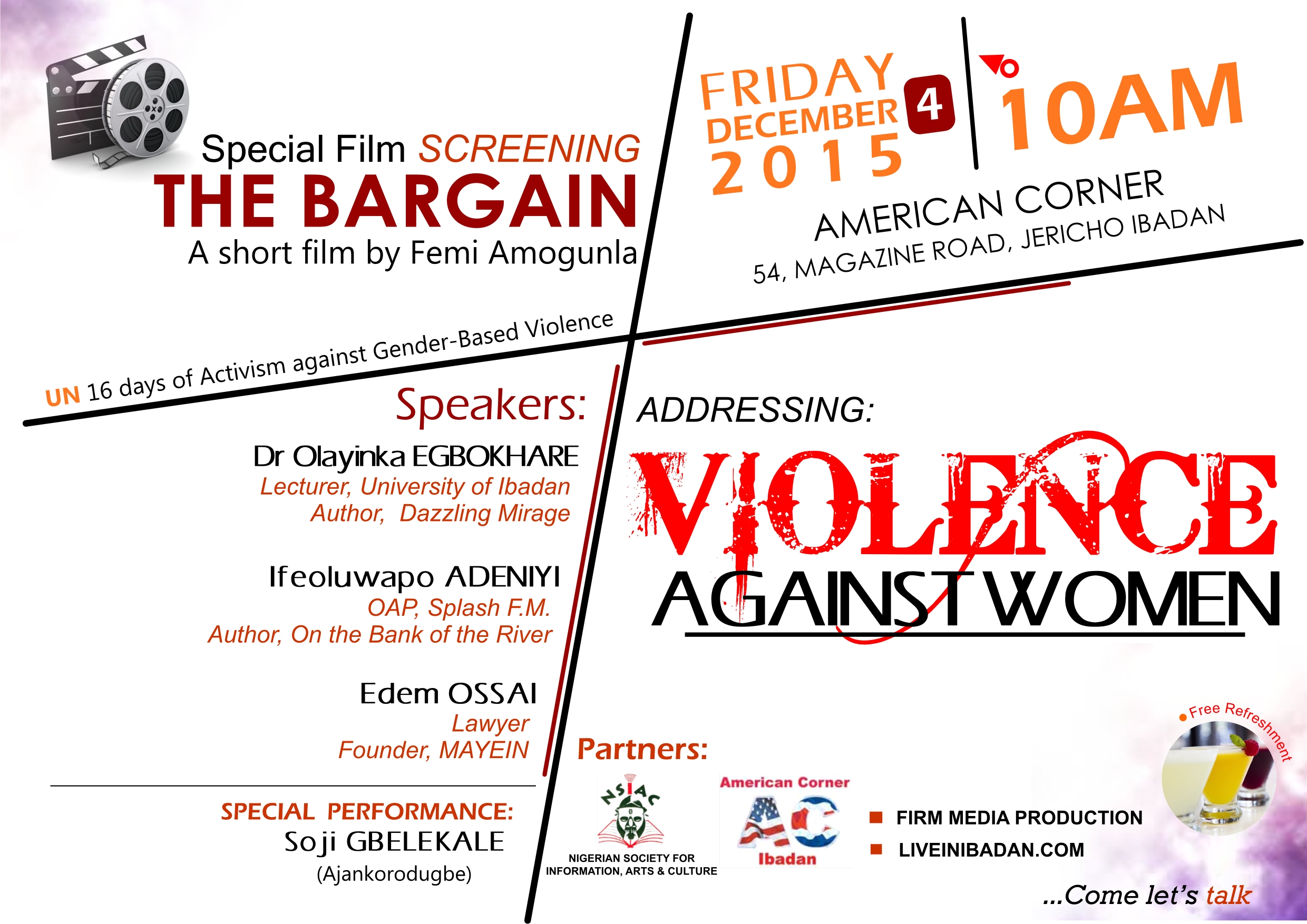
As part of the United Nation’s The 16 Days of Activism Against Gender-Based Violence, American Corner, the Nigerian Society for International Arts and Culture, Firm Media Production and Liveinibadan.com join the world to stand against gender-based violence.

The Bargain. AThe 16 Days of Activism is a yearly international campaign that runs from 25 November (International Day for the Elimination of Violence against Women), to 10 December (Human Rights Day). The Bargain is apt to raise awareness about these issues because it chronicles a woman’s life, from childhood to adulthood.

“I think that film has power not only to inform but to transform. Many will see themselves in film characters and I think much more than whine about the abuse that happens in marriages, it is important to do something. This is my own little something,” says Amogunla Femi, the producer of the short film.

The film screening will be followed by a conversation on the many manifestations of violence against women in the society.

Venue: American Corner, Jericho, Ibadan

Time: 10am

Date:  December 4, 2015

About The Bargain

The Bargain is a short film that chronicles the life of a Nigerian woman from childhood to adulthood. It shows the many manifestations of gender-based violence against her; this violence resonates with many Nigerian women. The film is about how the Nigerian woman negotiates her existence daily, the way she bargains with reality, with stereotypes. It is a call from one woman to another on the price they place on their lives, on their value. It also raises questions: what are the lessons women learn while paying this price? How much or with what will you trade your worth?

The Speakers

Dr. Olayinka Egbokhare teaches Communication and Language Arts at the Faculty of Arts, University of Ibadan. She is the author of the widely acclaimed novel Dazzling Mirage which was adapted for screen by Mainframe Productions.

Ifeoluwapo Adeniyi is an On-Air-Personality at SplashFm; she is also the author of On the Bank of the River which is on the longlist of the Etisalat Prize for Fiction, 2015. She loves literature and has a penchant for socio-economic and political issues.

Edem Ossai is a Lawyer, development practitioner and founder, MAYEIN (Mentors Assistance for Youths & Entrepreneurs Initiative). Edem received a Commonwealth prize in 2013 for her Essay on the role of women in leadership and entrepreneurship.

Abiade Abiola is a lawyer with an interest in women’s human rights, children’s rights, sexual and gender-based violence and alternative dispute resolution. She is also the founder of Human of Substance Empowerment Initiative.

Femi Amogunla is an award-winning multimedia artist who works with stories, photography and film. His poem My name, My Identity was curated, produced and performed as part of the 30 Nigeria House Project during the 2012 Olympics. In 2014, he was commissioned as one of the official photographers for the #VoteNotFight# campaign in Oyo State. His photography has also been featured in Kuramo Report.

When Femi is not writing or producing, he takes a shot at the world with photography. The Bargain is his first short film.

Aké Diary (IX): The Deadly Laughter

by Emeka Ofoegbu


When the four kings of the satire sit down to have a panel discussion you can only expect brilliance.

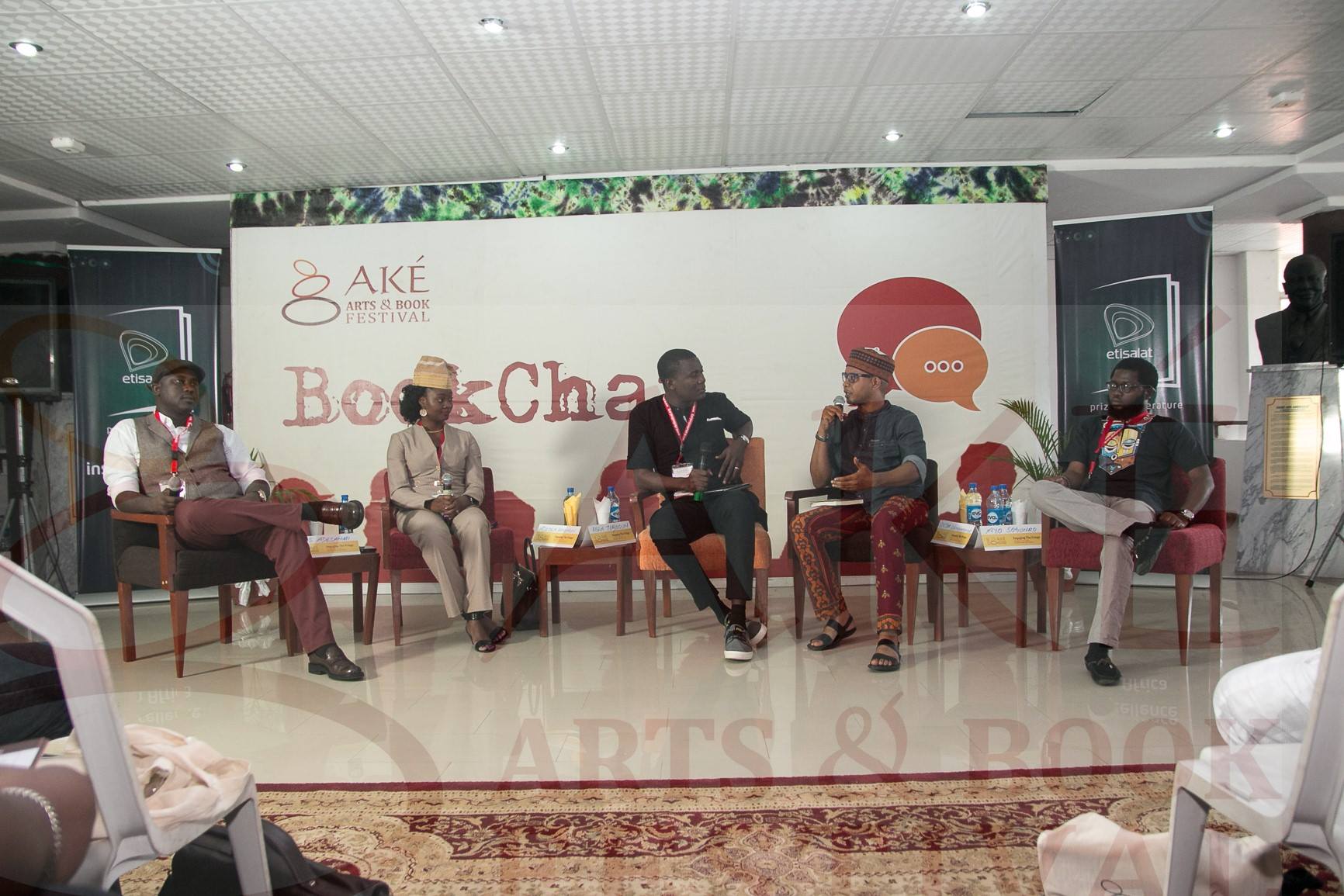
12240855_1072254982794106_817242026421824695_o The panelists are Pius Adésanmí, author of Naija No Dey Carry Last, Adéọlá Fáyẹhùn, host of popular online show Keeping It Real, Ayo Sógunró, author of The Wonderful Life of Senator Boniface & Other Sorry Tales and Victor Ehikhamenor, visual artist and author of Excuse Me. The topic is Deadly Laughter: Satire and Public consciousness in Africa. The moderator is Kọ́lá Túbọ̀sún, acclaimed linguist.

The discussion kicks off to Adéọlá admitting she has received countless death threats for the work she does on her show even with the disclaimer. This is something her fellow panelists agree with. Satire is an approach to dealing with major issues that affect our immediate society which is quickly catching on. The satire is meant to be as subtle as possible but still heavily packed with intent and often met with disapproval and hostility. One thing the panelists agree on is that as a writer of satire you must develop a readiness for vicious backlash. The art of subtle reproach is often too much for people to handle and for those who understand what is implied they cannot stand to be portrayed in that light so they strike back or speak out against it.

12291120_1072255166127421_2596372418372204354_oVictor lets us know that amidst the vicious attacks on satirists, the satire is meant to deflect violence being a way to say what you want to say without being direct. On whether people effectively understand the satire, Ayọ̀ says there are some people who “even if it is clearly marked and sent, some people still don’t get it”. Pius talks about his work saying that the satire respects no one. It brings out the people perpetrating wrongdoings and ridicules them. Often times the case is that they don’t like how they are portrayed so they prefer a direct attack.

Although the satire is meant to be daring, Ayọ̀ tells us there are certain things he cannot write about. He believes feminism is one of these things. He says this simply because he personally cannot handle the onslaught when it does come. To this Victor drops one of his many wise sayings “because you have sharp scissors doesn’t mean you’re going to be cutting everybody in the village’s head off”. It is explained that the moment as a satirist you threaten yourself by attacking matters that are unnecessarily dangerous you’ve crossed satire into sensationalism.

12247737_1072255476127390_4458254252724755255_oWhen the question of who censors the satirist came up, Adéọlá was quick to say “everyone.” She gave us examples of how she was hounded for speaking about a particular issue and again hounded by the same set of people when she decided to remain silent on the same issue. She explained her style of approaching the satire and how it has worked for her this far. According to her she lays the fertile ground before doing the dirty work of planting. She says complimenting before hitting the nail on the head is a style she has developed in her career as a satirist.

Questions were taken from the audience with Professor Niyi Ọ̀súndáre saying the steps to being a good satirist include: “dig your grave” “buy a good coffin” and “write your will”. When asked what it takes to be a satirist, Victor says to portray serious issues in a humorous yet objective way requires a level of humour to avoid it coming across as forced. After all, according to him “it helps for the snake to have venom before it bites”.


______

Photo credit: Ake Festival

Writer Sightings: Ndinda Kioko

This week: Ndinda Kioko

http://writersightings.tumblr.com/post/131822352375/ndinda-kioko-is-a-current-grantee-of-the-miles

Saworoidẹ Again

IMG_5604Yesterday, at the Lights Camera Africa Film Festival at the Federal Palace Hotel in Lagos, this movie, Saworoidẹ, from the stable of Mainframe Opómúléró, was screened.

It is not a new film. It was released in 1999 (and, according to the director, was premiered during the inauguration ceremony of at least one state government in Nigeria during the transition to civil rule in 1999). It was however a fresh intervention both as a way to look back at the country and where we’ve been, and as a way to contrast today’s movie production to where the industry had been. That was not the stated objective, of course, of the showing. This is my conjecture, purely. The film was screened as part of an exhibition of films at the annual film festival.

For me seeing the movie again for the umpteenth time, and for my family members who were watching the show for the first time, it was a a trip back into a familiar cultural resource. From the regular folk songs strategically placed into parts of the movie to reinforce particular didactic points, to the copious but tasteful use of proverbs and aphorisms, Saworoidẹ delights in ways that can’t be successfully described to a non-Yorùbá speaker. Even for Yorùbá speakers not fully versed in the oral literature, some appreciation of the work might lack in depth, but never completely. The story is well told, well shot, and very well portrayed by the seasoned actors. It’s sad to imagine native speakers of Yorùbá not being able to fully appreciate all of what the work serves to the viewer.

For someone familiar with some of the actors in the film, the showing was also a drive through memory lane. Now deceased Dr. Lárìnde Akinlẹ̀yẹ‘s efficient portrayal of a corrupt chief was and remains a bitter-sweet treasure. The actor and professor died at 56 from injuries sustained in a motor accident in Ibadan in 2004, but not before appearing in a couple of films by Mainframe, including Ó Le Kú (1998), Thunderbolt Magun (2001), among many others.

One question I forgot to ask the director Túndé Kèlání during the Q&A session at the end was how the casting process was like which resulted in a presence of some of the biggest veterans in Nigerian media in many of his movies. Saworoidẹ was written by Professor Akínwùnmí Iṣọ̀lá, and stars as big as names like Adébáyọ̀ Fálétí, Tóyọ̀sí Arígbábuwó, Lérè Pàímọ, Akínwùnmí Iṣọ̀lá, Bukky Wright, a young Kúnlé Afọláyan and a young Kabirat Káfidípẹ̀, among others.