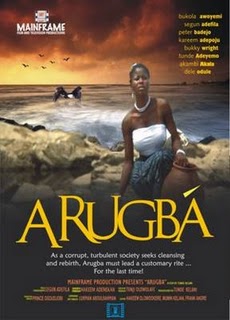
Set against the background of a corrupt society, the story of the votary virgin designated to “carry the calabash” for one last time before settling down into matrimony is enticing on its face. Add to that the intrigues of puberty and University life, the corrupt and often lecherous leaders (many of who have real life equivalents in Nigerian politics), historical figures in short cameos, and a multi-award winning director known for equally engaging films, and you have a winner, right? Yes, if you are a skillful playwright looking for a nice plot to use in writing the next bestselling play. No, if all you want is a screen flick that tries very hard to please everyone (UNICEF, Cultural experts, Movie buffs, Local language activists, suckers for love stories laced with music, and pretty much everyone else).
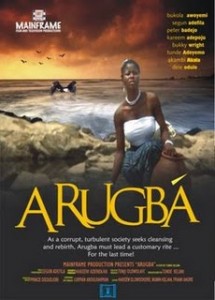 What I’m trying to say here, of course, is that I wasn’t much impressed with the movie except with the super acting by the seasoned actors (Lere Paimo, Kareem Adepoju, Bukky Wright, Peter Badejo, and the new Bukola Awoyemi), the song Afi fila perin , the major plot (which is the cleansing of a town as tied to the symbolic act of the virgin votary), and the picture quality. Everything else seemed distracting, especially the flashbacks. The sub-plots looked like poorly-handled attempts to situate everything in this quasi-imaginary world in which the events took place in the events of our real life. We see Obasanjo. We see Bola Ige. We see Abiola. We didn’t need to see them, but we did. Nothing else in the overall plot of the movie prepared or compensated us for the distraction. And even the love story which is the major subplot did not always convince. It surely didn’t live up to the standard of Ajani and Asake in O Le Ku handled by the same director.
The flashbacks were the main distraction. I did not see the point in keeping the details kidnapping attempt on Adetutu till the end. It should have been enlightening then, but it wasn’t, because we had already consoled ourselves – having seen her hale and hearty – that she had already survived in one piece; and the minor intrigue of the women who wanted her removed on the rumour that she had been raped did not really impress. What about the king’s inglorious offer to Adetutu earlier in the beginning? We didn’t know much about it until the end, for no justifiable reason. Other distractions included the sub-sub plot of the Islam and Christian adherents at the beginning and the end, Adetutu’s jealous rival (played by Kafat Kafidipe), the Oral Rehydration Therapy that eventually never saved a child from dying, the jealous housewives in the king’s palace, the spirits seen at the beginning and at the end coming out of the (supposed) Osun river to play with Adetutu (when we know for a fact that the story is not science fiction) among many others. I’m an ardent fan of Mainframe, but here, I see only minor resurrections of what we liked about Saworoide, Koseegbe, Campus Queen, and even O Le Ku. But that’s where the love ends. At the end of the movie, I did not stand, smile, ponder and send a text to my friends to go get a copy. I merely rewound it to listen to the song Afi Fila Perin many times again, then go to bed.
Now, this is what I suspect: there were too many consumer constituencies to cater for by this offering. And in the end, it ruined what could have been the best story since Death and the King’s Horseman (which is not even a movie yet, as it should be) – a classic meeting of tradition with “civilization” and the fallouts thereof. So many possibilities… Maybe if Tunde Kelani had written the story himself, or at least passed it through the hands of Akin Ishola, Bamiji Ojo, Wole Soyinka, or Bayo Faleti…
There, my KTrotten Tomatoes! Two stars out of five. Okay, maybe three. Maybe.