Browsing the archives for the Academic category.

Do You Speak English?

If I were to rank all the awkward questions that I’ve been asked since I came here, I’d rate this one the highest: “Do you speak English in Nigeria?”, along with its many variants of “How do you learn to speak this well/this fluently?” and “I like your accent.” I have got inured to its silliness over time, and learnt to enjoy it as a compliment whenever I hear it. So I respond instead with “Oh, thank you.” Sometimes for effect, I also add “Oh, I like your accent too” just to relish the priceless expression of shock or incredulity that immediately shows on the face of the person to which it’s directed. “Who? Me? What do you mean that I have an accent? I’m American…” as if accents were either a disease, or only one person’s idiosyncrasy. I have realized that many people, even in the university (well, not students of language), do not know that there are many accents of American English, depending on where one resides. St. Louis English accent is definitely different sounding from Boston accent, Chicago accent or Mississippi accent that all have their own peculiarities of more than just pronunciation but also grammar. In any case, whenever I’m bored, I occasionally like to relish the pleasure of trying to distinguish accents and speech peculiarities. It’s not easy for me, needless to say, since I’ve not lived in the United States for more than just four months.
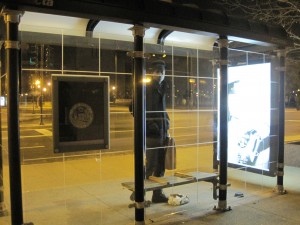
Away from accents for a little while. Less than two weeks ago, I was sitting in a bus stop at 5th and Missouri Metrolink train station waiting for the scheduled bus to take me from there back to Collinsville, and later to Edwardsville. Those familiar with the area would know how dangerous it could be at certain times of the day. It is in a part of Illinois called East St. Louis, just on the border of the state. It was evening, and it was cold. There were people around, but it didn’t give me any illusion of safety even as I put my iPod on and listened to some calming music. I was alert. There was a young African-American woman sitting beside me on the bench in the bus stop. A few seconds later, a young African-American man in sagged jeans and with a really loud phone, of perhaps around 24-25, who I’d seen prancing around talking to everyone passing by even when they didn’t stop to give him audience came towards me and said something. He was addressing me. I was listening to some of Fela’s best ballads. He was talking. I heard him clearly, but I didn’t pick out what he said, so I removed the earplugs and looked at him. I didn’t smile. He repeated what he was saying, and I still didn’t understand it, yet it sounded vaguely like English, so I gave up. I asked him to say it again and he did, for the last time. As she saw that I honestly didn’t understand him, the lady beside me looked at the young man and said “No, he don’t smoke/have weed.” What? That was what he’d been asking me (and the many other people) all the while, whether I had marijuana to share? Good Lord have mercy. Why didn’t he just say so in English? Well, he eventually left because I immediately turned my attention back to my music, and ignored his presence. Yet in me I wondered what would have happened if I’d said more than a sentence, and he’d discovered that I was not American, but an African with a heavy/strange English accent. Would that have made me a bigger target for mugging? There was a laptop in my bag, and there were my debit cards, along with my iPod and mobile phone. And my distinguished Nigerian passport. As I got on the bus a few long minutes later, I understood why George Bernard Shaw said that Britain and America are two countries divided by a common language.

And so today – thanks to patience, persistence, and prayers – I checked my account balance to find that my money has been refunded. Thanks providence. However, the part of it that inspired this post was in the email response I got from the bank representatives. I had sent them a complaint in an email, stating that I had made a transaction on Monday to the tune of a thousand dollars. From the response I got back, I have found out that it may be possible that American English doesn’t have any such expression as “to the tune of” in their language. Is this the case? I don’t think so too, but even if it is not, it doesn’t remove from the fact that Bernard Shaw could have been right after all.

Please read. It’s unedited, except for my account balance ;).

Dear KT, Thank you for contacting customer service. With reference to your e-mail, we regret to inform you that we do not see a transaction of over thousand dollars for “the tune” but there was a transaction on hold from SIUE Bursar’s Office, EDWARDSVILLE, IL, for $1,057.87 on 04th January 2010. This amount is already credited back to your account on 08th January 2010 and your current balance is $xxxx.xx. Whenever a transaction is on hold and if the merchant does not approve the transaction then the amount is released back to your account in 3-5 working days. Regards JP Morgan.
Random Confessions

The successful outing of my My [State/Country] posts on this blog (after Texas and Saudi Arabia) is giving me many more great ideas. How many states will I be able to “visit” virtually and publicly thank before my time here is over? Who wants me in their area? I definitely would like to show here to you my readers all the  relevant ktravula hot spots all around the world, just in case it ever occurs to anyone someday to organize a get-together/reunion party of all my blog readers, fans and commenters. 🙂 But I can’t. Or so I think. Physically, I’ve now been to Providence RI, Washington DC, Boston MA, St. Louis MI, Edwardsville IL, Cahokia IL, Principia IL, Chicago IL and Olney MD, among a few other small places. But virtually, I’ve been in many more places I probably would never see. Here’s the plan, as time permits, I will go around the world from here. The traveller is coming to a location near you. 😀

School resumes on Monday. I have not yet confirmed whether classes resume too. If so, then I will use this weekend to plan my class schedule for the year. It’s the hardest (I think) part of the work. When the plans are set, it not so hard to follow through in class, even though there usually occurs along the way some things never before planned, like public holidays, snow storms, and other engagements. But I like to have a plan. It helps to keep me focused. The last time I checked, I will now have sixteen students. That’s a higher number than the last nine who, like they told me on the last day of class, must have told their friends to sign up for that foreign language class where you could get an A (if you work really hard for it) and have fun all at the same time. Talking about As, all my last students but one got As. The person that didn’t get an A got a B, deservedly. She wasn’t as punctual as she should have been. And she did really poorly in the mid-term test. As for my own Linguistics class, I have not yet seen my results. Next week, maybe.

How did I spend my Christmas? I went to the house of my Professor A., originally from Nigeria, who was spending Christmas in town for the last time. He had resigned from this university and was moving into government work in the capital (Springfield). The most memorable part of the very beautiful evening was the “lucky dip” where everyone was asked to pick choice presents from a whole lot gathered in the living room. I got a wall clock. Now I can see what time it is while sitting on my bed without first having to pick up my phone or computer. However, there was not much Nigerian food at the table, surprisingly. There was mostly American foods, which I enjoyed. And there was moi-moi. It was a very memorable and enjoyable evening in company of people of different nationalities, behaviour and beliefs. I met his young children and their friends. One of his children’s young cousins in attendance had attended St. Patrick’s school, Bashorun Ibadan before relocating to the States. Our discussions brought back memories of truancy in secondary school days when we snuck out of our school premises to attend Christmas parades in the compound of the Broadcasting House just across the road…

New year’s eve. This one was a story with a k-leg, because Chris from class who had checked with me many times about our earlier plan to spend the eve together at his house partying, playing, reminiscing and flirting around with American girls suddenly had a work schedule! Oopsie. (Sorry Chris. I know you might not believe it, but not all of us from that side of the world play around with firecrackers around festive periods. 😉 ) In any case, I believe(d) him and stayed indoors since Ben also had suddenly disappeared earlier in the day to go to his folks at St. Louis. I fell asleep at nine, and woke up barely at a quarter to twelve, so I slept again, hoping my some miracle to wake up before twelve. The next time I opened those eyes, it was 1pm and I had two messages on my cell phone, from Nigeria. Happy New Year, they said. There were no fireworks like it would have been at New York’s Times Square, or back home in Nigeria (yes, we use fireworks too. Note to Chris: They are festive fireworks, not explosive firecrackers). I went back to sleep a few hours later, consoling myself that in some other parts of the world – in California, for example – they were still in 2009 by a few minutes.

I broke my first and major new year resolution on the third day of the year. I ordered a $24 pizza from Papa John’s! And as guilty as I felt after placing the order, I enjoyed it. It was coming after a few gruesome days of needed abstinence. Thankfully I didn’t have to eat it alone. But on the (not altogether so) bright side of this matter, a freak error/mixup of communication between me and woman at the housing office on Monday when I went to make payments for my housing rent has cleared my bank account/card of ALL available funds. The situation, as she apologetically promised afterwards, is now being rectified. Five days later, it has not, and I’m mad! One week, and perhaps more, is a very long time to wait. This means of course that there would be no more Papa Johns, even if I crave it. And as soon as my supplies of food run out, which they will, very soon, I will be very screwed :D, not literally. So, sigh, wish me luck people, or send relief, or remember me in your prayers. But whatever you decide to do, when you eat your nice meal of turkey, moi-moi, amala, potato salad, stuffing, egusi, pounded yam, broccoli, jollof/fried rice, ogufe, or whatever else you have on your plate on your side of the world tonight, please remember this American child that is now surviving on less than a dollar a day. Don’t look for any paradoxical punch-lines to this. There are none! 🙂 😀 🙁

On Foreign Language Teaching

I received this article this morning about how to thrive or survive as a department of foreign languages. It’s long, but for those interested in the topic of teaching foreign languages, especially in a depression economy, it is worth reading.

http://www.insidehighered.com/news/2009/12/29/languages

NOTE: It was just a few days ago that I was talking with friends who expressed surprise that a language like Yoruba is taught in an American institution. “French or German, yes, but Yoruba?” they wondered. “How is it ever useful to anybody anywhere?Who would use it? Everyone (including the Yoruba people in Nigeria) speaks English anyway.” they said.

Apparently, it is still hard to sell the idea of learning a foreign language that doesn’t come with a “sophisticated” appeal like Spanish or Russian to most common people anywhere in the world. My interlocutors were one American and one African. A day earlier, another friend – this time a Nigerian on the chat messenger – had expressed similar sentiments. He even added a twist of the absurd by insisting that I was working for the CIA. That was the only way he could rationalize a scholarship that affords me the opportunity to teach my language in the United States. He also could not understand why foreigners could be interested in the language.

I think this attitude is a result of a fundamental ignorance of the purpose of learning anything at all, which is simply to gain knowledge. And there is no knowledge that is not power, as that writer Ralph Waldo Emerson puts it. Learning a foreign language gives one access to new ways of looking at the world, no matter how small the number of people who speak the language is. But the Yoruba language is spoken by over 30 million people, and has a culture that has survived hundreds of years and has influenced countless other cultures all over the world from the Carribbeans to the United States’ African American population, and produced one Nobel Laureatte. What is there not to learn about its culture, and language, and people? The lesson for me – if any at all – is in learning more about the importance of linguistic, language documentation and cultural studies. It helps to have something to say while being challenged about the use, or uselessness, of what one does.

On The Origin of Names

What do the word “simian” and the name “Simeon” have in common, aside from a similar pronunciation? You guessed it – nothing at all, unless Simeon lives in the cage in a zoo or on a display plinth in a museum of extinct apes. If I were named Simeon, I would be very sad indeed if anyone were to laugh out loud every time they mentioned my name, especially if the person is a native speaker of English.

I remember my Kenya days, reclining under the mango trees on the grass lawns around the Margaret Thatcher Library on the campus of Moi University, Eldoret, discussing words and languages. All of us were guys, men, so the topic inevitably led to the risqué. All I wanted really was a chance to gather knowledge about the Kiswahili language to add to my vocabulary, and until then, everything was going smoothly. I would come out in the morning, lay on the grass while my informant, Ng’ash, a photographer (whose name also rhymed with nyash) did his work and dealt with my endless list of questions at the same time. After going through a list of over four hundred words in Kiswahili with him and his other equally fascinating and mischievous co-photographers in that spot of the campus, I found that ngozi meant “skin”, pole pole meant the same as pele pele (go gently), kiboko meant “buffalo” whose skin is used to make what we called koboko (the whip), Mungu meant “God” and jana meant the same as àná (Yoruba for “yesterday”), among many other amazing similarities. I also found out that kuma meant “vagina”, and that moto meant “hot”. The joke Ng’ash liked to make was that the first time a Kenyan found himself in Japan, he could not get his mind off the fact that the institution he was enrolled in was called the Kumamoto University. Kuma in Japanese is a popular name for children, meaning “bear”.

And so in Washington DC in December, I found myself on a dinner table with half a dozen Tanzanians who dared me to prove to them how much of Swahili I spoke. I did, starting with the everyday ordinary words. But they kept egging me on and I told them that I had actually learnt the private words first while I was in Kenya, and that I still remembered them even though I found a dinner table the least appropriate place to discuss such things. They would have none of it so I said, “I know that mbooro is for penis. Do you believe me now? I know that one for females but the point is proven, no?” The boys looked surprised, and the girls kept giggling mischievously, now resolved not to let me off until I gave voice to their body parts as well. It was an embarrassing almost awkward moment. But I did, and then shared the joke about the Japanese University. What else I found out afterwards was how easier to mention the word for privates in another person’s language. When asked to tell them what they were in my language, I could only tell them the word for penis. For vagina, I referred them to the Nigerian women in the hall, and as I correctly guessed, none of them took up the challenge to ask.

What I also learnt at the table was that the Nigerian name “Uche” in Tanzanian Swahili also meant the same as kuma, and that every time they heard the Nigerian name while watching a soccer game, they were giggling aloud not for the style of his dribble or the grace of his feet. Since I found out in Kenya in 2005 that Titi means breasts (as in matiti in Swahili), and “titties” in American English, I’ve always wondered what my name means in all the languages of the world if there was a way I could go on and find out. In American English, it means “a dark carbonated drink with a secret formula bottled in cans and bottles.” Not bad. What does it mean in Chinese, Malay, Emai, Nepali, Farsi, Akan, Ikaan, Uwu or Arabic? Maybe I should ask Reham about the Arabic part. I hope the meaning would not be too x-rated for her to tell me. I also remember one of my class sessions last semester when we were discussing colours. I had written the Yoruba ways of expressing colour on the board, and it included pupa for “red”, bulu for “blue”, funfun for “white” and dudu for “black” among many others.  By the end of the class, I was told by the students why of all the colours we learnt that day, they would most likely remember dudu for a longer time to come. In American English (slangs), the word doo-doo refers to excreta, they said. Talking with my Swahili friend recently about these, she told me that dudu in Swahili also means “a large insect”, in addition to being the word now used to refer to the HIV/AIDS virus. Very nice. So now, although eniyan means “person” in Yoruba, all of a sudden, I am never going to refer to myself as an eniyan dudu ever again! Not in America, and definitely not in Kenya.

End of Term

With my final examination completed this afternoon, I am finally done with the Fall Semester, and the holiday for me officially begins. Let me tell you a little about the exam. It was a test of everything we have done in the Linguistics class, and it lasted an hour, forty minutes, even though I finished before the set time. The notable thing was that the professor allowed us to bring notes into the examination hall, as long as it was on only one side of a blank sheet, and handwritten. It was a way, I guess, to make sure that everyone has a chance to succeed.

Many other changes are taking place around the campus. It is thinning out, and in a few days, the once bubbling mini-town that is campus will become an almost ghost town. Chris, my housemate has already packed his bags and is heading home. Ben, the rugged one, will be here for a little while more, but he will also eventually leave, and I will have the whole apartment all to myself. I may have to go buy my own christmas tree… Audrey the French is leaving. Her academic exchange programme was supposed to last one semester, and is now over. We are organizing a party for her at the apartment on Friday, which should be fun. She was such a nice company, fun, adorable and lively, although I haven’t seen her for a while in the last three weeks because of the hectic nature of that time of the semester. Also leaving are other international students from France who came on the same programme as Audrey. They all added colour in some way to the semester.

My most memorable times with Audrey included a long walk around Chicago in November while we were trying to locate our hostel much without luck. Until then, I had never seen her cute Frenchie self so upset by anything. And even though we all tried to maintain a sense of balance as frustration grew on us and the maps refused to point us in the right direction, when we stood at the bridge across Michigan Avenue and thought of how to proceed, I thought I saw her really pissed off, especially since we didn’t seem to understand each other’s words and motives. Eventually, her phone came to the rescue and we found out that we had just walked past the HI Chicago building by just one block. I also remember one of the many discussions we had in Chicago about breastfeeding (she was thoroughly against it, believing that it is “disgusting” to have anything come out of her breasts for anyone to drink), religion (doesn’t believe in it, rationalizing that there is too much wickedness in the world to believe in a good and kind God), and homosexuality (doesn’t have anything against it, since humans all have the right to express whatever they are), and how opposed to Reham she was every time the conversations took place. “As soon as I have a baby,” Audrey always said, “I will spend all my nights in bed, sleeping while my husband will feed the baby whenever it cries. I carried the baby for nine months, after all, and I’m not about to lose my sleep for anybody.”

She was fun.

The semester was fun. I hope the next one is just as fantastic.