Browsing the archives for the Academic category.

What In The World

“Twenty-five years ago, we recorded We Are the World to help Africa. Now it’s time to help Haiti”

Thus begins the introduction to this remake by legendary trumpeter and producer Quincy Jones, and Grammy Award winner Lionel Ritchie of the classic We Are The World song first recorded in 1985 to aid relief efforts in parts of Africa (not all of Africa). From the first chords in this new track to the first shot on the screen, be prepared to be re-introduced to the same magical emotions that defined the first version of the song. There are more participants, the vocals are wide in range, and very endearing; and for good reason, the writers have removed and re-written the utterly useless phrase from the first version of the song that read “As God has shown us/by turning stone to bread” – since God never turned stone to bread in any known text of the scriptures anyway.

But here’s the caveat: Please, I beg of you, when you watch the video, do NOT see it beyond the 5.50 time mark. Much of everything else from there falls downhill into the category of “What in the World!”. For me it was such a disappointing buzz-kill, and for a long time after seeing it, I was in a burning rage that dominated my first series of tweets in response to the video. It was from a kind of shock, I guess, that I could not immediately place. How could a song with so much resources and potential at eliciting genuine empathy bungle such a great chance on conformity to popular culture. Now I’ve realized that it was from too much expectation, on my part, and perhaps from too much holding on to the solemn standard of the 1985 version. I shouldn’t spoil it for you then, so maybe you should watch it and make up your mind. But beside that, and beside the quite abrupt ending, everything else seems fine, and much of the video quite enjoyable.

Look out for great vocals from Jenifer Hudson, Celine Dion, Lil Wayne, Wyclef Jean, Mary J. Blige, Barbra Streisand, Toni Braxton, and (of course) Michael Jackson. I especially liked the parts sung in Haitian creole, and I wished that part was longer. It is also doubly memorable for having been recorded in the exact same studio where the first version was recorded in 1985.

PS: In spite of my rants above, I still do love the song, very much. So to download the video and the song, the proceeds of which goes towards the relief efforts in Haiti, go to www.world25.org
The Year of the Tiger

I’m beginning to consider the possibility that I might have been Chinese in my former life. The more I think about it, the more I remember instances in which the Chinese people, or the Chinese language has revolved around me. One of my favourite FLTAs at our orientation in Providence, Rhode Island was Chinese, and she taught me to write my name and my country in Chinese, and I’d given up of ever having such a chance again.

But today, I had another chance or reunion with my adopted spiritual home in the continuation of the events marking the “Discover Languages Month”. Last week was Yoruba. this week is the celebration of the Chinese new year, called The Year of the Tiger, and the student of Chinese had come out to exhibit their skills and knowledge of the language. Supervising the event was none other than Professor Lavalle, the teacher of Chinese language and literature whom I’d blogged about a few days ago. As special attraction, there were marshmallows and chopsticks, and interested competitors can win one of several Chinese toys and artifacts if they could only hold the chopsticks right and move the marshmallows from one bowl into another.

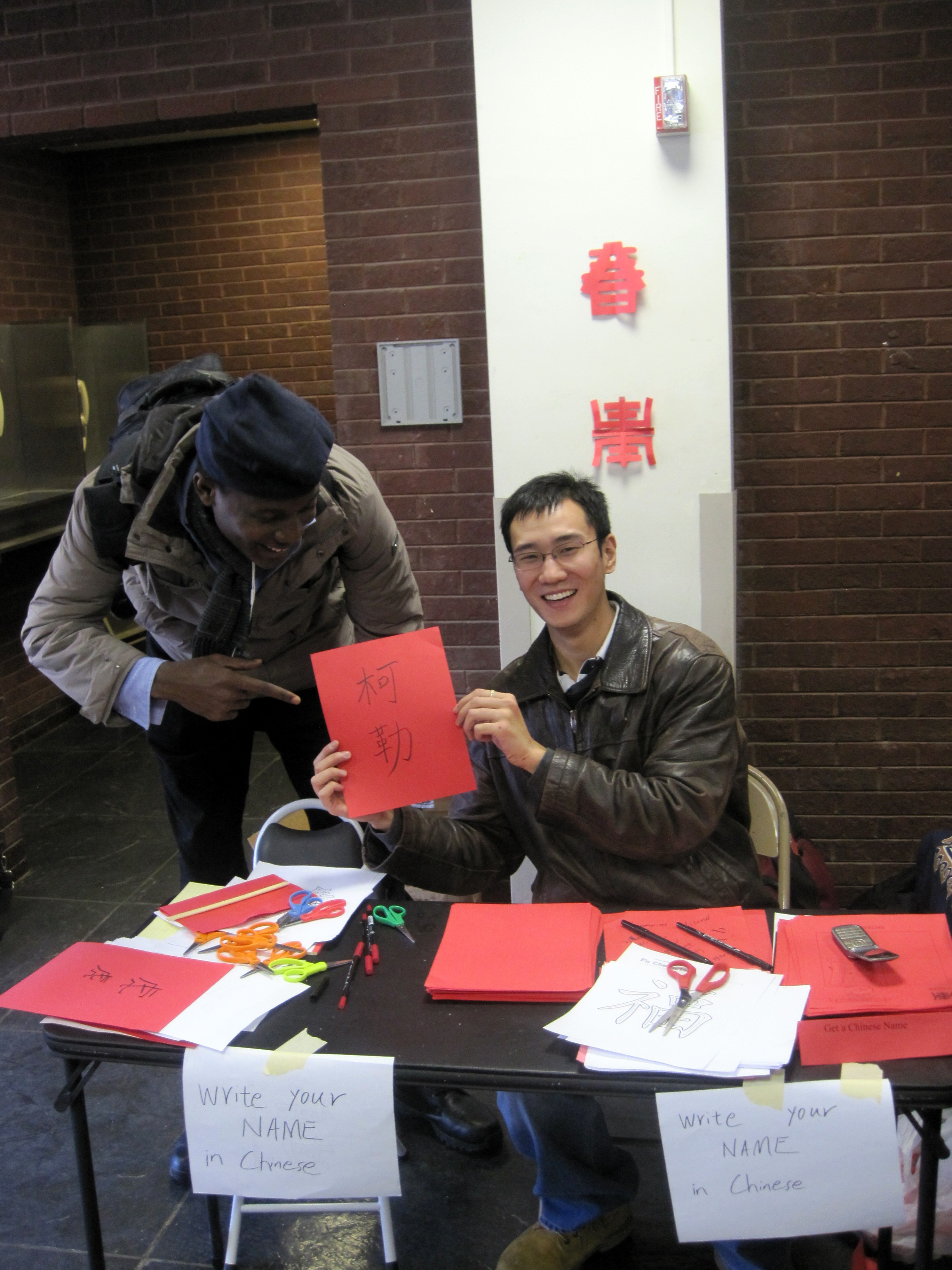
"My name is Chinese Kola"

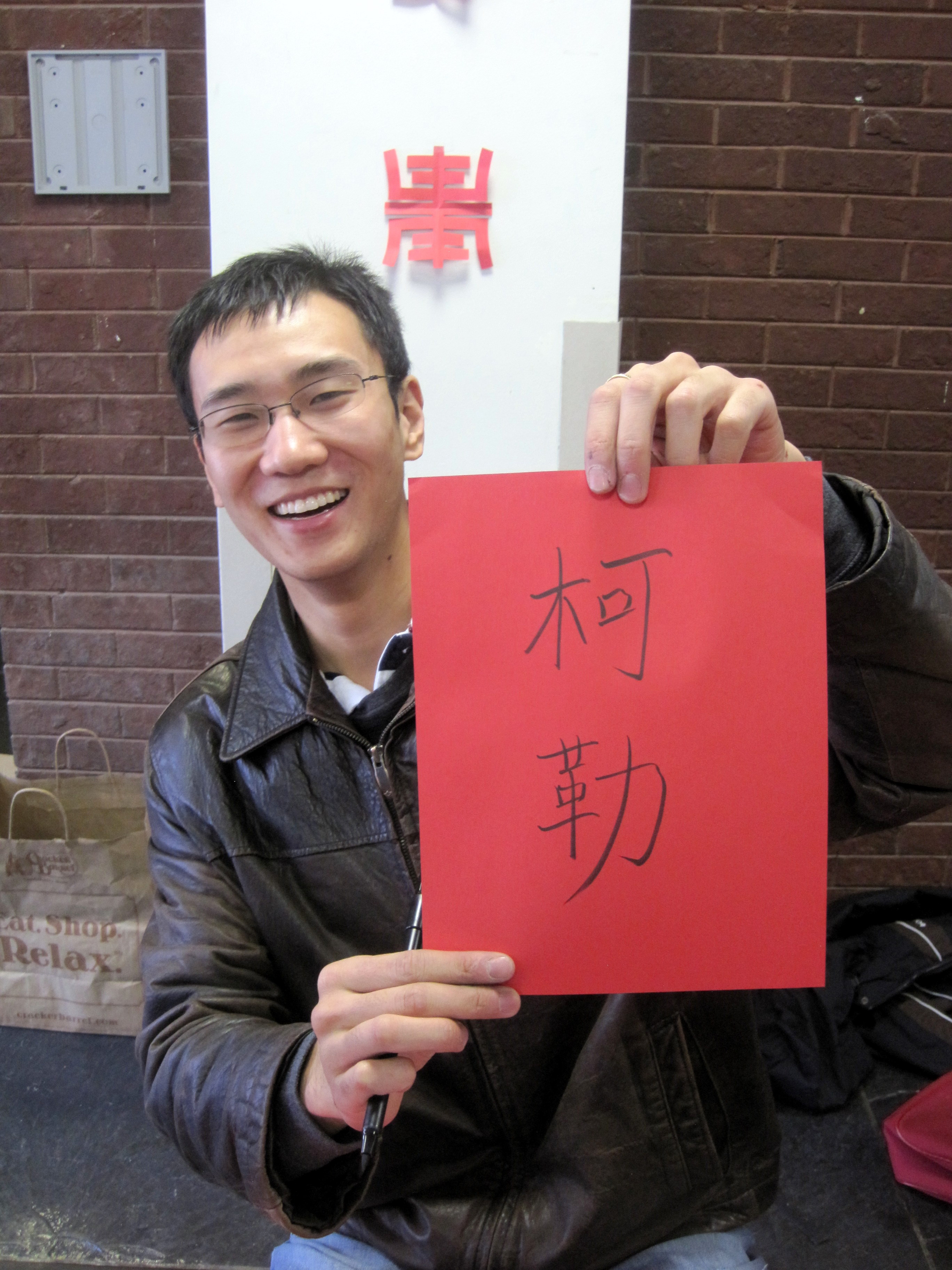
I had never had marshmallows before, so it was nice that I showed up. Afterwards, after devouring them all, with my hands – of course, I began to wonder why it was sooo sweet in the mouth. I also had dates, which were nice, and then a fortune cookie which predicted that I was about to become $8 poorer. Tell me what kind of a “fortune” cookie is that? Later, I walked up to the stand where calligraphy was being exhibited, and I had my name written, again, in Chinese. I can’t read it now, but I believe the Chinese guy who wrote it. And Prof Lavalle was there. I believe that he would have told me if it was wrong. More than that, I also confirmed that I had not forgotten the few words of Chinese that I know: Ni hau for “hello” and Shi-shi for “thank you. When next I get free time, I think I will be making a trip to Beijing.

If it helps, Chinese is a tonal language, just like Yoruba. Professor Lavalle had also told me on our first meeting that what he read of my poems reminded him of Chinese poetry, as opposed to the prosy and “confessive” nature of American poems. It is supposed to make me feel better, I guess, that my peripatetic spirit has now has more links to the Orients than I like to acknowledge?

Maybe this is why I like Jackie Chan so much. Blood is so thicker than water. 🙂

Culture Shock

This is a guest-post by my cool and brilliant colleague Professor of Spanish language and literature who also blogs as Clarissa on issues of feminism, literature, journalism , immigration, politics, and her love for the Kindle. 🙂 Originally from Ukraine, she migrated to Canada, and she got her PhD at Yale University in the United States. She has recently taught at Cornell University before coming over to our prestigious SI University. Hers is the first in a series of guest blogposts coming on this blog in the coming weeks. Thank you Clarissa for the post. Find her blog here.

____________________________________________________________________

When I was 22, I emigrated from Ukraine to Canada. I was fully prepared to experience a massive culture shock but none came. Sure, it took some time to get used to the idea of a credit card and a check-book, realize that a bus driver doesn’t give out change and there is no need to negotiate the price of a ride with the cab-driver before getting into the cab, and figure out why maple syrup can be poured on bacon and eggs. The process of learning these small things was really fun and caused me no shock whatsoever.
Five years later I decided to go to graduate school in the United States. Having lived in North America for a while, watching American TV and reading American books and newspapers, I expected even less of a culture shock on this change of residence. I was only moving to Connecticut, where the climate and the way of life were supposed to be pretty similar to what I had gotten used to in Canada.

Boy, was I ever wrong. A massive culture shock hit me immediately after crossing the US border and remained with me for years to come. It took time and effort to understand this new reality, learn to like, and eventually even love it.

I the US I discovered a deeply divided society. Glaring class inequalities, the likes of which I never saw back in Canada, racism, religious fanaticism, gender inequalities, economically devastated areas with the kind of poverty I never saw even back in Ukraine, crime, violence, inept governmental strcutures. All this was very different from the US I had seen in movies and TV shows.

But soon I also discovered that yet another US exists. The country of intellectuals, thinkers, artists. The country of hard-working, kind, generous people, who have not abandoned the struggle for the perfect society they inherited from their founders. The country of intellectually curious people. The country of people who hate injustice and inequality. The country that deserves better than the corrupt structures governing them.

When people read the very critical things I write about the US on my blog, they sometimes ask me, “Why do you live in this country if you dislike it so much?”. But I ask, does hating injustice and inequality mean hating America? Or is it just the opposite?

______________________________

I love Clarissa’s blog because of the way she looks at the world. Even though she hasn’t called it that, her blog is a travelogue of sorts as well – a response to the American society from the viewpoint of an immigrant. And as expected of someone of her level of brilliance, she doesn’t suffer fools gladly, and she says what’s in her mind no matter whose ox is gored. I particularly like the way she responds to the people who make foolish or hateful comments on her blog. I wish I could be that quick-witted sometimes. 🙂

Barking In A Foreign Language

This post was first published on Clarissa’s Blog today as part of a guest-writing project. Clarissa a cool Professor of Spanish language and literature at my department will also be a guest-blogger on KTravula.com in the coming days. Watch out.

___________________________________________________

Prompted by two related observations in my mind at the moment…

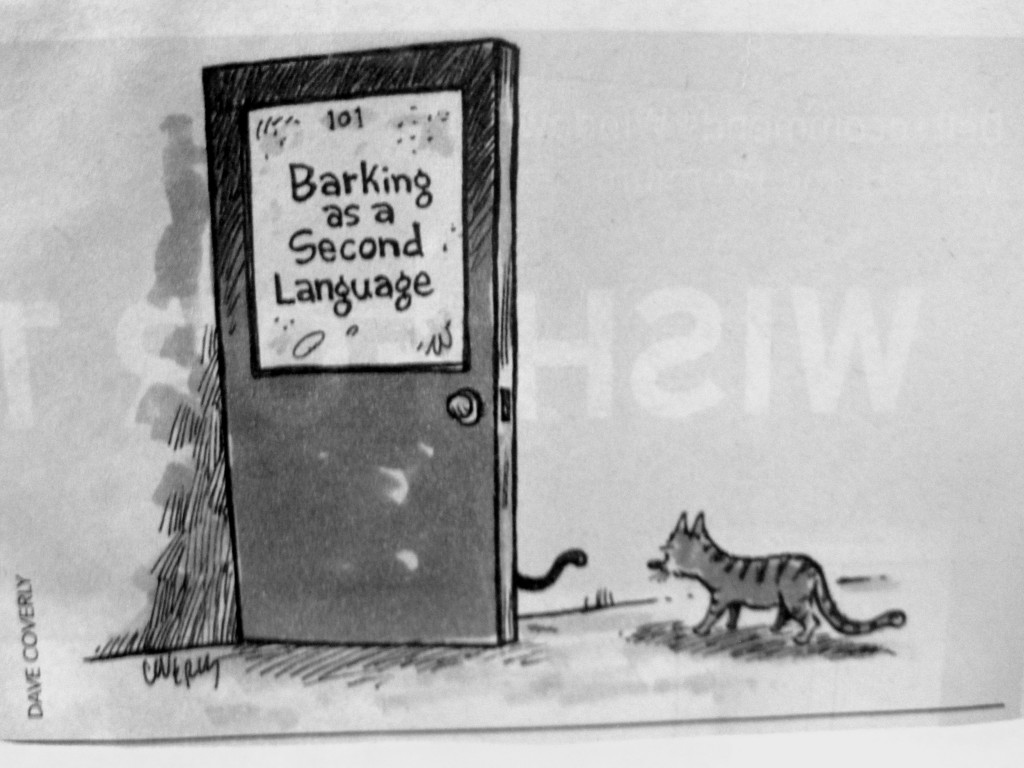
One was the search term in my blog statistics today. Some random person had apparently been directed to my blog by searching for the term “barking in a foreign language”. This is not so strange when I realize that I had once made a blog post about the cartoon that I found on the glass entrance to my department.

The second was this very comprehensive article, and discussion, in the New York times about why, or whether Americans will really, learn Chinese. I enjoyed reading it and picked up a few nuggets, one of which was the fact that the interest of many Americans in learning foreign languages came from political and economic expediencies: They learnt Russian during the Cold War, Arabic after 9/11, Spanish because of their neighbours, and now Chinese in the wake of China’s global economic uprising. Thus said the writers of the article. Not me, even though I have learnt also from a few  interactions on the matter that many American students now study Chinese for the purpose of gaining leverage in the emerging economic world.

The article doesn’t mention Yoruba, Swahili, or any of the other minority world languages being learnt in Universities all over America, but that is not the point – I guess. As much as this point in the article could be seen as a generalization of perhaps a genuine interest of students in expanding their worldviews, I believe that there’s something interesting about the said American foreign language fad. For a fact, the govenment of the United States has shown more interest in languages spoken in parts of the world with some economic, political or cultural relevance to its own survival. At the Fulbright conference in December, I had made friends with a guy called Osama from Yemen, a Fulbrighter on a similar programme. That was before the Christmas Day bombing attempt, and its subsequent link to Yemen. After the terror attempt, I asked a friend if she thought that Yemen will now get a lesser slot in subsequent Fulbright programmes because of the terrorism incendent, and she said NO. Quite the opposite, she said. If this all rings true, then Hausa will also soon become another language of interest for Americans in the coming years, because of the failed bombing attempt of Christmas day. This creed can then be summarized somewhat thusly:

“If he has tried to kick your ass, kick his ass too, and then learn his language. You might understand him more, and thus prevent any further aggression.”

Whether this is true, or whether it ever works as planned in the long term, is of course subject to debate.


The Yoruba Talking Drum

I made this video during the cultural awareness week on the campus of the University of Ibadan in May 2009. The talking drum is a uniquely Yoruba percussion instrument that is peculiar because of its ability to mimic tonal patterns of actual human speech. In this video, I tried to engage the drummer in a little competition of abilities; he on the skill of drumming, and I on the skill of discerning. Enjoy.

I showed it to students in class today, along with some music videos of Lagbaja, once again to illustrate the blend of tradition and modernity in Nigerian contemporary music. I had a reaction to his appearance almost in a similar form to the one I had the first time I showed him in class. My students are supposedly aware of the concept of the masquerade, but apparently, not in this particular shape and form. Let me get back to you after the Mardi Gras, and I’ll let you know what I learn about how American masquerades really look like. I’m guessing that they are not as elaborate, or as “scary”. We also learnt about the concept of Abiku, how different it is from the scientifically verifiable child mortality, and how many children often used it as a weapon against abusive parents.